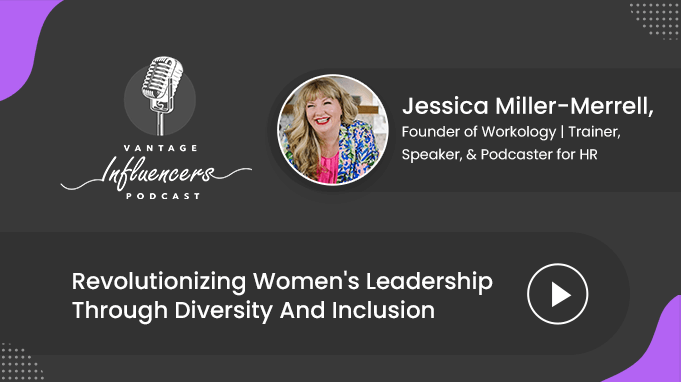
Revolutionizing Women's Leadership Through Diversity And Inclusion
Episode Overview
In this episode of the Vantage HR Influencers Podcast, host Susmita Sarma talks with Jessica Miller-Merrell, founder of Workology, about what it actually takes to bring more women into senior leadership roles. Jessica traces her own path from corporate HR executive to entrepreneur, explaining how a blog she started in 2005 for job seekers went viral during the 2008 to 2009 recession and became the seed for Workology, a resource Forbes has twice named a top career site. Her core argument is that diversity, equity, and inclusion cannot stop at compliance work like OFCCP reporting and affirmative action plans; real change means companies have to examine who actually sits in the executive pipeline, why women and people of color enter the workforce but stall before reaching senior roles, and what specific programs, from return to work initiatives to compensation audits, can close that gap.
The sharpest, most concrete point in the conversation comes when Jessica pushes back on the idea that women should accept a lower salary in exchange for remote work flexibility. She points to Salesforce's public compensation audit, which led the company to adjust pay so men and women doing the same job were compensated equally, as a model for treating pay equity as a fixable business problem rather than an inevitability. She also shares candid advice from her own family, telling her sister, who was interviewing for multiple jobs, to accept the first offer and treat any second offer as the real starting point for negotiation, since switching employers is usually the single biggest opportunity to increase a salary, bigger than any promotion or annual raise. For Jessica, protecting that earning power, alongside practical support like flexible scheduling and job share programs for new parents, is what turns DEI talk into an actual leadership pipeline for women.
Episode Highlights
- Jessica built Workology from a 2005 blog for job seekers into a resource that Forbes has twice ranked among the top career sites, after leaving a corporate HR executive role to work directly with HR leaders during major disruption.
- She argues DEI has to move past a compliance checklist like OFCCP reporting and affirmative action plans into a genuine effort to diversify who actually reaches senior leadership.
- Companies like IBM have built formal return-to-work programs that specifically reskill and upskill women so they can re-enter executive and leadership roles after stepping away.
- Salesforce's public compensation audit and resulting pay adjustments show what it looks like to treat gender pay inequity as a fixable business problem rather than an unavoidable norm.
- Jessica warns that accepting a lower salary in exchange for remote work flexibility permanently damages a woman's long-term earning potential and widens the gender pay gap.
- Becoming a parent, especially around childcare logistics and travel demands, pushed Jessica out of her own corporate HR executive job, which is why she pushes for flexible scheduling and job-share options for new parents.
About the Guest
Jessica Miller-Merrell, Founder, Workology
Jessica Miller-Merrell is the founder of Workology, a workplace resource for HR and recruiting professionals and the business leaders who rely on them; the site has twice been named a top career resource by Forbes. She is also president and CEO of Xceptional HR, a human capital strategy and consulting firm, and the published author of Tweet This!, a book on social media strategy for job seekers. Forbes has listed her among its top 50 social media power users, and her perspective on HR, recruiting, and the future of work is regularly sought out by outlets including The Economist, Forbes, CIO Magazine, CBS, Entrepreneur, and SHRM's HR Magazine.
Connect with Jessica on LinkedIn
Host
Susmita Sarma, Vantage Influencers Podcast Host
What You Will Learn
- Why treating DEI as a compliance checklist (OFCCP reporting, affirmative action plans) falls short of building a genuinely inclusive workplace.
- How to evaluate your own organization's leadership pipeline for gender and racial representation gaps.
- What return-to-work and upskilling programs, like IBM's, look like in practice for women re-entering leadership roles.
- Why a formal compensation audit, similar to the one Salesforce ran, is a concrete first step toward closing the gender pay gap.
- Why saying yes to a lower salary in exchange for remote work flexibility can permanently hurt a woman's long-term earning potential.
- How organizations can support new parents, especially new mothers, with flexible scheduling, hybrid options, and job-share arrangements.
Key Topics & Timestamps
| Timestamp | Topic |
|---|---|
| 00:45 | Introducing guest Jessica Miller-Merrell and the topic of women in leadership |
| 01:32 | Jessica's path from corporate HR executive to founding Workology |
| 02:38 | What sparked her passion for diversity and inclusion work |
| 04:28 | Why DEI deserves to be a top organizational priority right now |
| 06:25 | The role women play in the workplace and the case for more women in leadership |
| 08:18 | Promoting women into leadership without treating them as a special case |
| 09:49 | How workplace culture needs to adapt for women at different career stages |
| 11:57 | Remote work, flexible schedules, and the risk of widening the gender pay gap |
| 16:24 | Closing thoughts on valuing what both men and women bring to the workplace |
| 20:12 | Where to find Jessica and connect with her online |
Full Transcript
Click to read the full episode transcript
Welcome to the Vantage HR Influencers Podcast. This podcast is sponsored by Vantage Circle, the simple and AI powered rewards and recognition platform for employee engagement. A lot of companies now participate in diversity and inclusion activities, and as a result, we can already see a lot of women and people of color in organizations, but only in non-managerial roles. That is, they do not retain their numbers at higher levels. They enter the talent pipeline, but do not progress to senior management or any other top corporate positions. In this episode, we'll be discussing diversity and inclusion in the workplace with special considerations to women in leadership.
Susmita Sarma: Hi everyone, I'm Susmita from the Vantage HR Influencers Podcast. And to discuss diversity and inclusion in the workplace with special considerations to women in leadership, I have with me Jessica Miller-Merrell, who is the founder of Workology, a workplace resource for HR, recruiting professionals, and business leaders. Jessica is the president and CEO of Xceptional HR, a human capital strategy and consulting agency, and a published author of Tweet This! Jessica is listed by Forbes as a top 50 social media power user. Welcome to the show, Jessica.
Jessica Miller-Merrell: Thank you for having me. I'm so excited to be here.
Susmita Sarma: Once again, thanks a lot for joining me. So before anything else, I would like to know a little bit about yourself and your journey in the corporate world.
Jessica Miller-Merrell: Thank you again for having me on. My name is Jessica Miller-Merrell. I am a former corporate HR executive turned entrepreneur. In 2005 I started a blog that was really geared toward job seekers, and it went viral on the internet during the recession in the 2008 to 2009 timeframe. I broke away from the corporate world. I realized that what I could really help with, my superpower, is helping HR leaders make sense of all the changes and all the different things happening in their professional lives. Workology is a destination for HR leaders to connect, learn more about workplace resources, and support their organizations.
Susmita Sarma: Brilliant. Okay, so as I've already mentioned, today we'll be talking about DEI, and we have you with us for this particular topic for a reason, of course. So first, tell us what motivated you to embrace a creative mindset and a passionate commitment to diversity and inclusion in the workplace. Basically, we want to know how you got involved in DEI activities.
Jessica Miller-Merrell: So because of my background in HR, I've always been a learner, someone who's always seeking out new information, resources, and support. In the US, my exposure to DEI has often come from a compliance standpoint, things like OFCCP requirements and affirmative action programs at the different companies I've worked for. But DEI is more than just compliance, and I think you know that too. So I set out on this journey to learn as much as I could about diversity, equity, and inclusion and what different organizations are doing, talking to a lot of job seekers and HR practitioners to understand what's working and what's not. For me, it's about surrounding myself with different kinds of people from a variety of backgrounds. That's often uncomfortable, because as a white woman in HR, I might be in a meeting, a session, or a conference where I'm the only white person in the room. I think it's important to place yourself in those environments so you can learn and grow, and hopefully serve your organization and make your workplace more inclusive.
Susmita Sarma: Right, that's an interesting story. So why do you think prioritizing diversity, equity, and inclusion activities should be a top priority for everyone, and why is now the ideal time to do it?
Jessica Miller-Merrell: I think we're in this kind of great reset, where we've all been through, collectively but separately, a dramatic change in our lives and our workplaces. Things are already wild and crazy, so why not take that opportunity to reset and make things right. There has always been a lot of inequity in the workplace. When you look at the number of Fortune 500 CEOs who are minorities, or even the ones who are female, there's a huge disparity. If we truly want our workplaces to be equitable, a place where everyone feels comfortable and confident being their whole selves, we need to make organizational and cultural changes, and that takes time and effort. Companies need to think about who holds executive positions, who's in the pipeline, and the different types of people coming through it. If they're not attracting those people into their organizations, what can they do differently? That starts with taking a hard look at the executive team, what they're doing and saying, but also the culture, and how we can make our businesses more welcoming for people of all different backgrounds. When you surround yourself with different kinds of people, you learn, you grow, and you open yourself up to new opportunities and ideas. That's the kind of workplace and the kind of business I want, one with new and different people who push boundaries and push me to be a better human being.
Susmita Sarma: Right, so when we talk about DEI, it's a huge area, and we could talk a lot about all the different things and different people involved. I wanted to know your thoughts on the role that women play in the workplace. Do you think the world needs more women in leadership roles?
Jessica Miller-Merrell: Absolutely. At least in the US, this pandemic has pushed a lot of women to step out of the workplace, often because they're the primary caregiver at home. I'd encourage organizations to look at their terminations, resignations, and leaves of absence to see if that shift is happening, and then build programs, maybe special leadership or development opportunities, to attract more women back into the organization. One company doing a really great job of that is IBM. They have a return to work program focused solely on women, upskilling and uplevelling them to get them back into executive and leadership positions. So if there are disparities, first look at your workforce and where the opportunities are, then consider the programs or initiatives you can bring in to attract, retain, or develop those groups, including but not limited to women. It's important to pick a couple of programs to focus on rather than trying to do everything at once, but women in the workplace is a good first place to start building out your DEI programming.
Susmita Sarma: Right, so as you mentioned with IBM, what are some of the other things employers can do to promote women in leadership or executive positions, without treating them as a special case?
Jessica Miller-Merrell: I'd encourage organizations to do a deep dive into compensation inequities. Committing to eliminating those inequities, specifically around women, is a great step. Salesforce has been committed in this area and made some dramatic changes. They didn't like what they saw when they looked at their numbers, so they made pay adjustments so that, across the board, women were compensated the same as their male counterparts. I think the first step is to take a real look at your organization: your compensation, your breakdown of male versus female by position, and then pick a couple of areas to focus on and build programs from there. Compensation is a huge one. It's not fair, and it's not fun, to be a woman in the workplace knowing that your male counterpart doing the same job is making twenty to thirty thousand dollars more a year.
Susmita Sarma: Okay, talk to us a little about the changing needs of workplace culture. Many women leave the profession in their mid-career years, which results in a decrease in the number of women who advance in their careers. When people decide to get married or have children, they often make the decision to stop working. Don't you believe workplace culture needs to change to accommodate these women, giving them the flexibility many of them need after starting a family?
Jessica Miller-Merrell: Absolutely, and I can speak from personal experience. I left the corporate world after I had my daughter. It was incredibly hard to be an HR executive at an organization whose schedule wasn't working with mine: pickups and drop-offs for daycare, trying to juggle breastfeeding or pumping in between meetings. There are a lot more stresses on women and new parents in the workplace, so providing things beyond just nursing rooms, allowing flexible scheduling so women can work around children's activities and daycare, matters. I made the decision to exit my organization largely because of my schedule and trying to balance the new responsibilities of being a parent; travel became incredibly difficult on top of the added stress in my role. Organizations can find ways to support new parents, particularly new mothers, with flexible scheduling options, hybrid work options, and even work share programs so people can keep their jobs while sharing them with someone else in the organization.
Susmita Sarma: Nicely explained, Jessica. I'd like to shift a bit toward the current working scenario. The majority of women believe flexible work arrangements can help them achieve a better work-life balance, and particularly since the COVID-19 lockdowns, more women than men are looking for full-time work-from-home opportunities. Employers are devising policies to make it easier for women employees to move to part-time or other flexible work schedules, but don't you think this is damaging their career prospects and restricting their lifetime earnings potential, thereby widening the ever-present gender pay gap?
Jessica Miller-Merrell: I think working from home can sometimes impact your career negatively, but with so many more people able to work remotely, there are also a lot more opportunities to move jobs and shift your career in new directions. Women in general need to be really clear about their career aspirations and have a strategy. For example, my sister is interviewing for multiple jobs right now and has what she thinks could turn into multiple offers. In my experience, women don't approach compensation negotiation the same way men do, so I had a conversation with her: accept the first offer, and when the second offer comes in, that's when the real negotiation begins. I'm making a broad assumption here, but research tells us men tend to make more money because they value their own skills more, even when they're less qualified for the job than the women they're competing against, and that shows up in how differently they negotiate. I'm not saying women should mirror the way men negotiate or apply for jobs, but they do need to value their own work, research the market, and negotiate confidently, because switching jobs is often the single best opportunity to get the largest increase in salary, bigger than any promotion or annual raise would give you. These kinds of skills are incredibly important, and I don't think it's something we think about enough. Recently in the media, I've seen a lot of conversation around employees who are willing to take a pay cut in order to work from home. I think that kind of media conversation and buzz is damaging, particularly to women, because they read it and think, oh, I can take less money to be able to work from home. Absolutely not. If you're qualified to do the job, whether it's in person or remote, you should have the same or more salary. In my experience, when you're working remotely, you tend to work more hours.
Susmita Sarma: Exactly.
Jessica Miller-Merrell: And it makes that work life balance a challenge. You can be contacted or working at any time.
Susmita Sarma: Right, so it's basically making you available twenty four seven.
Jessica Miller-Merrell: Yes, so protect your boundaries. Make sure you're not available at certain times. There are times I don't answer phone calls or emails; that's focused time on family or focused time on work, and having those carved out in your schedule is incredibly important. But don't take a salary cut just because you want to be able to work from home. If it's the same job with the same skills, negotiate that, make your case. You might be far more productive because you can focus your time and energy on your job when you're working from home.
Susmita Sarma: Right, so ladies who are listening to us, if you're asking for full-time work-from-home opportunities, there's definitely no need to feel guilty at all, right?
Jessica Miller-Merrell: Absolutely. Yeah, don't settle. There's a lot of opportunity for new jobs out there right now if you're looking. And also, now's the time to sit down with your boss and say, hey, I really like it here, but I've done some research and I'm being undercompensated. Now's the time to make the case. Organizations, because they've started to experience the great resignation, are willing to make salary increases or changes to flexible schedules and options in order to keep their best people.
Susmita Sarma: Right, I'm sure this is going to offer value to our audience, Jessica. So, for a final opinion on the same: it's not about just celebrating women and not celebrating men, or vice versa. Rather, both men and women bring a variety of diverse attributes to work and life, and that is something to be celebrated. So what is your final take on that?
Jessica Miller-Merrell: I'm a fan of all different kinds of people. I think it's important to surround yourself with as many different kinds of people, from different backgrounds, experiences, and educational backgrounds, as you can. The more different kinds of people you have in your life, on your team, and in your workplace, the more creative and interesting the workplace is, and the more inclusive the environment. Even on my own team we have men, we have women, and we have people from a variety of different backgrounds. If there's disparity in your workplace or on your team, you should focus your initiatives on some specific programming or areas to bring in talent there. But it's not men versus women or women versus men. It's really about making sure you have an equitable and inclusive work environment where everybody feels welcome to be their best selves. When someone is worried about not feeling comfortable in the workplace, or worried about their schedule because of things like picking up kids, that's not an environment where they can do their best work. So as managers and leaders, we need to talk to our teams, understand what they need, get to know them, so hopefully they feel comfortable coming to us if there's a situation where they don't feel comfortable, or they want to make an announcement, like a change or a new life direction. We want to be accepting of those things, because it makes different kinds of people, customers, and individuals attracted to our organization, and it makes our teams work so much more productively.
Susmita Sarma: Nice. Thank you so much for sharing your views, Jessica. So finally, what would be your suggestions to our listeners?
Jessica Miller-Merrell: I think it starts with understanding where those potential inequities lie. Take a look at your teams and your organization overall: men versus women, race, experience, background, education. Sometimes you might not even realize that you're only hiring people from one university, one college, or one particular area. These kinds of unconscious biases exist. So take a deep dive into the demographics of your teams, look at that information, and have conversations with your executive team about it. If your team breakdown isn't representative of your geographic location or region, or of what your executive team is saying in earnings reports, shareholder meetings, or their own conversations, if they say they're an inclusive, family-atmosphere environment, but it's all men, or you aren't seeing enough people of color move into senior roles, that's where you need to have a frank conversation with your executive team, come up with a plan, and start making organizational changes. I do think the time is now. We're already in the throes of a really uncertain time, but if you're wondering why teams aren't performing or shifts aren't happening, it could be because your workplace and your culture aren't as inclusive as your executive team thinks they are.
Susmita Sarma: Right, brilliant. So finally, how can listeners reach out to you?
Jessica Miller-Merrell: The best place to go is our website, workology.com. You can also find me on social media. My personal account is generally J Miller Merrell, and you can find me on Instagram, LinkedIn, Facebook, all the places, even TikTok. Connect with me, I'd love to learn more about what's on your radar and talk about how we can make HR and our workplaces better.
Susmita Sarma: Thank you for sharing that, and thank you so much for taking the time out of your busy schedule to talk with us today, Jessica.
Jessica Miller-Merrell: Absolutely. Thank you for having me.
Thanks for listening to the Vantage HR Influencers Podcast. Please do subscribe to the Vantage HR Influencers Podcast on Apple Podcasts, Spotify, and our YouTube channel for new episodes.
FAQ
Why does Jessica Miller-Merrell say DEI has to go beyond compliance?
Jessica explains that her own early exposure to diversity, equity, and inclusion work came from a compliance standpoint, things like OFCCP requirements and affirmative action programs. She argues that treating DEI as a checklist misses the point: real progress means examining who actually holds executive positions, who is in the leadership pipeline, and making the organizational and cultural changes needed so people from different backgrounds can genuinely thrive, not just be represented on paper.
What can employers do to get more women into leadership roles?
Jessica points to IBM's return to work program, which focuses specifically on upskilling and uplevelling women so they can re-enter executive and leadership positions after stepping away. She also highlights Salesforce's compensation audit, which led the company to adjust pay so women were compensated the same as male counterparts doing the same job. Her advice is to first look at your own workforce data, then choose a couple of focused programs rather than trying to fix everything at once.
Should women accept a lower salary in exchange for remote work flexibility?
No. Jessica is direct on this point: if you're qualified to do a job, whether in person or remote, you should be paid the same or more, not less. She warns that media narratives encouraging people to take a pay cut for remote work are particularly damaging to women's long-term earning potential and widen the existing gender pay gap.
How can organizations better support new parents, especially new mothers?
Jessica speaks from personal experience, having left a corporate HR executive role after having her daughter because the job's schedule did not accommodate childcare pickups, drop-offs, and pumping. She recommends organizations go beyond nursing rooms to offer flexible scheduling, hybrid work options, and job share or work share programs so new parents, particularly mothers, can keep their careers while managing their new responsibilities.
Related Reading
Also listen on