The Evolving Role of HRBP in a Tech-Driven Workplace
Episode Overview
Jessie Lloyd Roberts opens with a reframe that most HR conversations skip: the HR business partner isn't shifting from people work to tech work, it's shifting from being a program steward to being a product thinker. She talks about treating people programs the way product teams treat features, piloting ideas in small pockets, A/B testing formats before a full rollout, and building AI fluency as a core capability rather than a nice-to-have skill. She's candid about where that shift gets uncomfortable, admitting her own mix of AI wins and "massive fails," and argues that discomfort is the point: curiosity, not certainty, is what separates HRBPs who keep pace with the role from those who get left behind.
The conversation moves into what earns an HRBP a seat at the table with product and engineering leaders, and her answer has little to do with HR expertise: dogfooding the product, asking the same blunt questions a product manager would, and respecting sprint cycles instead of dropping big HR processes into a launch window. She pushes back hardest on the idea that automation makes HR less human, arguing instead that used well, AI clears space for the parts of the job that were always about people: coaching a leader through a hard conversation, noticing potential someone doesn't see in themselves yet, and building the small daily rituals that create belonging on a team.
Episode Highlights
- The HRBP role is shifting from program steward to product thinker, treating people programs like products that get piloted, A/B tested, and iterated instead of rolled out once a year.
- AI fluency is becoming a core HRBP capability, not a side skill, giving teams access to real-time analytics and pattern recognition even without a dedicated analytics function.
- Non-traditional backgrounds, like a compensation lead moving into a people partner role, can bring an analytical, systems-oriented lens that strengthens the whole team.
- Credibility with product and engineering teams comes from dogfooding the product, asking the same simple questions those teams ask, and respecting their sprint and release cycles.
- Technology alone doesn't create belonging: deliberate rituals, like a Slack tool repurposed into a daily random-question ritual, do that work instead.
- The next big shift will come from AI co-pilots that help HRBPs and managers prep conversations and make sense of messy situations faster, though the most human moments will still need a person.
About the Guest
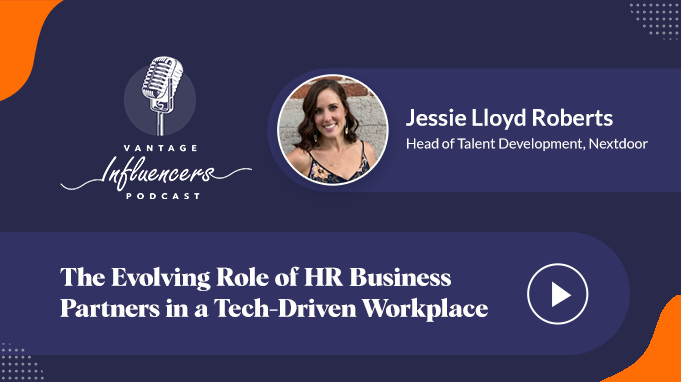
Jessie Lloyd Roberts, Head of Talent Development at Nextdoor
Jessie Roberts is a people and talent leader with deep expertise in organizational design, talent management, and performance, known for building simple, pragmatic people programs and for coaching leaders through complexity with clarity and care. She has been a trusted partner to executives across Product, Engineering, Go-to-Market, and G&A functions, and has played a central role in shaping organizational culture and guiding companies through defining milestones and challenging moments with steadiness and impact. People are her north star, and she approaches tough, human problems with compassion and a strong moral compass, recognized as principled, relentless, and kind.
Connect with Jessie on LinkedIn
Host
Sanjeevani Saikia, Vantage Influencers Podcast Host
What You Will Learn
- Why the HRBP role is shifting from being a program steward to being a product thinker, and what that looks like in practice.
- How piloting and A/B testing people programs, instead of rolling out annual initiatives, changes the outcomes HR gets.
- Why AI fluency is becoming a core HRBP capability and how it can free up time for judgment-heavy, human work.
- What builds real credibility with product and engineering teams, and why respecting their sprint cycles matters.
- How to use AI as a thought partner without losing the human element of coaching and connection.
- Why deliberate team rituals, not technology, are what actually create belonging.
Key Topics & Timestamps
| Timestamp | Topic |
|---|---|
| 01:13 | Jessie's corporate journey and what drew her to Nextdoor |
| 03:05 | How tech and AI are reshaping the core of the HRBP role |
| 06:25 | Using AI to show up as a strategic partner, not just a support function |
| 09:03 | Building credibility when working closely with product and engineering teams |
| 13:51 | Keeping HR human while processes become more digital and tech-driven |
| 19:37 | The tech trends, like AI co-pilots, likely to reshape the HRBP role next |
Full Transcript
Click to read the full episode transcript
Welcome to the Vantage Influencers podcast. This podcast is sponsored by Vantage Circle, the simple and effective recognition platform for employee engagement.
Sanjeevani Saikia: The more we look at how work is evolving, the more obvious it becomes that tech isn't something HR uses anymore. It's shaping decisions, workflows, and even culture in real time. And HRBPs are right at the crossroads of all of this. Their role has shifted from being mostly people focused to this interesting mix of strategy, data fluency, and emotional intelligence. That's the very reason I want to dig into how that shift is playing out day to day. So today I'm joined by Jessie Lloyd Roberts, Head of Talent Development at Nextdoor. She's someone who's living that evolution up close and has a front row view of how the HRBP role is being redefined from the inside. So let's begin the conversation with her. Hi, Jessie. How are you?
Jessie Lloyd Roberts: I'm good, thank you. I'm great. Thanks for having me.
Sanjeevani Saikia: It's a pleasure to have you on the show. Thank you so much for joining us in this episode. Before we begin our conversation on the topic, could you kindly walk us through your corporate journey so far?
Jessie Lloyd Roberts: Sure. First, I'm genuinely excited to be here. It's an honor to join you. I love that you're pushing real, honest conversations in the people space, and if I can add even one insight for your listeners, that will mean a lot to me.
So I lead the people partner and talent management organization over at Nextdoor. At a high level, my work sits at the intersection of people, culture, and performance, helping teams and leaders across the company do their best work while staying deeply connected to the neighborhoods we serve. Over the course of my career, I've partnered with senior leaders across every function, technical, go-to-market, and G&A, helping organizations scale, navigate change, and build strong, healthy cultures. I'm at my best when I'm coaching leaders through complexity, shaping org design, and building programs around performance, leadership, and culture that are simple, practical, and actually adopted.
I've been in the people space for more than 15 years across multiple industries, the last decade in tech. What really drew me to Nextdoor was the mission. We often say if it's happening in your neighborhood, it's happening on Nextdoor, and that's true. It's where people connect, share, and look out for one another, and I wanted to be part of building a company that brings that same sense of connection and belonging inside our walls too. So I'm really excited to dive into how the role is shifting today.
Sanjeevani Saikia: Amazing. Thank you so much for sharing your journey with us, Jessie. I'd love to start with the bigger picture. Tech is touching almost every function today, and HRBPs are expected to navigate that landscape daily. So how do you think the HRBP role is shifting at its core as tech becomes a driving force in the workplace?
Jessie Lloyd Roberts: Yeah, it's a great question. I think the HR business partner role is evolving faster than it ever has, and it's a really exciting time. We're shifting from being program stewards to being product thinkers and strategic operators. Tech, and especially AI, is touching every corner of work, and that means HRBPs can't sit adjacent to that. We have to be inside that evolution, helping adopt it and drive it within the organization.
At Nextdoor, we're treating people programs like products. Instead of rolling out big annual processes and hoping they stick, we design alongside the business, testing and iterating based on real user behavior, our employees. We run quick pilots, we A/B test programs the way you'd see on a product team, and these experiments are becoming part of our everyday operating rhythm.
Another way our role is shifting is through AI fluency. This is now a core capability, not just another tool in our toolkit. I've talked to a lot of people across the HR space, and there's a real range in fluency and comfort level with it. I don't want to get left behind by not adopting it, which is why I think it's so important that we're driving that evolution internally. We need to understand where AI introduces risk, how it can help us see patterns earlier, and how to focus more of our time on the human, judgment-heavy parts of the job.
Another shift is rethinking the traditional profile for an HR business partner. The role is expanding and the skills required are evolving just as quickly, so being open to non-traditional backgrounds can unlock a whole new level of impact. It broadens how we think, how we solve problems, and what the people function can deliver. We saw this at Nextdoor: our compensation lead moved into a people partner role on my team, and she's thriving. She brings a super analytical, systems-oriented view alongside a really empathetic, human approach, and that mix has elevated how we operate. It's proof that we don't have to come from one linear path as HR business partners.
Sanjeevani Saikia: Absolutely. So as you've already mentioned about AI, it naturally brings this into the picture. AI and data fluency is influencing major decisions, and HRBPs often need to prove they're not just operational partners, but strategic ones as well. It's a subtle but important evolution, I believe. So according to you, Jessie, what can HRBPs do to really show up as strategic partners, and not just support functions, in this new environment?
Jessie Lloyd Roberts: Yeah, I really do think AI will help us become more strategic partners if we use it the right way. It gives us access to analytics and insights in real time. One challenge we've seen at Nextdoor, and a lot of teams see this too, is that you get resource constrained and don't have a dedicated analytics person. But we do now, with AI. It's allowing us to be more data driven. We've always had to be data driven in this role, but AI helps us move faster.
I think of it like having a new teammate, someone who supplements the team when you use it the right way. It lets us see patterns faster, make more informed decisions, and direct our time toward the areas that need more of a human touch, coaching a leader through a difficult conversation, for instance, which AI can't provide the way I or the team can. Though it can help with how you approach that conversation. If you treat it more like a teammate, set up one-on-ones with your AI co-pilot and talk it through, it can help be a coach to some degree, but you're still going to lose some of that.
So I do think the shift starts with moving from reporting data to interpreting it. AI gives us speed and pattern recognition, but leaders don't need more dashboards. They need someone to tell them what it means and what to do next. AI can help us get to those decisions faster. It accelerates the what, but HRBPs elevate the so what and the now what, and that's the real value.
Sanjeevani Saikia: Yes, I think you've highlighted a very important point, that AI should be more of an enabler rather than completely replacing the human point of view. That's really crucial. There's also this interesting dynamic emerging where HRBPs are working more closely with product and engineering teams than ever before, and those conversations can get technical very quickly. So what skills or ways of thinking help HRBPs hold their own when collaborating with product and engineering teams?
Jessie Lloyd Roberts: This is a great question, I love this question. I've spent the majority of my career supporting product development organizations, product, engineering, and design. I think it's really important that when we're sitting in rooms with those leaders, we have the right level of credibility. And I've learned that we build that credibility when we stop looking at people work purely through an HR lens and shift to a product lens instead. That means asking the same questions product teams ask every day: is this simple, is it useful, what problem are we actually solving with the programs we're rolling into the business. Leading with a product mindset means treating our people programs the same way, as something that should deliver daily value and daily utility to the employees who use it.
Instead of rolling out big, once-a-year programs, we test, iterate, and design alongside those users to make sure people are actually engaging with it in the flow of their work. One example that comes to mind for Nextdoor is a peer feedback pilot. We started with a big vision around creating a manager scorecard, and instead of rolling out a brand-new process, we A/B tested two versions, piloting them with two small groups in the organization: a standalone survey and an integrated 360. The insights we got weren't what we expected, honestly, and it pushed us to change direction completely. But that's the point, to test, learn, and adjust. That's the product thinking behind it. We don't want to roll something out to the organization that takes a huge amount of time and then falls flat. I'd rather move faster in small pockets, almost like releases.
Another area that's really critical for anybody across the organization, not just within HR, is dogfooding the product yourself. When HRBPs use the actual product and track what's shipping, and understand not just the feature but the impact it's having on its users, for Nextdoor, our neighbors, that builds business awareness and strengthens our perspective in conversations about teams, capabilities, resourcing, and culture. AI plays a role here too. When we use AI tools ourselves, we build our own technical fluency. I've played around with a number of different AI tools and had a lot of aha moments where I felt proud of myself for holding my own a little in those rooms. But I've also had massive fails where I didn't fully understand what I was doing. Again, I'm learning because I'm curious, and I think that curiosity helps any partner you have in those rooms.
The last thing I'd say about credibility with product and engineering teams is honoring their rhythms. Product and engineering work in sprints, release cycles, and critical freeze periods, and dropping heavy HR processes in the middle of a launch kills trust instantly. I'd say the same is true even outside of product development. If you think about a sales organization and Q4 is their critical moment to get as many wins on the board as possible, you've got to leave them alone and let them sell. You can't drop big processes on them then. That's how you win credibility across the organization, not just within product development, by being mindful of the operating rhythms of other teams. I also don't want to introduce process for process's sake. I want to make sure we're getting the most value out of every program we bring to the organization and the team.
Sanjeevani Saikia: Yes, absolutely, well said. Shifting gears, this whole push toward digital has its own kind of tension. Everything gets quicker and more efficient, but sometimes the experience becomes a bit transactional. HRBPs are usually the ones holding the responsibility of keeping work feeling human, even as everything scales through tech. So how can HRBPs really hold on to that human element while the role becomes increasingly tech driven?
Jessie Lloyd Roberts: Yeah, it's a good question. I think AI can help HRBPs and managers be more human, almost. I know that might sound controversial, but I've talked about using AI as your thought partner, almost your teammate, and I think that will help managers and HR business partners be a little more human. You can talk to it, it learns you, you can say, I'm having this difficult conversation, I need it to be in this tone, or can you shift it to this tone. It helps with the script, it helps with finding the right words for some of these difficult conversations. Even just rolling out a program, you want to make sure you're sharing the why, and AI can help you add that human element to it. I can't stress enough, use AI as your teammate and talk to it like it's somebody sitting next to you at work, a thought partner.
The other thing I'd say is that technology alone doesn't create belonging, rituals do. Rituals are a big piece on our people team, and belonging isn't a program at Nextdoor, it's a practice. During COVID, when we were all remote, we had to find ways to feel like a team again. We were all just behind our computers and had lost that human connection, and it fell to the people team to figure out how to bring teams back together. One of my favorite rituals came from repurposing a Slack productivity tool called Stand Up and Prosper. Instead of using it for status updates, which is what it's for, we turned it into a daily moment of connection, asking one totally random, sometimes unhinged question to the team. The answers made us laugh, taught us about each other, and gave us something to look forward to each day. AI can feel scary, and it can make it seem like we're all just operating with robots, but I think it can also help bring some of those rituals, that belonging and connection, back to the team. We've layered in other rituals too, like Friday videos from our leadership team paired with a gif that sums up your week, small, simple things that make people feel seen.
So for us, AI isn't about removing the human from HR, it's about creating more space for people to be human, and using technology to elevate those moments of connection, belonging, and care that make the workplace feel alive, somewhere you want to show up to every day, whether in person or on a screen.
Sanjeevani Saikia: True. So my biggest takeaway from that response is that technology itself doesn't create belonging, people have to think beyond that, it's just an enabler, as you mentioned. So if I ask you, give me the three most fundamental problems HRBPs face while integrating tech and the human side of it, what would those be, the three you're seeing as most prevalent at this point in time?
Jessie Lloyd Roberts: I'd say one of the problems is people not adopting AI. I think that's a mistake, and I'm always surprised when I talk to people who say they use it in their personal life but never at work. I don't fully understand that reasoning. I think people are afraid it's going to make them dumber. I don't agree. I think it's actually letting me think about problems in a much more expanded way. It's like, oh, what haven't I thought about on this topic. But you can't just take what it gives you at face value. That's a real concern with AI, people talk to it and it spits something out, and you've got to put some reason and judgment into what it's telling you. That's where the magic happens, when you're going back and forth with it, challenging it, asking it to give you the opposing view of a proposal. You've got to be more curious about it, and that's the biggest takeaway for me with AI.
The shift I'd love to see is people having more curiosity and being willing to adopt it. I think the problem is people don't know where to start. I didn't know where to start either, which is why I mentioned there were some failings for me too. But those failings actually helped me get more comfortable using AI and having it be a more productive teammate. So I hope that answers the question, I'm not sure if that was exactly three things, but thank you so much.
Sanjeevani Saikia: Looking at everything happening right now, it almost feels like we're seeing the early stages. There are big shifts coming that could really redefine the HRBP role even further. We're reaching the end of today's episode, but before wrapping up, I'd like to ask, which tech trends do you think will reshape the HRBP role the most in the next few years?
Jessie Lloyd Roberts: I think I've said this a few times on this podcast already. Looking ahead, the biggest shift will come from intelligent co-pilots, AI teammates that sit alongside managers and HR and help us scale our work. These tools can pull context, break down patterns, and prep conversations, and get you to clarity much faster. It means people can make more strategic decisions no matter where they sit in the organization. What's exciting about AI is that it almost democratizes decisions, because you can use it to help discern information and get to the right call. I tell leaders all the time, treat it like a thought partner: ask AI to sharpen your message, rehearse tough conversations, make sense of a messy situation, it gets you most of the way there.
For managers, a lot of times there's a hurdle to just get pen to paper on what they want to say and how they want to say it, and I think AI will help shape that and help them move faster. I think the same can be said for any role within HR. After more than 15 years in the people space, I think the moments that matter most are still going to be the deeply human ones: helping someone work through doubt, seeing potential they don't see yet in themselves, supporting a leader through a hard conversation, being there when things get complicated. Technology will never replace those moments, and that's why I've stayed in this space for so long. I deeply value the relationships I have with the actual humans at Nextdoor. Technology will keep evolving faster than any of us can keep up with, but the magic of HR still sits with the moments that can't be automated.
Sanjeevani Saikia: Wonderful, Jessie, thank you so much for joining us in today's episode. Before we wrap up, is there any message for our listeners that you'd like to give? I'm sure our listeners would love to hear it from you.
Jessie Lloyd Roberts: Yeah, I'd say at the end of the day, our job really isn't to just run processes and programs, it's to build trust, belonging, and growth. The same kind of connection that powers the Nextdoor community, if AI can help us spend more time in those spaces, then it's not replacing the human part of HR, it's helping us bring more of it. One thing I'd encourage every listener to do is get more comfortable with AI, be more curious with it, be okay failing with it, but try to embrace it and try to get your teams to embrace it too. That's been a really empowering thing for us. Our head of people was very adamant that everyone on our HR team use AI every day, and I'm grateful to him for pushing that, because I'd be much further behind in my AI journey if he wasn't so insistent that we use AI, get comfortable with it, and build agents to help scale our work better.
That's what I'd say. And I'm also happy to connect with anybody on LinkedIn if they look up my name. It's been a real pleasure to join you, and I appreciate the tough questions.
Sanjeevani Saikia: Thank you so much, Jessie, once again, and it was wonderful to have you on the show.
Jessie Lloyd Roberts: Thank you so much.
Sanjeevani Saikia: Thanks for listening to the Vantage Influencers podcast. Be sure to subscribe on Apple Podcasts, Spotify, and our Vantage Circle YouTube channel for the latest episodes.
FAQ
How is AI changing the HR business partner role at Nextdoor?
Jessie Lloyd Roberts describes a shift from being a program steward to being a product thinker. Instead of rolling out annual HR programs and hoping they land, HRBPs at Nextdoor pilot ideas, A/B test formats, and iterate based on real employee behavior. AI fluency has become a core part of that shift, giving teams access to real-time analytics and pattern recognition, even without a dedicated analytics function, so HRBPs can spend more time on judgment-heavy, human work.
What helps an HRBP build credibility with product and engineering teams?
According to Jessie, credibility comes from dropping a purely HR lens and picking up a product one. That means asking the same questions a product team asks daily: is this simple, is it useful, what problem are we solving, and dogfooding the actual product so HRBPs understand its real impact on users. It also means respecting sprint cycles and freeze periods instead of dropping big HR processes into the middle of a launch.
Does using AI make HR less human?
Jessie argues the opposite. She treats AI as a thought partner, something to help sharpen a difficult message or rehearse a hard conversation, which frees up time for the parts of the job that genuinely need a person: coaching, noticing potential in someone, and building the small daily rituals that create a sense of belonging on a team.
What tech trend does Jessie expect to reshape the HRBP role next?
She points to intelligent AI co-pilots that sit alongside managers and HR teams, pulling context, breaking down patterns, and helping prep for conversations faster. She's clear, though, that this accelerates the "what," while the deeply human moments, like helping someone work through doubt or supporting a leader through a hard conversation, remain something technology can't automate.
Related Reading
Also listen on