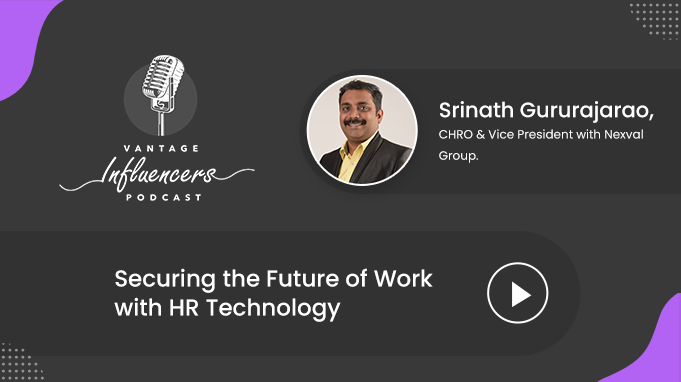
Securing The Future Of Work With HR Technology
Episode Overview
Srinath Gururajarao argues that the pandemic did not just change where people work, it exposed which human behaviors actually hold a company together once the ground shifts under it. He frames the shift with a simple before-and-after lens: enterprises built for a stable world versus enterprises built for one that keeps throwing unpredictable, large-scale disruptions at them. In his view, the traits that matter most in the second world are learning to learn, adapting quickly, and choosing to complete each other's work rather than compete over it, since competing makes little sense when an entire team is facing the same survival threat. He backs this up with a concrete story: when a cyclone knocked out his headquarters in the middle of the pandemic, the business was back to full uptime within two days, not because of a contingency binder but because people had already built the habit of adapting together.
From there, Srinath moves into what technology should and should not be trusted to do inside HR. He points to an AI-driven overhaul of employee insurance renewal, built on predictive illness modeling, that cut the illness ratio by 16 percent over three years while lowering costs for both the employer and the insurer. He is equally direct about where automation is already eating into HR's traditional territory: recruitment, he says, is close to fully automatable, and blockchain-based background verification is emerging that can confirm a candidate's history without ever routing data through a former employer. But he also warns against stripping too much judgment out of these systems, recalling a real case where an algorithm misread a candidate's facial expressions during an automated interview screen and wrongly rejected someone who was qualified. His conclusion is that HR budgets should be weighted toward building learning capability first, because knowledge, not the tools themselves, is what keeps an organization's edge intact when everything else keeps changing.
Episode Highlights
- Srinath frames the future of work as a shift from a "before-COVID enterprise" to an "after-COVID enterprise," where completing each other's work matters more than competing for it.
- A cyclone that knocked out Nexval's headquarters during the pandemic became a real test of resilience: the company was back to full uptime within two days.
- Nexval's AI-driven insurance renewal program, built on predictive illness modeling, reduced the company's illness ratio by 16 percent over three years while lowering renewal costs.
- Recruitment is already close to fully automatable, and blockchain-based zero-knowledge verification is emerging that can confirm a candidate's background without routing data through a former employer.
- Srinath argues HR budgets should prioritize learning capability above any other line item, pointing to Nexval's shift from 40 mandated training hours per employee per year to three or four times that scale.
- He cautions against removing too much human judgment from HR technology, citing a real case where an AI interview tool misread a candidate's expression and wrongly rejected someone who was qualified.
About the Guest
Srinath Gururajarao, CHRO & Vice President, Nexval Group
Srinath Gururajarao has diverse experience in strategy execution and innovation, with a human-centered approach to people practices. He has held leadership roles across the media, IT, ITeS, and banking industries, working with organizations including iGATE, Satyam BPO, and SREI Group before joining Nexval Group. He has been recognized with honors including "Top 50 Organisations with Great People Managers, 2019-20" and "Top 100 Great Managers, 2020-21" from the Great Managers Institute and Forbes, and "Top 100 HR Technology Minds" and "Best Employer 2018" from the World HRD Congress. He has authored seven intellectual properties in HR, spanning business intelligence tools to predictive HR performance models, and holds certifications in organizational analysis from Stanford University, people analytics from the Wharton School at the University of Pennsylvania, global business leadership from U21 Global and Harvard Business School Publishing, leadership in the 21st century from Copenhagen Business School, and design thinking in innovation from the University of Virginia Darden School.
Connect with Srinath on LinkedIn
Host
Rohit, Vantage Influencers Podcast Host
What You Will Learn
- How to think about "before-COVID" and "after-COVID" enterprises, and why completing each other's work matters more than competing for it during a crisis.
- How predictive, AI-driven data can reshape something as routine as insurance renewal, and reduce illness ratios while lowering costs for both employer and insurer.
- Why recruitment is already close to fully automatable, and how blockchain-based verification is changing how background checks work.
- How to build a company-wide learning culture using MOOCs and structured upskilling, and why HR budgets should prioritize learning capability first.
- Why removing too much human judgment from HR technology can backfire, and where a human face still needs to stay in the process.
- What roles inside HR are most exposed to automation, and which human-centered parts of the job are likely to remain.
Key Topics & Timestamps
| Timestamp | Topic |
|---|---|
| 0:00 | Introduction and welcome |
| 0:45 | How Srinath got into HR |
| 3:12 | New behaviors needed to succeed in the future of work |
| 8:03 | Building culture in a remote and hybrid company |
| 13:10 | Internal skills needed to build and integrate AI solutions |
| 18:30 | Creating a technology budget as an HR head |
| 21:54 | Which HR roles are most likely to be disrupted |
| 26:52 | Strategizing to drive performance and value through technology |
| 31:10 | Srinath's favorite business book |
| 32:10 | HR leaders and thought leaders Srinath follows |
| 32:53 | Advice for young HR leaders |
Full Transcript
Click to read the full episode transcript
Welcome to the Vantage HR Influencers Podcast. This podcast is sponsored by Vantage Circle, the leading employee benefits and engagement platform.
Rohit: Hello, this is Rohit from the Vantage HR Influencers Podcast, and today I'm excited to have Mr. Srinath, who is CHRO at Nexval Group and has more than 20 years of work experience. In this session, we want to talk about how to secure the future of work with HR technology. Welcome to this session, Srinath.
Srinath Gururajarao: Thank you, Rohit. Thank you for having me on this session. I'm really excited to be part of this and to share my experiences and the journey along the way. The future of HR is also what excites me most in the days we're in.
Rohit: Absolutely. And before we start, I wanted to understand how you got into HR and what excited you about being in this field.
Srinath Gururajarao: Thanks. A career in human resources wasn't a typical destination back in the 2000s, when I graduated. It was more about IT in those days. In the environment I grew up in, a public sector township in Bangalore, we grew up together from nursery through graduation, sharing the games, festivals, fun, and sorrows. That collective experience unconsciously pushed me early on toward an interest in human possibility, and it laid the foundation for a career in HR that I hadn't anticipated at the time.
To be more specific, the human role, as I like to call it, sits in the middle of the most compelling and competitive battleground in business, where companies deploy and fight over their most valuable asset: workforce talent. I never wanted to just be a post box for information exchange. I wanted to do work that actually brings value, that marries people's aspirations to the growth story of the business, and that plays a vital part in a person's journey. That's what excited me over the years.
In the early, formative years, it was more about realizing the trivial, everyday things and feeling distant, remaining just a headline on someone's resume. But as I moved along, like in any other profession, I started seeing the forest and the far-off hills beyond it. That shaped my learnings and my successes, and it moved me from being a mere administrator to a value generator. So to put it in context, human resources is now a part of me. It's part of my senses, and it's how I try to make a difference in people's lives as we journey along.
Rohit: Very nicely put. Since we're talking about how HR is going to change the future of work, what new behaviors do you think will be required to succeed in the future, given that we're already in the midst of a crisis? What new behaviors would the next generation need to develop to succeed?
Srinath Gururajarao: Yes. I call this the BCE and ACE framework, before-COVID enterprise and after-COVID enterprise. A new tribe of HR is emerging on the horizon, one that needs to understand and formulate human potential and then put it into practice: a journey of building an environment with cultural strength, connection strength, and capability strength to manage this transformation, all with agility at the back of our minds. An agile system is what's called for as a human practice in these times, because the world has suddenly changed and it's being talked about in every form.
Earlier, we were constrained by physical limits: we had to commute and then do the work. Now, suddenly, every home is an office, and home is also where you carry on and enjoy that work. That has led to an era of imagination that was already there but is now in full swing. It has set in motion the most capable tools to assist human imagination and potential, and HR is at the forefront of that, because we're the ones dealing with a set of competent behaviors essential to challenge, understand, and adapt to the unknown, while still providing a sense of balance to business strategy and performance. These behaviors have to be in continuous motion.
To give you a contextual example: we were held back not only by COVID but also by a major cyclone that hit our headquarters. We had to run our business continuity plan twice, one after the other, and that taught us that a black swan event isn't just something you read about, it's something you experience, and sometimes more than once. The human competency to adapt, to think through these situations and emerge from them, and to get fully back on our feet mattered. Within two days we were fully functional again, at 100 percent uptime, and we never struggled after that. It taught us fundamentals about how to reorganize and how business could still function with a human aspect to it.
All of this brought along the necessity of aligning to human frailty in the face of the environmental challenges thrown at us. Our tools have become sharper and more cognitive as a result, able to augment talent in ways that weren't possible before. I think this is also an era where human ability is being challenged more fundamentally, and that will only bring out the best in us. We've survived for roughly ten thousand years as a species, through the age of dinosaurs, industrial revolutions, and now the age of imagination, and we're still fighting for the fundamentals of survival and livelihood. That keeps us grounded at the core.
So, coming back to the essential behaviors needed to succeed in the future: learning to learn is underlined, the ability to adapt quickly is a given, and completing each other in collaboration matters more than competing. I say completing rather than competing because competition has run its course. We're facing a shared threat to survival and livelihood, so we can't afford to compete in this moment, we have to complete each other. It's a more philosophical way of framing behavior. When you complete each other, you find common ground and a path to face challenges head on. Those are the three traits I'd point to, Rohit.
Rohit: Correct. I absolutely agree about collaboration, because we can't be in a competing mode; it's important to collaborate with each other. Since we're all in a remote environment across the world, I wanted to understand what key levers should be used to build culture, whether in a remote setup, in a company that's been around for decades, or in a new company. What key levers should be there when you're looking to build culture in a company?
Srinath Gururajarao: Great question. Culture is a subtle thing, but it forms the entire core of a group, a team, an individual. Being culturally attuned is itself a talent that every leader needs to build. Culture expands possibilities, strategy focuses effort, and tactical ability delivers the here-and-now wins in our progress. A culture that respects, trusts, and completes each other, again, completing rather than competing, wins in a continuous environment full of challenges.
The HR construct for that is to enable activities that bind, bond, and drive progress, with an emphasis on completion, innovation, and collaboration. The more we collaborate, the smaller our challenges tend to become. The more we trust only ourselves and take things head-on without collaborating, the less we actually resolve the underlying threat.
To put this in context, at Nexval we started a unique storytelling initiative, a platform for employees to share experiences, understand each other, and celebrate points of success, learning from failures rather than viewing them through a lens of punishment, which only creates a culture of fear. That's been fundamental to how our culture has grown. We became a certified Great Place to Work this year, built on a set of practices around being human and carrying more smiles. Smiles are at the forefront of everything we do, and I have a simple philosophy: more smiles per hour of work. When people ask how we measure that, we say we don't, and that's the beauty of it. As long as it stays unmeasured, it remains genuine, something we bring to our employees' work rather than track as a metric. We facilitate their growth and their work, and we see the results almost daily in the value and cohesion we generate as a cultural unit. That's given us a uniform experience, transparency, and trust in our basic deliverables. People trust each other more, bond better, and create the wow factor that's necessary.
Another tool we built with technology support was an internal AI system that surfaces production and presence information to employees themselves. Earlier, that data was centralized, and the employer consumed it more than the employee who was generating it. We changed that technologically so employees could see their own data, build better accountability, and become more responsible for themselves, using a nudge-based approach. That's empowered employees; there's no micromanagement. Managers are happy because employees own their performance and expectations through the application that presents that information to them directly.
We've added more layers and more science to that over time, integrating artificial intelligence that helps us understand human behavior in a more scientific way and create small transformative changes day to day that add up to something significant by the end. Just to give you a number, we drove about 20 to 25 percent efficiency gains once we implemented this. We didn't let managers monitor the data; we let employees own their data and take responsibility for it themselves. That's where culture spoke and allowed a better connection around being more responsible in how we function. I'd call that our biggest transformation, one that changed how we worked and reinforced the parts of our culture that keep getting endorsed and generating value.
Rohit: Interesting. Since you're talking about AI, I wanted to understand what internal skills are needed to build and integrate AI solutions, and do you think AI could replace the human workforce?
Srinath Gururajarao: On AI replacing the human workforce, I'd say AI will definitely replace some tasks that have been carried out manually, and it will also assist humans in performing more complex tasks with better value generation. If you marry culture to intelligent decisions, AI plays a very important role, but we need to demonstrate a winning proposition to enable that alignment.
I'll give you a couple of examples of how we integrated AI solutions, without it needing to be complex or requiring a team of AI specialists; the focus was always on generating value in HR. The first was in employee insurance renewal. Every year, for decades, companies go through the motion of renewing insurance with a few benefit changes here and there, consumed by employees without much thought. We wanted to make a difference, so we looked at the wider market for intelligence that could help, and we settled on IBM Watson. We used our actual data to model future possibilities of illness by location and age, then went back to our insurer and constructed a different contract. That helped us in three ways: limiting the incidence of illness by taking preventive measures tailored to specific groups of people, running awareness activities aimed at those same groups, and reducing overall cost so we could redeploy that money elsewhere to make a difference in a different way. The insurer was happy too, because they had fewer illness claims that year. Over three years, we've made about a 16 percent difference in reducing our illness ratios, and the cost side worked in everyone's favor: the insurer renewed at a lower cost, and the employer paid less. AI created that differential, and we've kept using it to generate value and make a difference in our employees' wellbeing, which is what matters. When HR facilitates that, the power of AI is unleashed for each employee.
The next piece was a massive program of MOOCs. Everyone took courses in artificial intelligence, most took the basic course, and some went further into robotic process automation, since we're a business process company processing mortgage-related work in the banking industry that involves a lot of documentation. People completed those courses and deployed their own bots at their workstations, which transformed how we upskilled our people and changed how AI is consumed and how it generates value for the company. To give you a sense of scale, before 2016 we mandated about 40 hours of training per person per year; that's grown to three or four times that size, and we've kept clocking more hours of learning, which has helped us build capabilities in collaboration and innovation. We've been able to build different products for ourselves and make a difference even in this COVID era. We're one of the few companies in Calcutta that are hiring; we just completed a ramp of about 120 people last week, and we were also the highest job generator in the region last year according to the Software Technology Parks of India. So learning combined with AI skills has helped us. We've mandated a basic course in design thinking, a basic course in robotic process automation, and a basic course in communication across the board, because what you learn also needs to be communicated in a way that matters to the business and generates value. Those are some of the things I could share with you, Rohit.
Rohit: That's very interesting, that the company has also looked at AI as a solution. How should HR heads create a budget for technology, since Vantage Circle is also an HR tech company? How can HR departments look at creating a budget so that technology can make life easier for employees and for the company as well?
Srinath Gururajarao: I think budget creation for anyone is really about the direction you want to chart. In a world increasingly shaped by black swan events, it's more important than ever to direct our budgets toward learning capabilities, so that the competitive edge for building tomorrow stays focused on knowledge. Unless you have that edge, you won't be able to compete, or complete, in a way that lets you function better. Knowledge is the true edge, and technology budgets should enable that so our work becomes easier.
On budgeting for technology specifically, a tool in tech provides a multiplier effect. There's no real argument that investment in technology doesn't help in the long run; it does, it gives focus and scale. The one thing to be cautious about is your organization's level of maturity at the current moment: is this an incremental investment building on existing capability, or a zero-based investment in a capability you don't currently have? Today we've heard of technology where you don't have to write code at all, you just describe what you want in sentences, something like GPT-3, and it converts that into the code needed to build a website in almost no time. Who could have imagined that? The same goes for RPA. These are investments that will transform, if nothing else, the business process management space, which is a huge part of the Indian business landscape today. Most of us have invested there and are changing how repetitive, monotonous tasks that used to require hiring more people are now handled differently.
From a budgetary perspective, you should always separate what can be incrementally beneficial from what can be transformative, and chart your investment accordingly, especially given how much uncertainty is in the landscape now. It's important for an HR head to invest enough in technology so people can focus on what really matters: understanding the potential of employees, helping them aspire to a bigger vision, and enabling that on the ground through concrete, local steps. That's only possible at scale, and scale comes from technology, which we should constantly be mapping and enabling.
Rohit: Understood. In that same context, do you think there's any role in HR that would get disrupted, and how should companies prepare for that?
Srinath Gururajarao: There are definitely multiple aspects of disruption across the lifecycle of HR processes. I'd say an autonomous HR function isn't far away. Shared services, hire-to-retire processes, are already being platformized with AI and machine learning, which will reduce the need for a person to sit and manage that process end to end. It won't be long before HR's presence in areas of purely operational, transactional work becomes questionable.
Looking at the world today, recruitment is already close to fully automatable with better tools and hiring platforms; that's an area ripe for disruption. What's interesting now is the emergence of zero-knowledge proof systems based on blockchain, for instance in background-check verification. Previously, you'd need to share data from a previous employer and request credential verification directly. Now, without exposing that underlying data, systems can talk to each other and validate a claim without the person who originated the request being involved at all. I think that's a good development, and we'll see more maturity in this space over time, not necessarily always through blockchain itself, but through systems getting more integrated over time, especially now that COVID has pushed work-from-home to the forefront, well above 80 or 90 percent adoption in many places.
That's where I think the employer-to-employee contract will fully transform in the years ahead, and skill will govern how the match happens between an employee and a task, enabled fully by technology. Technology has a great role to play here, and systems are emerging in that space. We've had, and still have, platforms like Upwork and others that offer gig work as a way of life. The World Economic Forum's best estimate was that around 30 percent of work would be gig-based by 2025. But after this shift to an after-COVID enterprise, the emergence of technology has compelled us to look at that differently and figure out what can be leveraged so human potential can be augmented to the fullest.
Roles built around mundane, repetitive tasks, in HR or anywhere else, will largely disappear. What remains, and I'm not sure what we'll end up calling it because we're good at inventing names, is the task of human-to-human connection: where empathy is needed, where you need to put a shoulder in and walk alongside someone. Those things will remain in different forms. Another thing that will remain is the ability to shape how business strategy itself is conducted. If you look back at the early 1900s, the ratio of machine to people in industrial collaboration was close to 70:30. Today it's roughly 80 percent people-driven and 20 percent machine-driven. That means the role of HR in managing people and getting the best out of them requires a lot of skill, and HR is at the forefront of that, walking with people and building a culture where human effort can truly make a difference. I think that's the role that will keep emerging in different forms and names. Another aspect that will continue is the ability to structure learning. Even though we have a lot of tech platforms for it, enabling learning will still need a human face to drive the behaviors and the edge we want to build in our people.
Rohit: Interesting. How should HR heads strategize to drive performance and value through technology?
Srinath Gururajarao: Great question, Rohit. With technology driving transformation, long-term sustainable value will only be created by unifying business and technology to co-create exponential value for companies. That takes transparency and a culture of collaboration and trust, best achieved with technology assisting it, because you can't think of a system, practice, or process today that doesn't have technology underlying it. In any vertical, in any business, technology brings its core strength of scale, transparency, and trust. You can't really do anything without those.
It's a good thing that technology strategy is now woven into HR functions, so we build that capability, and every HR head needs to think about how to make technology more human in the process. What happens when you apply too much technology and remove the human face is that the touch points and the ability to understand empathy, the softer aspects of behavior, disappear. We've seen a real case where a system deployed to assess interview responses used facial recognition to interpret behavioral cues, and certain algorithms interpreted a candidate's expression differently and rejected someone who was actually qualified, because the algorithm read something as a negative signal that wasn't. So a human face is still required in some aspects, even as technology becomes more present. Humans will coexist with technology to better themselves, and that applies not just to HR but across humanity.
Performance that's well defined performs well; if it isn't defined, it doesn't, whether or not technology is involved. Technology acts as a bridge, with an audit trail, for the system to continuously improve. That's where the technology layer stands today, and it will keep evolving. As CHROs, it also helps us bring speed to transformation. Whenever we want to build something, technology is a great lever. I couldn't have imagined, ten years back, doing more than 40 hours of training without MOOCs; 40 hours per person alone was an arduous task to run as a classroom program. Today, I don't even have to think twice, it's done, and people are consuming more of it than ever, learning at a pace we haven't seen before. That's a force-multiplier effect across the board, and people today are excited that these options exist. You have platforms where everything you learn gets documented and indexed in one place, shareable, creating a learning ecosystem where people compare what's best to learn next. There's so much more to do. It really is the age of imagination, opening up daily through MOOCs. If you put on a learning mindset, technology gives you a strategic lever, more and more, every single day. That's how I think HR has to strategize to drive performance. Without technology, I don't think you can do much today.
Rohit: Absolutely right. Technology can be a great lever, not only to help your processes but also to acquire information and knowledge. Srinath, I'd like to do a quick round for you. What's your favorite business book?
Srinath Gururajarao: Straight from the Gut, by Jack Welch. What he said back then still applies today: being candid, authentic, truthful to what we do, and having the drive to transform, because nobody fully understands a transformation at the exact point it's happening. You need that drive and the know-how to work through systems, and it remains my favorite book. Another one I'd recommend is Made in Japan, Akio Morita's autobiography, the founder of Sony. It's an amazing book on people management and on how he traveled from Japan to the US without knowing English and still built a business empire as large as the Sony Corporation.
Rohit: Do you follow any HR leaders or CEOs that listeners should also follow?
Srinath Gururajarao: Yes, there are a lot of people I follow, and thanks to technology, you can access their thinking daily across different platforms. I follow quite a few HR and business thought leaders, though I'd rather not single out names, since that would be a disservice to the many others whose thinking I draw from. There are a lot of people who continuously help me grow as a person, and I try to borrow from their thinking and apply it in my day-to-day life.
Rohit: Finally, is there one piece of advice you'd want to give to young HR leaders, and to graduates who are coming out of college wanting to get into HR?
Srinath Gururajarao: Never fear your imperfections. Those are exactly the places where opportunity lives. That's the one piece of advice I'd give to anyone starting out: never worry about your imperfections, because that's where the biggest opportunity for improvement and change lies. I think we're designed that way so we can leverage ourselves better and reconstruct that part of ourselves in a better way.
Rohit: And what's the best way people can reach out to you and learn more about you?
Srinath Gururajarao: I'm available across most social platforms, LinkedIn and Twitter in particular, and by email as well. We'll put those details in the show notes.
Rohit: Thank you so much for taking the time. This was a very insightful session where we talked about how the future of work will change. Thank you so much.
Srinath Gururajarao: Thank you so much. Pleasure talking to you, and thanks to everyone listening. Best wishes.
FAQ
What does Srinath Gururajarao mean by "before-COVID" and "after-COVID" enterprise?
Srinath uses this framing to describe a shift in HR's underlying purpose. A before-COVID enterprise was built for stability, but an after-COVID enterprise has to operate with agility built in as a default, because the world now throws unpredictable, large-scale disruptions at organizations far more often. In his view, the behaviors that matter most in this second mode are learning to learn, adapting quickly, and choosing to complete each other's work instead of competing over it.
How did AI change employee insurance renewal in Srinath's example?
Rather than renewing insurance the same way every year, the organization used predictive data modeling, built on IBM Watson, to forecast future illness patterns by location and age. That data let them negotiate a different insurance contract focused on preventive measures for at-risk groups, which lowered the illness ratio by 16 percent over three years and reduced renewal costs for both the employer and the insurer.
Does Srinath think AI will replace HR jobs?
Not entirely. He expects AI to fully automate transactional, repetitive tasks, recruitment screening and shared-services work in particular, but he argues the human-to-human parts of HR, empathy, judgment, and walking alongside people through change, will remain. He also warns that removing too much human oversight from HR technology can misfire, pointing to a real case where an AI interview tool misread a candidate's expression and wrongly rejected someone who was qualified.
What does Srinath recommend for HR technology budgets?
He argues that budgets should be weighted toward building learning capability above any single tool purchase, since knowledge is what keeps a workforce's competitive edge intact as technology keeps shifting. He also says HR leaders need to distinguish between incremental technology investments that build on existing capability and zero-based investments in something the organization doesn't have yet, and plan budgets differently for each.
Related Reading
Also listen on