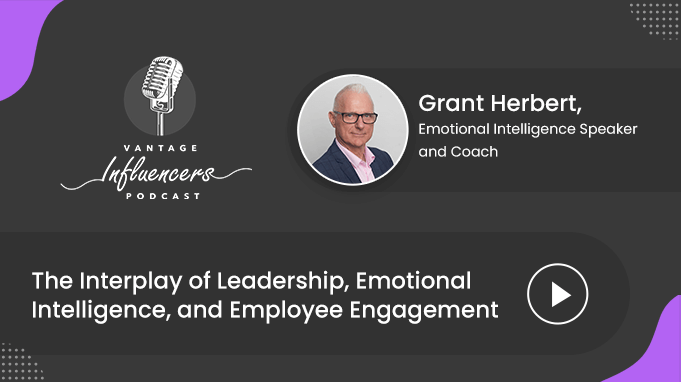
The Interplay of Leadership, Emotional Intelligence, and Employee Engagement
Episode Overview
Grant Herbert, Founder and Global Managing Partner of People Builders, joins host Susmita Sarma to unpack why emotional intelligence, not technical skill, is the real driver behind workplace conflict, disengagement, and leadership failure. Grant walks through the four quadrants of social and emotional intelligence (self awareness, self management, social awareness, and relationship management), arguing that most organizations jump straight to relationship management training without first building the self awareness and self management foundation that makes those skills usable. He is candid that the label "soft skills" undersells what these competencies actually do to an organization's bottom line.
The sharpest, most concrete moment in the conversation comes when Grant reframes "driving" employee engagement as a fundamentally flawed premise: a push strategy where people are told to be engaged rather than given an environment where they choose to engage themselves. He backs this with a real business case, citing Sheraton Hotels' 24% market share increase after investing in emotional intelligence training, and closes with a practical, word-for-word script for confronting a low EQ coworker or boss without triggering conflict or retribution.
Episode Highlights
- Emotional intelligence is a learnable ability, not an inborn trait, built on being aware of your own emotions and regulating them well enough to function with others.
- The four quadrants are self awareness, self management, social awareness, and relationship management, and skipping straight to relationship management training rarely sticks.
- Personal power (self worth, boundaries, and the ability to say yes and no appropriately) is the most crucial competency at any career stage.
- "Driving" employee engagement is a push strategy and the wrong frame; emotionally intelligent leaders build environments where people engage themselves.
- Low EQ costs organizations through lost talent, replacement costs, absenteeism, and disengagement that spreads through a team after someone leaves.
- A simple, direct boundary-setting script (naming the impact of a behavior and asking for a specific change) can resolve conflict with a low EQ coworker or boss without escalation.
About the Guest
Grant Herbert, Founder & Global Managing Partner, People Builders
Grant Herbert has been named Emotional Intelligence Speaker and Trainer of the Year for two consecutive years and has over 37 years of experience as a leadership trainer and coach across military, corporate, and entrepreneurial settings. As founder of People Builders and the People Builders Institute, he trains, certifies, and mentors coaches, corporate trainers, online course creators, and HR professionals worldwide, drawing on a 26-competency model of social and emotional intelligence built around self awareness, self management, social awareness, and relationship management.
Connect with Grant on LinkedIn
Host
Susmita Sarma, Vantage Influencers Podcast Host
What You Will Learn
- Why emotional intelligence is a set of learnable abilities rather than a fixed personality trait.
- How the four quadrants of social and emotional intelligence fit together, and why self awareness and self management come first.
- Why framing engagement as something you "drive" into people undermines the goal, and what to do instead.
- What lack of emotional intelligence actually costs an organization in talent, engagement, and market share.
- A practical, repeatable script for raising a boundary issue with a low EQ coworker or manager.
- How to start developing emotional intelligence at an individual and organizational level.
Key Topics & Timestamps
| Timestamp | Topic |
|---|---|
| 01:30 | Defining emotional intelligence and why it matters for leaders |
| 02:38 | Grant's path into emotional intelligence work |
| 05:25 | The four quadrants: self awareness, self management, social awareness, relationship management |
| 10:35 | Why "driving" engagement is the wrong frame |
| 14:34 | How leadership has evolved over 37+ years |
| 18:02 | The cost of low EQ: lost talent, disengagement, and the Sheraton Hotels case |
| 20:53 | A script for addressing a low EQ coworker or boss |
| 24:15 | How to develop EQ at the individual and organizational level |
| 27:29 | Daniel Goleman's influence and where to follow Grant's work |
Full Transcript
Click to read the full episode transcript
Welcome to the Vantage HR Influencers Podcast. This podcast is sponsored by Vantage Circle, the leading employee benefits and engagement platform. When it comes to leadership, emotional intelligence has recently become one of the hottest topics. Research also indicates that emotional intelligence has a strong impact on the engagement level of employees. We do know that it is a characteristic that can be measured and improved, but what exactly is emotional intelligence and how does it impact the way we think about leadership and engagement today. Let's know in today's episode. I'm your host, Susmita, and I have with me emotional intelligence speaker and trainer of the year, Grant Herbert. As the founder and global managing partner of People Builders and the People Builders Institute, Grant trains, certifies and mentors coaches, corporate trainers, online course creators and HR professionals to develop others all over the world. As I've already mentioned, Grant has been awarded the honour of being named the emotional intelligence speaker and trainer of the year for the past two years and is seen as a leader in his profession with over 37 years as a leadership trainer and coach. Despite his many credentials and awards, he describes himself simply as an ordinary guy with an outstanding wife and five amazing kids who has a passionate message to share about being authentic and living the life you were created to live. Welcome to the show, Grant.
Grant Herbert: Thank you, Susmita, I'm really glad to be here.
Susmita Sarma: Okay, welcome. So for those of our listeners who are unfamiliar with the word, let's start by defining the term emotional intelligence. What is emotional intelligence and why is it so necessary for HR leaders?
Grant Herbert: Great question, and I'm glad you asked that question because a lot of people think they know what it is. So I deal with both social and emotional intelligence, so I'm going to give you a definition of that together. Social and emotional intelligence is the ability to be aware of your own emotions and what might be going on in another person's emotions in the moment, and then to be able to use that information to manage yourself and manage your relationships. So if I break that down a little bit, the first thing I've got to understand is an ability. So it's not something you're born with or not born with. It doesn't matter what age or stage of career you're at, you can learn these skills, and it starts with being aware of your own emotions and being able to regulate them appropriately so that it can function well with other people.
Susmita Sarma: Okay, so Grant, how did you become involved in emotional intelligence and make it so central to your work?
Grant Herbert: Great question. So if I go back in my business, running a coaching and training and consulting business, like I got about 10 years ago, I was already doing quite well. I was working with lots of different organizations, individuals, and to be honest, I had sort of heard of this thing called emotional intelligence. Some people call it EQ, which is your emotional intelligence quotient, but I'd really not done a lot on it. And I could hear that a lot of people sort of talking about it, and I thought, well, I'll investigate what this is. And one of the first things I found out was that it was the reason why I had so many challenges in my own corporate career because I don't think I had any. And so I got really excited about the opportunity for my own life, but also for the people that I was working with. And I started off working with people with these competencies, and I could see that they were making changes that they weren't making before. So I realized that these competencies that I deal with, 26 of them in all, they are the crucial competencies that we need whenever we're working with people. And unfortunately, in our industry, people tend to call them soft skills. You would have heard of that term. And the challenge with this is they're not the soft ones. So everyone wants to teach the technical skills and spend all their efforts and time in that. These are hard skills. These are skills that are crucial that everybody needs. And if I asked any of your listeners to think about any conflict or unrest or challenge that they had over the last 30 days, I guarantee it wasn't based around your technical skill. It was around your emotional intelligence or indeed your social intelligence. I got really excited when I saw the value it was bringing, so I thought, well, that's not enough, Grant. So then I went and got some more training and development, and I was certified as a master trainer for the Institute for Social Emotional Intelligence in Denver, Colorado. And 10 years down the track, I now not only work in this area extensively, I also certify and develop internal and external human resources consultants, coaches and trainers to do the same. So yeah, that's pretty much, I'm obsessed about it and have been named the last two years the emotional intelligence speaker and trainer of the year. So I really, really took it on as being something that I can make a difference with.
Susmita Sarma: Great. So Grant, when we talk about our workplace, would you like to mention the top areas where we can apply emotional intelligence?
Grant Herbert: Yeah, great question. So as I said, I deal with 26 competencies, and probably a better way to answer this question, because it really depends on the context of the role. It depends on the organization. But if we break it down to the four key quadrant areas of social emotional intelligence, the first area is self awareness. And this is where we have to start. So self awareness, we look at our emotional self awareness, our ability to know what's going on for us in the moment emotionally, and we build our emotional vocabulary. We look at our ability to accurately assess where we are, and we develop the competency of personal power. And this is, I believe, the most crucial competency for anyone at any stage of their career or any position of leadership in an organization. And personal power is all about your own self worth, your own self confidence, your ability to set boundaries, to say yes and no appropriately, and those types of skills. So that would be the first area. The second area then is we go into self management. And within self management, this is about being able to say, well, okay, that's what my brain is telling me, that's what these emotions are telling me, so what am I going to do with that information? And this is where we look at things like behavioral self control. I don't know about you, in my corporate career I experienced people who would just fly off the handle and start yelling at people or whatever, and I used to do that myself in my early career. So behavioral self control is very, very important. Another one is resilience, stress management is another one as well. So there's some key elements in there. Right now, intentionality is a big one, being able to make sure that you don't just have a plan for today, that you understand where everything that you're doing in your career, in your business, in whatever it is, where it fits in. So self management is a key area, and that's the two quadrants that make up emotional intelligence. Then we get into social intelligence, and this is where we start looking at others, and we go into the competencies. And this is another big one, and that is empathy. Empathy says, I want to understand what you're going through, I want to understand it through your lens, not just my own. And I find a lot of leaders, particularly those with high achievement drive, lack empathy. So empathy is in the middle of apathy, which means I don't care, and sympathy, which means I feel sorry for you. So empathy is another big one. Also being able to be situationally and indeed organizationally aware of what's going on, here's another one, and service orientation. So that's social awareness. And then we get to the fourth area, which is relationship management. And this is unfortunately where most organizations want to start. And these are the skills like being able to communicate effectively, being able to work with others, coach and mentor others, inspirational leadership, conflict management, these sort of skills. And the problem is, although they're all very, very important, unless you build a platform in self awareness and self management, those relationship management competencies, you're not able to actually navigate very successfully. So I know it's a long answer, but I needed to, because two things I want you to understand. One is, as I said, it depends on who you are and what the context is. The second thing is, right now, in this new normal, as everyone's calling it, competencies like personal agility are extremely important. Being able to handle change that's coming faster and faster all the time, going in and out of lockdowns, all those sort of things, that is a really big one. And I'm doing a lot of work in that area and a lot of work in the area of resilience, and being able to eliminate catastrophizing and thinking about the worst case scenario and those sort of things. So having realistic optimism, which is another competency. So those are the key ones that I'm working on right now.
Susmita Sarma: Right. So I think as you already mentioned, Grant, all of these are closely related to soft skills that we use in the workplace, right?
Grant Herbert: Yes, it's a term that we have to use to be relevant. However, I just disagree with the term, because "soft" says warm and fuzzy, it's a nice to have, and unfortunately organizations don't invest enough in that area because of that mantle of soft skills. But unfortunately, they're the ones that have the biggest effect on the bottom line.
Susmita Sarma: Okay, so as you know, Grant, we at Vantage Circle are into employee engagement, so we'll definitely like to know about how to use emotional intelligence to drive employee engagement, or say, what is the emotionally intelligent way to engage employees?
Grant Herbert: Yeah, look, definitely. And if you just think back to the competencies I just talked about, and firstly we look at the people who are doing the engaging first, and then we'll look at the ones that we're trying to engage. So one of the biggest areas that I see, firstly in my own corporate career but now working in the work that I do, is a lot of people that are driving, and as the reason I put emphasis on that word I'll explain in a moment, driving employee engagement, they're not totally engaged themselves. I mean, we've all heard these statistics that say roughly, you know, there's only 20% of workplaces fully engaged, and there's another 20% on the other side that are actually fully disengaged and they're looking to leave, and then there's all the people in the middle. So for me, if you are someone who needs to engage others, you've got to be engaged yourself. So developing your own emotional intelligence is important. The second thing is, as I said, the word "drive." So drive is a push strategy. So the word itself is not really emotionally intelligent. So drive says, I'm going to, and I know you don't use these words, but I'm going to engage you. People don't want to be told what to do. They don't want to be engaged, they want to engage themselves. So an emotionally intelligent leader will provide an environment where people will engage themselves. They'll do that by being empathetic. So empathy comes in by having a coaching and mentoring methodology that they use, rather than a top down hierarchical, tell you what to do. They'll be in control of their emotions themselves and model that, and therefore get that back from people as well. They'll have a communication structure that is not one way, it's up, down, across, and people are allowed to have a voice, etc. So all these things, which sound like great strategies and they are, they are all grounded in social and emotional intelligence. So hopefully I've answered your question. If not, happy for you to check in with me and ask another one.
Susmita Sarma: Right. So I'm sure that leaders who are in charge of rewards and recognition as well, for them too, EQ is a very important factor, right?
Grant Herbert: Yeah, look, every single leader, and by the way, just let me give you my definition of a leader. It doesn't matter who you are in an organization. Leadership is, as John Maxwell says, leadership is not a position, it's a responsibility. So it starts with self-leadership. So if there's just you, and you're the newest employee in the organization, you are a leader. You are a leader of what you've got to get done, and you're a leader of your own body and mind and the way that you operate. So yeah, most definitely it's important. The other way that I'd like to answer that is that perhaps what leaders in reward and recognition could benefit from, by being developed in social and emotional intelligence, is to have a greater understanding of what motivates and inspires the people that they're trying to recognize and reward, because the challenge is not everyone wants more money, not everyone wants position. So when we're an emotionally intelligent leader in reward and recognition, we understand our people beyond the surface level, and therefore we know how to engage and reward and recognize them. Does that make sense?
Susmita Sarma: Right, exactly. So Grant, you have been into leadership for so many years now, how do you think leadership has evolved over the time you have been studying it?
Grant Herbert: Yeah, so I always tell people I've been involved in leadership for nearly 58 years now, because I've been trying to lead myself. But in the last 37 years, I've been leading in both the military and then corporate, and now in my own industry, my own business. And I've seen many, many changes. And the biggest change, and this is where emotional intelligence is so important, is that we've gone way past the industrial age, where we had a manager that just got all the information and then just told workers what to do. So hopefully we've evolved out of that. However, I do see a lot of places still working that way. We went into the information age, where everything was, you know, we changed and we wanted to call people leaders, not managers, but it was still very much one way feedback. Now things are different, we are so fast paced, the speed of change is so much faster. Who has a 10 year plan these days? Nobody, because things are changing, and even outside of the pandemic things change in quicker cycles. So I've seen the leader, and you've probably heard the term VUCA been thrown around a lot, the VUCA leader of today, and that's where I work, is looking in a place that's more volatile, uncertain, complex, and ambiguous. So we need to get more done with less, and it's a lot faster. We don't have all the answers. And one of the key things that emotional intelligence does with a leader is helps them to be okay in their own skin, and they're confident in themselves, and they have a much healthier identity, and they realize that asking for help or not knowing everything is okay. And therefore leaders today have, or need, the ability to be able to work with their team, and they're going to have people in their team who have skills that they don't, and that's where leadership has changed. This top down hierarchical structure of leadership doesn't work. Command and control leadership doesn't work anymore. So I'm not a proponent of all the different, you know, Gen X, Gen Y, millennial labeling and typecasting people, however what I have seen is that even more so the younger people of today want a voice, and they want to know that they're giving value, they're not just wanting to get a paycheck. So for me, we've got to lead people no matter what age or stage we are, and we need to be flexible, we need to be willing to change, and that's why emotional intelligence is so much more important than it ever has been. And that's why it's so popular now, and this is why major corporations that deal with this stuff are saying it's in the top two skills now that people need. So that's how I've seen leadership change, and it's going to continue to change. When you go through things like we're just going through at the moment, leaders have had to evolve, and I just get excited about being a part of the solution, but it's going to keep changing.
Susmita Sarma: Okay, then what are the threats or possible cost to leaders, career, team, or company culture if they lack emotional intelligence?
Grant Herbert: Well, people are organizations, so the threats of a low level of EQ is we lose talent, and when we lose talent, you know, it's conservatively, the figures say it costs one year of salary for that person to replace them. That is extremely conservative, because that's just that one person. But if someone leaves an organization, the people in the team, that creates a little bit of a lack of engagement as well, because they're starting to wonder about things. So one of the things that I find quite interesting is when I am working with a large organization and they want me to put some proposal together to fill up their people, and they say the other thing, they want me to quantify what it's going to return. And what I always ask to do is look at, well, these are the things that will be in your organization if you don't have a high level of EQ. People will be leaving, there will be lots of conflict, people will be less engaged, people will get sick, absenteeism and presenteeism will go up. So if you look at those things, they're costing billions of dollars every single year. If we look at some of the things that I've said, people moving on, we've all heard it before, people don't leave organizations, they leave people, they leave leaders, they leave relationships. So these are the biggest threats. If we look at it from the other way, those companies who do get in and develop their people, top down, not just, I'll get the middle managers done, or the HR team can do some of that stuff or whatever, it needs to be a culture of emotional intelligence across the entire organization. And companies that do that, I know we don't have time now, but I've got statistics that can show, I'll just give you one. So for example, Sheraton Hotels, they worked on emotional intelligence skills and it increased their market share by 24%. Now any of your listeners in their organization, just imagine increasing your market share by 24%. So there's the good side of it as well. So to finish answering your question, the cost is other companies are going to take your market share, other companies are going to grow while you're going to stagnate. And I hate to sound doom and gloom, but I see this happen all the time. So that's what I believe the biggest threats are, and it's simple to turn it around and to get these skills top of mind and start developing them.
Susmita Sarma: Right, and then Grant, what if we have a coworker or even a boss that we know is having low emotional intelligence, how can we provide them with actionable input or information?
Grant Herbert: Yeah, I get this question all the time. So I'll go and work with an organization and the people go, well, yeah, this is all good, that I am learning this stuff, but I work with these other people and how am I going to practice what you're teaching me, because they're not getting the training or whatever. So the first thing that I always like people to understand is that we are only responsible for our own behavior. We can influence the response we get from others, but it's not up to us to change them. The second thing is having a high level of emotional intelligence yourself means that you're going to navigate the relationship with that person in a way that's less harmful to you. Now let's take it another level. When we learn to set boundaries, when we learn the competencies that I teach around personal power, when we learn to say no but in a certain way, a soft no, etc, when we build up our own inner certainty and are able to firstly speak our truth, things change, because here's what the problem is right now. Most people don't say anything to their coworkers or to their boss in particular, for fear of retribution. So that's why I'm saying there's got to be a culture in an organization, but let's say you're not there yet. So for example, if I can give you a scenario to answer your question, that might be the best way. So let's say you've got someone that cuts you off in a meeting all the time, so every time you go to say something or give an idea, they cut you off or they dismiss you. So what I teach is a simple strategy, and the listeners can take this one, and that is to pull them aside, and it's not what you do, it's how you do it, that can either get you in trouble or can get you the result you want. So I might go, let's call him Bill, "Bill, can I just grab you for a couple of seconds after the meeting?" Bill says yes. "So Bill, I just need you to understand that when you cut me off every time I speak in the meeting, it makes me feel like I'm not valuable, it makes me feel like there's no point me being in the meeting, and that you don't care about my ideas. So Bill, can I ask you, in future, could you let me finish and then ask me some questions rather than cut me off, because when you do that I'm going to be able to give more and I'm going to be more engaged. However, if you're not prepared to do that, then I'm just going to sit in the meetings and I'm not going to say anything, and in fact if it was to continue I'm going to stop coming to them." Now obviously you've got to gauge that message depending on the relationship and who it is, but that's where we've got to be able to get to, and that's all part of learning how to set boundaries. So that's what we need to be able to do. We need to feel certainty that we can have an open dialogue with people and ask them to treat you the way you want to be treated. Does that make sense?
Susmita Sarma: Yeah, definitely. So finally Grant, our HR audience would love to know how we can develop emotional intelligence.
Grant Herbert: Great question. So if I look at it from the individual's perspective to start with, it's everybody's responsibility as a human being to develop their own emotional intelligence skills. I don't see it as being the responsibility alone of a workplace or a particular department of a workplace. So if you personally, as an individual, are feeling that you're not able to understand what's going on for you emotionally, you're not handling your emotional responses very well, a number of those different things that I've talked about, then you can start doing some reading on it. You can work with people like me, I have online programs that I've put together that are self-paced, you can get that level of awareness that you need and you can start working on it. If we take it to the organizational, team, and indeed organizational level, then I believe what we need to do is make sure, as I said, that we have some sort of general training for the entire organization. Now what I might do, or what I do a lot with an organization, I might do a webinar, an introductory webinar that everyone comes to and has access to, so they understand what it is, and we dispel the soft skills myth and the warm and fuzzy myth, and we get people thinking, yes, these are skills that are important for me and for the organization. Then we can look at, in the organization, where can we work with a pocket of people and start developing their skills, and it depends on the budget, and obviously it depends on the size of the organization. But if you had the budget and you had the ability, you would put every single person through some level of emotional intelligence training. There's many ways you can do it, and let me tell you that COVID has made it even easier because people being able to work remotely, and sometimes being forced to do that, they've got more opportunity to be able to get on a device and have some training around it. But the first thing is you've got to know that you need it, you've got to make a decision that it is something that you need to develop. And then you can go through some training, which is great, but you need some coaching, whether that be internal, external, or whatever, so that you rewire your brain and it becomes a long term change. One of the reasons why I do certification programs now all over the world is to help people inside organizations that are in places like reward and recognition and all areas of HR, etc, to be able to do this sort of work that people like me do internally, is that it is so vital to get it done. So there's that other level, two, of getting some champions within your organization who can then run programs and develop those people that are in your organization as well.
Susmita Sarma: Okay, amazing. So before we end this up, I would like to know if you follow any HR leader or your favorite HR book.
Grant Herbert: I think most of us would have, anyone who's heard of emotional intelligence and has an interest in it would have followed the work of Daniel Goleman, who started with a book in the late 80s called Emotional Intelligence. And he started off with the same four-quadrant model that I use, and then he went to a five-quadrant model, and funnily enough he's come back now to a four-quadrant model, and using the same as I do. He's a research scientist, so it's coming more from that perspective. But for me, and this is something that I have to say, obviously humbly but with confidence, I'm more than happy that people follow my work and follow what I'm doing, because I've now stepped into a level where I have a greater responsibility in this field. But there's heaps of stuff out there, so long as you look at it like I do, from a perspective of being relevant to today, and look at the neuroscience behind the emotions as well, that's really important, the positive psychology. So I put those three things together in the work that I do, but I'm more than happy for people to connect with me, follow me on LinkedIn, even go to my website and connect with us there, so that they can get some more information around the things that I've talked about today.
Susmita Sarma: Okay great, we'll put that up in our show notes. That was great connecting with you, Grant, thank you for the conversation.
Grant Herbert: No problem, so thank you for giving me a platform to help the many people that you guys help as well, so I appreciate the opportunity.
Thanks for listening to the Vantage HR Influencers podcast, where we engage with HR influencers about human resources. Please do subscribe to Vantage HR Influencers podcast on Apple Podcasts and Spotify for new episodes.
FAQ
What is emotional intelligence, according to Grant Herbert?
Grant Herbert defines social and emotional intelligence as the ability to be aware of your own emotions and what might be going on in another person's emotions in the moment, and to use that awareness to manage yourself and your relationships. He stresses that it is a learnable ability, not a fixed trait you're born with, and that it can be developed at any age or career stage.
What are the four quadrants of emotional intelligence Grant describes?
Grant breaks emotional intelligence into self awareness, self management, social awareness, and relationship management. Self awareness and self management form the foundation, including competencies like personal power, behavioral self control, and resilience. Social awareness (including empathy) and relationship management (communication, coaching, conflict management) build on top of that foundation, which is why he says relationship management training rarely works if the first two quadrants haven't been developed.
Why does Grant say "driving" employee engagement is the wrong approach?
Grant argues that "drive" is a push strategy: it implies telling people to be engaged, which people resist. Instead, emotionally intelligent leaders create an environment through empathy, coaching, and two-way communication where people choose to engage themselves. He also notes that leaders trying to drive engagement in others are often not fully engaged themselves, which undermines the effort from the start.
What does Grant say is the cost of low emotional intelligence in an organization?
Grant points to lost talent (conservatively costing a year's salary to replace one person), spreading disengagement among the remaining team, rising absenteeism and presenteeism, and lost market share to competitors who do invest in EQ. He cites Sheraton Hotels increasing market share by 24% after training on emotional intelligence skills as a concrete example of the upside.
Related Reading
Also listen on