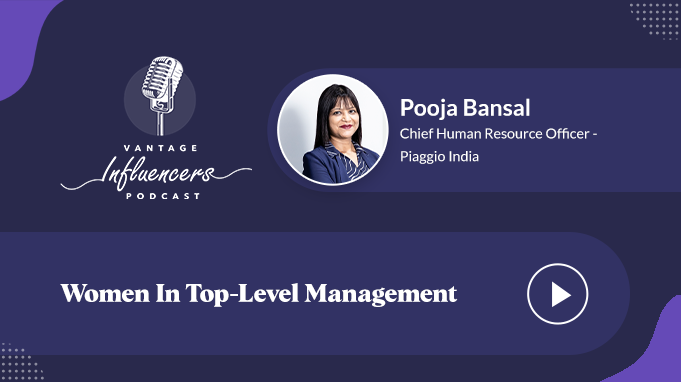
Women In Top-Level Management
Episode Overview
Pooja Bansal has spent nearly 19 years in HR, roughly 13 of them at Piaggio India, where she led the manufacturing facility's people function through the COVID-19 pandemic and has since driven digital transformation initiatives later replicated in Italy and Vietnam. Her sharpest point on why women remain scarce in top management isn't about individual ambition. It's that corporate culture can't be isolated from the broader society it draws from, so gender parity has to be a shared, cross-industry agenda, not something one or two companies can solve alone.
Her most concrete, actionable framework is the distinction between a mentor and a sponsor: a mentor helps you learn skills, but a sponsor is someone already in a position of power willing to bet on your competence and actively advocate for your advancement, and she argues companies need to explicitly push managers to become sponsors, not just mentors, because the glass ceiling is exactly what happens when growth stalls without one. She's equally direct about her own career: she says she never asked for extra flexibility as a woman, but she has consistently demanded meaningful work, growth opportunities, and to be treated exactly as a male peer would be in the same position.
Episode Highlights
- Gender disparity in leadership reflects the broader society companies draw employees from, which means gender parity has to be a shared, cross-industry agenda, not something one or two companies can fix alone.
- Pooja Bansal's first piece of advice to women pursuing leadership: stop feeling guilty about not doing everything perfectly, and openly negotiate shared home responsibilities with a partner instead of carrying that weight alone.
- The distinction between a mentor and a sponsor matters: a mentor teaches skills, but a sponsor is someone already in power who actively bets on your competence and advocates for your advancement.
- "Seat at the table" isn't enough without "voice at the table." Organizations need to ensure women are actually given room to speak, not just a nominal seat in the room.
- Real equal opportunity isn't about extra flexibility for women. Pooja Bansal says she never asked for that, but consistently demanded meaningful work and to be treated exactly as a successful male peer would be.
- Practical DEI actions: gender-neutral hiring (no marriage or family-planning questions asked only of women), bias-free training for male managers, and equal pride in paternity leave as in maternity leave.
About the Guest
Pooja Bansal, Chief Human Resource Officer, Piaggio India
Pooja Bansal is a highly motivated, results-focused HR leader with over 19 years of experience in multinational corporations, specializing in strategic leadership across talent pipelines, industrial relations, strategic HR management, and CSR. As CHRO of Piaggio India during the COVID-19 pandemic, she successfully managed a highly volatile period while ensuring continuity at the manufacturing facility. She holds a gold medal in Psychology and completed her Certified Strategic CHRO executive learning journey at Wharton, and has led digital transformation initiatives at Piaggio India later replicated in Italy and Vietnam.
Connect with Pooja Bansal on LinkedIn
Host
Sanjeevani Saikia, Vantage Influencers Podcast Host
What You Will Learn
- Why gender disparity in leadership reflects broader societal patterns, and why fixing it requires a shared, cross-industry effort rather than isolated company initiatives
- Why "ending the guilt trip" and negotiating shared home responsibilities matters as much as any workplace policy
- The critical difference between a mentor and a sponsor, and why companies need to actively cultivate sponsors for women
- Why "seat at the table" without "voice at the table" isn't real inclusion
- Why real equal opportunity means meaningful work and growth, not just flexibility accommodations
- Concrete, practical DEI actions: gender-neutral hiring practices, bias-free manager training, and equal pride in paternity leave as in maternity leave
Key Topics & Timestamps
| Timestamp | Topic |
|---|---|
| 02:07 | Pooja's corporate journey so far |
| 03:30 | The fundamental problems behind fewer women in top-level management |
| 06:09 | Importance of work-life integration for women in the corporate world |
| 09:10 | Balancing personal and professional life |
| 11:10 | Approaching networking and building relationships |
| 16:03 | Effective self-promotion and personal branding for women |
| 20:03 | Unique strengths women bring to leadership positions |
| 24:24 | How companies can provide equal opportunities for women to reach top-level management |
| 32:30 | How men can be effective allies and advocates for women |
| 37:02 | The future of women in the corporate world |
Full Transcript
Click to read the full episode transcript
Gender equality isn't just a nice to have, it's a must-have. And companies have begun to understand it all too well, from breaking down the old boys' club to smashing the glass ceiling, companies are taking action to ensure gender equality prevails. But despite the progress made toward gender equality in the workplace, women remain significantly underrepresented in leadership positions. Women make up only a fraction of top executives in the corporate world, with even fewer occupying C-suite roles like CEO or CFO. But why is this still the case in the 21st century? What are the barriers, and what can we do to level the playing field?
Sanjeevani Saikia: Hello listeners, welcome to another episode of the Vantage Influencers Podcast, where we explore a wide range of HR topics designed to grab your attention and inspire you. I'm your host, Sanjeevani Saikia, and today we'll be having a conversation on women in top-level management. And for that, I have with me Pooja Bansal, Chief Human Resource Officer, Piaggio India. Hi Pooja.
Pooja Bansal: Hi Sanjeevani. Thank you so much for inviting me, it's an extremely interesting subject, and I'm looking forward to this interaction.
Sanjeevani Saikia: Before we dive deeper into today's topic, women in top-level management, could you walk us through your corporate journey so far?
Pooja Bansal: Sure. I hail from Mumbai, born and brought up there, and I have approximately 19 years of corporate experience. I completed my majors in Psychology, then went on to do my Human Resources Management, and recently completed my Strategic CHRO course from the Wharton School at the University of Pennsylvania. It's been a very interesting corporate journey, I've been with Piaggio for almost 13 years, and prior to that, I worked at two other manufacturing organizations, so all 19 years of my experience has been in manufacturing organizations.
Sanjeevani Saikia: Wonderful, thank you for sharing your journey with us, you've clearly gained a lot of valuable insight along the way. Now we can dive straight into the topic. I've observed that the higher you climb the corporate ladder, the fewer women you see, only a few women find a seat in top boardrooms in Indian companies, and even those who reach these positions often earn less than their male counterparts. Pooja, where do you think the fundamental problem lies?
Pooja Bansal: You're right that women face a lot of apprehension, obstacles, and challenges in the professional world, and that's a fact we can't ignore, it's data-driven, not opinion. I think the fundamental problem has a lot to do with corporate climate and culture, and a lot to do with our society as well. Even today, despite organizations driving agendas around gender parity, we still live in a society that differentiates, that's still somewhat male-dominated, and that gets carried into the corporate world. What you see in families or the external world can't be isolated from the corporate environment, because at the end of the day, the people working in your company represent society as well. As organizations, the biggest problem is we're still struggling internally to figure out how to bring about parity, and if we can't solve it internally, how do we extend it to society? This isn't something one or two companies can fix alone, it has to be a shared societal agenda, the way CSR interventions are, driven by organizations for the benefit of the broader community.
Sanjeevani Saikia: Absolutely true. I'd like to know your perspective on work-life integration, it's crucial for women, allowing them to fully embrace all aspects of their lives without sacrificing one for the other. Could you shed some light on its importance for women in the corporate world?
Pooja Bansal: Very interesting question. The first thing I'd say is women have to stop feeling guilty. The first thing we tend to feel, as women, is guilt about not giving enough time to family or not giving enough time to work, because we're conditioned to want to be perfect in everything we do. If you know you want to climb the professional ladder, stop putting yourself on this guilt trip. If you have a spouse, partner, or other male family member, speak up and ask them to share home responsibilities alongside you. Don't shy away from asking your male counterparts to take on more of that if you want to move up. If you can get out of that guilt trip, I think half the problem is solved for women leaders. We're all talking about work-life balance and juggling career and family demands, but why is this specifically harder for women leaders, why doesn't the same problem exist for men? Because we've accepted this expectation of being a so-called "wonder woman," and honestly, it's not a compliment, we need to get rid of that label. There's no point framing ourselves as some out-of-this-world people; we belong to this world just like everyone else, and we need shared responsibilities. When we act otherwise, we set an expectation for others that we can do it all, when really, we're human, we can only do just enough to occupy that space well.
Sanjeevani Saikia: Our listeners would also like to know your perspective on how women can balance career demands with personal and family responsibilities.
Pooja Bansal: As I said, the first thing is accepting that we'll make mistakes too, since we're juggling multiple roles and responsibilities. It's important to openly tell people we need help, that we need someone managing the house when we're traveling, or taking care of kids when we're working late or on an important project. Reach out, be open that you need support, and don't try to project an image that as a woman you don't need anything, or that you're a superwoman expected to manage everything independently. When you can talk about it openly and look for support, half the work-life balance problem is already solved.
Sanjeevani Saikia: Those are some key ways women can strike that balance. Moving on, networking has enormous power and influence in today's competitive world, and for women to get ahead, networking matters just as much, if not more. How can women best approach networking and building relationships in the corporate world?
Pooja Bansal: I love this question because it's so relevant. The first thing is that women often feel a little awkward going out and networking, nothing to feel bad about, because even I felt that awkwardness early in my career, having to strike up conversations with people I'd never met. But networking is equally important for both men and women, it adds valuable connections, gives you visibility, and the fact remains that most critical job opportunities come through networking. It's equally important for both, but for women, I'd say it's even more important, because they often have to go a step further than what comes naturally to men in this regard. Beyond conferences and social media, women should genuinely talk about their achievements, for some reason, we naturally hesitate to talk about our own accomplishments, worrying it looks like showing off, when it comes so naturally to men. Why not talk about what you've achieved, show your network your skills and experience, and let organizations genuinely interested in women leaders see the value you can add?
One important addition to networking: identify a woman role model, whether inside or outside your organization. I've personally supported young women leaders, and I've found that even when I can't offer a concrete solution, just being a listening ear instills confidence and gives them a way forward. So along with networking, I'd strongly recommend every young woman building a career find a woman mentor, it benefits you not just professionally, but personally too.
Sanjeevani Saikia: Would you agree that this role model doesn't need to be a CEO or CHRO, it could be your immediate manager, or even a colleague?
Pooja Bansal: Absolutely, even a friend, if they have the relevant skills. I'd keep that title open; the key is simply having a woman role model. Another aspect that can't be missed is self-promotion and personal branding, since you've built your own personal brand successfully, how can women effectively do this to highlight their accomplishments?
I touched on part of this earlier, the first thing women need is confidence that they're doing good work, and then to speak about their accomplishments publicly, even if it means "screaming from the rooftop." Don't just share within a small, closed network, talk about it broadly, because you never know how many people you might inspire in the process. There's nothing wrong with building visibility this way, if it's not framed as showing off for men, the same standard should apply to women. Second, build your own confidence to articulate and present your own ideas in meetings and other professional settings, there's no reason to wait for someone else to invite you to speak up, since professional platforms are meant to treat everyone equally. And personal branding is deeply tied to building and nurturing relationships, women are naturally strong on EQ, and that's a real advantage worth leaning into. So: speak up, articulate, communicate, build visibility, share your accomplishments confidently, and nurture relationships, that's what builds real personal branding.
Sanjeevani Saikia: Coming from you, these tips hold even more value. Women possess an innate quality to lead with grace, grit, and panache. Could you highlight some unique strengths women bring to leadership, and how those benefit organizations?
Pooja Bansal: The first thing that comes to mind is multitasking, I think most of us would agree women are naturally blessed with this. If given a task requiring both logical and intuitive thinking, I'm confident both the left and right brain work effectively at the same time for women. I actually read some interesting research recently on exactly this, how women's multitasking ability connects the left and right brain effectively, which also helps with personal branding, since that requires both logic (knowing what you want to communicate, and to whom) and intuition. So multitasking is one skill women really have and should nurture, it puts us a bit ahead in many areas. Another is persuasion and negotiation, something that comes naturally to us, the skill of relating to others and nurturing someone toward success, especially in conversations involving feelings and emotions.
Sanjeevani Saikia: If I add resilience to that list, would you agree women are resilient?
Pooja Bansal: I'd say yes, but I'd also credit men with resilience, I was trying to think specifically about what comes more naturally to women, because a natural trait puts you a notch ahead of whoever you're comparing yourself to. These three skills, multitasking, persuasion and negotiation, and EQ, have worked to my advantage in my professional career, and I'm confident many other women take advantage of them too.
Sanjeevani Saikia: Well said. Companies have a responsibility to create a workplace that values diversity and inclusion, ensuring equal opportunity isn't just a moral obligation but also a legal requirement. How can companies ensure they're providing equal opportunities and support for women to reach top-level management positions?
Pooja Bansal: You put it beautifully, it is a moral obligation, and there's a legal compliance angle too, but that's the latter part. First, organizations need to provide equal opportunity to everybody, beyond just men and women. When I talk about equal opportunity, it's not just about assuming women need flexibility or a hybrid model to manage work-life balance, it goes beyond that. In my 19 years, I've never asked my company for additional flexibility as a benefit, because if I want to be treated equally, I need to demonstrate the same behaviors my counterparts would. What I've genuinely demanded is meaningful work, challenges, opportunities for growth and progression, and most importantly, to be treated the way a man would be treated if he were successful in the same position, pay parity, promotions, learning and development opportunities. That's what companies need to focus on. If they want to drive a DEI agenda, they have to stop assuming women can do certain things and men can do others, they need to take women seriously, which means not hiding behind the excuse that challenging, high-visibility work goes to male counterparts while women get less impactful assignments.
Beyond that, there are smaller actions companies can take to enable a DEI agenda, no miracle is going to suddenly create gender parity, so we have to enable small, deliberate actions. Formal mentoring programs that clarify women's career paths within the organization are one. Another, connected to mentoring, is sponsorship, every professional, man or woman, needs a sponsor, someone already in a position of power willing to bet on your skills and take you to the next level, which is different from a mentor who helps you build knowledge and skills. Companies must encourage managers to become sponsors, not just mentors, especially for women who've achieved substantial success but suddenly feel stuck, that's exactly what the glass ceiling is. That requires a culture where sponsoring women is seen positively, the same way every man in the system is quietly sponsored, not just growing automatically.
Another important thing, people talk a lot about "a seat at the table." I want to go a step further: it's not just about a seat, it's about voice too. Can you actually let them speak? We fight for a seat in the boardroom, but do we also ensure women get the same opportunity to talk, which rarely happens in a room full of men? And last, organizations need to create women's communities within the company, employee resource groups, internal or external, where women can connect, mentor and be mentored, and network. Companies need to actively encourage these groups to flourish. These are things I've learned from my own experience, needing a sponsor, needing a seat and a voice at the table, and companies need to put in real, extra effort to make this happen.
Sanjeevani Saikia: Absolutely true. Men still make up a significant portion of leadership roles worldwide, so they have a vital role to play in actively supporting and advocating for their female colleagues. How can men be effective advocates for women in the corporate arena?
Pooja Bansal: They can play a huge role. First, organizations need to be more serious about DEI strategy, document it, hold formal reviews of the strategy and actions, and hold people accountable for hitting whatever targets are set. Everything begins from the top, so DEI has to be part of the overall company strategy. Now, since roughly 80-90% of the workforce in most organizations is still men, they naturally have a larger role to play in hiring, rewarding, and performance management. But from my experience, I'd say men also need to shift their mindset about how they view their women colleagues, they need to understand that whatever traits or behaviors they might expect from women in their own families aren't necessarily the same traits their female colleagues bring to the workplace. These colleagues are working in the same company, aspiring to grow, engaging in healthy competition, and contributing equally, if not more, to the same role. Men need to listen, that's very important, and if they listen, they can become the biggest advocates. They also need to engage in genuinely supportive partnerships with women, and when running a DEI agenda, men need to be made responsible participants in driving it, not just showing up for a Women's Day celebration, which is very different from actually putting in effort toward the diversity agenda. That accountability has to come from the top, built into the company strategy, with clear, measurable indicators in performance management tied to driving the diversity agenda.
Sanjeevani Saikia: Hopefully our male listeners have taken note as well, it's not about pointing fingers, it's genuinely in the interest of the organization.
Pooja Bansal: Absolutely, it makes complete sense.
Sanjeevani Saikia: Pooja, we're arriving at the end of today's episode, but there's one last question I'd love your take on, what's your hope for the future of women in the corporate world, and what needs to change to make progress toward gender equity?
Pooja Bansal: I'm a very positive, optimistic person, so I'll stick to that, women have a long way to go, but there are ample opportunities in the industry, and a lot women can gain by building their careers. Progress is slightly slow, but it's not the end of the tunnel, so I'm very hopeful. As for what needs to change, honestly, a lot. I'm not saying organizations aren't doing enough; there are genuinely good companies making solid efforts to ensure equal opportunity and pay parity with men. But the fact remains, women are still paid less than male counterparts, there are still gender biases, prejudices, stereotypical judgments, and women remain underrepresented in leadership. So there's a lot to be done, starting with basics: making the hiring process gender-neutral, so female candidates aren't asked about marriage plans or family planning, questions that are both deeply personal and never asked of male candidates. Another example: maternity leave, many men have historically had objections to it, even at four months, let alone the current 26 weeks, feeling it disrupts work when someone steps away. But organizations take great pride in introducing paternity leave, so why not extend that same pride to how we treat maternity leave? It comes down to breaking mindset silos through small actions that create outsized impact, a discrimination-free company culture starts with those hygiene factors. Simple things like bias-free training for male managers make a real difference, especially since men still make up 70-80% of most workforces, a lot of the change has to happen on that side too.
Sanjeevani Saikia: Pooja, we've reached the end of today's podcast. Do you have any message for our listeners? And how can they stay in touch with you?
Pooja Bansal: Thank you so much for this extremely engaging conversation, Sanjeevani, I didn't realize we'd crossed 40 minutes. This subject is very close to my heart, and something I can speak about from real experience. For the women listening, I want them to believe there's a whole lot they can win, they're extremely competent, they just need to stand firm. There will be challenges and obstacles, some experiences that might put them off, but they have to keep going, stay confident, and move on. For the male listeners, I'd say: try to create that kind of environment, and see the benefits for yourself too, because at the end of the day, it's not women competing against men, it's healthy competition between professionals regardless of gender. That mindset has to break. Try to make women a genuine part of your workforce, and see how much creativity, innovation, and benefit you can reap from a genuinely diverse workforce.
Sanjeevani Saikia: Pooja, it's been a pleasure to have you as our guest today. Your insights and expertise have been invaluable, and we're grateful for the time you've taken to share your knowledge with our listeners. Thank you so much, thanks a lot.
Pooja Bansal: Thank you, Sanjeevani. If listeners want to reach out, look me up on LinkedIn, Pooja Bansal, Piaggio, you'll find me. I'm very active on LinkedIn, and whenever people reach out with a message seeking help or support, I always respond. So feel free to reach out.
Sanjeevani Saikia: Wonderful, thank you so much. Thanks a lot, Pooja.
Pooja Bansal: Thank you, Sanjeevani. Bye.
FAQ
Why are fewer women in top-level management positions?
Pooja Bansal argues the root cause isn't individual ambition. Corporate culture reflects the broader society employees come from, and gender parity requires a shared, cross-industry effort rather than isolated company initiatives.
What's the difference between a mentor and a sponsor for women's career advancement?
A mentor helps you learn skills and knowledge, while a sponsor is someone already in a position of power who actively bets on your competence and advocates for your advancement. Pooja Bansal argues companies should explicitly encourage managers to become sponsors, since a lack of sponsorship is often what creates the "glass ceiling."
What does "seat at the table" miss about workplace inclusion?
Pooja Bansal argues that a seat at the table without a genuine voice, the actual opportunity to speak and be heard, isn't real inclusion, and organizations often overlook this distinction.
How can men be effective allies for women in the workplace?
Pooja Bansal says men need to genuinely listen to their female colleagues, engage in supportive partnerships, and be held formally accountable through performance management metrics tied to DEI outcomes, not just participate symbolically in events like Women's Day.
Related Reading
Also listen on