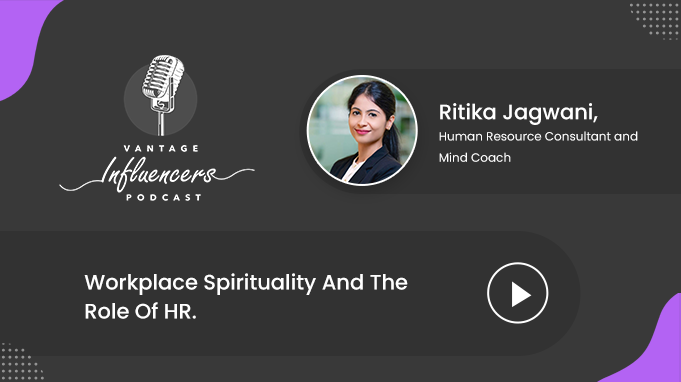
Workplace Spirituality And The Role Of HR
Episode Overview
Ritika Jagwani built her HR career over roughly six years, starting in India right after her master's degree, before relocating to Dubai after getting married and continuing her work there as an HR consultant and mind coach. In this conversation, she argues that workplace spirituality is not a trend imported from outside an organization: it flows directly from the organization's own culture, values, and policies, the same way parents shape the culture a child grows up in. HR, in her framing, acts as that parent figure, making sure an organization's stated values actually show up in daily decisions, especially in high-pressure moments when it would be easy for a company to drift away from them.
Her sharpest, most concrete point is the personal discipline she credits for staying composed under pressure: naming five things she is grateful for every single night before bed, even when the list repeats from day to day, because gratitude for health, family, and basic security retrains how a person reacts to uncertainty. She links this directly to what she calls corporate Nirvana, the calm, even-keeled state that separates employees who treat challenges as fuel for growth from those who crib no matter how supportive their environment is. She backs the argument with a real HR decision from her own workplace: when the organization needed pay cuts to survive, HR's job was to structure those cuts so junior employees were protected while the business stayed solvent, evidence, in her view, that spiritual values only count when they show up in actual policy.
Episode Highlights
- Ritika Jagwani frames workplace spirituality as flowing from an organization's own culture, values, and policies, not a trend borrowed from outside, with HR acting as the parent figure that keeps those values consistent daily.
- She cites a real example from her own workplace: HR structured pay cuts during a crisis so the business survived while junior-level employees stayed protected.
- Her personal gratitude practice, naming five things she's grateful for every night before bed, is the concrete habit she credits for staying calm under pressure.
- She contrasts employees who treat challenges with enthusiasm and get recognized for it against those who crib regardless of their environment, arguing the difference is inner state, not circumstance.
- She insists workplace spirituality is a development tool, not a passing trend, since trends fade while the human need for peace and meaning at work does not.
- She cites HR policies that exceed legal minimums, such as extended maternity leave, plus wellness activities and employee feedback loops, as tangible signs of it in practice.
About the Guest
Ritika Jagwani, HR Consultant & Mind Coach
Ritika Jagwani is a Human Resource Consultant and a mind coach based in Dubai, with a demonstrated history of working in MNCs, following roughly six years of HR experience that began in India right after her master's degree. She is passionate about people, credits a daily gratitude practice for keeping her calm under pressure, and believes that the backbone of any successful organization lies in strong human resources.
Connect with Ritika on LinkedIn
Host
Susmita Sarma, Vantage Influencers Podcast Host
What You Will Learn
- How to think about workplace spirituality as something rooted in an organization's own culture, values, and policies rather than an external trend
- Why HR functions as the "parent figure" that keeps an organization's stated values consistent in daily decisions, especially under pressure
- A real example of HR balancing pay cuts against protecting junior-level employees during a business crisis
- A simple nightly gratitude practice you can use to build the calm, composed mindset behind "corporate Nirvana"
- What separates employees who treat challenges as growth opportunities from those who stay dissatisfied regardless of their environment
- Concrete signs that a company is living out workplace spirituality, from parental leave policies that exceed legal minimums to employee feedback loops
Key Topics & Timestamps
| Timestamp | Topic |
|---|---|
| 01:35 | Ritika's HR career, from India to Dubai |
| 02:43 | Defining workplace spirituality and its link to individual spirituality |
| 04:41 | Key characteristics of a spiritual organization |
| 06:16 | Benefits of a spiritual workplace for employees and organizations |
| 06:57 | The role of HR in applying spirituality to workplace culture |
| 09:18 | Corporate Nirvana and the gratitude practice behind it |
| 13:51 | Is corporate Nirvana realistic under everyday work pressure |
| 15:10 | Workplace spirituality as a development tool, not a passing trend |
| 15:52 | Recent trends: leave policies, engagement activities, and employee feedback |
| 20:30 | The future outlook for workplace spirituality |
Full Transcript
Click to read the full episode transcript
Welcome to the Vantage HR Influencers Podcast. This podcast is sponsored by Vantage Circle, the leading employee benefits and engagement platform.
Susmita Sarma: Hello everyone, this is Susmita, and welcome to another episode of the Vantage HR Influencers Podcast. Workplace spirituality is not a new phenomenon. Businesses in the eighteenth and nineteenth centuries were established and run on loving and spiritual principles, but somehow, somewhere along the twentieth century, business and spirituality got separated. And that was because business then was more dominated by men, and as you all know, men are more into left-brain thinking. As a result, corporate houses were increasingly concerned with left-brain viewpoints, such as strategic planning, analytical thinking, reasoning, and profits. Today things are changing, and there is an influx of women in the corporate world, and with them they bring in their compassion, spirituality, love, and empathy, and all the aspects of the right-brain perspectives which are correlated with women. Thus, we can say that the rise of the modern, women-dominated corporate world has contributed to a more stabilized and spiritual workplace. And today we have a discussion on workplace spirituality and the role of HR. I am so glad to have Ms. Ritika Jagwani with me. Ritika Jagwani is a human resource consultant and a mind coach based in Dubai, with a demonstrated history of working in MNCs. She is passionate about people and believes that the backbone of any successful organization lies in strong human resources. Welcome to the show, Ritika.
Ritika Jagwani: Thank you so much for the kind introduction, Susmita.
Susmita Sarma: So before we start, please let us know a little about yourself and your journey in the corporate world.
Ritika Jagwani: Yes. I started my journey six years ago in India, right after I completed my master's. I had the privilege of being a part of some amazing organizations in India, and I moved to Dubai after I got married a little more than two years ago, where I started working with a corporate group there. My corporate journey has been enriching, with immense learning and growth so far. Being in HR, I feel it's day one every day, because you come across so many experiences being a part of this dynamic field that each day is a new learning, a new challenge, and I'm glad I'm able to contribute to that. I'm extremely passionate about this, and I find ways to improve myself and just make a meaningful difference every day.
Susmita Sarma: Right, okay, so great, Ritika. So coming to the topic, workplace spirituality and the role of HR. So Ritika, the first question that I would want to ask is, how do you define workplace spirituality?
Ritika Jagwani: So I think before we understand the concept of workplace spirituality, one should understand the concept of spirituality individually. So before I share my thoughts on the table, I would like to ask you, what do you think spirituality is?
Susmita Sarma: Okay, so according to me, as far as I can understand, spirituality is what connects us to our soul, or our inner life.
Ritika Jagwani: Yeah. So spirituality is basically nothing but being concerned with your own soul and detaching yourself from the material and physical things, in simple terms. So it's connecting within oneself and realizing what our true soul power is. All of us are on a journey in this world, and the very original form of every soul is love, peace, happiness, and positivity. But given the current world scenario, referring to a concept from Hindu philosophy describing an age when negative emotions like stress, anxiety, jealousy, and hatred are said to overpower the world, we need to come to a realization of self-consciousness, of who we are, and to act and implement that in our everyday life by being the original form of the love, peace, and positivity that we are. That is what spirituality is. And workplace spirituality is as simple as living those spiritual values in the workplace and in the corporate world. It merely means finding meaning and purpose in what we are doing and connecting with one another. It is when both mind and soul are in sync, and we find passion in what we do. It's something very intangible. It can only be felt.
Susmita Sarma: Okay, so what are some of the key characteristics that spiritual organizations have?
Ritika Jagwani: I believe that workplace spirituality flows in the form of an organization's culture, values, and policies. It comes from the very roots of the organization. This could still be debatable, but in simple terms, the characteristics could be the values and beliefs of the organization: why the organization exists, and what its main aim is to contribute to this world. It's about having the awareness that the organization's culture understands that every employee is different, with different belief systems, emotions, and moods, and it gives them the environment to express themselves freely and openly, to accept one another and respect one another, because we all come from different backgrounds, so our emotions and everything about us is different. Coming to the fact that every person is unique, and accepting the person the way they are, is one of the characteristics. Among the others, there would be the organization promoting and fostering growth, and of course it's a two-way street: the employees also expect the same from the organization, and the organization expects the same from the employee, to grow together. Trust and interconnectedness matter, and very importantly, the policies of the organization, because what you believe has to be put in the form of policies for everybody to follow. And I think the last one would be compassion, for sure.
Susmita Sarma: So can you talk about the benefits of a spiritual workplace, along the same lines?
Ritika Jagwani: Yeah, exactly. So the benefits go both ways. Like I said, it's a two-way street. I come to the organization, I get an open environment, and I'm contributing, I'm learning new things, I'm wanting to grow, and of course that results in the growth of the organization as well. So the application of spirituality in the workplace is very much in line with newly emerging perspectives on good HR management practices.
Susmita Sarma: What is the role of HR in applying spirituality in the workplace?
Ritika Jagwani: The role of HR is very important in this. The culture is created at the very roots, as we discussed earlier, so HR acts like a promoter of this culture. In a house there are parent figures, they inculcate culture and values and bring us up. Similarly, I strongly feel that HR acts as a promoter of this culture, and acts like that same parent figure in the company, ensuring that the culture and values flow naturally in the day-to-day work. And especially in these unprecedented times, it is very easy for anyone to drift away, because everybody is going through a high level of emotions, and the world is experiencing a new normal, which is a drastic change. So HR plays a very important role in creating a balance between both sides of the table. It supports the organization as well as the employees, and creates a balanced work environment. I want to share an example I experienced myself in the past few months. In the company, when the whole world was going through this change, and companies across the world were laying off people and cutting salaries, the role HR played, and I think it made a bit of a difference, was creating a balance around this pay cut. We had to save the organization, meaning the money, by doing this pay cut so the organization could survive, and on the other side of the table, we had to ensure that the junior-level employees were not impacted as much, that they were able to sustain themselves, and we wanted to put them at ease and in comfort. So we structured the pay cuts in a way that created a balance: it saved money for the organization, and it also ensured that the rights of the junior-level employees were secured. So that's the value HR brings to the table.
Susmita Sarma: Okay, so I came across this term called corporate Nirvana. Is it the same as workplace spirituality, or is it something different?
Ritika Jagwani: I think, yes, you can say it is the same. Nirvana is the highest state of mind, of being peaceful and calm. You're not worried about anything whatsoever, and you're absolutely composed, calm, and in your best possible peace of mind. So you come across two kinds of people in organizations. If you walk into an organization, just to give you an example, you'll see two kinds of people. The ones who are really happy, enthusiastic, outgoing, and you give them challenges, come what may, they'll face it with a lot of zeal and enthusiasm and overcome it, and they're the same kind of people who will get promotions, will be rewarded, will be recognized, and who'll be like the stars of the organization. And the other kind of people are the ones you'll always see sad, always cribbing, even if the organization is supporting them and giving them the leverage and exposure to do whatever they want, they will still find ways to crib and cry, and they're just not happy. So these are the two different kinds of people that we see in any typical organization. But have you ever wondered why that difference exists? It's the same culture, it's the same organization, everybody is being treated fairly, so why is it that two people can be so different from each other?
Susmita Sarma: Maybe because... yeah, go ahead.
Ritika Jagwani: Maybe because they are not enjoying what they do, even when they are given the opportunity, that could be one thing. But honestly, I feel it comes from the core values that the person brings to the table. If I'm happy, I'll be happy in any place, and I'll enjoy it. Even if the work given to me is something I'm not enjoying, I'll take it on as a challenge and convert it into something that will benefit the company, and I will experience joy in that. So the positive ones are the ones who practice spirituality, they are calm and happy in any working condition.
Susmita Sarma: Exactly, exactly, exactly.
Ritika Jagwani: Yeah, so they're peaceful, calm, and they respond to every situation with a cool mind. For every human being it's very natural that when something uncertain happens, we react, we immediately create a thought and then we react, and there are repercussions to that. We don't calmly think through the possible solutions or outcomes in ways that we can overcome that situation. The only instant response for any normal individual is an instant reaction, which is not right. So the positive ones start their day with positivity, they practice gratitude and positive affirmation. I'm a firm believer in practicing gratitude, so every night, personally, when I go to bed, I name five things that I'm grateful for. They can be very basic, and they can be the same every day, because it's a privilege to have those things, like health: you can fall sick anytime, but I'm healthy today, so that's one blessing for me. I have a very supportive family who allows me to follow my dreams, who are supportive and there for me. I have a house, I have basic necessities, and the list can differ from person to person. So you have to be grateful for those five things, and end your day with gratitude, and also start your day with gratitude, because you might not get up the next day, so always be thankful for being given that additional day, so that you can contribute and make a meaningful difference. So gratitude is one thing that I practice every day, and that's what positive people also do, and that's how they overcome all the possible situations that come across in life. It's nothing but the state of mind: you experience and get what you think.
Susmita Sarma: One thing I would like to ask you: there's immense competition today in the business world, every employee is under work pressure, and everyone has to perform well. Under that condition, is corporate Nirvana a practical thing?
Ritika Jagwani: Well, absolutely, I will still support the fact, because everything flows from what your thought is. So every morning, the simple tip is: get up a little early, practice gratitude and positive affirmation, give time to yourself, go for a morning walk, stand in front of the mirror, do some positive talking to your own self, tell yourself that you're a fighter and you can do it, and all the positive words you say to yourself basically train your mind to get into that zone. And when you go out into the corporate world, it would seem like a piece of cake to accomplish all the tasks given to you. So yeah, and honestly, I have experienced that myself, and it really works.
Susmita Sarma: Okay, great, I think I'll try that too.
Ritika Jagwani: You should.
Susmita Sarma: So knowing all the benefits, would you like to call workplace spirituality a development tool, or a trend with growing interest?
Ritika Jagwani: It is a development tool, for sure, because when we say trends, trends come and go, they fade away at some point. Spirituality is something that each one of us has inside us, so we just need to make some effort and explore the untapped side of our own self that we've not explored. We have to understand that each one of us wants to be at peace, wants to be happy, that's our original call. So it's definitely a development tool.
Susmita Sarma: Okay, so how are various Indian companies reaching out to workplace spirituality? Are there any recent trends you would like to share?
Ritika Jagwani: Since workplace spirituality does not have a specific definition, we can notice this being followed by companies around the globe in the form of excellent HR policies that support and go beyond the required laws. For example, as per the law here, on the maternity side, a woman is allowed forty-five calendar days of maternity leave, but many organizations are recognizing that and going beyond the law, giving extra leave days to women employees and supporting them, and similarly for other leaves. So anything you're doing beyond and above the law, and supporting your workforce, comes in the form of workplace spirituality, valuing one another. And one more important point that indirectly flows from this is employee engagement activities that contribute to work-life balance, connect people with one another, and also support the development of people in an indirect form. It's very intangible, and it's like an investment that can only be seen over a period of time. So companies over the years have started contributing in the fitness area, doing various kinds of activities such as indoor and outdoor sports tournaments, marathons, yoga, and meditation sessions, and things like that. And instead of working one way and following the traditional top-down approach, companies are also extensively taking surveys, doing internal and external feedback, and working on building and creating value and a better experience. Basically, they want to hear from others how they can improve, rather than just following their own stereotypes. And if you allow me, I would also like to highlight and thank Vantage Circle for their contribution in the employee engagement field. I strongly feel that the company is doing some amazing work and making a lot of difference out there. I've noticed that it's an awesome amalgamation of great initiatives such as rewards and recognitions, perks and benefits, and employee feedback, it's just like a one-stop solution that you guys are offering, and I really like the idea behind it. I've also been a part of, and seen, organizations ignore these things and find it so irrelevant, thinking it doesn't matter if we do all of this, what difference does it make. But I'm actually happy to see that Vantage Circle is working towards all of this and giving a platform for people to invest in these kinds of activities. And most importantly, on the fitness side, I completely believe that the health of employees is a very important factor that directly affects their work, because when you're healthy and active, your mind also functions that way. So the solution you offer goes beyond the traditional sort of effort, like giving gym memberships and doing a one-day activity. It's a solution I really believe in, and you're actually supporting organizations and HR professionals by giving them a platform for these kinds of engagement activities.
Susmita Sarma: Yeah, I do believe that health and fitness, and now, considering the current situation, has become really important in the workplace.
Ritika Jagwani: Yeah, absolutely. So traditional HR has been looked upon as just doing things like Rangoli competitions and celebrations at the end of the month, and people think that's the role of HR. But this solution actually gives HR people and organizations a way to make a real difference in their employees' lives.
Susmita Sarma: So I really admire the work you're putting in, thank you so much. So the last question is, does workplace spirituality have a future?
Ritika Jagwani: It has always existed, and given the current times, it will only get better in the future. Companies are realizing it sooner, and the year 2020 has made us more considerate of one another. To put it simply, employees are realizing how much companies are struggling to even survive, and they're giving their best, working long hours, supporting fellow colleagues without any expectations, because they just want to be there for the company. And similarly, on the other side of the table, companies are realizing this too, they want to do their bit by supporting their employees, providing flexibility, giving them more engagement, and providing coaching sessions, given the current situation, to ensure that employees are at ease and contributing to the best of their abilities. So compassion and empathy are at their peak these days.
Susmita Sarma: Thank you so much, Ritika, for all the insights. Lastly, can you tell us how a business can reach out to you?
Ritika Jagwani: Yes, they can reach out to me on my LinkedIn profile, my name is Ritika Jagwani on LinkedIn, and if they want, they can also drop me a note by email.
Susmita Sarma: Okay, it was great to have you with us, Ritika, thanks for joining.
Ritika Jagwani: Thank you so much, thank you.
Thanks for listening to the Vantage HR Influencers Podcast. Do subscribe to the Vantage HR Influencers Podcast on Apple Podcasts and Spotify for new episodes.
FAQ
What does Ritika Jagwani mean by "workplace spirituality"?
She defines it as living spiritual values inside the workplace: finding meaning and purpose in the work itself and connecting genuinely with colleagues, rather than importing a concept from outside the organization. In her framing, it flows from the organization's own culture, values, and policies, with HR acting as the promoter that keeps those values consistent day to day.
What is "corporate Nirvana," and how does Ritika Jagwani build it herself?
She describes corporate Nirvana as the highest state of calm and peace of mind, the quality that separates employees who face challenges with enthusiasm from those who stay dissatisfied no matter how supportive their environment is. Her own practice for building it is a nightly gratitude ritual: naming five things she is grateful for before bed, even when the list repeats, alongside starting the day with positive affirmations and a morning walk.
What role does HR play in workplace spirituality, according to Ritika Jagwani?
She compares HR to a parent figure that keeps an organization's culture and values flowing naturally into daily work, especially during high-pressure periods when it would be easy to drift from them. She points to a real example from her own workplace, where HR structured pay cuts during a crisis so the business stayed solvent while junior-level employees were protected as much as possible.
Does Ritika Jagwani think workplace spirituality is just a passing trend?
No, she argues it is a development tool rather than a trend, since trends fade over time while the human need for peace and meaning at work does not. She points to concrete signs of it in practice, such as HR policies that go beyond legal minimums and employee engagement activities that support wellbeing over the long term.
Related Reading
Also listen on