A training effectiveness survey measures whether a training program changed what people know and do on the job, not just whether they enjoyed it. This guide gives you 100 employee training survey questions by category, a copy-ready 10-question template, the four Kirkpatrick levels to measure, and when to send each survey.
Most training gets judged on two numbers: how many people attended, and how they rated it on the way out. Neither tells you whether anyone is doing the job better a month later. A training effectiveness survey closes that gap by asking learners the right questions at the right time, so you can see what actually transferred to the work.
The stakes keep rising. Employers expect 44% of workers' core skills to be disrupted within five years, according to the World Economic Forum. Training is how people keep up, but only if it works, and a good survey is how you know whether it did.
Key Takeaways
- Use the 100 questions below, grouped into 8 categories, or copy the ready-made 10-question template to launch a survey in minutes.
- A training effectiveness survey measures whether learning changed what people do on the job, not just whether they liked the session.
- The Kirkpatrick model's four levels (reaction, learning, behavior, results) decide what to measure and when.
- Send more than one survey: a short one right after the session, then 30-day and 90-day follow-ups, with an optional baseline before.
- Keep each survey to 10 to 20 questions, mix Likert, multiple-choice, and open-ended formats, and act on what you find.
100 employee training survey questions

Below is a categorized list of 100 copy-ready training survey questions for employees, spanning quick post-training feedback questions, deeper effectiveness items, and learning-and-development checks. They adapt just as well to coaching effectiveness surveys and workshop evaluations. Each includes a recommended format so you can drop them straight into your next survey or poll. Match the format to the kind of answer you need.
| Format | Best for | Example |
|---|---|---|
| Likert (5-point agreement) | Opinions and trends you track over time | "The training met my expectations." |
| Multiple-choice | A single clear rating or priority | "Overall, how would you rate this training?" |
| Yes/No | Quick checks | "Would you recommend this training to a colleague?" |
| Open-ended | The "why" behind the scores | "What could be improved for future sessions?" |
1. Overall Experience (10 questions)
- The training met my expectations. (Likert)
- I found the training relevant to my role. (Likert)
- The length of the training was appropriate. (Likert)
- I was able to stay engaged throughout the session. (Likert)
- The training was well-organized. (Likert)
- Would you recommend this training to a colleague? (Yes/No)
- How would you rate your overall satisfaction with this training? (Multiple-choice: Excellent / Good / Fair / Poor)
- The session was worth the time I invested. (Likert)
- What did you like most about this training? (Open-ended)
- What could be improved for future sessions? (Open-ended)
2. Learning Objectives (10 questions)
- The learning objectives were clearly stated. (Likert)
- The training objectives were met. (Likert)
- I understood how the content connected to the objectives. (Likert)
- The training addressed the skills I need in my job. (Likert)
- The learning objectives matched the pre-training communication. (Likert)
- Which objectives were most valuable to you? (Open-ended)
- Were there any objectives you felt were missing? (Open-ended)
- How confident are you in applying what you learned? (Multiple-choice: Very confident → Not at all confident)
- The objectives were realistic and achievable. (Likert)
- What additional skills would you like to see covered in future training? (Open-ended)
3. Content Quality (15 questions)
- The training materials were clear and easy to understand. (Likert)
- The content matched my expectations. (Likert)
- The examples provided were relevant to my work. (Likert)
- The balance between theory and practice was appropriate. (Likert)
- The case studies or examples helped me learn. (Likert)
- How well did the content match your skill level? (Multiple-choice)
- The content was up to date. (Likert)
- The amount of information presented was manageable. (Likert)
- The content avoided unnecessary jargon. (Likert)
- How would you rate the usefulness of the content overall? (Multiple-choice)
- The training deepened my knowledge of the topic. (Likert)
- The training addressed real-world challenges. (Likert)
- Which content areas were most helpful to you? (Open-ended)
- Which content areas were least helpful? (Open-ended)
- What additional content should be included? (Open-ended)
4. Trainer/Facilitator (10 questions)
- The trainer explained concepts clearly. (Likert)
- The trainer was knowledgeable about the subject. (Likert)
- The trainer encouraged participation. (Likert)
- The trainer handled questions effectively. (Likert)
- The trainer kept the session engaging. (Likert)
- How approachable was the trainer? (Multiple-choice)
- The trainer used real-world examples effectively. (Likert)
- The trainer managed time well. (Likert)
- The trainer created an inclusive learning environment. (Likert)
- Any feedback for the trainer? (Open-ended)
5. Delivery & Format (15 questions)
- The training platform or room was easy to navigate. (Likert)
- The pace of delivery was appropriate. (Likert)
- The session format (online/in-person) worked well. (Likert)
- Technical issues were minimal. (Likert)
- The training allowed for interaction and discussion. (Likert)
- The visuals (slides, handouts) were clear. (Likert)
- The audio quality was clear. (Likert)
- Breaks were well-timed. (Likert)
- Which delivery method did you prefer? (Multiple-choice)
- How comfortable were you using the platform? (Likert)
- The delivery supported different learning styles. (Likert)
- The training was accessible (captions, transcripts, etc.). (Likert)
- What challenges did you face during delivery? (Open-ended)
- How could the delivery be improved? (Open-ended)
- Would you prefer a different delivery method in the future? (Multiple-choice)
6. Application & Impact (20 questions)
- I can apply what I learned immediately. (Likert)
- The training will help me perform better at work. (Likert)
- The training improved my confidence in the topic. (Likert)
- The training will positively impact my team. (Likert)
- The training supports my career development. (Likert)
- The training addressed real challenges I face at work. (Likert)
- I can already identify ways to use the training. (Likert)
- This training will help reduce errors or mistakes. (Likert)
- This training will improve customer outcomes. (Likert)
- How likely are you to use the new skills within 30 days? (Multiple-choice)
- The training filled a critical knowledge gap. (Likert)
- The training reinforced skills I already had. (Likert)
- What specific tasks will you apply this training to? (Open-ended)
- What challenges might stop you from applying it? (Open-ended)
- How can the company support you in applying it? (Open-ended)
- Did you discuss applying this training with your manager? (Yes/No)
- Do you need follow-up support? (Yes/No)
- What kind of support would help you apply the training? (Open-ended)
- Do you see this training affecting your long-term growth? (Yes/No/Unsure)
- The training will contribute to organizational goals. (Likert)
7. Accessibility & Inclusion (10 questions)
- The training was accessible to all participants. (Likert)
- I was able to fully participate without barriers. (Likert)
- The training considered diverse perspectives. (Likert)
- Accessibility features (captions, transcripts) were helpful. (Likert)
- The training environment was inclusive. (Likert)
- Were you able to request accommodations if needed? (Yes/No)
- The materials were easy to read and understand. (Likert)
- I felt respected during the session. (Likert)
- What could make the training more inclusive? (Open-ended)
- What accessibility supports were most valuable to you? (Open-ended)
8. Open Feedback (10 questions)
- What was the most valuable part of this training? (Open-ended)
- What was the least valuable part? (Open-ended)
- Did the training meet your expectations overall? (Yes/No)
- How could we improve this training for the future? (Open-ended)
- Was the timing of the training convenient? (Yes/No)
- If you could change one thing, what would it be? (Open-ended)
- Would you like more advanced training on this topic? (Yes/No)
- Are there other topics you'd like training on? (Open-ended)
- Any final comments or suggestions? (Open-ended)
- Overall, how would you rate this training? (Multiple-choice: Excellent → Poor)
A ready-to-use 10-question training survey template
Short on time? Start here. These 10 questions cover reaction, learning, and intended application in under three minutes, which keeps response rates high. Use them as a ready-made employee training survey questionnaire, an end-of-training feedback form, or a quick post-training poll.
- The training met my expectations. (Likert)
- The content was relevant to my role. (Likert)
- The objectives were clear and were met. (Likert)
- The trainer explained concepts clearly. (Likert)
- The pace and format worked well for me. (Likert)
- I can apply what I learned in my job. (Likert)
- How confident are you using these skills now? (Multiple-choice: Very confident → Not at all confident)
- Would you recommend this training to a colleague? (Yes/No)
- What was the most valuable part of this training? (Open-ended)
- What would you change for next time? (Open-ended)
You can load these into a tool like Vantage Pulse for anonymous responses, instant analytics, and clear insights you can share with leadership. If you also run broader listening programs, the employee engagement survey questions bank covers those formats in full.
What is an employee training survey?

A training effectiveness survey is a structured feedback tool used to understand whether a learning program achieved its goals. It goes past asking if people "liked" the training and measures whether the content was relevant, the delivery was clear, and whether learners feel confident applying what they learned on the job.
The most widely referenced framework here is the Kirkpatrick Model of Training Evaluation, created by Donald Kirkpatrick. It organizes training evaluation into four levels, and each one maps to a different kind of survey question.
| Level | What it measures | Example question |
|---|---|---|
| 1. Reaction | Did participants find the training engaging, useful, and worth their time? | "The session was worth the time I invested." |
| 2. Learning | Did they acquire the intended knowledge, skills, or attitudes? | "I can explain the key concepts the training covered." |
| 3. Behavior | Are they using those skills in their day-to-day work? | "I have applied what I learned in my role." |
| 4. Results | Did the training affect business outcomes like quality, safety, or productivity? | "My output or work quality improved after the training." |
Post-training surveys usually focus on the first two levels, Reaction and Learning. They also set up the measurement of Behavior and Results through follow-ups, manager feedback, and performance data, which makes them the starting point for proving ROI and improving programs over time.
When to send training surveys
Do not rely on a single survey at the end of the session. A short baseline before, a reaction survey right after, and two follow-ups tell you far more than one form ever could. Each point answers a different question.
| When to send | What it measures | Kirkpatrick level |
|---|---|---|
| Before training (baseline) | Existing skill level and expectations | Pre-assessment |
| Immediately after | Reaction and perceived learning | Reaction, Learning |
| 30 days after | Early on-the-job application | Behavior |
| 90 days after | Sustained behavior change and results | Behavior, Results |
New-hire training often overlaps with the first months on the job, so pair these with your employee onboarding survey questions to track learning and ramp-up together.
Benefits of running training surveys
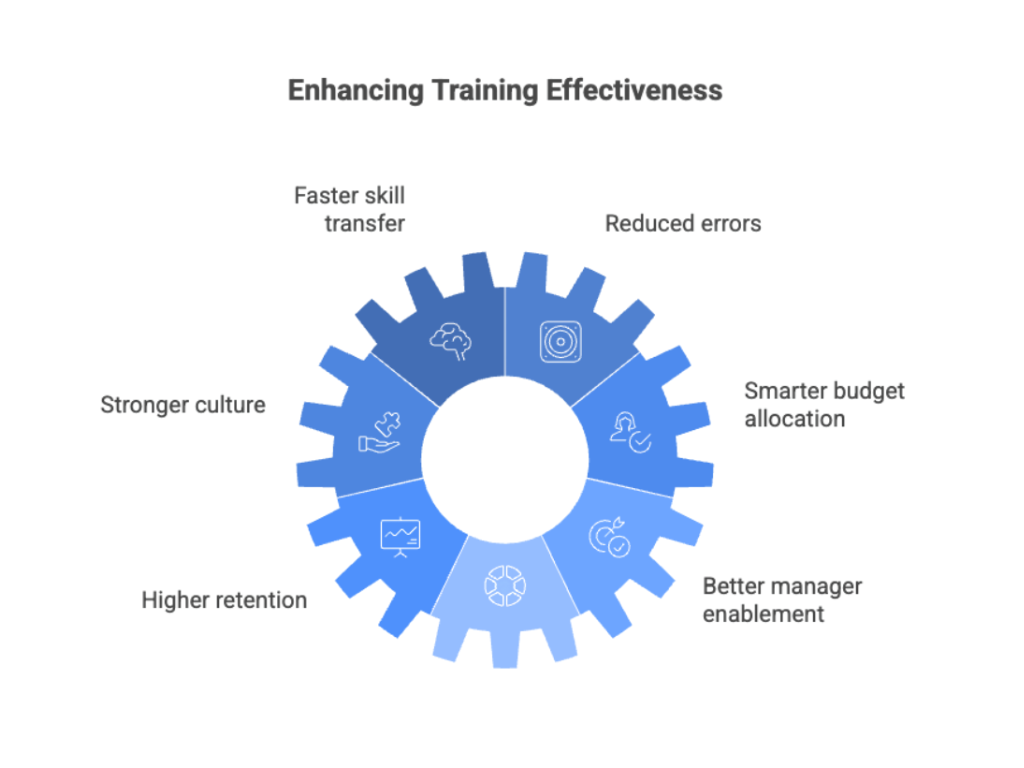
1. Faster skill transfer and measurable performance gains
The sooner employees can apply what they learned, the sooner the business sees value. Post-training surveys uncover the sticking points, like a workflow step that was not clear or too little practice time. Fixing those issues means employees use the skill right away rather than weeks later.
Adding a checklist or short practice block after a confusing module can cut "time-to-first-use" sharply, so productivity gains show up within days instead of months.
2. Reduced errors, rework, and compliance risks
When learners flag confusing instructions or unrealistic examples, you get an early warning for mistakes that would otherwise show up in operations. Adjusting the content or adding practical job aids reduces costly rework and helps employees perform tasks correctly the first time. It also lowers safety and compliance risk, which regulators such as OSHA treat as part of effective training and evaluation.
3. Stronger culture of safety and accountability
Surveys confirm whether employees actually understand how to respond to real scenarios, not just classroom exercises. If gaps appear, training teams can revise modules to reflect real-world risks. This loop matters most in industries where safety and compliance are non-negotiable. It also signals that the organization is serious about equipping people to do their jobs safely.
4. Smarter budget allocation
Most organizations spend heavily on learning every year, but not all programs deliver equal value. By comparing survey responses across cohorts, formats, or instructors, HR and L&D leaders can see which investments pay off. High-impact courses get scaled, and low-performing ones get improved or retired, so the budget goes to programs that actually improve business outcomes.
5. Higher retention by supporting growth
Employees stay longer when they feel the company is investing in their growth and giving them tools to succeed. Surveys provide evidence that feedback is heard and acted on, which makes training more relevant to daily work. Replacing an employee can cost between one-half and two times their annual salary, according to Gallup, so reducing turnover through better training has a direct financial payoff.
6. Better manager enablement
A common barrier to applying new skills is lack of manager support: no time to practice, no system access, or no reinforcement in one-on-ones. Surveys surface these issues quickly, so HR can involve managers in clearing obstacles. That tightens the link between learning and on-the-job coaching, so new skills become part of daily work instead of fading.
Best practices
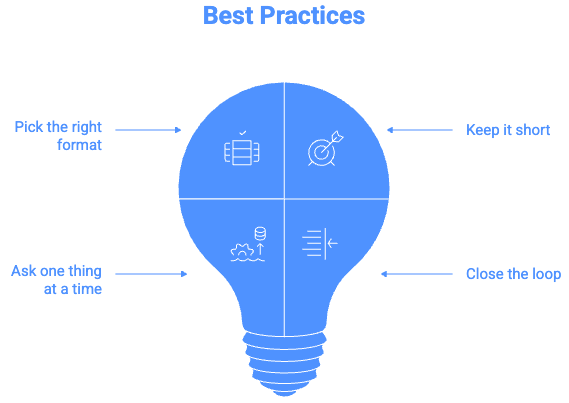
- Keep it short. Aim for 10 to 20 questions. Longer surveys turn people off and reduce response quality. (Pew Research Center)
- Pick the right format. Use agreement scales for opinions, single-choice when you want a clear priority, multiple-choice to capture all blockers, yes/no for quick checks, and open-ended for detail.
- Ask one thing at a time. Avoid combining two ideas in one question, and make sure every question has an owner who can act on it (trainer, content designer, or HR admin).
- Close the loop. Share back within two weeks: what you heard, what you are changing, and when people will see updates. Reading the open-ended employee sentiment responses is where the real fixes usually hide, and acting on them is what builds trust for the next survey.
If you want feedback to be continuous rather than one-off, short recurring pulse surveys keep a read on how training and engagement shift over time.
Conclusion
A strong set of training survey questions turns learner feedback into next-week decisions. Keep your survey short, choose formats that fit the decisions you need, and include a few items on confidence and intent so you can act fast. Share what is changing, then compare the next cohorts to confirm impact. Use the 100 questions and the template above to build your survey in minutes and turn feedback into momentum, one course at a time.
FAQs
1. What is a training effectiveness survey?
A training effectiveness survey is a structured set of questions that measures whether a training program achieved its goals. It captures whether the content was relevant, the delivery was clear, and whether learners can apply the skills on the job, going beyond a simple satisfaction rating.
2. How many questions should a training survey have?
Aim for 10 to 20 questions. That is enough to cover reaction, learning, and intended application without fatiguing respondents. Longer surveys lower completion rates and bias the sample toward people who are already disengaged.
3. What is the Kirkpatrick model of training evaluation?
The Kirkpatrick model is a four-level framework for evaluating training: Reaction (did people find it useful), Learning (did they gain the knowledge or skills), Behavior (are they using it on the job), and Results (did it affect business outcomes). Most post-training surveys measure the first two levels and set up the rest with follow-ups.
4. When should you send a post-training survey?
Send a short reaction survey immediately after the session, while it is fresh, then follow up at 30 and 90 days to measure on-the-job application and lasting results. A baseline survey before the training is also useful for measuring the change.
5. What is the difference between a training effectiveness survey and a training feedback form?
A feedback form usually captures immediate reactions, such as whether people enjoyed the session. A training effectiveness survey goes further and measures whether learning transferred into changed behavior and business results over time.
6. What question formats work best for training surveys?
Use a mix. Likert agreement scales track opinions and trends, multiple-choice captures a clear rating or priority, yes/no handles quick checks, and open-ended questions surface the reasons behind the scores. Combining them gives you both measurable data and context.
7. What questions should you ask after a training session?
Right after a session, ask end-of-training feedback questions focused on reaction and perceived learning: whether the training met expectations, was relevant to the role, was well delivered, and whether the person feels ready to apply it. Keep this round short, then save behavior and results questions for your 30-day and 90-day follow-ups.

People, culture, and what makes employees genuinely engaged, I write about it all, with practical insights HR teams can actually use.
Connect with Sahil on LinkedIn.