
Workplace transparency is the practice of openly sharing company goals, decisions, financial performance, and feedback processes with employees to build trust, boost engagement, and improve organizational performance. It requires four elements to function: open communication channels, accountability for decisions, safe feedback mechanisms, and recognition of transparent behaviors.
Key Takeaways
- Transparency is purposeful, not total disclosure: Share information that helps employees act with confidence; protect sensitive personnel and legal matters.
- Four pillars sustain it: Communication, accountability, feedback mechanisms, and recognition must all be present — removing one weakens the entire structure.
- Gen Z expects it as baseline: 85% of Gen Z workers want employers to be open about how decisions are made, making transparency a retention issue.
- It is measurable: Track trust scores, information clarity ratings, and eNPS to verify transparency efforts are working.
- Recognition reinforces it: Celebrating managers who explain difficult decisions signals that openness is a valued cultural norm.
Workplace Transparency at a Glance
| Aspect | Detail |
|---|---|
| Definition | Purposeful openness that removes ambiguity and replaces rumor with fact |
| Key Benefits | Higher trust, better engagement, lower turnover, stronger alignment |
| Four Pillars | Communication, Accountability, Feedback, Recognition |
| Common Challenges | Over-sharing anxiety, leadership resistance, inconsistent execution |
| Best For | HR leaders, executives, and managers building high-trust cultures |
Who Should Read This
This guide is for HR leaders, executives, and people managers who want to build a high-trust workplace culture. If you're rolling out an engagement initiative or struggling with rumor-driven disengagement, you'll find a practical 4-pillar framework and measurement tools here.
1. What Is Transparency in the Workplace?
1.1 Definition and Core Meaning
Transparency in the workplace means employees have access to the information they need to understand organizational direction, decisions, and expectations. It is not unlimited information sharing. It is purposeful openness that removes ambiguity and replaces rumor with fact. When leaders explain the reasoning behind decisions, when feedback flows in both directions, and when goals are visible across teams, employees can align their work with organizational priorities and contribute more effectively.
1.2 Why It Matters Now
Transparency has become a non-negotiable expectation in the post-pandemic workplace. Gallup's 2024 State of the Global Workplace report found that only 23% of employees worldwide are engaged at work, with communication clarity among the top cited factors for disengagement. Gen Z employees, who now make up a growing share of the workforce, expect transparency from leadership as a baseline. LinkedIn's 2023 Workforce Insights report found that 85% of Gen Z workers say they want their employer to be open about how decisions are made. Organizations that meet this expectation retain talent. Those that do not face higher turnover and lower productivity.
1.3 Transparency vs. Over-Sharing
Transparency does not mean sharing everything. Leaders have a responsibility to protect sensitive information, including pending legal matters, confidential negotiations, and individual performance data. The distinction is intent: transparency is about removing ambiguity on matters that affect employees' ability to do their jobs well. Over-sharing creates anxiety. The boundary is defined by relevance: share information that helps employees act with confidence; protect information that could harm individuals or the organization.
| What Transparency Includes | What It Does NOT Mean | Why This Boundary Matters |
|---|---|---|
| Sharing company goals and strategy | Disclosing confidential personnel matters | Protects trust by keeping shared information relevant |
| Explaining the "why" behind key decisions | Revealing unresolved legal or financial risks | Prevents anxiety from premature disclosure |
| Publishing team and org-wide performance metrics | Sharing individual salary figures without HR governance | Maintains fairness and avoids decontextualized comparisons |
| Creating open channels for upward feedback | Making every decision by committee | Preserves leadership authority while inviting input |
| Communicating status updates on change initiatives | Oversharing problems without actionable solutions | Ensures transparency informs rather than overwhelms |
Related: 6 Practices To Ensure Trust In The Workplace With Employee Engagement Initiatives
2. The 4 Pillars of Workplace Transparency
Organizations that sustain transparency over time build it on four interdependent pillars. Removing any one of them weakens the entire structure.
2.1 Pillar 1: Communication
Information flows deliberately, consistently, and across levels. This means scheduled all-hands meetings, published decision logs, and clear escalation paths. Communication transparency is not a one-time event. It is a cadence. Leaders commit to sharing updates at predictable intervals, employees know where to find information, and no team operates in an information vacuum.

2.2 Pillar 2: Accountability
Decisions have visible owners. When a strategic direction shifts, employees know who made the decision, what information was considered, and what outcome is expected. Accountability transparency prevents the "it was decided somewhere" culture that breeds disengagement. It positions leaders as responsible stewards of the organization rather than distant decision-makers.
Related: Accountability in the Workplace: The Foundation of High-Performance Culture
2.3 Pillar 3: Feedback Mechanisms
Employees need safe, structured channels to share honest input. This includes anonymous pulse surveys, structured 360-degree feedback, and open-door policies with documented follow-through. Without feedback channels, transparency is one-directional: information flows down but not up. Real transparency is bilateral. Organizations that create safe channels for honest feedback identify problems before they become culture failures.
2.4 Pillar 4: Recognition and Reinforcement
Transparent behaviors must be celebrated to become cultural norms. When a manager publicly explains the reasoning behind a difficult decision, recognize that behavior. When a team shares a failure and what they learned from it, highlight it. Recognition tied to transparent behavior signals to the entire organization that openness is valued and expected.
| Pillar | Key Actions | Measurement via Vantage Tools |
|---|---|---|
| Communication | All-hands cadence, published decision logs, visible goals | Vantage Pulse: engagement survey on information clarity |
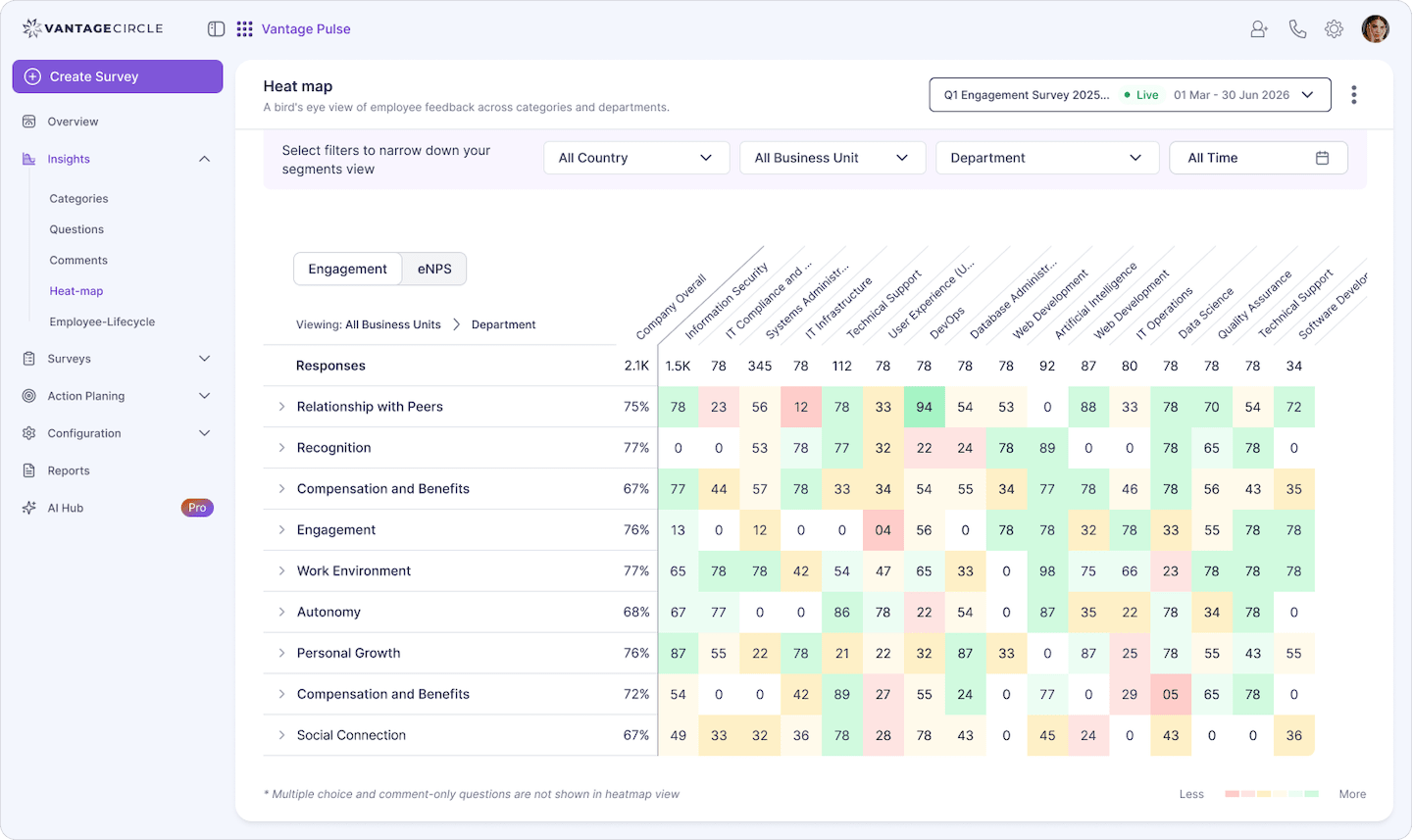
| Accountability | Decision ownership records, strategy visibility | Vantage Pulse: department-wise trust score breakdown |
| Feedback Mechanisms | Anonymous surveys, 360-degree feedback, open-door policy | Vantage Pulse: eNPS, anonymous response channels |
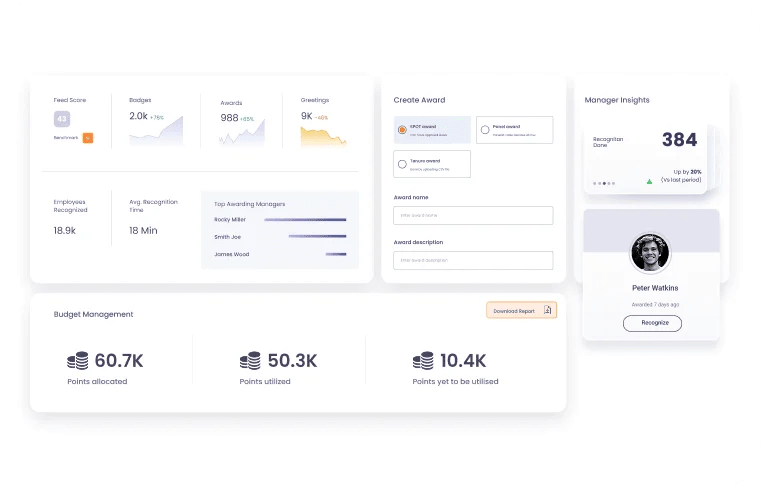
| Recognition & Reinforcement | Real-time peer recognition, values-based awards | Vantage Rewards: core values alignment, social recognition feed |
3. The Business Case: Key Benefits of Transparency
Transparency in the workplace is not a values statement. It is a performance strategy with measurable financial outcomes.
3.1 Builds Trust and Reduces Rumors
Trust is the foundation of high-performing teams. When leaders communicate openly, employees stop filling information gaps with speculation. Trust reduces the cost of alignment. Teams that trust their leadership spend less time in clarification cycles and more time on productive work.
3.2 Boosts Employee Engagement and Retention
Transparent organizations report significantly higher engagement scores. Harvard Business Review's 2013 employee engagement survey found that 70% of employees are most engaged when senior leadership continuously communicates company strategy. Engaged employees are far less likely to seek new roles.
Related: The Ultimate Guide to Employee Engagement
3.3 Improves Performance and Goal Alignment
Employees who understand organizational goals align their daily work to broader outcomes. When team objectives, key results, and performance metrics are visible, employees prioritize without constant manager check-ins. This creates a self-directing workforce that operates with clarity.
3.4 Drives Higher Profitability
The financial case for transparency is direct. According to Forbes (2023), organizations with high transparency report 21% higher profit margins than their less transparent counterparts. Transparency reduces wasted effort, improves decision quality, and accelerates organizational learning. Each of these outcomes contributes directly to the bottom line.
According to Forbes (2023), organizations with high workplace transparency report 21% higher profit margins than their peers. Transparency is not just a culture initiative. It is a measurable performance advantage.
3.5 Strengthens Employer Brand and Recruitment
Candidates research culture before accepting offers. Organizations known for transparent leadership attract stronger applicant pools and close offers faster. Glassdoor's 2023 Workplace Transparency Survey found that 96% of job seekers cite company culture as a key factor in their decision to apply.
4. How to Implement Transparency: A Step-by-Step Roadmap
Declaring "we value transparency" without a system to support it produces nothing. These six steps build transparency from the ground up.
Step 1: Assess Your Current State
Start with a transparency audit. Survey employees on how informed they feel about organizational direction, how safe they feel sharing honest feedback, and how visible leadership decisions are. Use eNPS as your baseline metric. Without a starting point, progress cannot be measured.
Baseline your transparency perception using anonymized eNPS surveys. eNPS asks employees how likely they are to recommend the organization as a great place to work, a trusted proxy for perceived transparency and organizational trust. Track scores quarterly and benchmark against industry norms to set your improvement target.
Step 2: Define What to Share
Not all information is appropriate for all audiences. Create a governance framework that classifies information by audience and timing: what leadership shares at all-hands meetings, what managers share with their teams, and what remains confidential. Clarity on these boundaries prevents both over-sharing and information hoarding.
Step 3: Establish a Communication Cadence
Set predictable rhythms for information sharing. Monthly all-hands meetings, weekly team standups with published notes, quarterly strategy updates, and post-decision communications form the minimum infrastructure for a transparent organization. Predictability reduces anxiety. Employees who know when to expect updates stop seeking them through informal channels.
Step 4: Create Safe Feedback Mechanisms
Employees share honest feedback when they trust the channel is safe. Anonymous survey tools remove fear of retaliation, enabling employees to surface transparency gaps and trust concerns that public channels suppress.

Step 5: Build a Recognition System for Transparent Leaders
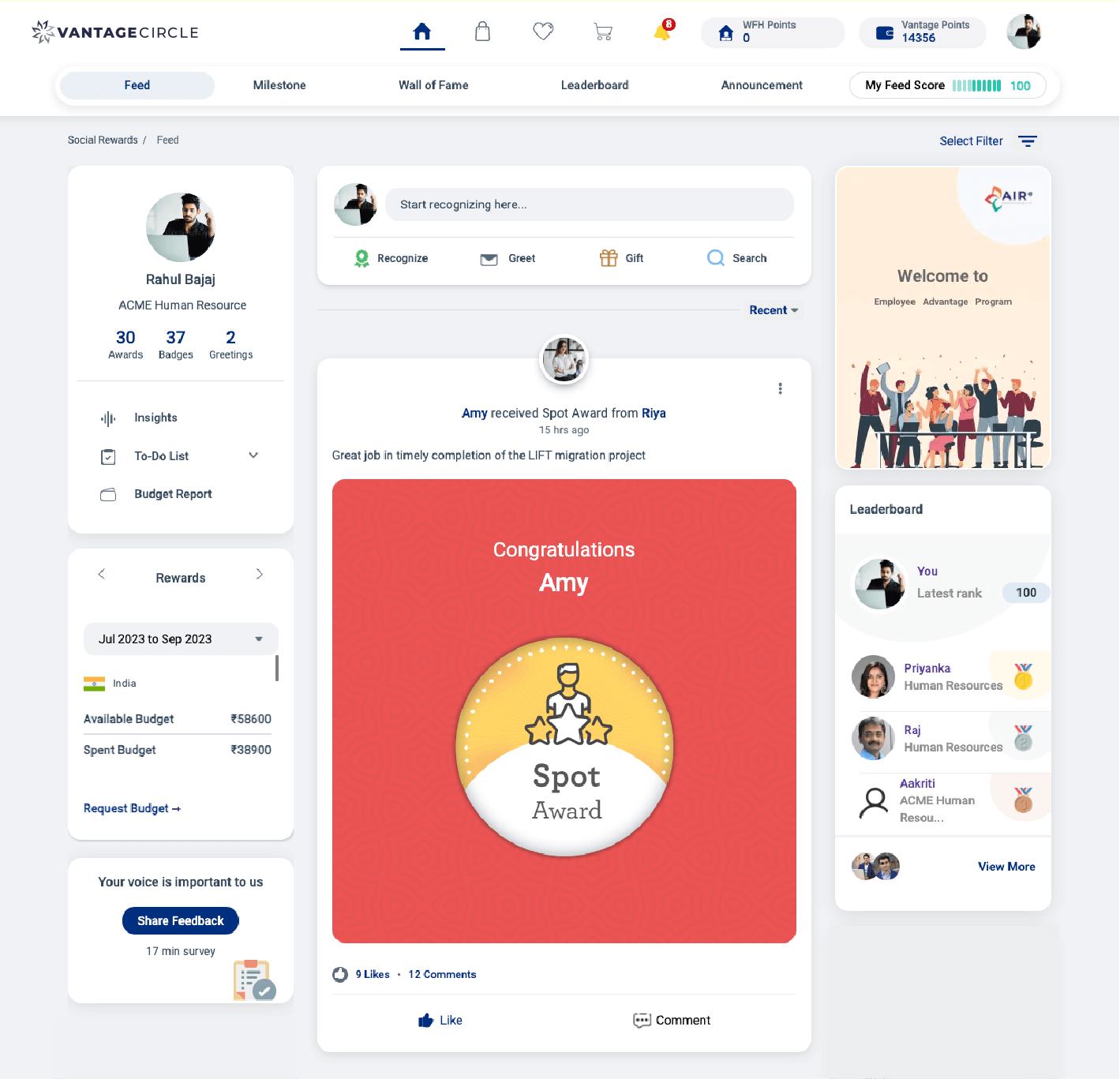
Amplify your transparency culture by recognizing and celebrating transparent leadership in real time. When managers explain the reasoning behind a difficult decision or share a project failure with lessons learned, recognize that behavior publicly. Recognition tied to your core values creates behavioral reinforcement. Others see transparency as valued and non-negotiable.
Related: Designing a Winning Employee Recognition Strategy
Step 6: Measure and Iterate
Transparency is not a one-time project. Run quarterly pulse surveys, review eNPS trends, and monitor sentiment analysis to identify departments where trust is eroding. Use data to guide leadership coaching and communication adjustments. What gets measured gets managed.
5. Pay Transparency: A Special Case Study
Pay transparency, the practice of openly sharing salary ranges, pay equity data, and compensation decision processes, is one of the most impactful and most debated applications of workplace transparency.
5.1 What Is Pay Transparency?
Pay transparency means employees understand how their compensation is determined, what salary bands exist for their role and level, and whether pay equity is maintained across gender, race, and tenure. It does not require publishing individual salaries. It requires publishing the system by which pay is set.
5.2 Why Pay Transparency Builds Trust
Employees who understand how their pay is determined report higher fairness perceptions, lower turnover intent, and stronger organizational commitment. Deloitte's 2024 Workplace Transparency research found that organizations with published salary bands and regular equity audits see a 19% reduction in voluntary attrition among mid-level employees.
5.3 Implementation Guardrails and Legal Considerations
Pay transparency implementation varies by jurisdiction. In the United States, states including California, Colorado, and New York require salary range disclosure in job postings. In the EU, the Pay Transparency Directive mandates pay reporting for organizations with 150 or more employees. Consult legal counsel before implementing pay transparency policies to ensure compliance with applicable regulations.
5.4 Measuring Pay Equity and Perception
Pay equity audits identify systematic disparities by gender, ethnicity, or role type. Pulse surveys measure employee perception of pay fairness. When audit data and perception data align, a pay transparency program is functioning as intended.
| Common Pay Transparency Concerns | How to Address Them |
|---|---|
| Employees compare salaries and create conflict | Publish bands, not individual salaries; train managers to handle comparison conversations |
| Managers cannot explain pay differences | Train managers on compensation philosophy and role-based criteria before publishing bands |
| Top performers feel underpaid if peers earn similarly | Differentiate base pay with performance-linked bonuses; communicate the full total rewards picture |
| Legal exposure from disclosing too much | Define what to share vs. protect with legal counsel; limit initial disclosure to bands and process |
| Perceived unfairness surfaces existing inequities | Conduct an equity audit first; address identified gaps before publishing to avoid reactive culture issues |
6. Real-World Examples of Workplace Transparency
Example 1: Weekly All-Hands Sharing Company Metrics
A technology firm publishes monthly revenue, growth targets, and customer retention rates at its all-hands meetings. Every employee sees the same data leadership uses to make decisions. Teams align their work to visible metrics, and leadership credibility increases because employees can hold the organization accountable to its own stated goals.
Example 2: Open Salary Bands and Career Progression
A mid-size HR consultancy publishes salary bands for every role and level on its internal career portal. Employees know what it takes to move to the next level and what compensation range applies when they get there. Manager conversations about performance and pay become fact-based rather than discretionary, reducing turnover among high performers who would otherwise assume they are underpaid.
Example 3: Transparent Project Decisions and the "Why"
A product team adopts a decision log practice: every major product decision is documented with the options considered, the criteria used, and the rationale for the chosen direction. When the roadmap shifts, the team reads the log rather than speculating. Morale stays stable through change because employees understand the reasoning.
Example 4: Anonymous Feedback Channels via Pulse Surveys
An operations team at a manufacturing company implements quarterly anonymous pulse surveys. Employees flag a long-standing communication gap between supervisors and night-shift workers. The gap had been invisible to HR because employees feared speaking up in person. Survey data triggers a targeted communication training program and a new shift-handoff protocol, reducing errors and improving team satisfaction scores.
7. Frequently Asked Questions
What is transparency in the workplace?
Transparency in the workplace is the practice of openly sharing organizational information, including goals, decisions, financial performance, and feedback processes, with employees. It creates an environment where employees understand the reasoning behind decisions, trust leadership's intentions, and feel safe providing honest feedback. Transparency functions across four pillars: communication, accountability, feedback mechanisms, and recognition of transparent behaviors.
What are the three attributes of transparency?
The three core attributes of transparency are openness, consistency, and accountability. Openness means information is shared proactively rather than withheld until employees ask. Consistency means transparency is a daily practice, not a crisis response. Accountability means decisions have visible owners who can explain their reasoning. When all three attributes are present, transparency functions as a culture driver rather than a communications strategy.
What are 5 examples of transparency in the workplace?
Five concrete examples of workplace transparency are:
- Publishing monthly company financial and performance metrics at all-hands meetings
- Sharing salary bands and career progression criteria on the internal career portal
- Maintaining a decision log that explains the reasoning behind major product or strategy shifts
- Running anonymous pulse surveys with published results and documented action plans
- Publicly recognizing leaders who model transparent communication, including those who acknowledge mistakes and share what they learned from them
What are the 3 C's of meaningful work?
The 3 C's of meaningful work are Community, Contribution, and Challenge. Community refers to the sense of belonging and connection among colleagues. Contribution means employees understand how their work impacts the broader organization or mission. Challenge means the work stretches employee capabilities in a way that drives growth. Transparency reinforces all three: open communication builds community, visible goals clarify contribution, and shared accountability creates the psychological safety to take on challenges.
How do you measure workplace transparency?
Measure workplace transparency through: trust scores from pulse surveys, clarity ratings on information sharing, eNPS trends, anonymous feedback volume, and recognition frequency for transparent behaviors. Tools like Vantage Pulse track these metrics over time. Run quarterly sentiment analysis to identify departments where trust is eroding, and correlate communication initiatives with eNPS movement to establish what is actually moving the needle.
8. Overcoming Challenges: The Transparency Paradox
Transparency is not uniformly beneficial. Deloitte's 2024 research introduced the concept of the "transparency paradox": in some conditions, greater transparency erodes trust rather than building it.
8.1 When Transparency Goes Wrong
Transparency creates anxiety when it surfaces problems without solutions. Sharing revenue decline projections without a recovery plan triggers fear and speculation. Transparency also backfires when it creates information overload, when employees receive more data than they can process or act on. Purposeful transparency shares information that enables action, not information that simply discloses.
8.2 Distinguishing Transparency from Oversharing
Sharing every concern, every budget scenario, and every leadership debate creates a culture of anxiety. Transparency requires editorial judgment. Leaders filter information by asking: Does sharing this help employees do their jobs better? Does it clarify expectations? Does it build or undermine trust? Information that fails these tests belongs in leadership forums, not org-wide communications.
8.3 Managing Information Flow to Prevent Overwhelm
Establish clear protocols for information channels. Organizational strategy updates belong in all-hands presentations. Team-level operational updates belong in weekly standups. Individual performance feedback belongs in one-on-one conversations. When information flows through the wrong channel, it creates confusion rather than clarity.
8.4 Building Leader Capability
Not all managers communicate transparently by default. Leadership development programs that include transparent communication coaching, active listening skills, and structured feedback frameworks are required for cultural transformation. Training managers before expecting them to model the behavior is essential.
9. Measuring Transparent Culture: From Metrics to Action
Building a transparent culture is not enough. Organizations need a measurement system to know whether transparency is increasing, stagnating, or eroding over time.
9.1 eNPS as a Transparency Health Indicator
Employee Net Promoter Score is the single most reliable leading indicator of perceived transparency. When eNPS rises, trust is increasing. When it falls, examine the open-text responses for signals: confusion about strategy, frustration with hidden decisions, or fear of retaliation for speaking up. Track eNPS quarterly and correlate results with communication initiatives to establish what is actually moving the needle.
Related: Employee Net Promoter Score (eNPS): A Complete Guide for HR
9.2 Sentiment Analysis on Open Feedback
Open-text survey responses contain the richest transparency signals. AI-powered sentiment analysis identifies recurring themes across hundreds of responses: appreciation for clarity in one team, frustration with hidden decisions in another, fear of change in a third. Use sentiment analysis on open feedback to detect trust and transparency themes at scale. Rather than manually reading 500 responses, identify sentiment clusters to pinpoint where transparency is working and where it is breaking down.
9.3 Department-Wise Transparency Perception
Transparency perception varies significantly across teams. Operations employees often feel less informed than sales teams. Night-shift workers feel more disconnected than day-shift counterparts. Senior leaders consistently overestimate how much transparency their direct reports experience. Drill down by department to find pockets of mistrust. Targeted leadership coaching in low-transparency departments yields faster culture shifts than org-wide initiatives applied uniformly.
9.4 Recognition Activity as a Leading Indicator
When peer recognition activity is high, employees are acknowledging each other's contributions publicly. A drop in recognition activity often precedes a drop in engagement scores. Track recognition activity as a leading indicator: if transparent behaviors are being recognized at scale, your transparency culture is self-reinforcing. If recognition is low or concentrated among a small leadership group, the culture has not yet distributed transparency as a shared value.
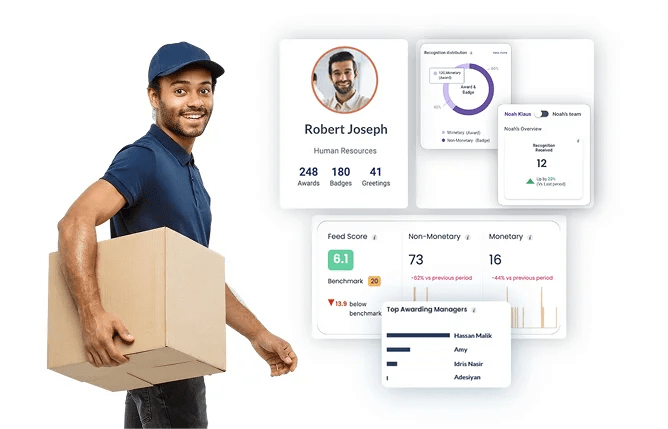
Track transparency perception quarterly via pulse surveys. Use sentiment analysis to identify departments that need leadership coaching on open communication. Monitor recognition activity weekly: a rise in values-based peer recognition is an early signal that your transparency culture is taking root across teams.
10. Conclusion: Sustaining Transparency Long-Term
Transparency in the workplace is not a program. It is a culture that organizations build and maintain through four deliberate pillars: communication, accountability, feedback mechanisms, and recognition of transparent behaviors. The organizations that sustain it deliver 21% higher profit margins than those that do not, according to Forbes (2023).
Start with a transparency audit using eNPS surveys to establish your baseline. Build a recognition program to reinforce transparent behaviors in real time. Measure quarterly sentiment trends to identify where trust is growing and where it needs leadership attention. Sustain the momentum by making transparency measurable, not aspirational.
Related: Trust and Employee Engagement: How They Work Together
About the Author
Lupamudra Deori is a content strategist and workplace culture researcher at Vantage Circle. She specializes in employee engagement frameworks, organizational behavior, and evidence-based HR practices.
Last updated: May 1, 2026. This article was reviewed for accuracy by the Vantage Circle editorial team.

Lupamudra is a content marketing specialist at Vantage Circle, where she has written 50+ articles on employee recognition, rewards, and workplace culture, alongside employee engagement, diversity and inclusion, and HR compliance topics, including how India's tax rules apply to recognition and rewards programs.
Connect with Lupamudra on LinkedIn.