Employee surveys fail because organisations collect feedback but have no system to convert it into decisions, owners, and visible action. The fix isn't a better survey tool. It's an operating rhythm that makes follow-through easier than avoidance.
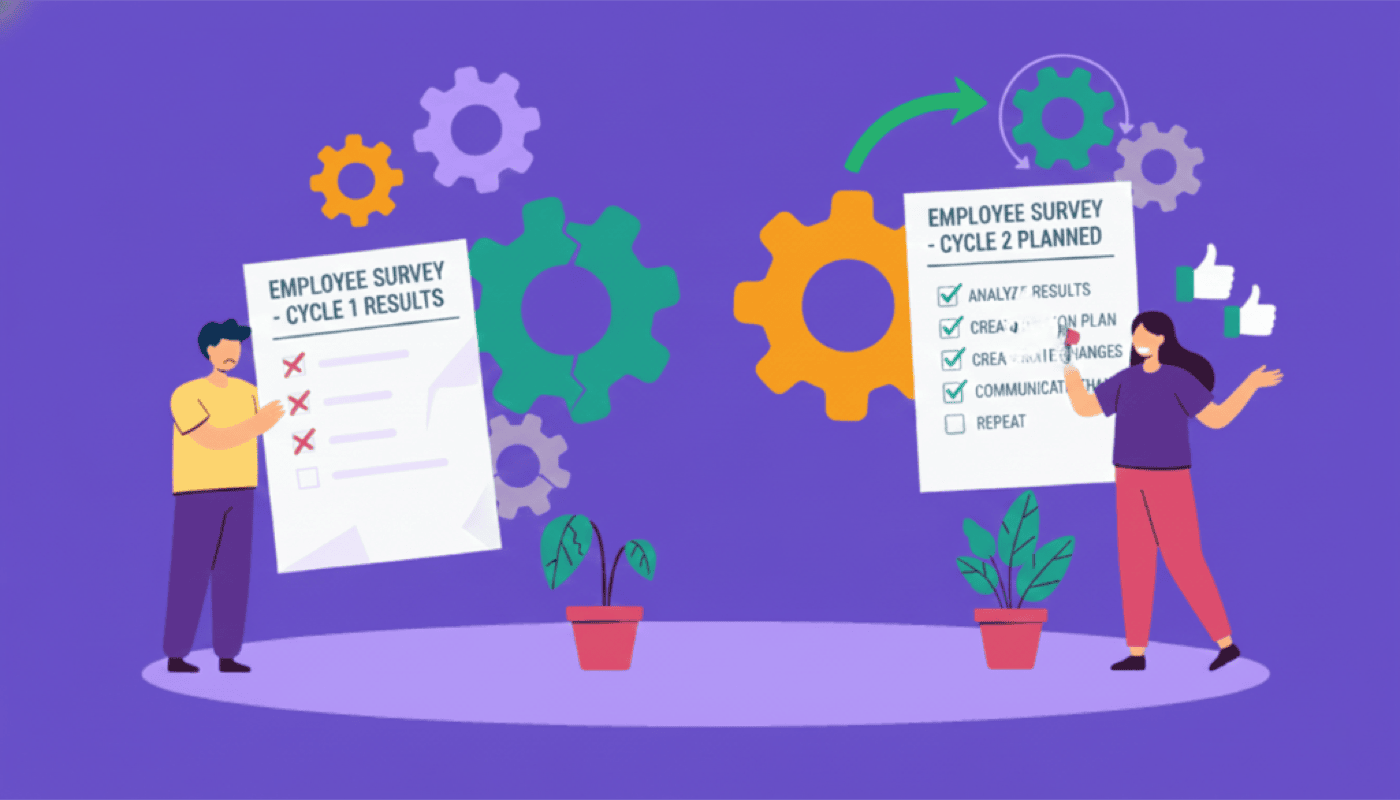
Every year, HR runs an employee survey hoping to surface honest feedback and uncover what's really going on inside the organization, yet more often than not, those efforts amount to nothing. The results get packaged into a deck, leaders sit through a meeting, and then the findings quietly disappear.
After a cycle or two of this, employees stop bothering to participate, not because they're disengaged, but because they've learned the hard way that nothing will change. The usual suspects get blamed: survey fatigue, bad tools, a distracted workforce. But the survey worked fine. The organization just has no idea how to act on what it learned.
The Real Reason Employee Surveys Fail: No System for Follow-Through
Implementation amnesia is what happens when a survey creates insight, but the organization has no reliable way to convert that insight into decisions, actions, and visible progress updates. In practice, it becomes a trust problem. Employees participate once, then watch priorities shift and the work stall.
Gallup’s data reflects how common this is. Only 8% of employees strongly agree that their organization takes action on survey results. That number matters because it describes the default employee expectation going into the second cycle.
The stakes go beyond employee sentiment. A large meta-analysis study found meaningful relationships between unit-level satisfaction and engagement and outcomes such as productivity, profit, turnover, and safety incidents. When follow-through breaks, the risk shows up in business outcomes, not only in survey participation.
Three Things That Need to Exist Before Any Survey Tool Will Work
The prerequisites:
1. You need an executive who can actually approve spending
If your survey “sponsor” can't shift budget or change priorities, you have a problem. Feedback without funding is just venting with extra steps.
2. Your culture has to be able to handle bad news
If every critical result gets explained away with “well, people don't understand the context,” just stop surveying. You're not ready. Some organizations would rather preserve comfort than face reality, and no amount of data will change that.
3. You have to be willing to fix less stuff
You cannot simultaneously address compensation, career development, work-life balance, manager quality, and tooling gaps. Pick two things. Actually fix them. That beats a 12-point action plan that goes nowhere.
If these conditions don't exist in your organization, pause your survey program and solve those first. Otherwise, you're just manufacturing evidence of dysfunction.
Where Survey Programs Actually Die
Death by meeting
The meeting happens, results get shared, and the discussion is genuinely good. Then it ends, and nobody has written down who is doing what by when. Two weeks later, the work that was discussed has quietly been absorbed by other priorities, and the moment is gone as if the meeting never happened.
Death by unfunded plans
Someone in the room says “great idea, someone should really work on that,” and the room nods along. But the follow-up questions never get asked: with what time, what budget, and whose existing priorities get bumped to make room? Without answers to those questions, the plan exists only as a good intention, and good intentions do not survive contact with a full calendar.
Death by unrealistic expectations
The problem here is a "mismatch" between the actual issue and the suggested fix. When a company realizes pay is too low but tells managers to simply "talk more about careers," they are trying to solve a money problem with a conversation.
This is unfair to local managers. They don't control the company budget, yet they are the ones who have to explain the lack of raises to their teams. By asking small teams to fix a big, corporate-wide issue, the company makes those managers look like they don't know what they’re doing. It avoids the real problem, the paycheck, and puts the blame on the wrong person.
Death by silence
Most organisations share the results, promise a plan, and then disappear for six months. Employees do not need a follow-up survey to figure out what happened, because silence is its own answer.
The damage extends beyond one bad cycle. Silence does not just disappoint people; it teaches them that the survey is theatre, that the results went into a deck and died there, that participating was a waste of time they will not get back. By the third cycle, you are no longer fighting low engagement but earned cynicism, which is a much harder thing to reverse.
The organisations that sustain high participation over time do not necessarily have better surveys. They have better communication habits. They tell people what they heard, what they decided, and what they chose not to fix and why. That last part matters more than most HR teams realise, because employees can accept "we cannot address this right now" far better than they can accept being ignored.
A Framework for Making Employee Surveys Work
Stop making this a special HR project. Build it into how the business already runs. There are three layers:
- Executive Layer (Quarterly): An executive with real budget authority owns outcomes, makes 2-3 funded commitments publicly, and communicates decisions and trade-offs on a regular cadence.
- Functional Layer (Monthly): Department heads translate enterprise commitments into specific team-level actions with named owners and simple progress scorecards.
- Team Layer (Within 2 Weeks): Managers run a 20-minute structured conversation to identify one team-controlled action and one escalation item with a named owner.
The Executive Layer (Quarterly)
Someone with actual power needs to own this. Not “provide input” own it. This person sits in quarterly planning meetings and says “what employees told us, what we're funding, what we're not doing and why.”
Output: 2–3 commitments with real budget, public progress updates that name specific changes, and a decision log, so people can see the trade-offs.
This can't be an HR meeting. This has to be a business meeting.
The Functional Layer (Monthly)
Your department heads translate those enterprise commitments into actual work. Marketing fixes onboarding, Engineering changes how code reviews work, Sales adjusts territory assignments... whatever the data says needs fixing.
Output: Function-specific actions with owners, simple scorecards tracking what moves and what's stuck.
The Team Layer (Within 2 Weeks)
Managers run a 20-minute conversation with their team. Not a therapy session, not a strategy summit. Just a structured conversation about what the team can control and what needs to get escalated.
Output: One thing the team changes, one thing that gets kicked upstairs, and a follow-up date already on the calendar.
Managers need a script, not a dashboard. Give them the exact words to say, three actions the team can pick from, and one escalation item with a name attached. Make it easier to run the conversation than to avoid it.
That shift runs through every layer. Here is how it compares to what most organisations actually do:
| What most organisations do | What actually works |
|---|---|
| Share results in a deck, move on | Assign every result a named owner before the survey closes |
| Run one annual survey | Run short recurring pulses tied to the business calendar |
| HR owns follow-through | An executive with budget authority owns outcomes |
| Build a 10-point action plan | Pick two things, fund them, fix them visibly |
| Go silent after publishing results | Send regular updates naming what changed and why |
| Give managers a dashboard | Give managers a script and a 20-minute conversation format |
What to Track If You Actually Care About Follow-Through
Response rates don't tell you if anything changed. Track this instead:
- How fast did managers discuss results with their teams?
- What percentage of teams actually picked an action and assigned an owner?
- How many committed actions got done on time?
- Do employees even know you made changes? (Ask them.)
- Are people still participating, or are they checking out?
These tell you whether your system works or whether you're just generating reports nobody reads.
How to Recover If You've Already Blown It
Burned trust with a survey that went nowhere? You can fix it, but you need to move fast and be visible.
Weeks 1-2: Identify one executive who controls budget and can make funding decisions. Pick ONE thing to fix over the next 12 weeks. Train managers on how to have the conversation.
Weeks 3-6: Run a short pulse on that one thing. Have managers discuss it within two weeks (not two months). Make small changes teams can see. Route the hard stuff upward with real owners attached.
Weeks 7-10: Scale what works. Fund one visible change at the company level. Communicate what changed and why. Use actual names and dates.
Weeks 11-12: Measure whether anything moved. Decide what to keep, what to stop, and what's next. Put the next cycle on the calendar before this one ends.
Twelve weeks. One theme. Visible progress. That's how you rebuild credibility.
The Uncomfortable Truth About Survey Tools
The survey tool isn't the cause of the execution gap. But it can make closing that gap significantly easier or harder. Most platforms are built around data collection. They measure well and stop there. The harder part is turning results into decisions, owners, and visible follow-through. Most tools hand that back to HR with no infrastructure to support it.
That said, some tools make execution easier than others. When we built Vantage Pulse, we started with the assumption that measurement isn't the hard part. Closing the loop is. So we built the platform around that problem.
The three-layer framework described above maps directly to how Vantage Pulse works:
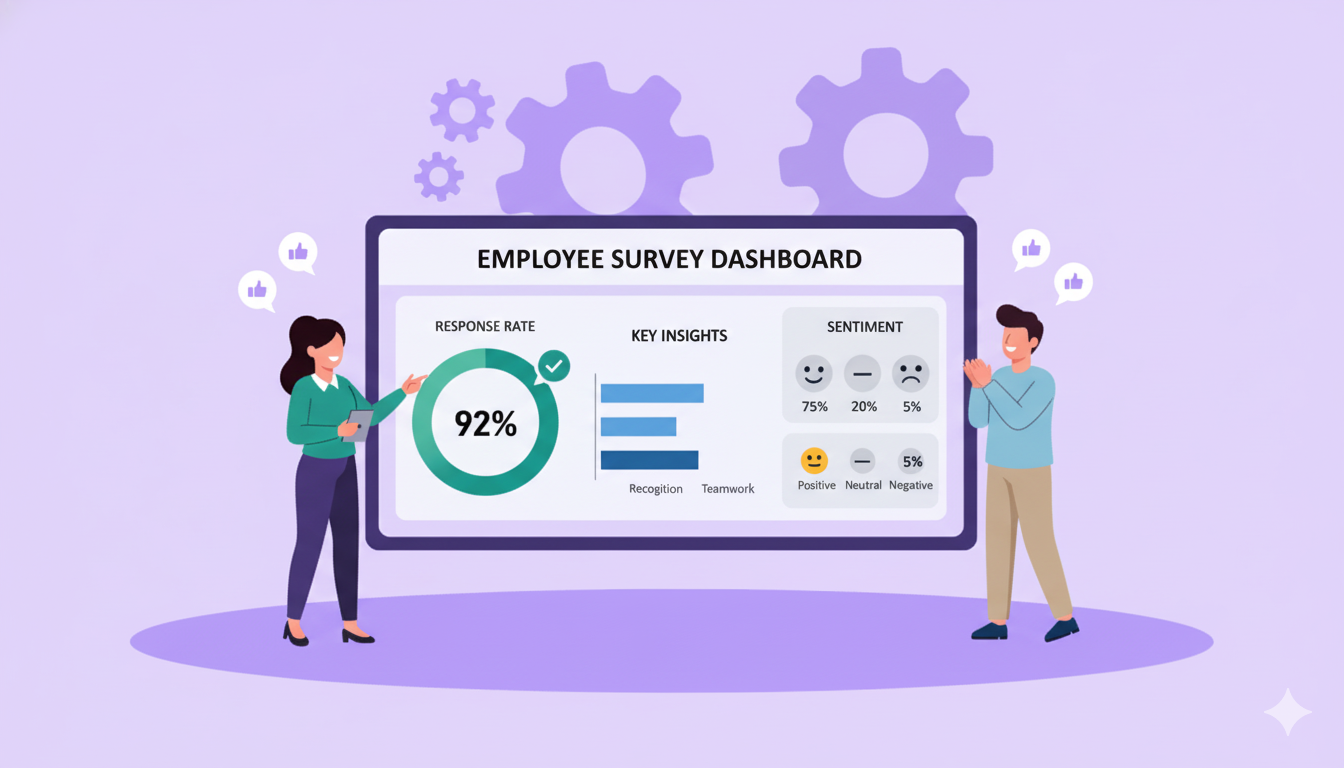
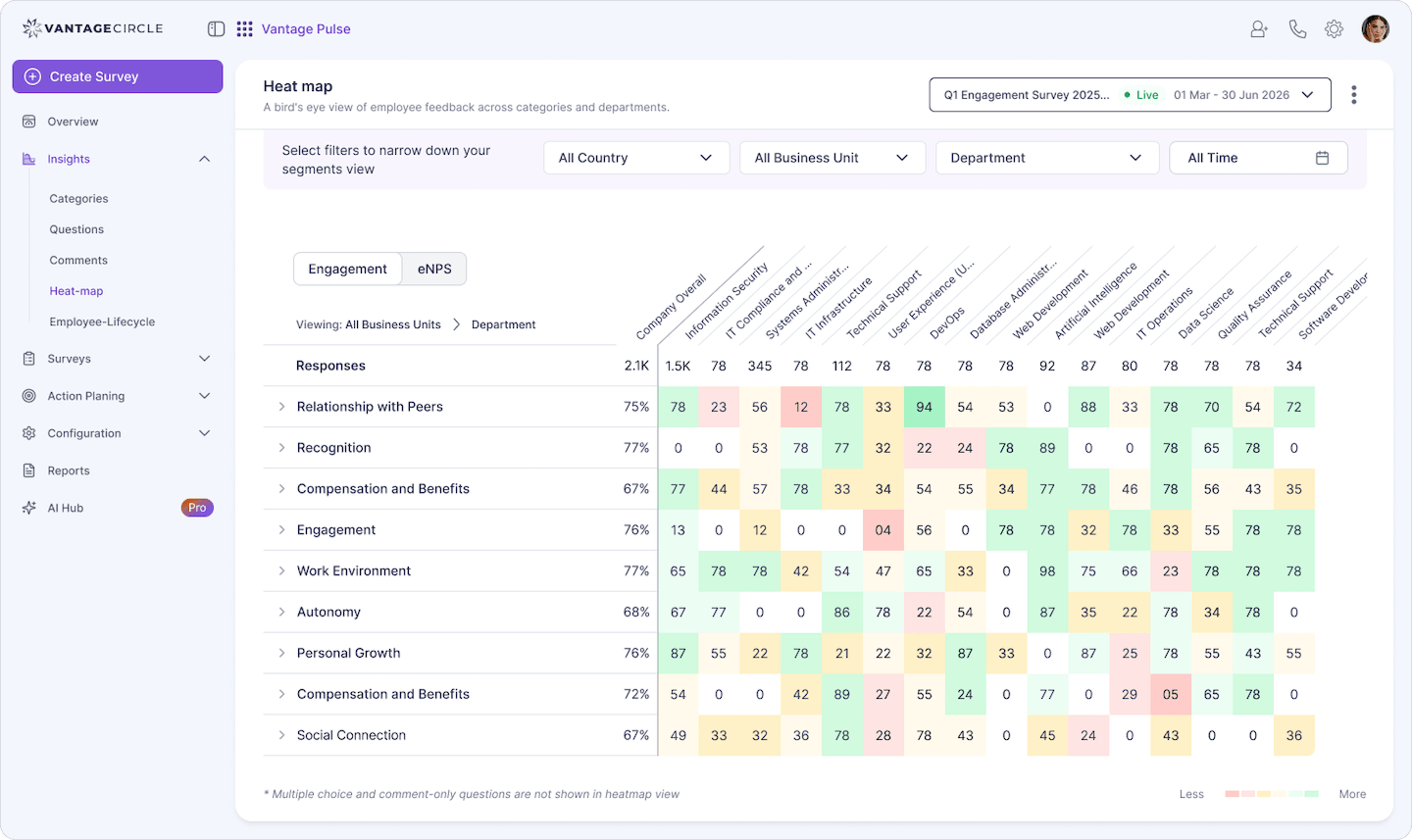
- Executive layer: Real-time engagement dashboards with eNPS trends, participation benchmarks, and demographic heatmaps so leadership can see exactly where the gaps are — by department, region, or tenure.
- Functional layer: Department-wise insights and segment filters that let HR and department heads isolate specific issues rather than reading a company-wide average.
- Team layer: Action Planning built into the platform with owners, deadlines, and progress tracking. Managers get a focused view — not a wall of data — plus a Two-Way Anonymous Conversation thread so employees can follow up without losing anonymity.
The AI Hub surfaces an overall sentiment summary and suggests empathetic response drafts for HR replies, so the follow-up conversation happens faster and more consistently across the organisation.
But the operating rhythm has to exist first. The tool just supports it. If your organization doesn't have executive ownership, cultural willingness to change, and the discipline to focus, no platform will save you. Get those right, and the tool becomes useful. Skip them, and you're just buying a nicer dashboard for data nobody acts on.
If you're ready to build the system that makes surveys work, we'd be happy to show you how Vantage Pulse fits into that process.
What Actually Matters
Survey programs die when organizations treat listening as an event and follow-through as optional. They survive when feedback becomes part of the regular business rhythm, when it shows up in the meetings where money gets allocated and priorities get set.
You don't need a perfect system. You need a consistent one. Pick a few things, fix them visibly, tell people what you did, and do it again next quarter. That's the whole game.
The alternative is running surveys that train your employees not to trust you. And in a labor market where people quit at the first sign things aren't working, that's not a risk worth taking.
If you're ready to break that pattern, start with the prerequisites. Get executive ownership. Pick one focus area. Build the three-layer loop. Make follow-through easier than avoidance. The framework works, but only if you're willing to treat survey insights as seriously as you treat your quarterly numbers.
FAQs
1. What causes employee surveys to fail?
Employee surveys fail when there is no system to act on the results. Feedback gets collected, discussed once, and then quietly dropped as other priorities take over. The problem is rarely the survey itself. It is the absence of clear ownership, funded commitments, and visible follow-through.
2. How do you fix a survey program that has lost employee trust?
Start by picking one issue and fixing it visibly within 12 weeks. Assign an executive owner, run a short follow-up pulse, and communicate what changed using specific names and dates. Employees rebuild trust through evidence, not promises.
3. Why do employees stop participating in surveys?
Employees disengage from surveys when they see no evidence that their feedback changes anything. After one or two cycles with no visible action, participation drops because the expected return is zero. Consistent follow-through is the only reliable way to sustain response rates over time.
4. How long does it take to rebuild trust after a failed survey cycle?
Most organisations can begin rebuilding credibility within 12 weeks if they focus on one issue, close the loop with managers within two weeks, and make at least one visible company-level change. Full trust recovery typically takes two to three survey cycles of consistent follow-through.
5. What should managers do with employee survey results?
Managers should run a short team conversation within two weeks of results being shared. The goal is not to solve everything, but to identify one thing the team can control and one issue to escalate with a named owner. Speed and specificity matter more than comprehensiveness.

People, culture, and what makes employees genuinely engaged, I write about it all, with practical insights HR teams can actually use.
Connect with Sahil on LinkedIn.