
When most of us picture a reward at work, cash is rarely the first thing that comes to mind. It's a trophy on a shelf, a hamper at the door during the festive season, a handwritten note tucked into a laptop bag, a bouquet on your desk, or just hearing "great job" said out loud in front of the whole team. Those are the moments people actually hold on to, and not one of them touches payroll.
That instinct holds up: you can reward employees without money by giving what cash simply cannot, things like time, visibility, growth, and a genuine say in the work. In practice, that means specific public recognition, a bit of schedule flexibility, choosing your own project, or a direct line to a senior leader. Do it consistently and free recognition compounds, because it shapes the culture people work in, not just the number on their paycheck.
This guide lays out 25+ ways to reward employees without spending a dime, sorted into five categories with the true employer cost of each one. You'll also get a four-part script managers can use this week, a weekly recognition cadence checklist, and one real example (numbers included) of a company that grew its peer-to-peer recognition culture 2.8x without adding to the rewards budget. If you're building a broader employee recognition strategy and this is one piece of it, this guide fits under that wider plan rather than replacing it.
What Counts as a No-Cost Employee Reward?
A no-cost employee reward is any form of recognition, flexibility, growth, or autonomy that costs the employer nothing per instance. It differs from a non-monetary incentive, which can still carry a real cost, think training budgets, offsites, or event catering, even though no cash changes hands directly with the employee.
That distinction matters because "without spending a dime" and "non-monetary" get used interchangeably, and they aren't the same promise. The table below sorts the three tiers so you can pick ideas that actually match your budget.
| Type | Example | Employer cost |
|---|---|---|
| No-cost | Public shoutout, flexible schedule, project choice | $0 per instance |
| Low-cost | Team potluck, rotating trophy, small gift card | Under $5 to $25 per instance |
| Non-monetary (can still cost money) | Training budget, offsite, wellness stipend | Real line-item cost, just not cash to the employee |
| Monetary | Cash bonus, raise, commission | Direct payroll cost |
This post stays inside the first two rows. If you want the full program-design view of non-monetary incentives, including the ones that carry a budget, that's covered separately. And if you're trying to decide how much of your budget should go toward cash versus recognition in the first place, incentive vs reward breaks down that split in more detail.
The mistake most "creative rewards" lists make is treating all of this as one undifferentiated bucket of nice gestures. It isn't. A meeting-free day costs the company nothing measurable. A wellness stipend costs real money even though it never touches the employee's paycheck directly. Knowing which tier you're actually reaching for matters, because a "$0 rewards" program that quietly accumulates low-cost and non-monetary line items stops being the zero-budget program leadership signed off on.
Why Non-Monetary Rewards Work
Non-monetary rewards work because they target intrinsic motivation, the drive that sustains effort longer than a one-time bonus does.
The psychology, briefly
Daniel Pink's Drive breaks intrinsic motivation into three drivers: autonomy (control over how work gets done), mastery (the pull to get better at something that matters), and purpose (knowing the work connects to something bigger). Non-monetary rewards map directly onto these. A public shoutout feeds purpose. A stretch project feeds mastery. A flexible schedule feeds autonomy. A cash bonus, by contrast, mostly just removes a source of dissatisfaction; it doesn't build any of the three, which is why the effect of a raise on morale tends to fade within weeks while the memory of being singled out for real work doesn't.
Recognition also carries what researchers call "trophy value." You don't frame a $50 gift card on your wall, but you might keep a handwritten thank-you note from a leader, or screenshot a public shoutout to look back on later. That's why free, personal recognition tends to outlast a cash reward in how it shapes someone's relationship to their work. It's also social in a way pay never is: when a manager praises someone in front of the team, everyone else in the room learns what the team values, not just the person being praised. A private bonus teaches nobody anything.
"You get the best effort from others not by lighting a fire beneath them, but by building a fire within them."
Bob Nelson, author of 1001 Ways to Reward EmployeesMcKinsey's Great Attrition research found 54% of employees who quit said they didn't feel valued by their organization, ahead of pay-related complaints, and Pew Research Center found 57% of workers who quit in 2021 cited feeling disrespected at work as a reason. Neither number is about money. Both are about whether people feel seen.
When Subex Limited, a 1,500+ employee telecom analytics firm, put a structured peer-to-peer recognition program on top of its existing rewards platform, peer-to-peer recognition itself grew 2.8x in the following quarter, alongside a 32% rise in overall engagement, with no change to the cash rewards budget (Vantage Circle case study, 2022). The full breakdown is later in this guide.
How to Reward Employees Without Money: 25+ Ideas by Category
The 25+ ideas below are grouped into five categories: recognition and visibility, time and flexibility, growth and development, autonomy and influence, and team-based rewards. Each one is tagged with its true cost, so nothing here quietly turns into a budget line without you noticing.
| Idea | Category | Cost tier | Best for |
|---|---|---|---|
| Specific public shoutout in a team meeting | Recognition & visibility | $0 | Any team, any size |
| Handwritten thank-you note from a leader | Recognition & visibility | $0 | Introverted team members |
| Peer-nominated "Team MVP" badge | Recognition & visibility | $0 | Post-project wins |
| Spotlight story in the all-hands | Recognition & visibility | $0 | Cross-team visibility |
| Manager-written LinkedIn recommendation | Recognition & visibility | $0 | Career-focused employees |
| Public "wall of fame" post | Recognition & visibility | $0 | Ongoing, low-effort cadence |
| Personal thank-you email from a senior leader | Recognition & visibility | $0 | Company milestones |
| Meeting-free focus day | Time & flexibility | $0 | After a crunch period or launch |
| Early Friday finish | Time & flexibility | $0 | Sustained morale, low cost |
| Choose-your-own-schedule week | Time & flexibility | $0 | High-trust, remote-friendly teams |
| Extra work-from-anywhere day | Time & flexibility | $0 | Remote and hybrid teams |
| Protected deep-work block | Time & flexibility | $0 | Individual contributors, makers |
| Late-start pass after a crunch period | Time & flexibility | $0 | Burnout prevention |
| Stretch project assignment | Growth & development | $0 (manager time) | High-potential employees |
| Shadow a senior leader for a day | Growth & development | $0 (manager time) | Curious, ambitious employees |
| Represent the team in a cross-functional meeting | Growth & development | $0 | Building visibility and confidence |
| Informal mentorship pairing | Growth & development | $0 (manager time) | Career growth, retention risk |
| Nomination to speak at a webinar or conference | Growth & development | $0 | Subject-matter experts |
| Pick the next project | Autonomy & influence | $0 | Engaged, self-directed employees |
| Swap out a disliked task | Autonomy & influence | $0 | Retention on repetitive roles |
| Sit in on a strategy or leadership call | Autonomy & influence | $0 | High performers wanting more context |
| Own a process end-to-end | Autonomy & influence | $0 | Ownership-driven employees |
| Weekly peer kudos ritual | Team-based & low-cost | $0 | Distributed or async teams |
| Rotating team trophy or mascot | Team-based & low-cost | Under $5 | Team bonding, playful cultures |
| Themed potluck or snack break | Team-based & low-cost | Under $25 (shared) | In-office or hybrid teams |
| Dedicated "kudos" channel | Team-based & low-cost | $0 | Scaling recognition across a company |
| Project wrap "mini-party," even virtual | Team-based & low-cost | Under $25 (shared) | Closing out major deliverables |
Recognition & Visibility
Shoutouts, notes, badges, spotlight moments
Time & Flexibility
Focus days, early finishes, schedule control
Growth & Development
Stretch work, shadowing, mentorship
Autonomy & Influence
Project choice, ownership, a seat at the table
Team-Based & Low-Cost
Rituals, potlucks, shared celebrations
Recognition and visibility (7 ideas, $0)
These work because appreciation only compounds if someone other than the manager sees it. A peer-to-peer recognition habit, where any employee can call out any colleague the moment good work happens, turns a one-off thank-you into a steady signal instead of something that depends on one manager remembering. Tagging a shoutout to a specific company value does double duty too: the person feels seen, and everyone watching learns what "good" looks like here.
Time and flexibility (6 ideas, $0)
Offering time back tells someone you trust them with it, which is a harder thing to fake than a bonus. A meeting-free day after a launch or an early Friday finish costs nothing on the books, but it directly reduces the burnout that eats into next quarter's output.
Growth and development (5 ideas, $0 to manager time)
Development is recognition with a longer half-life. A stretch project or a chance to shadow a leader signals "we see what you're capable of" in a way no plaque can. The only real cost is a manager's time, and that's an investment most managers are already underspending.
Autonomy and influence (4 ideas, $0)
Letting someone pick their next project or sit in on a strategy call is trust made visible. It works especially well for employees who are already engaged and looking for more say, not less supervision.
Team-based and low-cost ideas (5+ ideas, $0 to under $25)
A few of these carry a small shared cost, a potluck or a wrap party, but they buy something recognition can't do alone: a shared moment the whole team remembers together, not just the individual being recognized.
Recommended Read: 100+ Employee Recognition Ideas for Every Budget and Team
Making any of this stick without relying on one manager's memory is what a peer-to-peer recognition tool is for: anyone can send a shoutout, tag it to a company value with a values-based badge, or nominate a colleague for a spot award, and it shows up on a shared feed instead of staying in one inbox.
The Manager's 5-Minute Recognition Script
The most reliable no-cost reward is specific verbal recognition delivered within 48 hours. Use this four-part script: name the action, name the impact, name the value, and ask what support they want next.
"Hey [name], I want to call out [specific action] on [project or task]. [What it changed, saved, or prevented]. That's exactly the [value or behavior] we want more of on this team. Is there anything blocking you right now that I can help clear?"
"Hey Sam, I want to call out the mapping error you caught in the migration checklist before go-live. That saved us a rollback and a weekend of cleanup. That's exactly the ownership we want more of on this team. Is there anything blocking you right now that I can help clear?"
Managers who want to recognize well still forget to, not because they don't care, but because recognition rarely has a scheduled slot the way a 1:1 does. It competes with deadlines, status updates, and everything else on a manager's plate, and it's the first thing to slip in a busy week precisely because skipping it has no immediate consequence. A simple weekly cadence fixes that more reliably than good intentions do, because it turns recognition into a checklist item instead of something a manager has to remember to feel motivated enough to do.
| Frequency | Action |
|---|---|
| Daily | Scan the team channel for one specific win worth calling out |
| Weekly | Send one written note naming a behavior, not just an outcome |
| Weekly | Give one flexibility or autonomy reward tied to that week's work |
| Monthly | Run one peer-nominated award or shoutout in the all-hands |
| Quarterly | Review recognition frequency and reach, and close the gaps |
Scheduled prompts and a simple giving dashboard can nudge managers through this cadence automatically instead of leaving it to memory, which is the gap most manager-recognition tools are built to close.
What Actually Gets Used vs What Gets Ignored
Not every no-cost idea earns its place on a list like this. Reserved-parking spots and "Employee of the Month" plaques are the classic example: they get set up with enthusiasm and quietly stop happening within two quarters, because nobody owns tracking them and the novelty wears off fast.
What tends to stick, based on how recognition programs actually get used once the launch excitement fades, is anything specific and public: a named shoutout beats a generic "thanks," and public praise outlasts private praise because it keeps working as a social signal long after the moment has passed. Flexible-hours requests and project-choice rewards also hold up well, because they're renewable, an employee can ask for the same kind of reward again without it feeling repetitive, unlike a one-time trophy.
Two other patterns show up consistently. First, anything that requires a separate manual step, ordering a physical trophy, printing a certificate, booking a room, decays faster than anything that lives inside a tool people already use daily, like a chat channel or a recognition feed. Second, programs run entirely top-down (only managers can recognize) fade faster than programs where peers can recognize each other too, because the volume of recognition depends on far more people remembering to give it. A recognition analytics dashboard that shows which teams have gone quiet on giving or receiving recognition is usually the difference between a program that fades and one that gets managed like any other metric that matters, the same way manager participation itself has to be tracked, not assumed.
A Real Example: Subex Limited
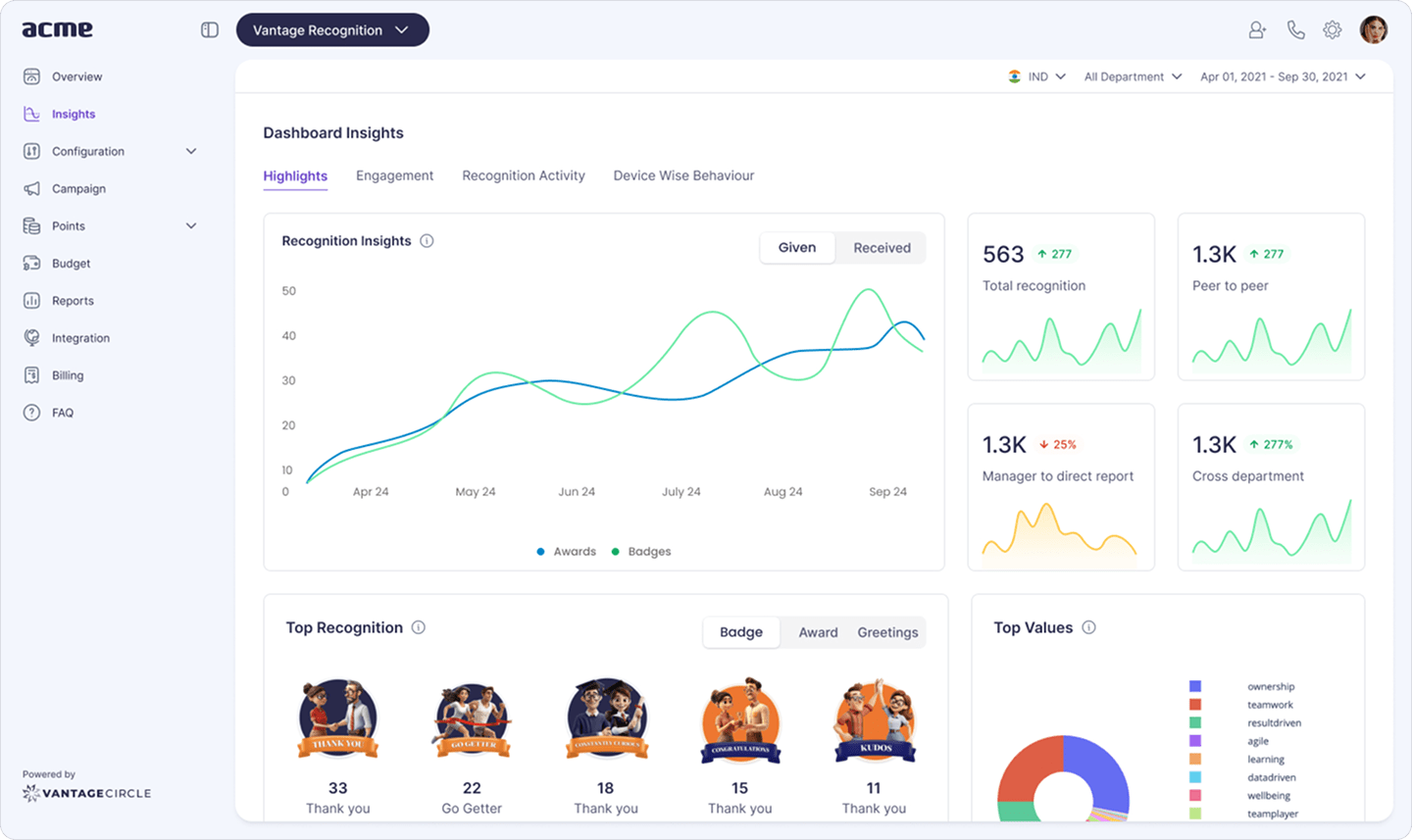
Subex Limited, a telecom analytics firm with 1,500+ employees, needed to build a culture of connection and recognition without adding new cash incentives to the budget. After rolling out a peer-to-peer recognition and rewards platform, employees could send shoutouts, badges, and points to each other directly, and managers could recognize specific accomplishments without a separate approval cycle.
In the first quarter after launch, Subex saw a 32% increase in overall engagement and a 2.8x rise in peer-to-peer recognition, with a 4.2x increase in appreciation activity in just the first two months (Vantage Circle case study, 2022). None of that came from a bigger rewards budget. It came from making recognition easy enough that it happened without being scheduled.
Read the full breakdown: Subex Limited: 2.8x Growth in Peer-to-Peer Recognition
How to Measure Whether Non-Monetary Rewards Are Working
Track three signals: recognition frequency and reach, eNPS movement, and voluntary turnover among recognized versus non-recognized employees.
Frequency and reach tell you whether recognition is actually happening and whether it's concentrated in a few teams or spread across the company. A team that gives plenty of recognition but only within itself has a reach problem, not a frequency problem, and the two call for different fixes. eNPS tells you whether people's sentiment about working here is moving in response, and it's worth tracking at the department level, not just company-wide, since a strong company average can hide one team where recognition never lands. And a gap in voluntary turnover between employees who get recognized regularly and those who don't is usually the clearest signal that non-monetary recognition is doing more than making people feel good in the moment, it's changing who stays.
None of these three signals is useful in isolation. High recognition frequency with flat eNPS usually means the recognition is happening but isn't specific enough to register. Rising eNPS with falling recognition frequency usually means something else is driving sentiment, and the recognition program is getting credit it hasn't earned. Track all three together for at least one full quarter before drawing conclusions, since recognition habits take longer to show up in turnover data than they do in a pulse survey.
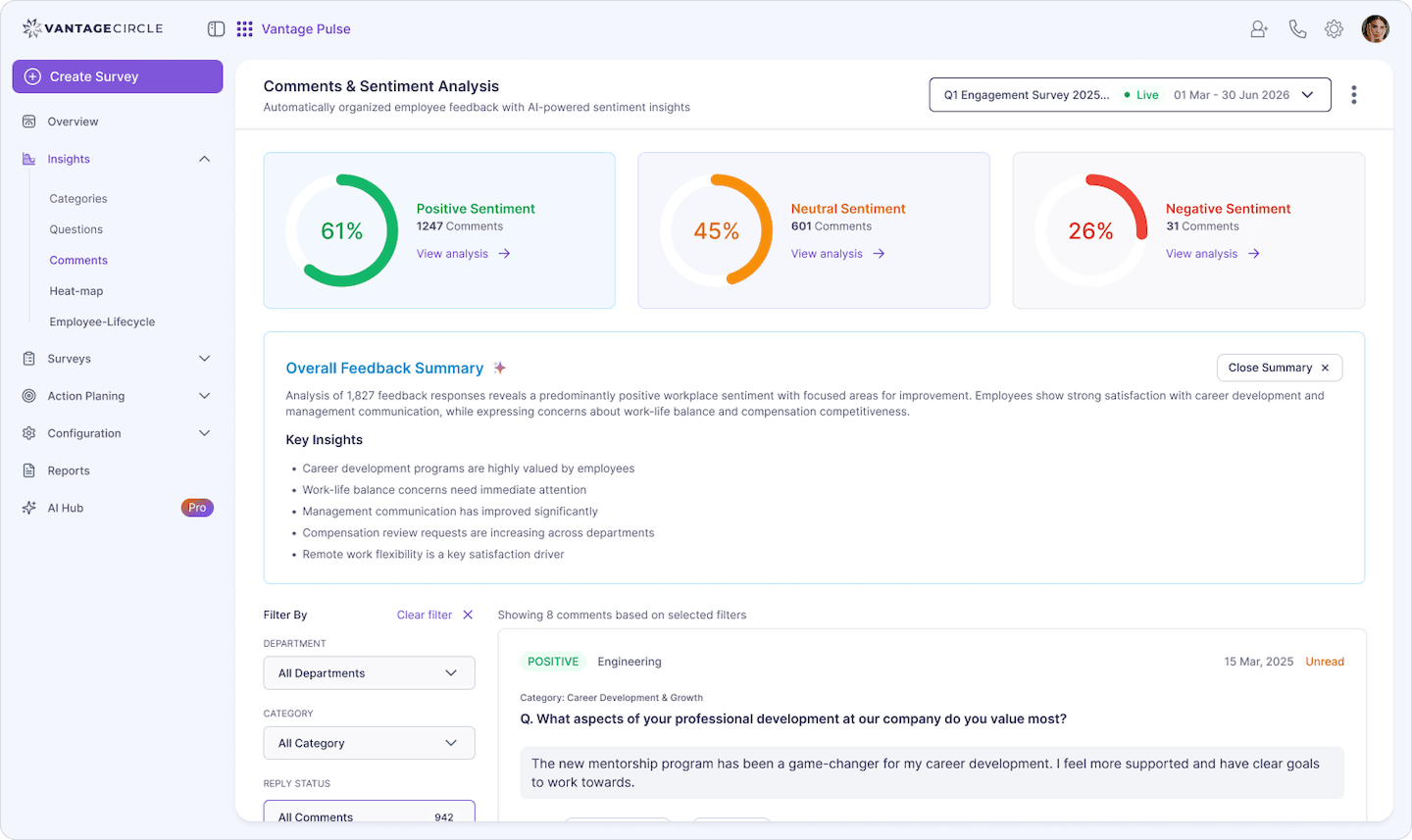
Short, frequent pulse surveys are how most HR teams keep an eye on the sentiment side of this without waiting for an annual engagement survey to tell them what already changed months ago.
Frequently Asked Questions
What is an example of a non-monetary reward?
A public shoutout naming a specific accomplishment, a handwritten thank-you note from a leader, an extra flexible day off, or the chance to lead a new project are all non-monetary rewards. Each costs the employer nothing in cash but signals recognition, trust, or growth.
How do you reward your staff without money?
Reward staff without money by giving specific public recognition, schedule flexibility, growth opportunities, and autonomy over their own work. The most reliable version is verbal or written recognition that names the exact action and its impact within 48 hours, not a generic "great job."
What are non-financial rewards for employees?
Non-financial rewards are forms of appreciation, flexibility, or development that don't involve cash or a monetary voucher, things like public recognition, extra time off, mentorship, stretch assignments, or a say in team decisions. They sit alongside, not instead of, fair pay.
What are some good small prize ideas for employees?
Good small prize ideas include a rotating team trophy, a themed potluck, a peer-nominated badge, or a small gift card tied to a specific shoutout. The prize matters less than the specificity of the recognition attached to it.
What are some creative reward ideas for employees?
Creative no-cost reward ideas include letting someone pick their next project, arranging for them to shadow a senior leader for a day, giving a public LinkedIn recommendation from their manager, or hosting a milestone celebration built around their actual work, not a generic template.
What is a prize that everyone wants?
There isn't one universal prize, but the closest thing is specific, public recognition of real work. Independent research backs this: McKinsey's Great Attrition research found 54% of employees who quit said they didn't feel valued by their organization, a bigger factor than pay, and Pew Research Center found 57% of workers who quit in 2021 cited feeling disrespected at work as a reason.
Conclusion: Free Recognition Is a System, Not a Gesture
You don't need a bigger rewards budget to change how people feel about working here. You need a system: 25+ ideas sorted by real cost, a script managers actually use, and a way to check whether it's working. Subex grew its peer-to-peer recognition 2.8x without touching its cash rewards budget. The lever wasn't money. It was making recognition easy enough to become routine.


Lupamudra is a content marketing specialist at Vantage Circle, where she has written 50+ articles on employee recognition, rewards, and workplace culture, alongside employee engagement, diversity and inclusion, and HR compliance topics, including how India's tax rules apply to recognition and rewards programs.
Connect with Lupamudra on LinkedIn.


