
Free employee recognition ideas acknowledge good work without drawing on a budget. Specific verbal praise, public credit in front of peers, a written note, a manager's undivided attention. Each works for the same reason: recognition lands on specificity and timing, not on spend. The catch is that some popular "free" ideas quietly cost something else.
Most lists of free employee recognition ideas do not admit that. They count an extra day off as free. They count four hours of a manager's week as free. Neither is.
So this post does two things. It gives you 30 ideas that genuinely cost zero. Then it examines 8 that routinely appear on free lists but are not free. They cost time, coverage, or flexibility rather than money, and a cost that never reaches an invoice is still a cost.
What Counts as Free Employee Recognition?
Free employee recognition is any acknowledgment that requires no money, no procurement, and no approval. If it needs a purchase order, it is not free.
That leaves you three currencies to spend instead, and they are the ones that actually determine whether recognition works:
- Specificity. Naming the exact behavior, not the person's general excellence.
- Timing. Saying it while the work is still fresh.
- Visibility. Choosing who else hears it.
None of those cost anything. All three are harder to do well than writing a check, and none of them arrive on their own.
The $0 test: if delivering the idea requires a purchase order, a budget line, or someone else's paid time, it is not free. It might still be worth doing. But price it before you promise it.
30 Free Employee Recognition Ideas
These 30 ideas cost nothing to deliver. They are grouped by what each one actually asks of you: your attention, a few minutes, a willingness to say it publicly, or a system that runs without you.
Ideas That Cost Nothing but Your Attention (1 to 8)
Free recognition starts with noticing, and noticing is easy to skip when the work goes well. These eight ask you to look properly before you speak.
- Name the behavior, not the person. "You are a star" fades. "You caught the pricing error before it reached the client" repeats.
- Recognize the near miss. Someone ran a good process on a deal that still fell through. Say so, or you teach the team that only outcomes count.
- Thank the enabler, not just the finisher. The person who unblocked the work rarely gets named in the launch email.
- Recognize the quiet contributor first. Every team has someone whose work is only noticed when it stops.
- Ask them to teach it. "Can you show the team how you handled that escalation?" is recognition and knowledge transfer in one sentence.
- Thank someone for something months old. Delayed recognition for work that still matters lands harder than same-week praise for something forgettable.
- Recognize the decision, not the result. Good judgment that happened to get a bad outcome is still good judgment.
- Say what would have happened without them. The counterfactual makes the contribution concrete.
Ideas That Cost Nothing but a Few Minutes (9 to 16)
Nine through sixteen are all short enough to do between meetings. Most take about a minute, and none of them need a slot in your calendar.
- Write a handwritten note. Slower than a message, which is exactly why it registers.
- Send a voice note instead of text. Tone carries what typing flattens.
- Open your weekly meeting with one specific win. Same slot, every week, no exceptions.
- Reply-all to a customer compliment and name the person responsible.
- Forward the client's exact words, unedited. Your paraphrase is weaker than what they actually wrote.
- Write a LinkedIn recommendation. Public, permanent, and worth more to their career than a gift card.
- Copy the praise into their performance file so it exists at review time, not just in the moment.
- Tell their manager, not them. Recognition that travels upward is worth more than recognition that stops with the recipient.
Ideas That Make Recognition Public for Free (17 to 24)
Visibility is what turns one recognition into an example. The same thank-you said privately helps one person; said publicly, it sets the standard. That is the whole argument for social recognition, and none of it requires spend.
- Create a standing wins slot in the weekly team meeting.
- Open a shared channel where anyone can post a thank-you without permission.
- Read peer recognitions aloud at all-hands. Someone else's words, in front of everyone.
- Use a physical wall. A whiteboard with names on it still works, particularly for frontline teams.
- Rotate who gives the recognition. When it is always the manager, it reads as performance management.
- Recognize teams, not just individuals. Team recognition reaches more people per moment and avoids the winner-loser dynamic.
- Name the company value out loud when you recognize the behavior, so people learn what the values look like in practice.
- Let the recognized person nominate the next one. A chain costs nothing and runs itself.
Ideas That Cost Nothing and Scale to Thousands (25 to 30)
Most of the first 24 still depend on someone remembering to act. These six keep working when nobody remembers, which is where free recognition usually dies.
- Give everyone named badges they can award. Unlimited, non-monetary, and instantly repeatable.
- Remove the approval chain from peer recognition. Every approval step is a reason not to bother.
- Put recognition inside the tools people already use. Chat platforms like Slack or Microsoft Teams beat a portal nobody opens.
- Automate service milestones so no anniversary depends on a manager's memory.
- Make giving visible, not just receiving. A public feed turns one recognition into a prompt for the next.
- Prompt managers about who has not been recognized. Coverage gaps are invisible until someone surfaces them.
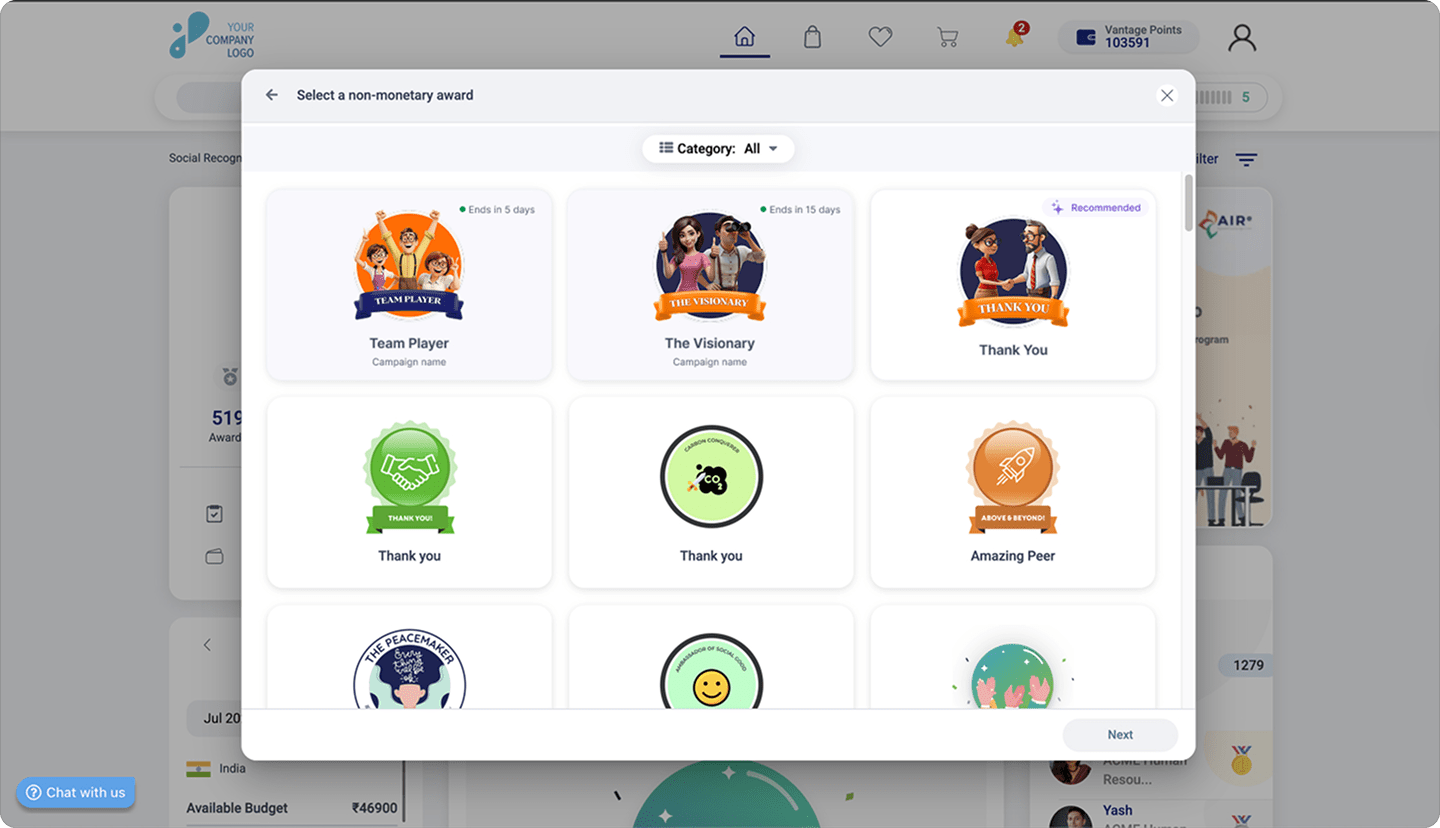
Ideas like these are how free recognition stops depending on goodwill. Vantage Recognition, Vantage Circle's employee recognition platform, gives every employee a catalog of non-monetary badges tied to named company values, so a peer can recognize a peer without a budget line or an approval.
8 Recognition Ideas That Cost More Than You Think
Eight ideas appear on almost every free-recognition list and are not free. They cost time, coverage, or flexibility instead of money. Most are still worth doing. They just need planning, not improvisation.
| The idea | What it actually costs | When it is still worth it |
|---|---|---|
| An extra day off | A day of output, plus whoever covers the work. On a lean team, that is two people affected. | For exceptional, one-off effort that already cost the person personal time. |
| Early finish on Friday | Collective hours across everyone who leaves. Small per person, large in aggregate. | After a delivery crunch, where the alternative is people quietly recovering anyway. |
| The prime parking spot | Nothing in cash, but it is zero-sum. Whoever held the spot before gives it up for as long as the award runs. | Where the perk is genuinely scarce and rotation is visible and fair. |
| Lunch with the CEO | Executive time, which is heavily committed and does not scale past a handful of people. | For a small number of high-impact contributors, scheduled in advance, not promised broadly. |
| "Pick your next project" | Planning flexibility. Someone else now gets the project nobody chose. | When the roster genuinely has slack and the choice is real rather than cosmetic. |
| A half-day of manager mentoring | Manager capacity, which is already stretched in most organizations. | When it is development the person actually asked for, not a prize they must now attend. |
| A recognition committee | Recurring hours from several people, every cycle, indefinitely. | For formal awards needing defensible judgment. Never for everyday appreciation. |
| A peer-nominated award program | Administrative time to collect, shortlist, and adjudicate fairly. It grows with headcount. | When the nomination and scoring run in a platform rather than a spreadsheet and an inbox. |
None of these belong on a free list without a footnote. Account for what each one takes, then choose it deliberately. Spending the time is not the problem. Promising something you never accounted for, and quietly dropping it two months later, is.
Does Free Recognition Actually Work?
Yes, and at enterprise scale. Three Vantage Circle clients have grown their zero-cost recognition layer substantially over multi-year periods.
Wipro grew non-monetary awards, meaning badges and appreciation tokens that cost nothing to give, by 97.5% in two years between 2021 and 2023. In a single fiscal year the program reached over 57% of associates. "At Wipro, we firmly believe that when appreciation becomes a habit, excellence becomes the norm," said Sunita Cherian, Senior VP and Chief Culture Officer. "Considering our size, this coverage attests to the strong performance of our recognition program."
L&T Technology Services saw non-monetary recognitions rise 68% in two years, with over 12,000 non-monetary recognitions received in 2023-24 alone. Tata Communications recorded a 185% increase in peer-to-peer non-monetary recognition between FY 2020-21 and FY 2024-25.
Three organizations, and the same pattern in each: the zero-cost layer grew fast and kept growing. None of these numbers required a bigger budget to produce.
The headroom is real too. Vantage Circle's AIRe Benchmarking Report for the United States found that use of non-monetary awards "needs to go up significantly," and that fewer than 20% of employees are recognized in a given quarter. Gallup puts the same gap another way: only one in three US workers strongly agree they received recognition for good work in the past seven days.
Closing a gap that size is a question of how often recognition happens, not how much each instance is worth.
Vantage Influencers Podcast
"Reward and recognition is not necessarily cost money and a pat on the back and official letter is much more valuable than anything else."
Ramesh Shankar, Founder, Hrishti; former Head of HR, Siemens South Asia
Listen to the EpisodeHow to Make Free Recognition Land
Free recognition succeeds or fails on delivery. The same words work or fall flat depending on four things, and none of them cost anything to fix.
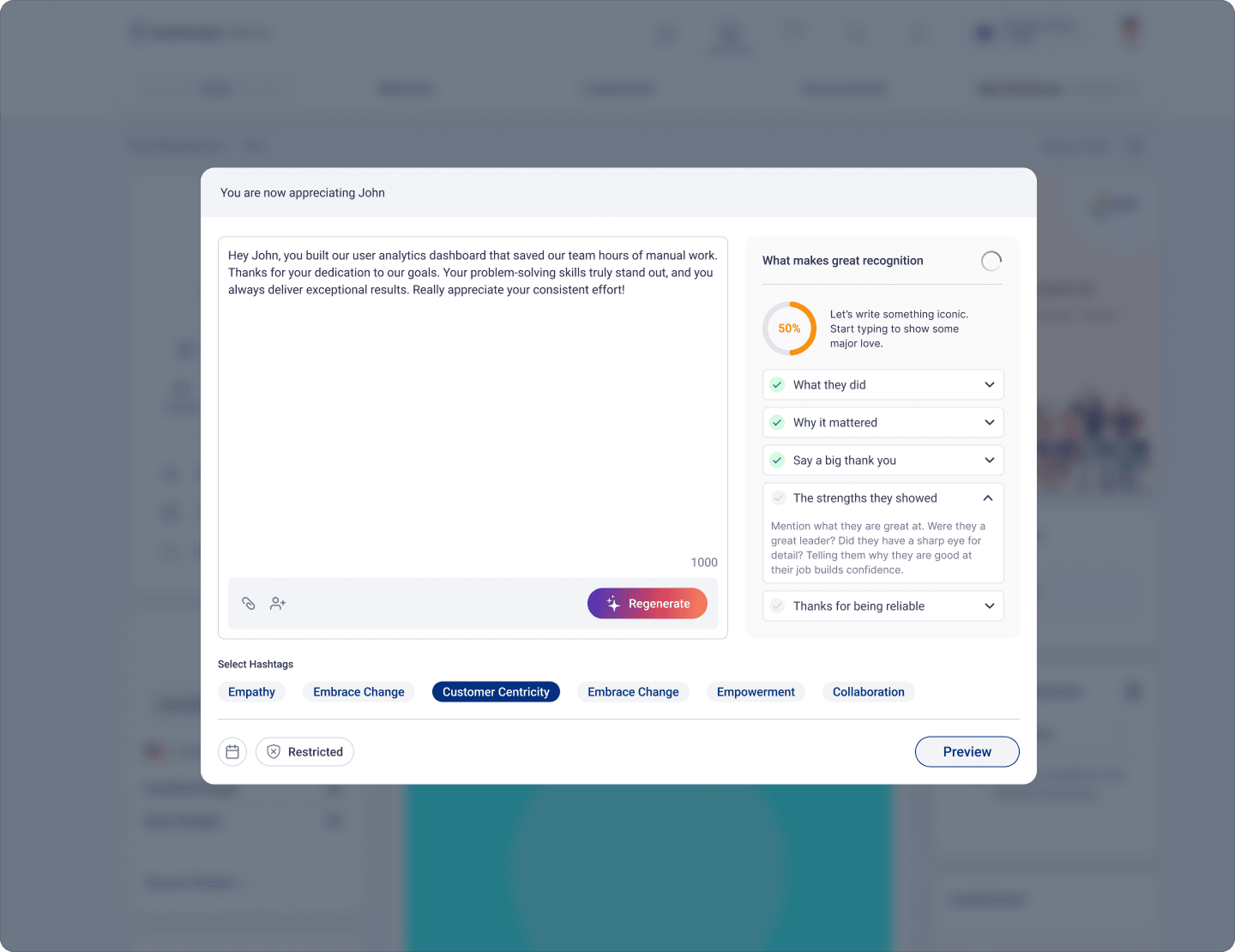
Be specific. "Great job" is not recognition. It is politeness. Name the behavior and its effect, which is the whole discipline behind giving recognition at work that people actually remember.
Be quick. Recognition given the same week almost always lands harder than the same words at a quarterly review. Delay converts a moment into an administrative task.
Choose the audience deliberately. Some people want the all-hands mention. Others want a private note and will resent the spotlight. Ask once, then remember.
Be consistent. A small thing every week beats a grand gesture once a year. Consistency is what turns individual praise into a recognition culture, and it is where a strong peer-to-peer recognition habit does more than any manager can alone.
One practical fix for specificity: give people a prompt at the moment of writing. Vantage Recognition's composer scores the quality of a recognition message as it is being written and asks for the behavior and its impact before it will call the message good.
When You Do Need a Budget
Free recognition covers frequency and appreciation well. It does not cover everything, and a program that claims otherwise will be found out at the first milestone it cannot mark properly.
Three things genuinely need money. Long service and milestone awards, where a token with no value reads as an insult. High-impact annual awards, where the reward has to match the contribution. And anything you have promised to scale across a global workforce, where consistency itself has a cost.
The honest framing is a split. Use free recognition for the everyday layer that reaches everyone often. Use budget for the small number of moments that need weight. If you are working out where that line sits, start with your recognition budget rather than your idea list.
Get the ratio wrong in either direction and it shows. Programs that are all budget and no frequency produce an annual awards night nobody connects to their daily work. Programs that are all frequency and no budget eventually feel cheap, because a fifteen-year milestone marked with the same badge as a good Tuesday tells people exactly how much the fifteen years counted. Well-built employee recognition programs run both layers on purpose, and know which one each moment belongs to.
To see which half of that split your program is short on, the AIRe Assessment scores recognition design across Appreciation, Incentivization, Reinforcement, and eMotional Connect. A program can score well on one dimension and poorly on another, which is usually invisible until something measures it.
Summing It Up
Free employee recognition works at scale, and there is enterprise evidence for it. Wipro grew zero-cost recognition 97.5% in two years and reached over 57% of associates in a single year. Budget was not what made that possible.
But be honest about what free means. An extra day off is not free. Neither is four hours of a manager's week. Price those before you promise them, and keep the genuinely free 30 running underneath everything else.
Start with one: open your next team meeting by naming one specific thing someone did, and what would have happened without them. That costs nothing and takes ninety seconds. Book a demo if you want to see what it looks like running across a few thousand people.
FAQs
What are good employee recognition ideas?
The best employee recognition ideas are specific, timely, and public where the person is comfortable with it. Naming the exact behavior beats generic praise, saying it the same week beats saying it at review time, and letting others hear it multiplies the effect. Many of the most effective ideas cost nothing at all.
How to reward employees for free?
Reward employees for free by spending attention instead of money. Write a handwritten note, forward a client's exact words with the employee named, give a public shout-out in the weekly meeting, write a LinkedIn recommendation, or ask the person to teach the team how they solved something. Named peer badges let this scale beyond what individual managers remember.
What are some fun awards for employees?
Fun awards work when they name a real behavior rather than an inside joke. Peer-nominated titles tied to company values, a rotating trophy for the best save of the month, or a chain award where each recipient picks the next one all cost nothing. Avoid anything that could read as a backhanded compliment.
What are some low cost appreciation ideas?
Low cost appreciation ideas include a standing wins slot in team meetings, a shared thank-you channel open to everyone, reading peer recognitions aloud at all-hands, and a physical recognition wall for frontline teams. Each costs nothing to run and reaches more people than an individual award.
Are free employee recognition ideas actually free?
Many are, but not all of the ideas commonly listed as free. An extra day off costs output and coverage. Lunch with the CEO costs executive time. A recognition committee costs recurring hours from several people. These are often worth doing, but they need to be planned and costed rather than treated as free.

Nilotpal M Saharia is an Assistant Manager, Content Marketing at Vantage Circle and a recognition-and-rewards (R&R) strategist with 9 years of experience spanning Marketing, HR, and content strategy. He helps HR leaders turn employee recognition and leadership research into practical workplace programs.
Connect with Nilotpal on LinkedIn.