
Many organizations recognize the importance of employee appreciation, but how many actually get it right? It’s easy to say “thank you,” but how do you build a truly impactful employee recognition program? What are the best practices to ensure that employees feel valued consistently?
The truth is, employee recognition isn’t just about giving out awards or bonuses. It’s about fostering a culture where employees feel seen, appreciated, and motivated to give their best.
According to a study, well-recognized employees are 7 times more likely to be fully engaged compared to those who are not recognized.
When done right, recognition drives engagement, improves retention, and strengthens company culture. But how can you ensure your program is effective and engaging for all employees?
Most companies already recognize their employees. Far fewer do it in a way anyone would call a program. The difference is structure. A program defines who can recognize whom, which behaviours qualify, how recognition reaches people, and how you know it is working. Without that, appreciation depends on which manager you happen to report to.
Below you will find the nine types of recognition program, what four companies actually built and measured, a six-step sequence for building your own, and a template you can adapt today.
So, let's dive in.
What is an Employee Recognition Program?
An employee recognition program is a structured system for acknowledging employee contributions on a consistent basis, rather than leaving appreciation to chance. It defines who can recognize whom, which behaviours qualify, how recognition is delivered, and how it is measured.
That structure is the whole difference. A formalized program goes beyond a casual "thank you" and becomes a system for regularly acknowledging hard work and achievements.
These programs can take many forms. You might give a -
- quick shout-out in a team meeting,
- award an “Employee of the Month,” or even
- celebrate milestones like work anniversaries.
What’s important is that recognition happens frequently and in a way that feels authentic.
It’s not just about celebrating big wins. Recognizing day-to-day efforts and contributions is equally essential. Employees want to feel valued when they complete a big project and also for all the small ways they help the company succeed.
A great recognition program strengthens company culture. It shows employees that their hard work is truly appreciated. And when employees feel seen and valued, they’re more likely to stay motivated and continue delivering great work.
Also read: The science of Recognition
Vantage Influencers Podcast
"The most proven principle of management and performance is you get what you reward. Whatever you recognize will be repeated."
— Dr. Bob Nelson, Creator of Employee Appreciation Day and bestselling author
Listen to the EpisodeThat principle is what makes program design consequential. Whatever behaviour your program rewards is the behaviour you will get more of, whether or not it was the behaviour you intended to encourage.
9 Types of Employee Recognition Programs
There are nine recognition program types in common use, and they vary along two axes: who does the recognizing, and whether the reward carries monetary value. Most working programs combine three or four of them rather than relying on one.
Here is each type, with what it does well and where it breaks.
1. Peer-to-Peer Recognition
What it is / How to do:
Peer-to-peer recognition allows employees to acknowledge and appreciate each other’s contributions. It builds a culture where recognition flows freely, not just top-down. You can implement this through digital tools, informal recognition such as shout-outs in meetings, or nomination systems.
| Pros | Cons |
|---|---|
| Encourages a culture of appreciation across all levels | Can feel biased or cliquish if not moderated |
| Builds stronger team relationships | Some employees may hesitate to participate without encouragement |
| Helps identify unsung heroes who may not be visible to managers |
2. Monetary Rewards
What it is / How to do:
Monetary rewards offer financial incentives such as bonuses, gift cards, or spot bonuses for specific achievements. These are best used to recognize high performance, project completions, or hitting goals.
| Pros | Cons |
|---|---|
| Highly motivating and tangible | Can become expected rather than appreciated |
| Easy to customize by budget or occasion | May overshadow non-monetary recognition if overused |
| Appeals to employees who value financial recognition |
3. Non-Monetary Rewards
What it is / How to do:
These include verbal praise, certificates, handwritten thank-you notes, or digital badges. They focus on emotional value rather than financial rewards and are easily incorporated into the daily work routine.
| Pros | Cons |
|---|---|
| Cost-effective and personal | May not be valued equally by all employees |
| Encourages everyday recognition | Can feel insincere if not delivered thoughtfully |
| Builds emotional connection with the team |
4. Employee of the Month/Year
What it is / How to do:
This recognition highlights outstanding employees on a monthly or yearly basis. It’s typically based on performance, behavior, or impact and is often announced in team meetings, newsletters, or internal platforms.
| Pros | Cons |
|---|---|
| Creates a consistent cadence of recognition | May feel repetitive or predictable |
| Offers clear benchmarks for excellence | Risk of demotivating others if recognition feels exclusive |
| Publicly celebrates achievements |
5. Service Awards
What it is / How to do:
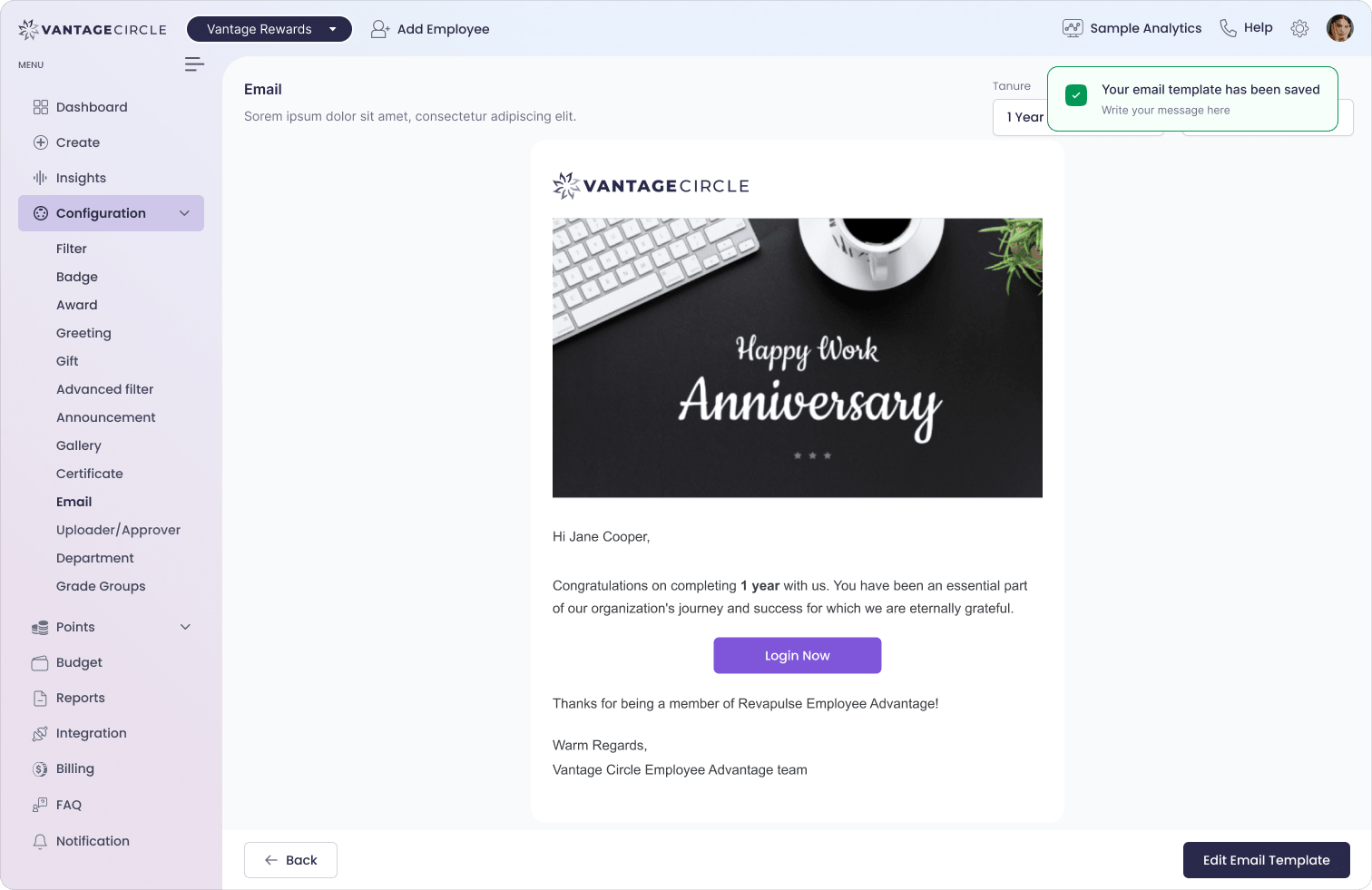
Service awards recognize employees for their tenure, such as 1, 5, 10, or 20 years at the company. These can be celebrated with certificates, plaques, digital yearbooks, or customized gifts.
Source: Vantage Recognition
| Pros | Cons |
|---|---|
| Acknowledges long-term loyalty and commitment | Can feel ceremonial if not personalized |
| Reinforces retention and stability | Doesn’t address day-to-day achievements |
| Easy to plan annually or quarterly |
6. Spot Awards
What it is / How to do:
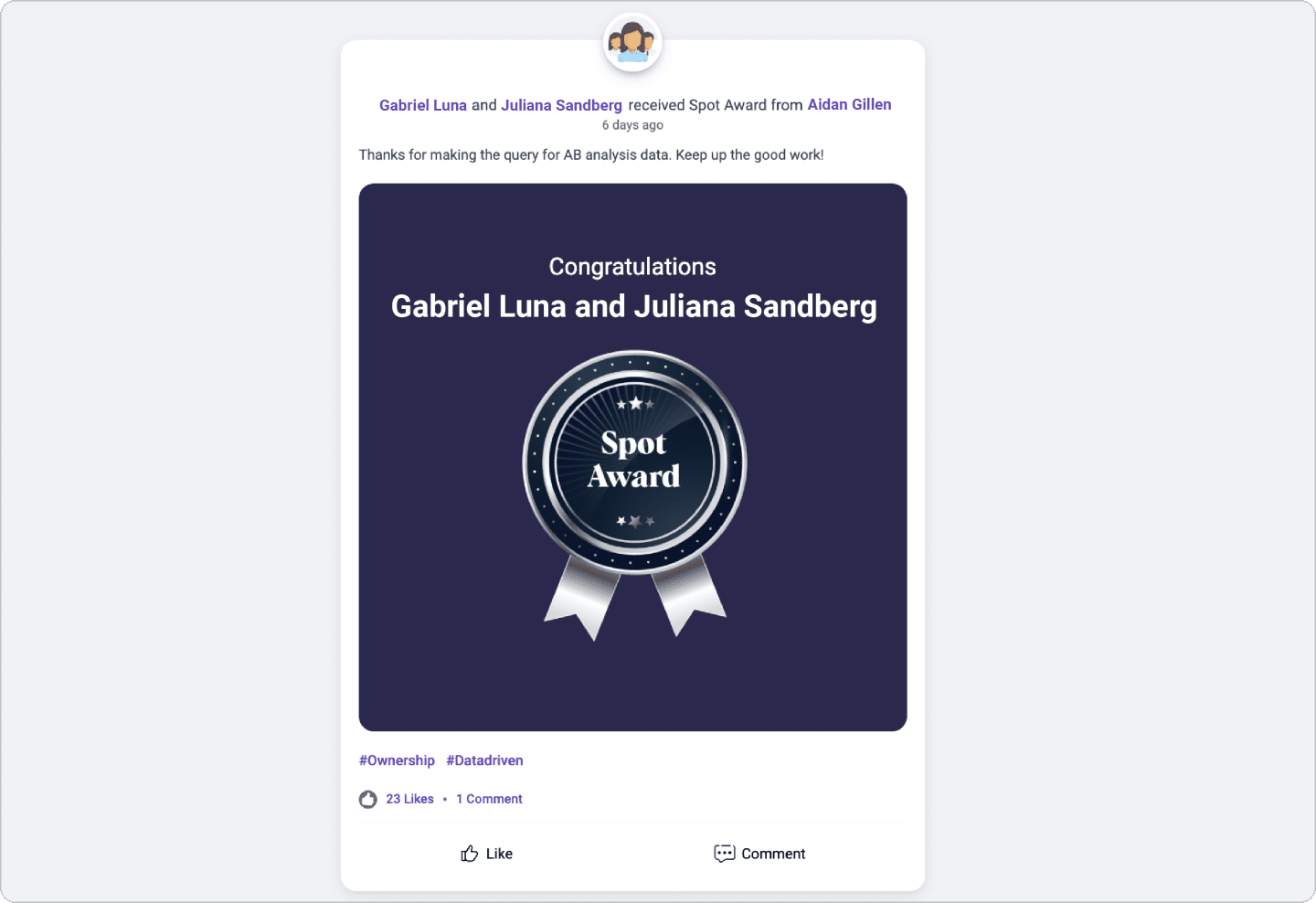
Spot awards offer instant recognition for exceptional work or going above and beyond. They can be monetary (e.g., small bonuses) or non-monetary (e.g., thank-you notes or team shout-outs) and should be given as close to the achievement as possible.
Source: Vantage Recognition
| Pros | Cons |
|---|---|
| Immediate and impactful | Requires discretion to avoid inconsistency |
| Reinforces desirable behavior quickly | Risk of favoritism if not tracked transparently |
| Boosts motivation in real time |
7. Training and Development Opportunities
What it is / How to do:
Providing access to courses, certifications, or workshops as a form of recognition. This shows investment in an employee’s growth rather than just rewarding past performance.
| Pros | Cons |
|---|---|
| Encourages continuous learning | May not feel like a “reward” to all employees |
| Appeals to career-driven employees | Requires planning and budget allocation |
| Builds long-term value for both company and employee |
8. Public Recognition
What it is / How to do:
Public recognition involves celebrating achievements in front of peers through meetings, newsletters, or on recognition platforms. It amplifies the recognition moment and creates ripple effects across teams.
| Pros | Cons |
|---|---|
| Boosts confidence and visibility | Not ideal for introverted employees |
| Reinforces cultural values company-wide | Risks of feeling performative if not genuine |
| Inspires others to achieve similar results |
9. Personalized Recognition
What it is / How to do:
Tailor your recognition based on the employee’s personality or preferences. This could be a favorite book, a handwritten note, a hobby-related gift, or even flexible work options.
| Pros | Cons |
|---|---|
| Feels thoughtful and meaningful | Takes more time and effort |
| Shows you know and value the individual | Can be hard to scale across large teams |
| Creates lasting emotional impact |
Employee Recognition Program Template: What to Put in It
A recognition program template is a one-page document that captures your objectives, eligibility rules, recognition types, budget, approval flow, and review cadence, so the program survives a change of HR leadership. Most programs live in someone's head and end when that person leaves.
Below is the template itself. Type your answers into the right-hand column, then download the whole thing as an editable document. Nothing you type leaves your browser.
Two fields do most of the work. Field 2 is what lets you defend the program a year in, and field 8 is what makes sure anyone looks. A program with no review date does not get reviewed, and a program nobody reviews quietly becomes a rewards catalog.
If you are not sure what to put in a field yet, leave it. The six-step build sequence further down works through each decision in order, and your answers here are saved as you go.
Employee Recognition Program Examples: What 4 Companies Actually Built
The programs worth studying are the ones with numbers attached. Below are four enterprise recognition programs, what each was designed to solve, and what it measurably changed. All four ran on Vantage Recognition, Vantage Circle's employee recognition platform, so the participation figures are drawn from platform data rather than survey recall.
Wipro: Getting recognition to 57% of a 200,000-person workforce
Scale is the enemy of recognition. Wipro's problem was reach, not intent. The program was designed so that any associate could recognize any other associate without routing through a manager, which removed the bottleneck that keeps large-company recognition concentrated among the visible few.
The result was 57% of associates covered by recognition, and recognition activity running at one recognition every 1.2 minutes across the organization. The program won Brandon Hall Gold in 2023.
L&T Technology Services: 93% participation by making it a habit
Participation rates tell you whether a program is a system or a poster. LTTS focused on frequency and manager enablement rather than on award ceremonies.
93% of employees participated in the program, and 83% received recognition rather than only giving it. That second number is the one most programs miss. It is easy to get enthusiastic givers; it is hard to make sure recognition actually lands on everyone. Brandon Hall Gold, 2024.
Tata Communications: 185% growth in peer recognition
Tata Communications had manager-led recognition already working. What was missing was the peer layer, which is where most day-to-day contribution is visible.
Shifting emphasis to peer-to-peer recognition produced 185% growth in peer recognition volume. Brandon Hall Gold, 2024.
DHL: 74% active participation across a distributed frontline
Frontline and distributed workforces are the hardest population to reach, because they are not sitting at a desk with the intranet open. DHL's program had to work on a phone, in a warehouse, between shifts.
74% of registered employees actively participated, with 60% classified as active platform users. For a deskless population, that is the number that matters.
| Company | Program shape | Measured outcome | What made it work |
|---|---|---|---|
| Wipro | Any-to-any peer recognition at scale | 57% coverage; 1 recognition every 1.2 minutes | Removed the manager bottleneck |
| L&T Technology Services | High-frequency, manager-enabled | 93% participated; 83% received recognition | Measured receiving, not just giving |
| Tata Communications | Peer layer added to manager-led base | 185% growth in peer recognition | Recognized what peers could see and managers could not |
| DHL | Mobile-first for a deskless workforce | 74% active participation; 60% active users | Met the workforce where it actually works |
Notice what none of these programs led with. Not a rewards catalog, not a budget, not an annual awards night. Each one started with a specific reach problem and designed backwards from it.
What are the Benefits of an Employee Recognition Program?
Recognition programs deliver four measurable categories of return: higher productivity, lower turnover, stronger engagement, and a more durable culture. The size of that return depends far more on recognition quality than on recognition volume.
An employee recognition program is more than just about handing out rewards. It’s about creating a culture that thrives on appreciation. When employees feel valued, it leads to a host of benefits that go far beyond just good vibes. Let’s dive into some of the key advantages that come from recognizing your team.
1. Enhanced Productivity
Employee recognition directly impacts productivity. When employees are regularly acknowledged for their efforts, they feel motivated to continue performing at their best. This creates a positive cycle where recognition fuels more work, and more work leads to more recognition.
Gallup's Q12 meta-analysis, which pooled 183,806 business units across 53 industries and 90 countries, found the most engaged teams are 18% more productive than the least engaged. Recognition is one of the strongest levers on that engagement.
A simple “thank you” or a public acknowledgment can go a long way in ensuring that employees feel invested in their work and motivated to put in their best effort every day.
Recognized employees frequently have a stronger personal connection to their job and coworkers, which leads to improved effort and higher productivity.
Recognized employees also stay. That connection is covered in detail in the next section.
2. Increased Employee Retention and Lower Turnover
One of the biggest challenges organizations face is retaining their top talent. High turnover rates cost money and break up working teams, and recognition plays a big part in improving employee retention. When employees feel appreciated, they’re less likely to look for new opportunities elsewhere.
In fact, Gallup's research found that well-recognized employees are 45% less likely to change organizations after two years. This can save your organization money and effort spent on recruitment and training. Plus, it helps foster a loyal and engaged workforce.
The cost of replacing someone is significant, and it varies sharply by role. Gallup puts it at roughly 40% of salary for frontline workers, 80% for technical roles, and 200% for leaders and managers.
Companies can save considerable resources on hiring, training, and transitional inefficiencies by reducing turnover.
3. Boosted Employee Engagement
Engagement is the level of emotional commitment employees have to their work and their organization. Recognition is a key driver of engagement. Employees who feel appreciated are more likely to be engaged, leading to improved performance and a more vibrant company culture.
When employees are regularly recognized, they feel like their contributions matter. This boosts their commitment to their work, which, in turn, leads to a greater sense of purpose and satisfaction. Engaged employees are more productive, more innovative, and less likely to burn out.
The same Gallup meta-analysis found the most engaged business units are 23% more profitable than the least engaged, alongside 78% lower absenteeism and 32% fewer quality defects.
4. Strengthened Company Culture and Values
Recognition programs are an excellent way to reinforce your company’s culture and core values. When recognition is tied to specific behaviors that align with the company’s mission, it helps employees understand what’s important and what they should strive to achieve.
Quality matters more than frequency here. Gallup's recognition research found that employees whose recognition met all four of its quality markers were nine times as likely to be engaged as those whose recognition met none. Recognition that ignores what someone actually values does not land, however often it arrives.
By celebrating the behaviors and actions that reflect your company’s values, you create an environment where these values are celebrated by your employees. This strengthens the overall culture and ensures everyone is working toward a common goal.
5. Improved Employer Brand and Attractiveness
Recognition doesn’t just benefit current employees. It can also enhance your company’s reputation in the job market. When employees are regularly recognized, they are more likely to share their positive experiences, which helps boost your employer brand.
Organizations known for recognizing and valuing their employees tend to attract top talent. Research from LinkedIn Talent Solutions has long put the share of job seekers who check an employer's brand before applying at around 75%, and more recent LinkedIn talent trends data puts it higher still.
A strong employer brand attracts top talent who want to work for a company that values its people. If your recognition program is well-known, it can help you stand out from competitors and make your organization more appealing to potential hires.
How to Create and Implement an Employee Recognition Program
Building a recognition program takes six steps: set objectives, align to values, set the budget, write the policy, launch with manager training, then measure and iterate. Skipping step one is the most common reason programs fade by month three.
It does not happen overnight. It takes planning, clear objectives, and genuine buy-in from leadership. Where most programs fail is not the design, it is the follow-through after launch week.
Here is the sequence, in the order that actually works.
Step 1: Laying the Foundation: Strategic Planning
To build a successful recognition program, you need a solid foundation. This step involves setting objectives, aligning the program with your company culture, budgeting, and laying out clear policies. Without these elements, your program may lack direction and sustainability.
1.1 Setting Clear Objectives
What it is about:
This step involves defining SMART (Specific, Measurable, Achievable, Relevant, Time-bound) goals for your recognition program and identifying key performance indicators (KPIs) to track progress.
Why it’s required:
Clear objectives ensure your recognition program has purpose, direction, and measurable outcomes. Without them, it’s difficult to assess the program’s effectiveness or gauge success.
How to implement it:
Start by having meetings with key stakeholders to understand the needs of the organization. Document the program’s goals and create measurable KPIs. For example, track employee engagement, recognition frequency, and participation rates to measure success.
1.2 Aligning the Program with Company Culture
What it is about:
Align your recognition program with your company’s core values, behaviors, and attitudes. This step ensures that the recognition you give reflects the culture you want to promote. Our guidance on building an employee recognition strategy covers how to make that alignment concrete rather than aspirational.
Why it’s required:
A program that aligns with company culture feels authentic and motivates employees to exhibit the desired behaviors. This creates a strong sense of connection between employees and the organization.
How to implement it:
Review your company’s values and mission statements. Conduct workshops with employees to understand what behaviors align with those values.
When aligning your program with company culture, consider using Vantage Circle's AIRe framework as your foundation. This proven framework ensures your recognition efforts incorporate all four essential elements:
- Appreciation for acknowledging contributions both big and small,
- Incentivization to motivate desired behaviors,
- Reinforcement to guide employees toward company values, and
- Emotional Connect to make recognition feel authentic and meaningful rather than transactional.
By building your recognition criteria around the AIRe framework, you create a comprehensive approach that goes beyond simple rewards to foster genuine cultural alignment and employee engagement.
Then, integrate these behaviors into your recognition criteria and messaging.
1.3 Allocating a Budget
What it is about:
Plan a budget that ensures your program has the necessary resources to be effective and sustainable. This step ensures that the program’s impact is long-lasting and supported by the organization.
Recommended Read: Employee Recognition Budget: How Much to Spend (With Industry Benchmarks)
Why it’s required:
A recognition program without a budget may lack the resources to deliver meaningful rewards and can feel disorganized. Allocating funds demonstrates the company’s commitment to recognizing its employees.
How to implement it:
Research the costs of different recognition methods, whether that is gift cards, bonuses, or recognition tool subscriptions. Create a detailed budget and secure approval from stakeholders.
Budget conversations stall when the number is a guess. Model the program cost against the turnover it is meant to prevent using our recognition ROI calculator, which uses role-segmented replacement costs rather than a blanket multiple.
1.4 Outlining Clear Policies and Guidelines
What it is about:
Develop policies and guidelines to ensure your recognition program is fair, consistent, and legally compliant.
Why it’s required:
Clear guidelines prevent confusion, ensure fairness, and keep the program aligned with regulations. Without these policies, the program could become inconsistent or biased.
How to implement it:
Write a comprehensive policy document that outlines the program’s purpose, eligibility criteria, and recognition procedures. Ensure it complies with labor laws and distribute the document to all employees.
1.5 Forming a Recognition Committee
What it is about:
Assemble a diverse committee of employees and management representatives to guide the development and implementation of the recognition program. Getting manager participation right at this stage is what determines whether the program survives its first quarter.
Why it’s required:
A committee ensures that the program reflects different perspectives, making it more relevant to all employees. It also fosters collaboration and strengthens the program’s overall impact.
How to implement it:
Invite employees from various departments and levels within the company. Define their roles clearly, hold regular meetings to discuss the program’s development, and ensure that everyone is on the same page.
Step 2: Understanding Your Employees: Tailoring the Program
Once you have the foundation in place, it’s time to tailor the program to meet your employees’ needs and preferences. Let’s explore how to create a recognition program that truly resonates with your team.
2.1 Talking to Employees about Their Preferences
What it is about:
Gather feedback from employees on how they prefer to be recognized. This ensures that the recognition you offer is meaningful and resonates with them.
Why it’s required:
Without employee input, your recognition efforts may fall flat. Understanding what types of recognition are valued most helps you create a more personalized, engaging program.
How to implement it:
Use surveys, focus groups, or one-on-one conversations to gather data on employees’ preferences. This will help you understand whether they prefer public recognition, private praise, or tangible rewards.
2.2 Developing Clear Criteria for Employee Recognition
What it is about:
Create clear, objective criteria for employee recognition that align with your company’s values and goals.
Why it’s required:
Clear criteria ensure that recognition is fair and consistent. Employees will be more motivated when they understand the specific actions or behaviors that lead to recognition.
How to implement it:
List specific, observable behaviors or achievements that should be recognized. Align these criteria with your company values and provide clear examples to ensure transparency.
Step 3: Implementing and Maintaining the Program
This phase is where the real work begins. It is not just about launching your program. It is about ensuring it runs smoothly, stays relevant, and keeps employees engaged.
3.1 Effective Communication
What it is about:
Communicating the details of your employee recognition program clearly and frequently is essential to ensure everyone is aware of how it works and how they can participate.
Why it’s required:
Clear communication ensures that all employees understand the purpose of the program and how they can get involved. If employees don’t know about the program or how to use it, it won’t be effective.
How to implement it:
Develop a communication plan that includes multiple channels: emails, company newsletters, and team meetings. Host a launch event to introduce the program, explain its goals, and provide guidance on how to participate. Regular reminders, such as internal announcements or updates, will keep the program top of mind.
3.2 Establishing Clear Channels for Recognition
What it is about:
Setting up simple and accessible platforms or tools for employees to give and receive recognition. Whether it’s an online tool or a specific location where recognition takes place, these channels should be easy for everyone to use.
Why it’s required:
To encourage participation and make recognition easy, you need a user-friendly platform or method for employees to send and receive praise. The simpler the process, the more likely it is that employees will engage with it.
How to implement it:
Implement a recognition platform or integrate with existing communication tools like Slack or Microsoft Teams. Ensure it’s intuitive and easy to use. Provide training and resources to help employees understand how to give and receive recognition on the platform.
3.3 Empowering Employees to Recognize Each Other
What it is about:
Encourage employees to participate in peer-to-peer recognition, where they can recognize and praise their colleagues for their efforts. This fosters a positive, inclusive culture. Share a few peer-to-peer recognition ideas to help them get started.
Why it’s required:
Peer recognition is powerful because it helps build stronger relationships between colleagues and reinforces a team-oriented culture. When employees recognize each other, it strengthens trust and collaboration.
How to implement it:
Promote peer-to-peer recognition by offering training or workshops on how to give effective recognition. Provide templates for peer recognition messages, and track participation to ensure it’s being used regularly.
3.4 Increasing the Visibility of Recognition
What it is about:
Making recognition visible is a great way to amplify its impact. Publicly sharing recognition boosts morale and reinforces the behavior you want to see.
Why it’s required:
Public recognition makes employees feel proud and appreciated. It also encourages others to step up and perform better, as they’ll see that hard work is celebrated. This visibility can have a ripple effect, inspiring more employees to engage.
How to implement it:
Create public recognition boards, digital displays, or even highlight employee achievements in team meetings. You could also feature stories in company newsletters or on social media to further amplify the recognition.
3.5 Celebrating Key Moments in the Employee Journey
What it is about:
Recognizing milestones in an employee’s journey, such as work anniversaries, birthdays, or key project completions, helps employees feel valued throughout their time at the company.
Why it’s required:
Celebrating key moments reinforces the idea that employees are valued, not just for their daily work but also for their commitment to the organization. It shows employees that you care about them as individuals, not just as workers.
How to implement it:
Develop a system to track important employee milestones. Create personalized messages, small gifts, or celebrations for each milestone. This could include team lunches, a company-wide email, or a personalized note from management.
3.6 Getting Started Designing the Program Based on Employee Feedback
What it is about:
Before launching your program across the entire organization, start with a pilot program. Gather feedback from a small group of employees to refine the program before full implementation.
Why it’s required:
Feedback from employees ensures that the program is well-received and truly meets their needs. Starting small helps identify potential issues and allows you to make adjustments before rolling it out company-wide.
How to implement it:
Select a small group of employees from different departments to test the program. Gather feedback through surveys or focus groups to determine what’s working and what could be improved. Use this feedback to refine the program before scaling it up.
Step 4: Monitoring and Evaluation
Once your recognition program is up and running, it’s time to track its effectiveness and ensure it delivers on its goals. Regular evaluation helps you stay on course and make improvements where needed.
4.1 Monitoring and Reviewing the Program’s Effectiveness
What it is about:
Regularly assess how well your recognition program is performing. Tracking KPIs and gathering feedback will help ensure the program is meeting its objectives and driving the desired outcomes.
Why it’s required:
Monitoring the program’s effectiveness allows you to make data-driven decisions about what’s working and what isn’t. It helps you identify areas for improvement and fine-tune your approach to maximize impact.
How to implement it:
Track key performance indicators (KPIs) such as employee engagement, recognition participation, and employee satisfaction. Use surveys, feedback forms, and analytics tools to gather insights. Regularly review these metrics with leadership to ensure the program aligns with broader organizational goals.
Where AI Fits into a Modern Recognition Program
AI in recognition splits into two categories: assistive, where it helps a human write better recognition, and automated, where it triggers recognition without a human deciding. The first works. The second is where programs get into trouble.
The failure mode of most recognition is not frequency, it is specificity. "Great job on the launch" tells someone nothing about what they did well, so it lands as noise. Writing specific recognition takes effort that busy managers do not have at 6pm on a Thursday.
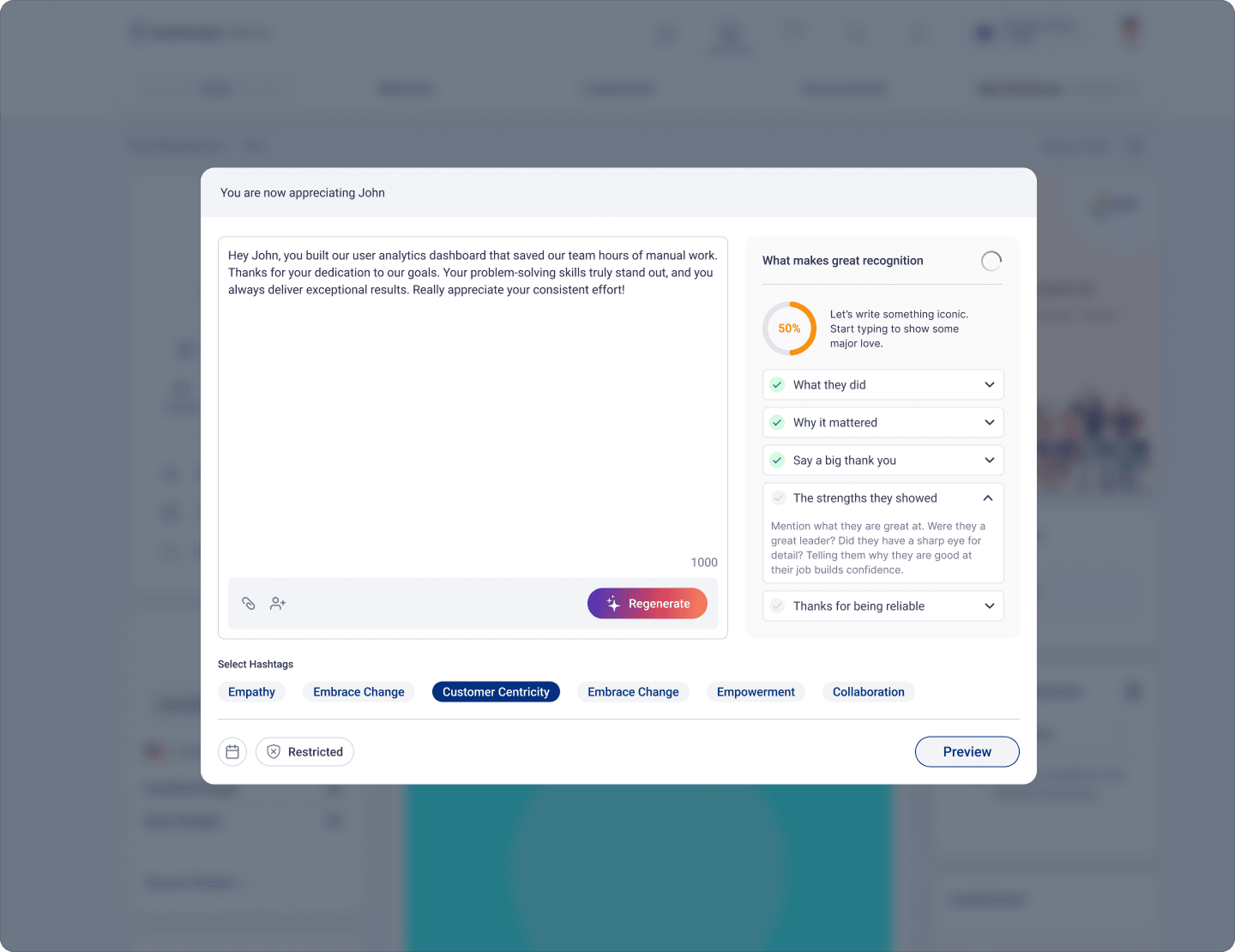
That is the problem assistive AI actually solves. Vantage Recognition's composer prompts the giver for what the person did, why it mattered, and which strengths they showed, then scores the message before it sends. The human still decides who deserves recognition and why. The tool only stops them sending something generic.
Automated recognition is a different matter. A system that fires a message on every closed ticket produces recognition nobody values within about three weeks, because everyone understands that no judgment was involved.
We cover the distinction, and where the line should sit, in more depth in our post on AI in employee recognition.
Source: Vantage Recognition
How to Measure Whether Your Program is Working
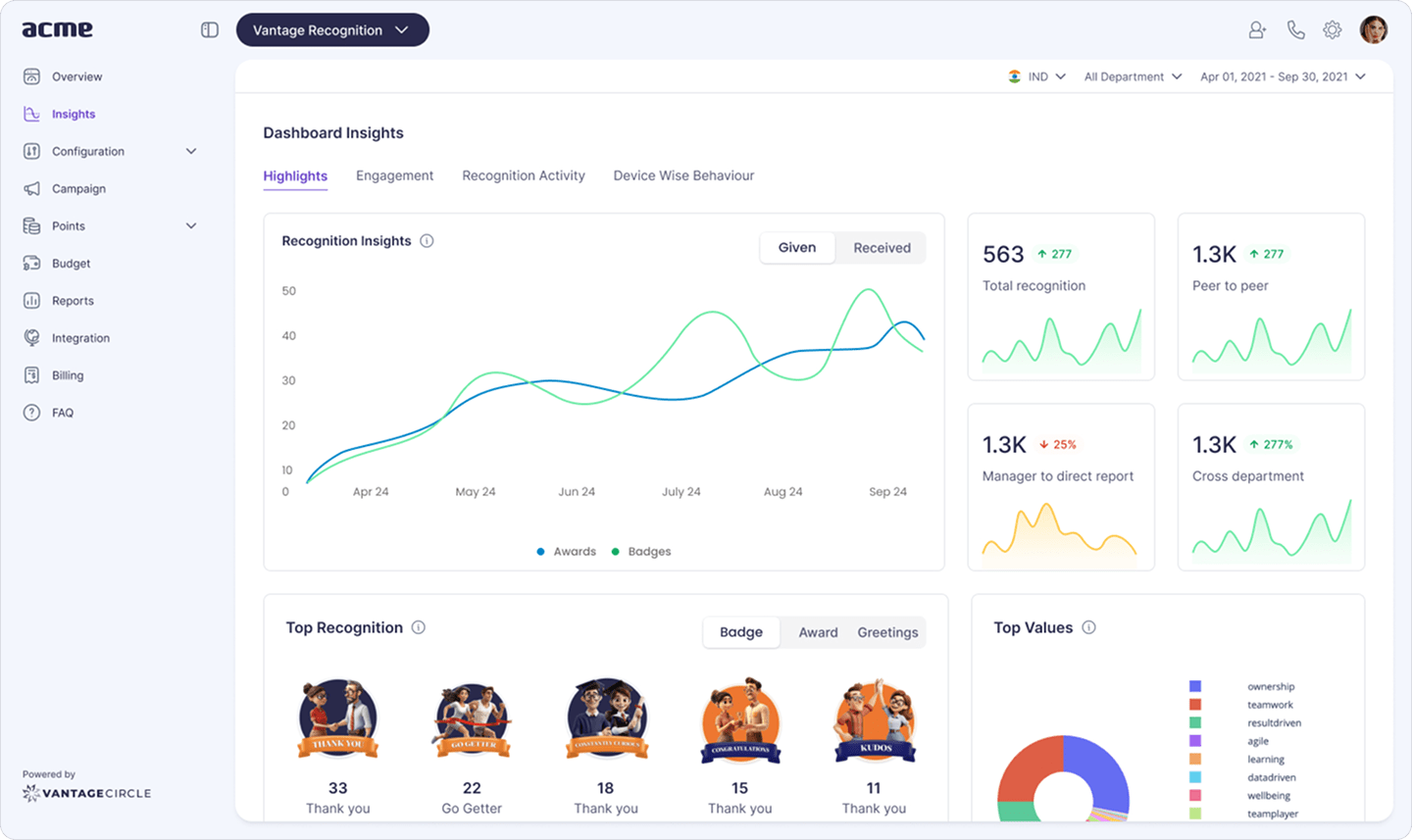
Measure a recognition program on three layers: activity, reach, and sentiment. Activity alone is the number most programs report and the least useful one, because a high total can hide the fact that the same twenty people are recognizing each other.
| Layer | What to track | Why it matters | Review cadence |
|---|---|---|---|
| Activity | Recognitions sent, budget used, campaign participation | Tells you the program is running at all | Monthly |
| Reach | Giver coverage, receiver coverage, cross-department ratio, teams with zero activity | Tells you whether recognition is reaching everyone or pooling | Quarterly |
| Sentiment | eNPS, recognition-specific survey items, exit interview themes | Tells you whether the activity is actually landing | Half-yearly |
Receiver coverage is the number worth arguing about in a leadership meeting. It answers a question most HR teams cannot: what percentage of employees received any recognition at all last quarter? At L&T Technology Services that figure was 83%. If yours is below half, you have an enthusiastic minority rather than a program.
For the benchmarks to hold that number against, see our guidance on setting recognition program benchmarks and the recognition program KPIs worth tracking.
Source: Vantage Recognition
Avoiding Common Mistakes in Your Employee Recognition Program
Five mistakes account for most failed recognition programs: treating all employees the same, inconsistent criteria, fragmented departmental efforts, no organization-wide framework, and rewarding only outcomes while ignoring behaviours.
Even with the best intentions, many recognition programs fall flat due to a few common missteps. Here’s how to steer clear of them and build a more effective, inclusive system of appreciation.
1. Avoiding a One-Size-Fits-All Approach
The first mistake you can make is assuming all employees value the same type of recognition.
How to Avoid:
Conduct surveys or one-on-one conversations to understand individual preferences. Offer a variety of recognition options (e.g., public praise, gift cards, experiences, professional development). Empower managers to personalize recognition based on their team members' unique needs and interests.
2. Inconsistency in Recognizing Behaviors
Recognition efforts that are irregular, subjective, or based on favoritism can cause more harm than good.
How to Avoid:
Establish clear criteria for what kinds of behaviors or achievements merit recognition. Train managers and leaders to spot and reward these consistently. Use a platform or centralized system to ensure recognition is timely and fairly distributed across teams.
3. Consolidating Fragmented Programs
Having multiple, disconnected recognition efforts running in silos across departments.
How to Avoid:
Unify your efforts under one comprehensive recognition strategy. Bring various department-specific initiatives into alignment with your company-wide goals and values. A centralized recognition platform can help streamline the process and increase visibility and consistency.
4. Avoiding Independent Programs within Departments in Larger Organizations
When different departments run their own programs independently, it can lead to inequity and confusion.
How to Avoid:
Create a core recognition framework that applies organization-wide. Departments can still personalize their approach, but it should ladder up to a common structure. This avoids disparities and ensures every employee receives equal opportunities for recognition, regardless of their team or role.
5. Rewarding Only Performance
Focusing solely on metrics and outcomes, while overlooking behaviors, collaboration, or values-driven actions.
How to Avoid:
Recognize more than just results. Celebrate effort, teamwork, innovation, and values-aligned behaviors. A well-rounded program appreciates both what employees achieve and how they achieve it, fostering a healthier and more inclusive culture.
Summing Up
Employee recognition is a strategic tool that fosters a culture of appreciation, trust, and growth. When executed thoughtfully, a well-designed recognition program does much more than boost morale. It drives engagement, enhances productivity, strengthens company culture, and helps retain top talent.
The key to a successful program is consistency, personalization, and alignment with your company’s values and goals. By recognizing both big and small contributions, you make every employee feel valued and motivated. This ultimately creates a thriving workplace where everyone is empowered to do their best work.
FAQs
What is an employee recognition program?
An employee recognition program is a structured system for acknowledging employee contributions consistently, rather than leaving appreciation to individual managers. It defines who can recognize whom, which behaviours qualify, how recognition is delivered, and how success is measured. The structure is what separates a program from occasional praise.
How do you create an employee recognition program?
In six steps. Set an objective tied to a business outcome and record a baseline. Align the qualifying behaviours to your company values. Set a budget covering both rewards and platform costs. Write the policy and eligibility rules. Launch with manager training, not just an announcement. Then measure activity, reach, and sentiment on a fixed cadence and adjust.
How do you implement an employee recognition program successfully?
Implementation succeeds or fails on manager enablement. Most programs launch well and fade by month three because managers were told the program exists but never shown how to use it or held accountable for using it. Train managers before launch, give them a recognition budget they control, and report participation by team so the gaps are visible.
What makes a good employee recognition program?
Specificity and reach. Recognition that names what someone did and why it mattered lands; generic praise does not. Reach means checking receiver coverage, not just total volume, because a high activity number can hide the same small group recognizing each other while most of the workforce receives nothing.
What’s the most important factor of a recognition program?
The most important factor is authenticity. Recognition should feel genuine, timely, and aligned with the values and goals of the company. Employees can sense when recognition is forced or insincere, so make sure it’s always meaningful and connected to real contributions.
How effective are employee recognition programs?
Effective, but only when the recognition itself is good. Gallup's research found well-recognized employees were 45% less likely to have left after two years, and that employees whose recognition met all four of Gallup's quality markers were nine times as likely to be engaged as those whose recognition met none. Frequency alone does not produce those results. Recognition that is specific, timely, and tied to something the person actually values does.
How much does employee recognition cost?
It varies widely depending on the approach. Peer-to-peer praise and verbal acknowledgment cost nothing. Monetary rewards, points-based systems, and custom gifts need a budget line. A commonly used planning benchmark is 1 to 2 percent of payroll, though what you actually need depends on headcount, how much of the program is monetary, and whether you are running it on a platform or manually. Set the budget against the cost of the turnover you are trying to prevent, which runs from roughly 40 percent of salary for frontline roles to 200 percent for managers.

Nilotpal M Saharia is an Assistant Manager, Content Marketing at Vantage Circle and a recognition-and-rewards (R&R) strategist with 9 years of experience spanning Marketing, HR, and content strategy. He helps HR leaders turn employee recognition and leadership research into practical workplace programs.
Connect with Nilotpal on LinkedIn.