
A standard employee recognition budget sits at 1–2% of payroll, or $200–$2,000 per employee per year, depending on where your program is in its maturity. Startups typically start at 0.5–1% of payroll. Mid-market companies settle into 1–2%. Enterprises running structured programs with milestone awards as a core layer allocate 1.5–4%. The right number isn't universal. It depends on your headcount, your turnover risk, and how much of your recognition program is structural versus reactive.
The table below gives you a starting point by company stage. These are working benchmarks pulled from programs across industries. They're not aspirational targets.
| Company Stage | % of Payroll | $/Employee/Year | Best Allocation Model |
|---|---|---|---|
| Startup (<100 employees) | 0.5–1% | $200–$500 | Occasion-based (spot awards + milestone) |
| Mid-market (100–1,000 employees) | 1–2% | $500–$1,200 | Per-head + occasion hybrid |
| Enterprise (1,000–10,000) | 1.5–3% | $1,000–$2,000 | Payroll % with milestone weight |
| Large enterprise (10,000+) | 2–4% | $1,500–$2,500+ | Multi-tier with service awards as anchor |
Here's the thing about employee recognition budgets - most companies treat them like an afterthought. "We'll figure it out later" or "let's see what's left over" becomes the strategy.
That's backwards thinking.
Your recognition budget isn't just a line item on a spreadsheet. It's a strategic lever that drives engagement, reduces turnover, and shapes company culture.
Get it right, and you'll see measurable returns in productivity and retention. Get it wrong, and you're literally throwing money away.
The workplace reality check? Companies with strong recognition programs see 31% lower turnover according to recent research. Meanwhile, replacing a skilled employee costs 1.5x their annual salary. Do the math - investing in recognition isn't optional anymore.
Here's what you'll walk away with from this guide:
Key Takeaways
- How to calculate the right recognition budget for your company?
- Cost-effective recognition strategies that actually work
- Practical approaches for remote and hybrid teams.
- Plus, real industry benchmarks.
What is a Good Employee Recognition Budget?
Most companies allocate 1–2% of payroll to employee recognition programs. The right budget depends on your goals, workforce size, and culture. In this guide, we'll show how to calculate your recognition budget and ensure it drives engagement. The goal is impact, not just added expense.
But that's just the starting point. Let's dig into what really matters.
What is an Employee Recognition Budget?
Let's cut through the corporate speech. An employee recognition budget is simple - it's the money you set aside to tell people "Hey, you did great work, and we notice."
(Source: Vantage Recognition)
Sounds basic, right? But here's the thing most companies get backwards. They treat recognition budgets like they're buying office supplies - just another line item to keep as small as possible.
Wrong approach.
Your recognition budget isn't money disappearing into a black hole. It's fuel for your company's culture. It's what turns "just another job" into "a place where I actually want to work."
Think about the last time someone genuinely recognized your good work. Remember that feeling? That's what you're buying with a recognition budget - not just the gift card or bonus, but that feeling of being seen and valued.
A Gallup study found that employees who get well-rounded recognition are 4.4 times more likely to find real purpose in their work.
Here's what actually happens when you recognize someone properly. They walk a little taller. They tell their friends about their awesome workplace. They stick around longer. And - this is the part that gets me excited - everyone else watches and thinks "I want to work somewhere that appreciates people like that."
That ripple effect? That's not the cost. That's a compound interest in culture.
Your recognition budget covers the obvious stuff - bonuses, gift cards, team lunches, and anniversary awards. But it also includes the behind-the-scenes pieces that make recognition actually work. The platform to track it. The training so managers don't just say "good job" and call it a day. The time to do it right.
Bottom line: A recognition budget is your company putting its money where its mouth is. It's saying, "we value good work" and backing it up with real investment, not just empty words in a company meeting.
How Much Should You Spend? (With Benchmarks)
Alright, let's talk numbers. Because "we should do more recognition" sounds great until someone asks, "how much more?"
The standard benchmark you'll hear everywhere is 1-2% of total payroll (SHRM). That's your starting point, not your ending point. In reality, companies spend anywhere from 0.5% to 4% depending on their industry, culture, and how serious they are about retention. Comparing your number against recognition program benchmarks by company size keeps it grounded.
Here's what one should follow:
- Industry Median: 1.5% of payroll
- Low end: 0.5-1% (often companies just getting started)
- Sweet spot: 1.5-2.5% (most successful programs)
- High performers: 3-4% (companies with recognition as core strategy)
But the percentages don't tell the whole story. Let me show you how this plays out in real-world companies.

Tata Realty
Why it Works
- Built a centralized R&R platform that enables real-time appreciation
- Recognition linked to core values (e.g. Integrity Champion, Leadership Champion), reinforcing culture
- Enabled fair recognition across all employee levels with better visibility
- 66% rise in total employees rewarded and 90% program coverage
- 10,700+ recognition moments since launch
- Easy reward distribution for activities like quizzes, festive events, and milestones
- Backed by analytics for managers to drive performance through recognition

ACG
Why it Works
- Onboarded a centralized R&R platform to strengthen peer recognition across the organization
- Made recognition transparent and accessible to employees at every level
- Paired manager-driven points with badges to balance monetary and non-monetary appreciation
- 66% rise in peer-to-peer recognition after onboarding Vantage Circle
- Backed by analytics that give HR visibility into engagement and program health

Wipro
Why it Works
- Integrated Wipro's 5 Habits of Culture directly into the recognition framework
- Empowered business units to customize R&R within a consistent global structure
- Automated personalized service-milestone awards across a massive, dispersed workforce
- 97.5% increase in peer recognition and 553,490+ total awards in two years
- Recognition happening roughly once every 1.2 minutes, reaching 57% recognition coverage
- Wipro's Winners' Circle program won the Brandon Hall Gold Award 2023
The key isn't hitting an exact percentage - it's finding the sweet spot where your investment drives real engagement without breaking the bank.
The case studies mentioned here are in-house studies done by our team and the numbers hold true to their value.
Things to Include in Your Recognition Budget
Most recognition budgets are built backwards. You pick a number, throw it at Employee Appreciation Day, and hope for the best.
Here's the reality check: 66% of employees who quit say lack of appreciation was a major reason for leaving. Yet most companies treat recognition as an afterthought, not a strategic investment.
The problem? Most HR teams underplan their recognition budgets because they focus on one-off rewards or single events. You plan a company picnic, order some branded swag, and call it a day.
But that's event planning, not a recognition strategy.
Recognition Throughout the Employee Lifecycle
Smart leaders know better. Recognition should be embedded throughout the employee journey, not just the highlight reel moments.
Think about it - your employees interact with your company culture every single day. From their first day on the job to their last team meeting, each touchpoint is an opportunity to reinforce values and drive behavior.
Research from Gallup shows that employees who receive regular recognition are 5x more likely to stay and 3x more likely to feel engaged. But "regular" doesn't mean "expensive."
Your recognition budget should mirror your employee experience. Every interaction is an opportunity to make people feel valued, not just the annual celebration.
The Most Important Budget Categories
Here's the breakdown of what actually matters when you're allocating your employee recognition budget:
1. Onboarding Recognition
New hires form lasting impressions in their first 90 days. Yet most companies spend zero on recognition during this critical period.
What to budget for:
- Welcome packages that feel personal, not generic.
- First-week achievement recognition.
- 30-60-90 day milestone acknowledgments.
- Manager training on new hire recognition.
Why it matters: Employees who feel recognized in their first month see the culture as positive. This helps them stay past their first year.
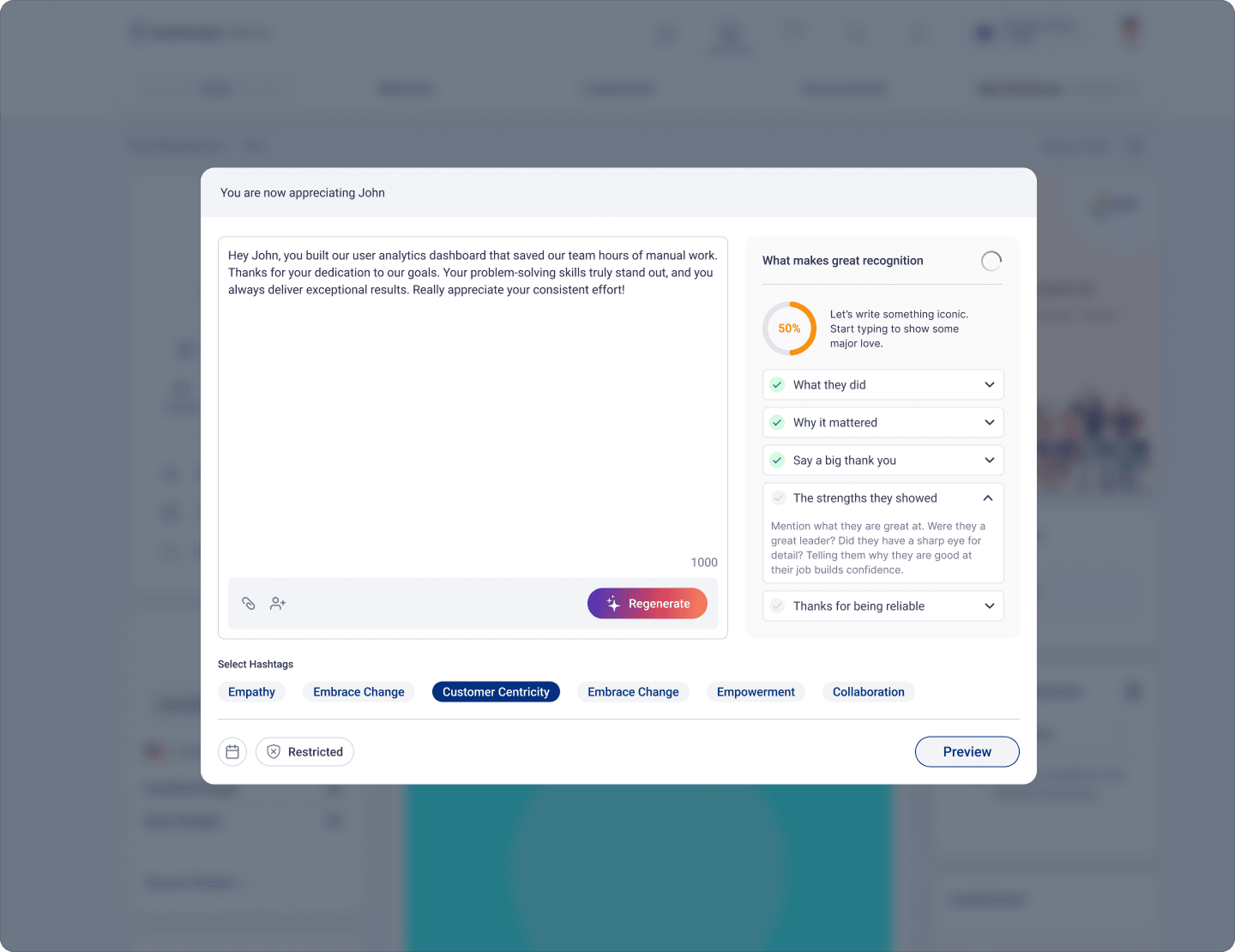
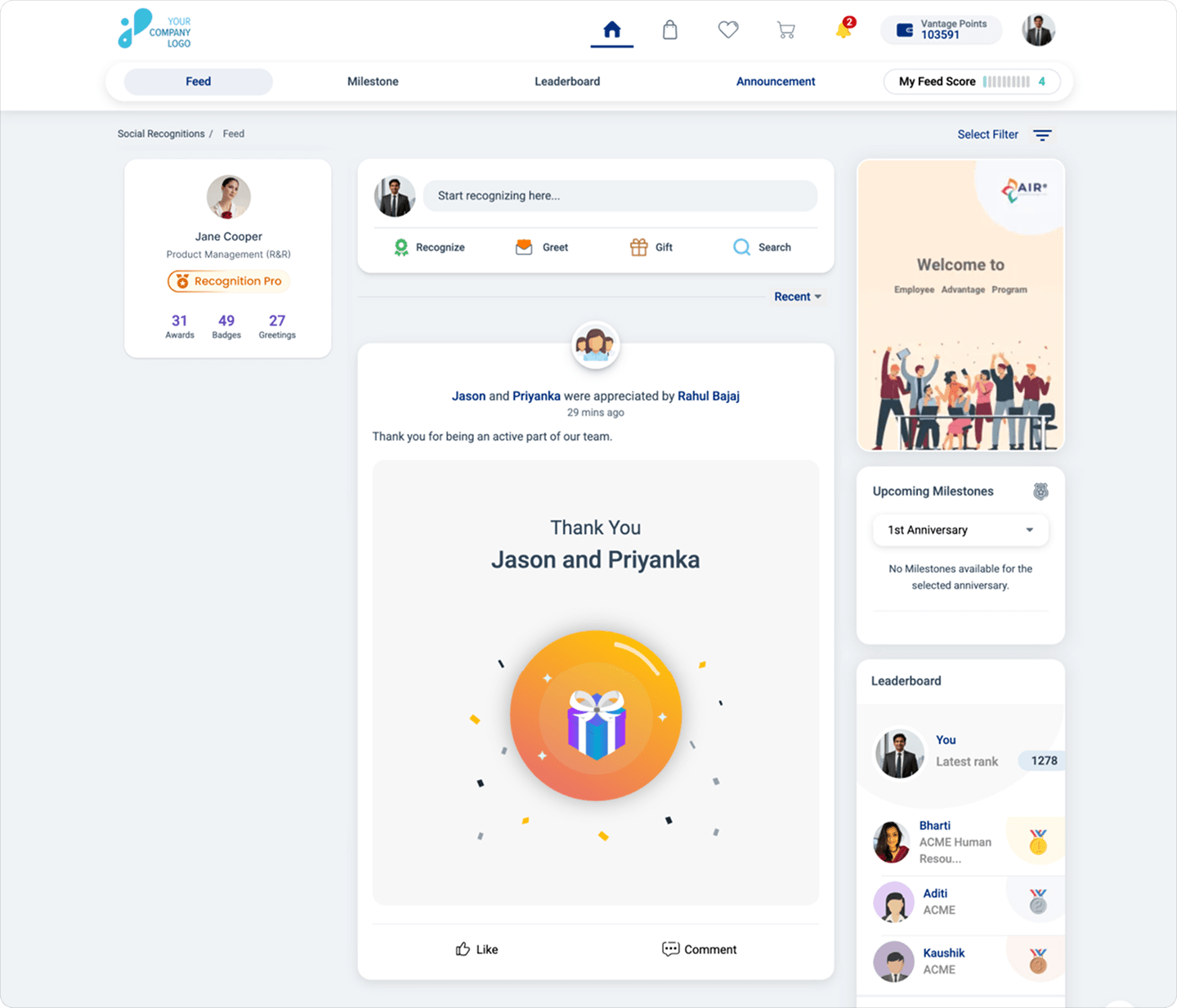
2. Peer-to-Peer & Real-Time Recognition
Your managers can't see everything. Your employees can. Peer recognition programs tap into the daily moments that matter most.
(Source: Vantage Recognition)
What to budget for:
- Digital platform subscriptions.
- Small-value reward options ($25-100).
- Recognition training for all employees.
- Monthly peer recognition events.
The multiplier effect: One peer recognition moment typically generates 3-4 additional recognition actions within the same team.
Recommended Resource: Empower the Workforce With A Culture of Peer-to-Peer Recognition
3. Milestone & Goal-Based Recognition
Performance-driven recognition aligns individual achievement with business results. It's recognition with ROI.
(Source: Vantage Recognition)
What to budget for:
- Goal achievement rewards.
- Project completion recognition.
- Sales milestone celebrations.
- Innovation and improvement awards.
Pro tip: Tie recognition value to goal difficulty. Stretch goals deserve stretch recognition.
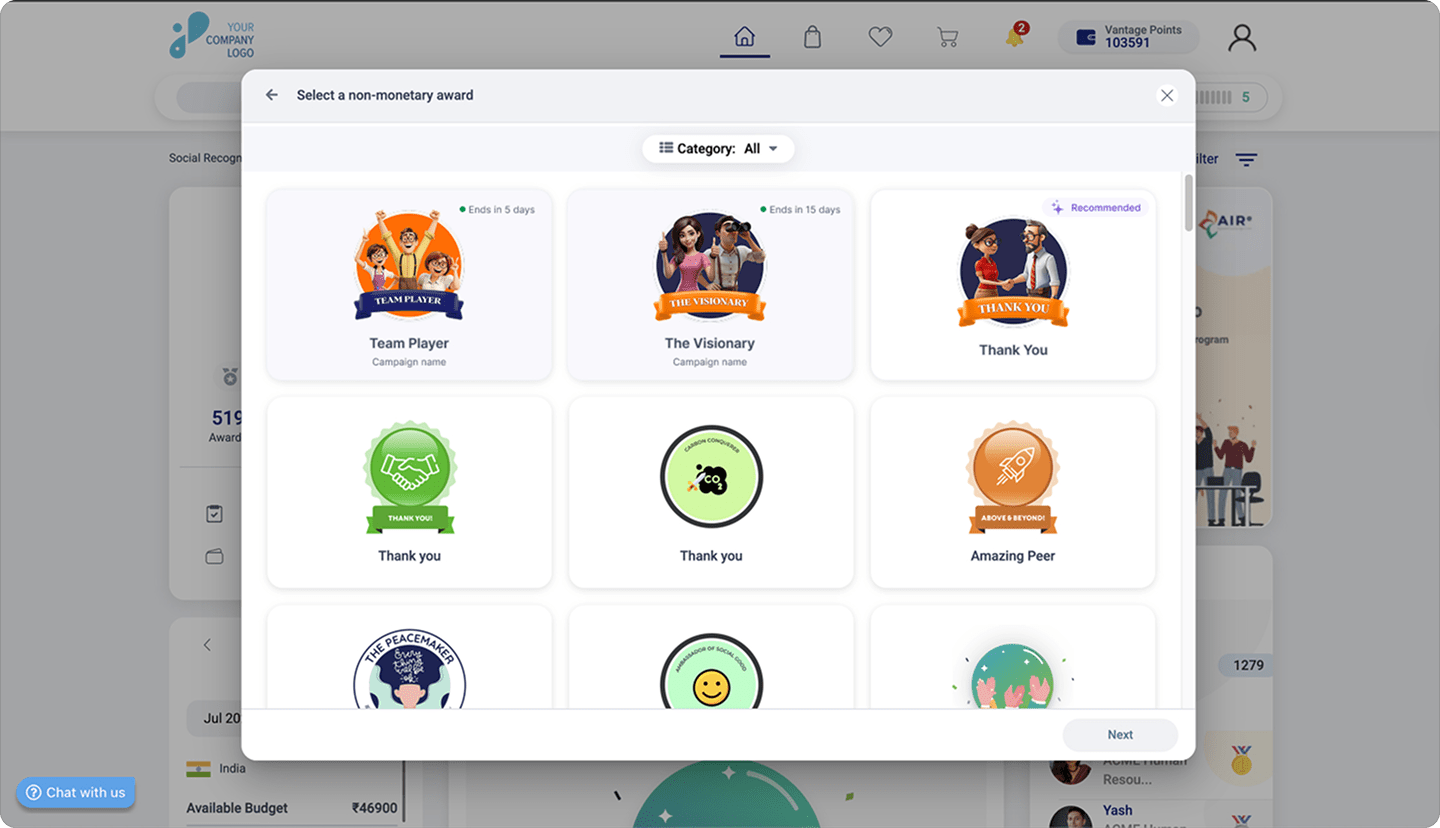
4. Values & Culture-Based Recognition
Recognition that reinforces your company values creates behavior change. It's how you build the culture you want, not just acknowledge the one you have.
(Source: Vantage Recognition)
What to budget for:
- Values-based award programs.
- Culture champion recognition.
- Leadership behavior modeling rewards.
- Cross-department collaboration recognition.
The ripple effect: Values-based recognition influences behavior across entire teams, not just individual recipients.
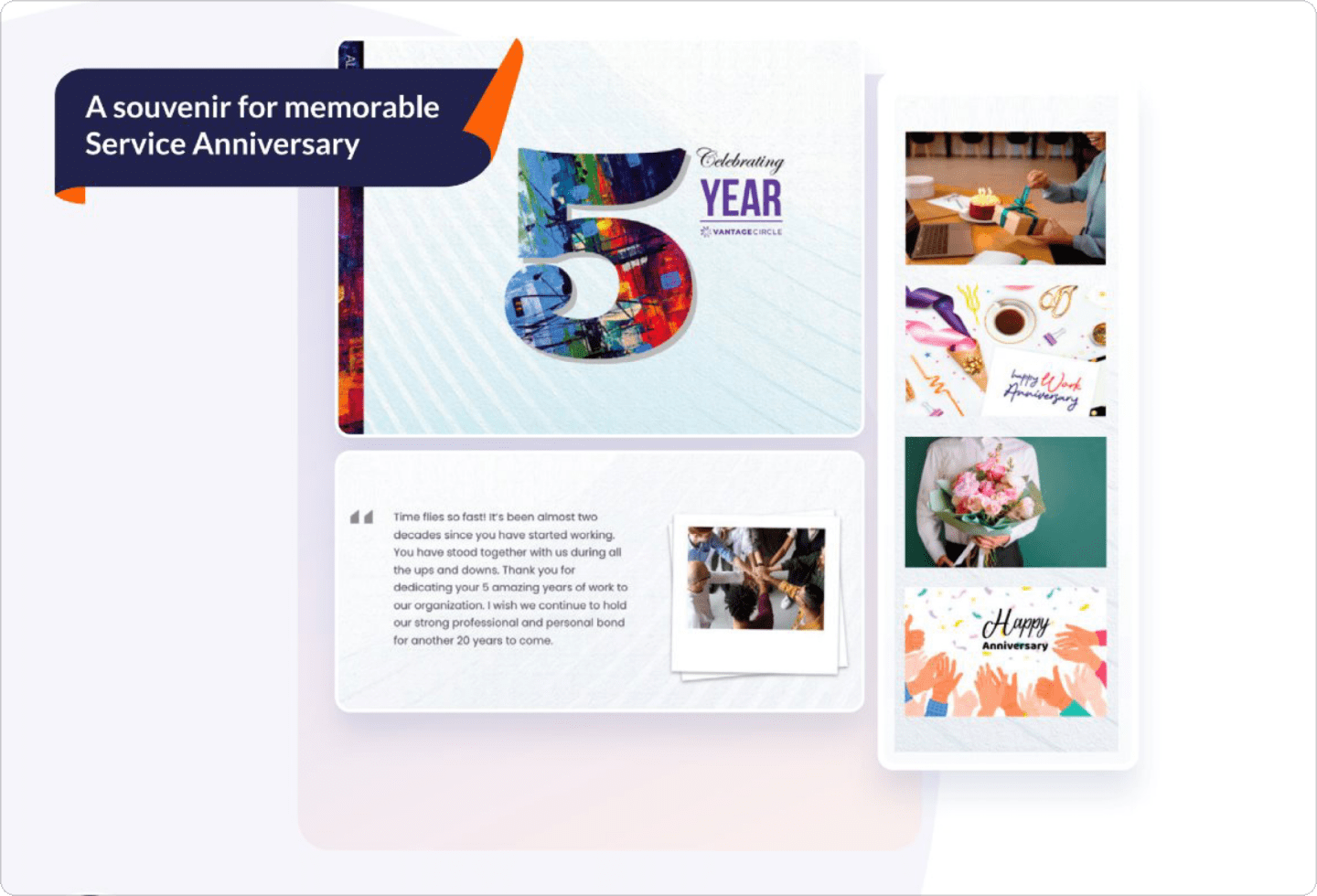
5. Service Anniversaries & Career Milestones
Traditional but still powerful. People want their tenure acknowledged, especially in today's job-hopping economy.
What to budget for:
- Anniversary gifts and experiences.
- Career progression celebrations.
- Retirement and transition recognition.
- Long-service award programs and service yearbooks.
Modern twist: Let people choose their recognition format - some want public celebration, others prefer private acknowledgment.
6. Company-Wide Celebrations
These are your culture moments. When done right, they create shared experiences that bind teams together.
What to budget for:
- All-hands achievement celebrations.
- Company milestone events.
- Team success parties.
- Virtual celebration platforms.
Key insight: The most memorable company celebrations recognize collective achievement, not individual performance.
7. Technology, Training & Enablement Costs
Recognition programs don't run themselves. You need systems, training, and ongoing support to make them work.
What to budget for:
- Recognition platform licensing.
- Manager training programs.
- Communication and marketing.
- Program administration costs.
Hidden truth: Most recognition programs fail because of poor execution, not inadequate funding.
8. Tax & Compliance Buffer
Recognition has implications for tax. Budget for them upfront or get surprised later.
What to budget for:
- Tax grossing up for cash awards.
- Compliance consulting.
- Legal review of program terms.
- Backup funds for unexpected costs.
Reality check: Every dollar you give in recognition might cost you $1.30 after taxes and compliance costs.
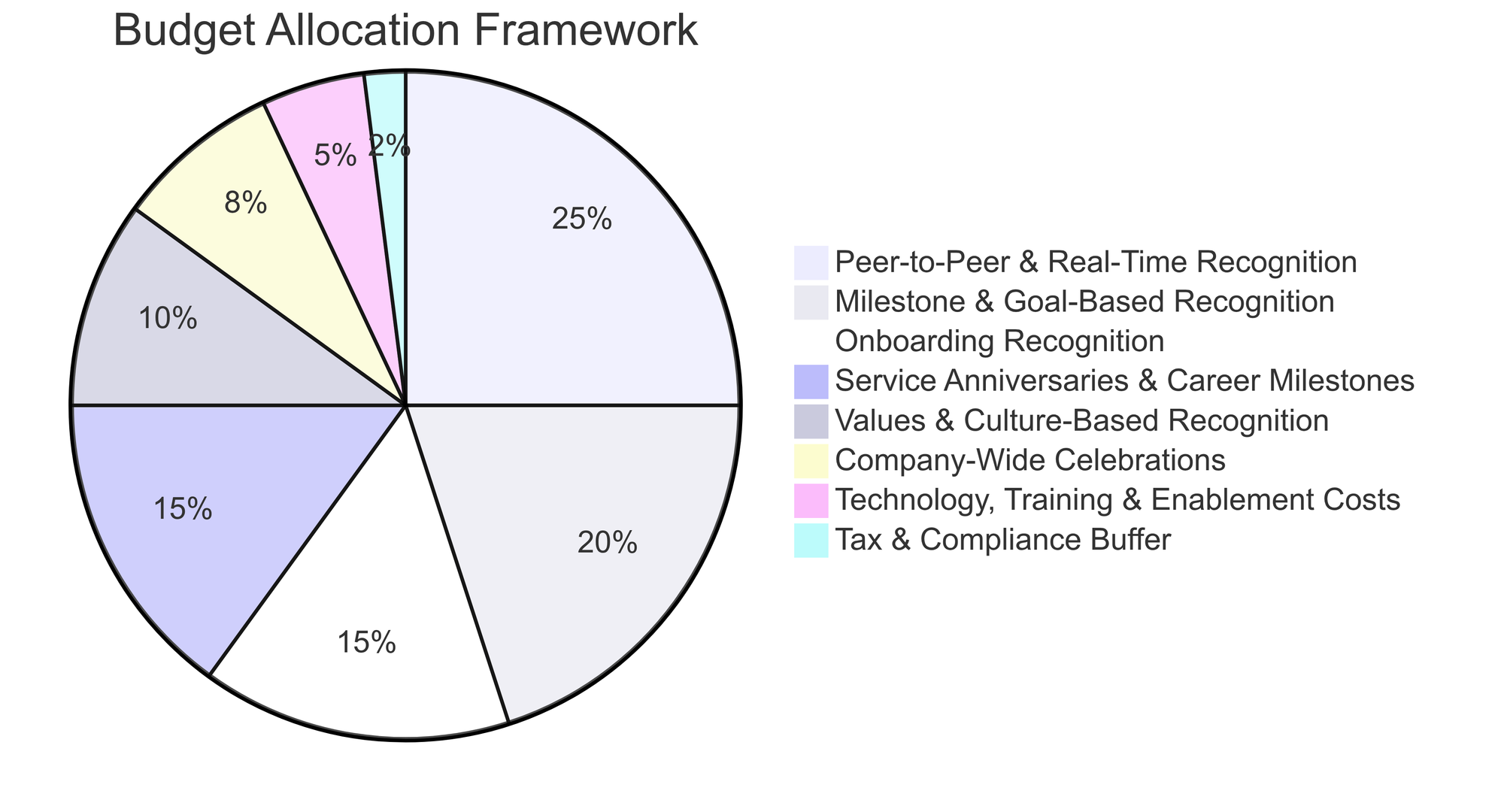
Recognition Budget Allocation Models
(Source: Vantage Recognition)
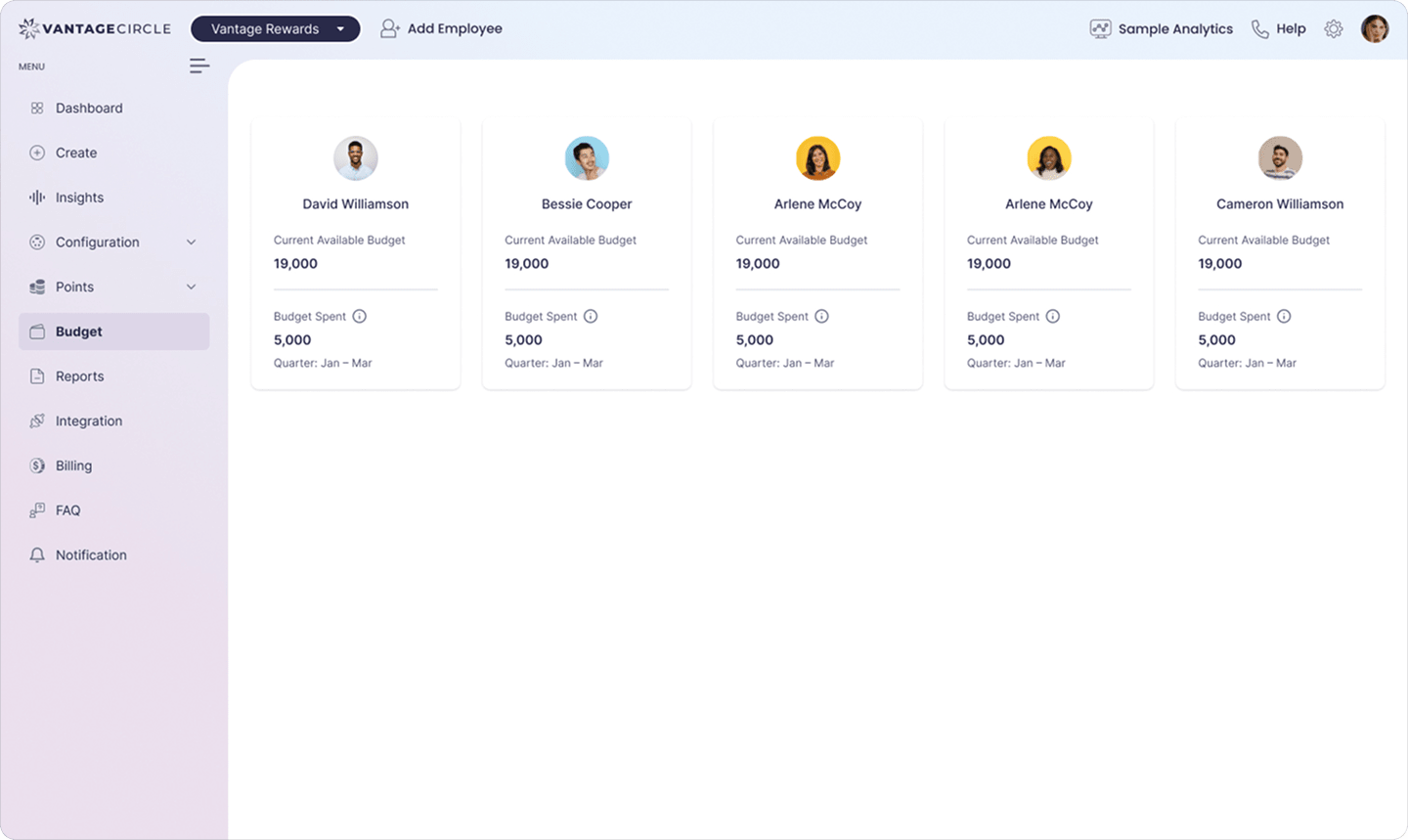
Now that you know what to include, how do you actually allocate the budget? There's no one-size-fits-all answer, but there are models that work.
The key is picking the right model for your company's maturity, size, and recognition philosophy.
Method 1: Payroll Percentage Model
This is the most common approach. You set aside a fixed percentage of your total payroll for recognition programs.
How it works: Calculate 1-3% of your annual payroll and allocate that to recognition. A company with $10M in payroll might budget $150K for recognition (1.5%).
The math is simple: As your team grows, your recognition budget scales automatically. No complex calculations or annual debates about "how much is enough."
When to use this model:
- Your company has predictable payroll growth
- You want recognition spending to scale with headcount
- You prefer simple, defendable budget calculations
- Leadership sees recognition as a standard HR investment
Method 2: Per-Head Allocation Model
Fixed dollar amount per employee, regardless of salary level. Every person gets the same recognition budget allocation.
How it works: Budget $500-2000 per employee annually for recognition. A 100-person company might allocate $75K total ($750 per person).
The philosophy: Everyone deserves equal recognition opportunities, regardless of their paycheck. It's democratic and fair.
When to use this model:
- You have similar roles/levels across the organization
- Company culture emphasizes equality over hierarchy
- You want predictable, easy-to-track spending
- Recognition focuses on effort and values, not just results
Method 3: Occasion-Based Allocation Model
Budget based on specific recognition moments and events throughout the year.
How it works: Map out all recognition occasions (birthdays, anniversaries, achievements, holidays) and budget for each. More complex but highly targeted.
The approach: $50 per birthday, $200 per work anniversary, $100 per goal achievement, $5K for company-wide celebrations.
When to use this model:
- You have well-defined recognition moments
- Company culture is built around specific traditions
- You want tight control over recognition spending
- Recognition is event-driven rather than continuous
Hybrid Models: The Best of Both Worlds
Most mature companies don't pick just one method. They combine approaches based on recognition type.
Example hybrid approach:
Base budget: 1% of payroll for core recognition programs
Per-head allocation: $300 per employee for peer recognition
Occasion-based: Fixed amounts for anniversaries and achievements
Why it works: You get the stability of payroll-based budgeting with the flexibility of targeted spending.
When to use hybrid models:
- You have diverse recognition needs
- Company culture values both equity and performance
- You want flexibility without chaos
- Leadership supports sophisticated recognition strategy
Choosing Your Model: Company Maturity Matters
Startup/Early-Stage Companies: Start with per-head allocation. You need simple, fair recognition that builds culture from day one.
Growing Companies: Move to payroll percentage. You want recognition to scale with your growth without constant budget battles.
Mature Companies: Consider hybrid models. You have the sophistication to balance multiple recognition goals and the data to optimize spending.
Enterprise Organizations: Occasion-based or hybrid models work best. You have defined processes and can manage complex recognition programs.
How High-Performing Programs Allocate Their Budget (2026)
Here's where most budget conversations stall. Companies know roughly how much to spend but have no disciplined framework for where that money actually goes. The breakdown below reflects how high-performing recognition programs are structuring their spend in 2026, based on program data and industry benchmarks.
| Recognition Category | % of Total Recognition Budget |
|---|---|
| Milestone & Service Awards | 30% |
| Peer-to-Peer Recognition | 20% |
| Manager-Driven Awards | 15% |
| Values-Tagged Recognition | 15% |
| Spot Bonuses + Time-Bound Campaigns | 20% |
The 30% milestone weighting surprises some HR leaders. It shouldn't. Service anniversaries, retirements, and work-aversaries are the highest-emotional-impact moments in an employee's tenure. They're also predictable, which means you can budget for them quarterly rather than scrambling at year-end. Vantage Recognition automates milestone awards across 100+ countries, which removes the manual coordination most HR teams consistently under-resource.
See It In Action
Want to see how recognition budgets, milestone awards, and peer recognition come together in one platform? Take a quick guided tour of Vantage Recognition.
Book a Demo →Budgeting for Remote and Hybrid Teams
Remote work broke the old recognition playbook. That cake in the break room? Nobody's there to eat it. The surprise team lunch? Half your team is three time zones away having dinner.
Here's what actually works when your people are everywhere:
Prioritize Digital Delivery Channels
Budget for: Recognition platforms, digital gift cards, virtual experiences, and mobile-first solutions.
The truth: Physical recognition gets lost in remote work. Digital recognition happens instantly and reaches everyone equally - whether they're in New York or New Delhi.
Smart allocation: Put 60-70% of your recognition budget into digital channels for remote teams. It's where your people actually are.
Account for Physical Logistics
Budget for: Shipping costs, international delivery, local fulfillment partners, and customs handling.
Reality check: Sending a $50 gift internationally can cost $30 in logistics. Suddenly that thoughtful gesture becomes an expensive headache.
Pro tip: Partner with local vendors in key markets. Your London team shouldn't wait two weeks for recognition that comes from your Dallas office.
Build for Flexibility and Choice
Budget for: Multi-option reward catalogs, personalized recognition experiences, and flexible value redemption.
Why this matters: Your remote developer in Bangalore wants something different than your sales rep in Miami. Choice beats one-size-fits-all every time.
Smart approach: Offer 3-5 recognition options at each value tier. Let people pick what actually matters to them.
Fund Virtual Celebrations and Rituals
Budget for: Virtual event platforms, online team experiences, digital celebration tools, and facilitation support.
The challenge: Creating shared moments when people never share the same space? That takes real effort and intentional investment.
What works: Budget $25-50 per person for virtual celebrations. Enough to make them feel special, not like another Zoom meeting they want to skip.
Support Manager Enablement in Remote Contexts
Budget for: Manager training programs, recognition coaching, digital recognition tools, and ongoing support resources.
The uncomfortable truth: Managers are terrible at remote recognition. They see less, connect less, and recognize less. They need help.
Key investment: Allocate 10-15% of your recognition budget to manager enablement. It multiplies the impact of everything else you do.
Bottom line: Remote recognition costs 20-30% more than in-person recognition, but the engagement impact is higher when done right. Your people notice when you put in the effort.
How to Track ROI?
(Source: Vantage Recognition)
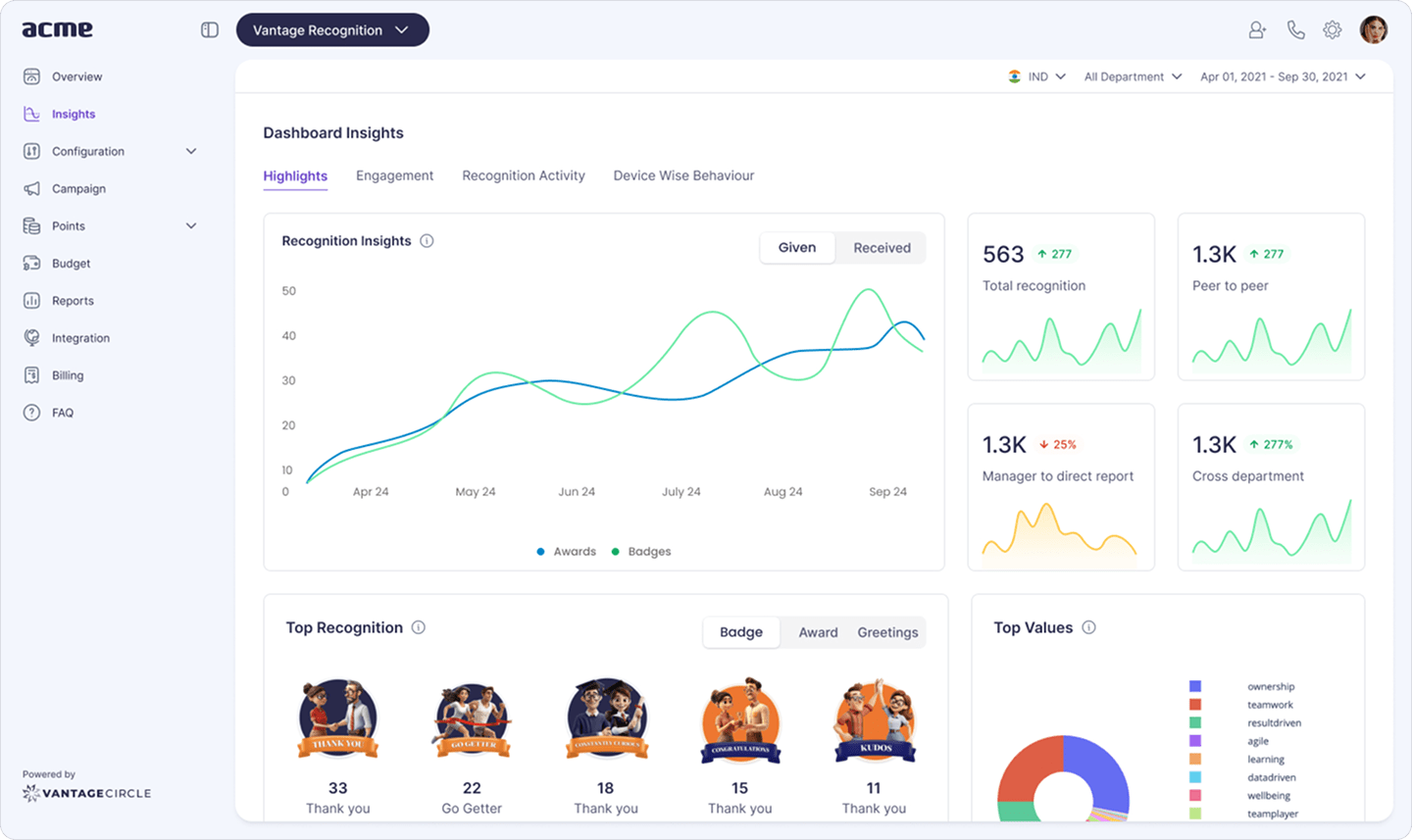
Here's the uncomfortable truth: most recognition programs can't prove their worth. You're spending money on feel-good initiatives while your CFO asks for hard numbers.
But recognition ROI is absolutely measurable. You just need to track the right stuff and actually look at the data.
Track the Key Metrics That Actually Matter
Employee Net Promoter Score (eNPS)
This is your recognition program's report card. One simple question: "How likely are you to recommend this company as a place to work?"
The connection: Employees who receive regular recognition score 31 points higher on eNPS. That's the difference between people who promote your company and people who trash it.
Retention Rates
Recognition programs should keep people from leaving. If they're not, you're wasting money.
What to track: Compare turnover rates between teams with high recognition vs. low recognition. The difference will shock you.
The benchmark: Companies with strong recognition programs see 31% lower voluntary turnover. If you're not hitting that, your program needs work.
Engagement Scores
Recognized employees are 5x more likely to be engaged. But engagement has to translate to business results, or it's just a feel-good metric.
Recognition Usage and Adoption
Your program only works if people actually use it. Track who's giving recognition and who's getting it.
The warning signs: If less than 70% of your managers are actively giving recognition, your program is failing. If recognition is concentrated in a few teams, you've got a culture problem.
Tools to Track Recognition Impact
Survey Tools
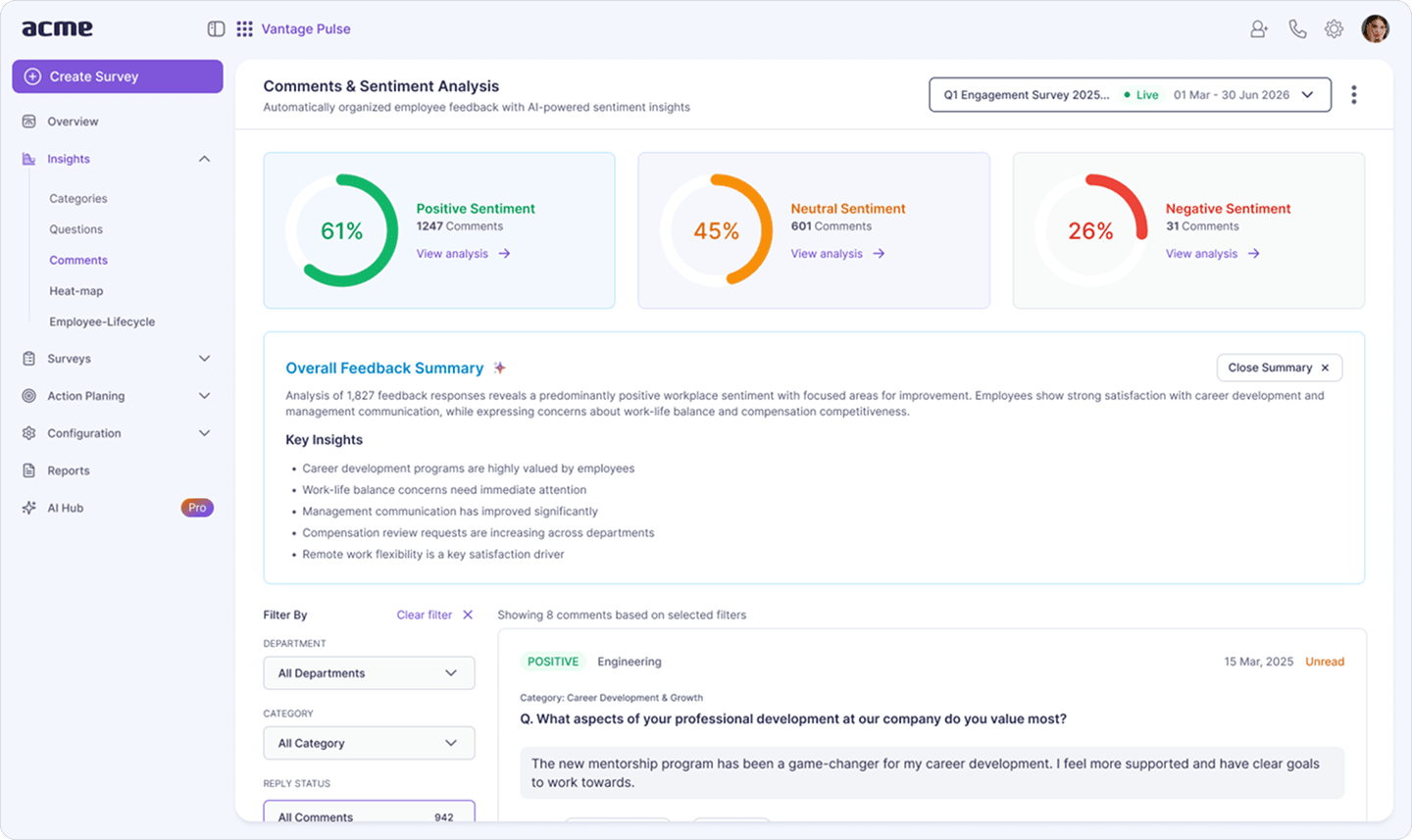
Pulse surveys: Monthly 2-3 question surveys that track recognition sentiment. Tools like Vantage Pulse or Glint make this easy.
(Source: Vantage Pulse)
Exit interviews: Ask about recognition experiences. You'll learn fast what's broken.
Recommended Resource: Exit Interview: What to ask and How to Prepare for it?
Platform Dashboards
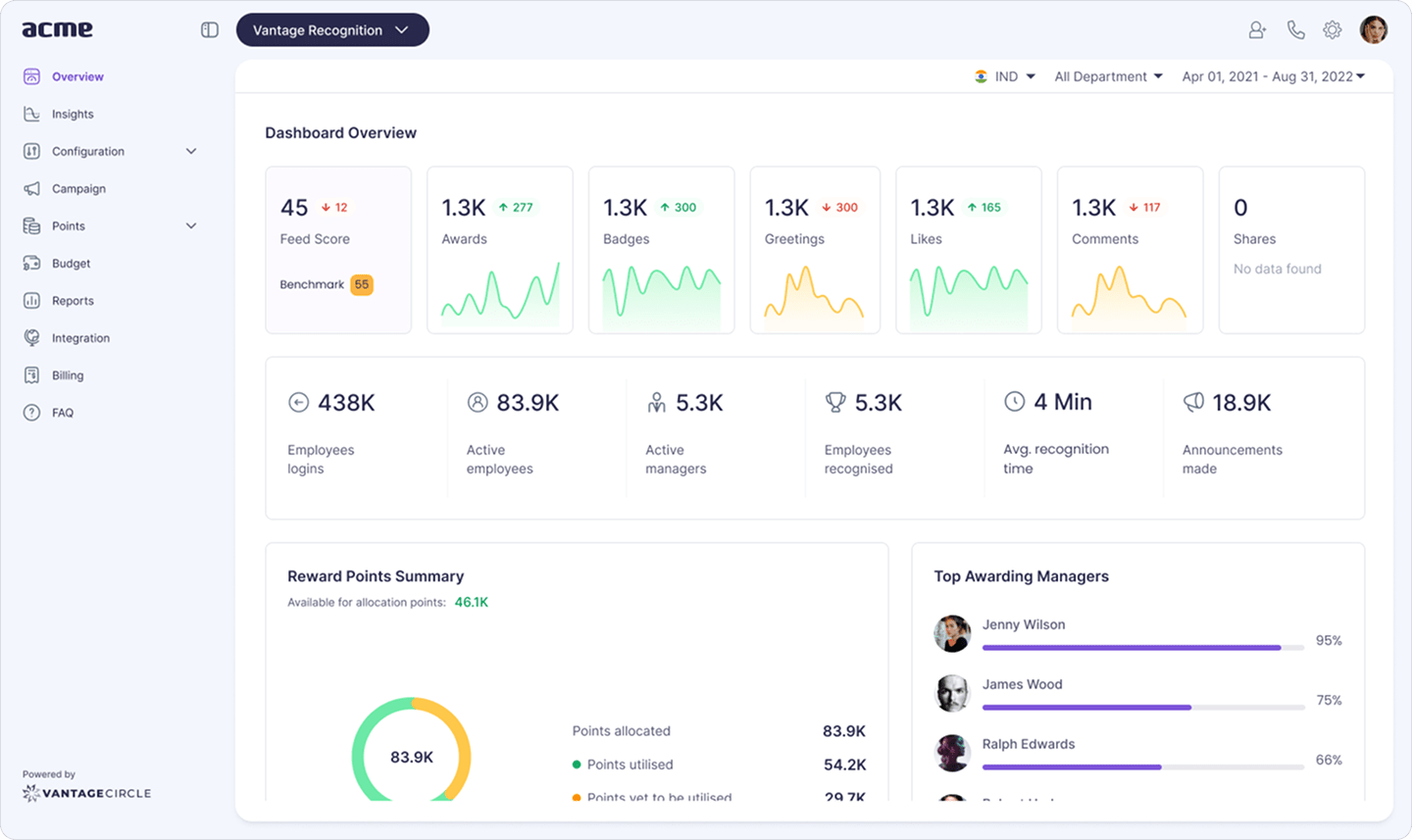
Recognition platform analytics: Most tools (like Vantage Circle) have built-in analytics. Use them to track usage patterns and manager effectiveness. If you're still evaluating options, our roundup of the best employee engagement software breaks down what to look for.
(Source: Vantage Recognition)
HRIS integration: Connect recognition data to your HR system. See how recognition correlates with performance and retention.
The key insight: Don't just track recognition activity - track recognition outcomes. Activity without impact is just busy work.
Reporting Frameworks That Drive Action
The Monthly Recognition Scorecard
Track these monthly and share with leadership:
- Recognition frequency per employee
- Manager participation rates
- eNPS trends
- Voluntary turnover rates
The Quarterly Business Review
Every quarter, show leadership:
- Total recognition spending and ROI
- Who's giving recognition, who's not
- Impact on retention and engagement
- What needs to change
The ROI Reality Check
Here's what good recognition ROI looks like:
- 20-30% reduction in voluntary turnover
- 15-25% higher engagement scores
- $4-6 return for every dollar invested
If you're not seeing these results, your recognition program needs work. The metrics don't lie - they just tell you what you need to fix.
The Strategic Takeaway
Your recognition budget should be as strategic as your hiring budget. Both are investments in the people who drive your business forward.
The companies winning the talent war understand this. They're not just recognizing good work - they're creating systems that make good work more likely to happen.
Recognition isn't an HR program - it's a business strategy. Budget for it accordingly.
Frequently Asked Questions
Q1. How much should you spend on employee recognition?
A: Most organizations spend 1–2% of total payroll on employee recognition. SHRM recommends a minimum of 1% of payroll as a baseline. Programs below this threshold tend to produce recognition that feels token rather than meaningful, and the engagement lift simply doesn't materialize.
Q2. What percentage of payroll should go to employee recognition?
A: The standard range is 1–2% of payroll for mid-market and enterprise organizations. Startups and early-stage companies often start at 0.5–1% and scale as headcount grows. Companies running structured milestone programs typically land between 1.5–3%. That tier treats service awards as a formal budget category. [Source: SHRM; Vantage Circle Recognition Index 2026]
Q3. What is a good recognition budget per employee?
A: A per-employee budget of $200–$2,000 per year covers most program types. The lower end ($200–$500) works for occasion-based, informal programs. Structured programs with milestone awards, peer recognition, and values-based incentives typically require $800–$1,500 per employee annually to feel substantive. Anything below $150 per employee per year tends to produce symbolic recognition without measurable engagement impact.
Q4. How do you budget for employee recognition?
A: Start with your total payroll figure and apply the 1–2% benchmark to get your baseline number. Then allocate by category: milestone and service awards (30%), peer-to-peer recognition (20%), manager-driven awards (15%), values-tagged recognition (15%), and spot bonuses or campaigns (20%). Build milestone awards as a fixed line item since those dates are known in advance. Leave 15–20% of your total budget as a flexible pool for campaigns and reactive moments.
Q5. What does an employee recognition program cost?
A: Program costs vary by type and platform. A basic recognition program with e-cards and manager shoutouts costs almost nothing to run. A full-platform program covering peer recognition, milestone awards, a global rewards catalog, and analytics typically runs $2–$8 per employee per month in platform fees, plus your actual rewards budget on top. For a 500-person company spending 1.5% of a $25M payroll, that's roughly $375,000 per year in total program cost. That figure covers platform fees plus rewards.
Q6. How do you calculate ROI on employee recognition?
A: Track three numbers: recognition coverage (what percentage of employees received recognition in a given period), turnover rate among recognized versus unrecognized employees, and engagement score delta year-over-year. If your recognition coverage is above 80% and your turnover rate among recognized employees is measurably lower, your program is generating positive ROI. The harder calculation is translating that retention lift into dollars saved. Multiply your number of prevented exits by 1.5x the average annual salary to estimate replacement cost avoided. [Source: Gallup, 2024]

He has worked in the human resources environment and has elevated recognition and rewards through his insightful and detailed writing. He aims to enhance the practice of Recognition in the workplace with new ideas and innovation that will help shape the work culture. For any related queries, contact editor@vantagecircle.com