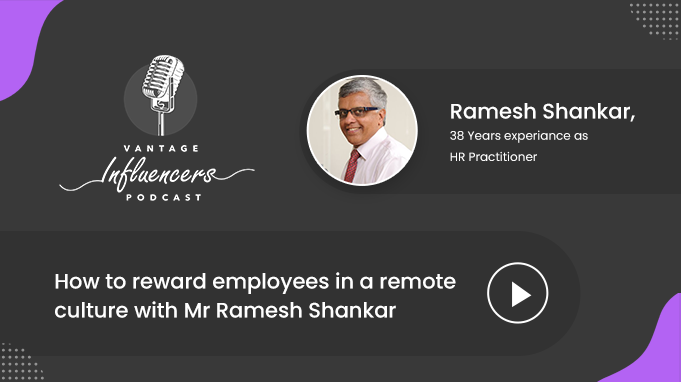
How to reward employees in a remote culture with Mr Ramesh Shankar
Episode Overview
Ramesh Shankar draws on a 38-year HR career, spanning steel, automobiles, FMCG, and engineering companies, including Britannia, ABB, and Siemens, to make a simple but often ignored case: recognition is not a nice-to-have, it is one of the few employee engagement levers that costs almost nothing and works in good times and in a crisis. He argues that remote work strips away the casual, in-person cues managers used to lean on, a hallway comment, a lunch-table thank-you, so the emotional distance workers feel has to be closed on purpose, through a phone call, a note, or a small gesture of appreciation, instead of assumed to happen by itself.
His sharpest point comes from two personal examples he uses to show that gratitude beats cash. At Siemens, he let a young employee redesign the annual recognition event so that, instead of naming a best performer, staff nominated a family member or friend who had shaped their life and handed that person a signed, framed letter of thanks; the response, dozens of calls from mothers and neighbours calling it the best gift they had ever received, convinced him that recognition budgets matter far less than sincerity. He repeats the point with his own habit of writing short, handwritten appreciation notes for employees he heard good things about, a five-minute letter, laminated and hand-delivered, that people kept and took selfies with, proof that in a remote or hybrid workplace, a manager's attention is worth more than a bonus.
Episode Highlights
- Recognition costs little but delivers more emotional impact than monetary rewards, especially during a crisis or remote work, when employees feel physically and emotionally distant from their teams.
- A framed, personally signed letter of appreciation, handed to family members nominated by employees, generated an outsized response: dozens of calls thanking the company for the best gift a relative had ever received.
- Handwritten, personalized notes of appreciation, even brief ones, create a stronger emotional connection than templated or purely public recognition programs.
- Remote work demands more self-discipline from employees and clearer, outcome-based targets from managers, rather than reliance on visible activity or constant availability.
- Hiring priorities have shifted toward attitude and resilience over formal qualifications, since skills can be taught but adaptability and grit are harder to develop later in a career.
- Millennials and Gen Z employees value flexibility, defined outcomes, and frequent, informal recognition over monetary rewards or rigid processes.
About the Guest
Ramesh Shankar, Founder, Hrishti; former Head of HR, Siemens South Asia
Ramesh Shankar built a 38-year HR career across steel, automobile, FMCG, and engineering companies, including stints at Britannia and ABB, before becoming Head of HR for Siemens' South Asia cluster, based in Mumbai, until his retirement in 2019. After retiring, he founded Hrishti (Sanskrit for joy), a social enterprise through which he coaches, trains, and mentors HR professionals and organizations, while directing his post-retirement earnings toward causes such as preventing avoidable blindness.
Connect with Ramesh Shankar on LinkedIn
Host
Rohit, Vantage Influencers Podcast Host
What You Will Learn
- Why recognition matters more, not less, in a remote or crisis-hit workplace, and how to keep it going without a travel budget or in-person events.
- How to design a low-cost recognition gesture, like a personal letter or a family shout-out, that leaves a lasting emotional impression on employees.
- What separates high-potential hires from the rest: why attitude and resilience often outweigh formal qualifications or credentials.
- How managers can protect work-life boundaries on remote teams by setting clear outcomes instead of monitoring visible activity.
- What Gen Z and millennial employees actually want from an employer: flexibility, purpose, and frequent, informal recognition over money.
- How one HR leader is using his post-retirement career to mentor others and give back through Hrishti.
Key Topics & Timestamps
| Timestamp | Topic |
|---|---|
| 00:00 | Introduction to Ramesh Shankar |
| 00:37 | Ramesh's 38-year journey through HR, from steel and mining to Britannia, ABB, and Siemens |
| 05:44 | The top qualities recruiters should hire for: skill versus attitude |
| 08:51 | Why rewards and recognition matter even more in remote work |
| 15:46 | Shifts in hiring strategies over the past decade |
| 18:25 | How technology is changing hiring and recognition |
| 20:01 | Balancing work and life remotely without hurting productivity |
| 25:19 | What millennials and Gen Z actually want from employers |
| 29:20 | Founding Hrishti, a joy-focused social enterprise |
| 32:36 | Advice for young HR leaders |
| 33:36 | Ramesh's favorite book and how to reach him |
Full Transcript
Click to read the full episode transcript
Welcome to the Vantage HR Influencers Podcast. This podcast is sponsored by Vantage Circle, the leading employee benefits and engagement platform.
Rohit: Hi, I'm Rohit from the Vantage HR Influencers Podcast. Today I'm excited to have Mr. Ramesh Shankar, who is the founder of Hrishti, a social enterprise that acts as a platform to give back to society. He retired as Head of HR for Siemens' South Asia cluster, based in Mumbai. Ramesh is also an alumnus of a business school. Welcome to the show, sir.
Ramesh Shankar: Thank you, thank you, Rohit. Thanks for inviting me.
Rohit: Awesome. So can you talk about your journey and how you got into HR, and what your experiences have been?
Ramesh Shankar: Yeah, actually I graduated in science and then did a postgraduate program. When I finished in 1981, most people in my batch wanted a government job or hoped to clear the civil services, and I tried that route myself, three attempts, three interviews, but I didn't make it. The private sector wasn't very developed at that point either. So, like many of my batch, I ended up joining a large industrial company as a trainee in 1981, and I ended up spending the next 14 years there. HR was my choice from the start, because I always loved working with and serving people.
Over those 14 years I had multiple experiences: working in the iron ore mines, inside a steel plant, in commercial functions, and as executive assistant to the general manager. Each of those roles taught me something, but by the mid-1990s I felt I'd been promoted without really learning anything new, so in 1995 I decided to move on.
I joined a steel company next and spent close to a decade there. That company sent me to Delhi and then to Chennai, including a stint with one of its automobile-sector associate companies, before I moved back to Delhi and eventually left after ten years. That company gave me my real foundation in HR. It ran on the idea that every manager is also an HR manager, that how you assign work, how you recognize people, and how you treat everyone with dignity is core to the job, not separate from it.
From there I moved to Britannia in 2005 and spent three years in a corporate HR role. Britannia taught me what building a brand really means, including how employer branding works much like consumer branding, and it gave me insight into applying marketing thinking to HR and to building an employer brand.
I then moved to ABB for three years. ABB was a genuine multinational, so it gave me exposure to working across countries, understanding the differences between India and other markets, and travelling to interact with people on projects in different geographies.
Finally, in 2009, I joined Siemens, where I stayed until my retirement in 2019, based in Mumbai. Siemens is one of the top engineering companies in the world, and what struck me was how a company that started humbly could evolve across generations while still doing well in India. Siemens is also committed to strong ethics, and it has consistently turned crises into opportunities, which is part of what makes it a great company. Being a German company, Siemens also taught me how strong German engineering and systems are, and how you can build HR processes the same way, systems that sustain themselves and drive forward like a well-built car.
Each of these companies, the steel company, Britannia, ABB, and Siemens, added a different dimension to my career, and I'm grateful to all of them and to the people I worked with.
Rohit: No, clearly you have a very illustrious career over the past 38 to 40 years. And it's very important in these times to hire high-quality talent. What are the top skills a recruiter must have to hire high-quality talent?
Ramesh Shankar: I personally believe recruiters and managers should look for two things: skill and will. Skill is the ability to do the job, and will is the person's attitude toward the job and their career. I always give more weight to will than to skill, because skills can be developed at any point in your career or life, but attitude tends to be far more fixed. It's not that people can't change their attitude, but it's much harder to change how someone approaches life, work, or living compared to changing their skills. So I focus heavily on identifying the right attitude first. Once someone has the right attitude, you can build the skills the job needs.
Given the current environment, I'd add adaptability and resilience to that list, because the world is changing fast. Digitalization is accelerating, especially because of the COVID crisis, and we'll see fewer people-heavy factories, more robots, more remote servicing instead of technicians physically visiting to service machines and products. That kind of transformation is happening at the workplace and in the marketplace, and consumer behavior is changing too. All of that means the ability to adapt, and the resilience to bounce back from setbacks, matters enormously. All of us go through crises in life; some of us get stuck in them, and some jump back up and keep moving. The best example is a professional athlete: even after losing a match, they don't fall apart, they look for the lesson in the loss and move on to the next game. That's the attitude we should be hiring for: people with a great attitude and real resilience.
Rohit: Right, and how important is reward and recognition for employees who are working remotely in these times?
Ramesh Shankar: In my view, reward and recognition matter for employees at all times, and possibly even more so right now. The reason I say that is many people don't realize recognition doesn't have to cost money, a pat on the back or a letter of appreciation can be worth far more than anything else.
Let me give you two examples from my own career of how deeply reward and recognition can touch people. The first was at Siemens. We used to hold an annual conference where we recognized employees, and one year a young employee came to me with an idea for that event. I always got excited when a young employee, whether inside or outside the organization, came to me with an idea, and I'd try to see if I could implement it. His idea was this: instead of the usual recognition of the best employee or best team, ask every employee to nominate one person from their family or friend circle who had really impacted or inspired them. We'd collect those names, then draft a one-page letter for each, signed by me, and present it in a framed certificate on the day of the event. The employee would then be asked to go and personally hand that letter to the person they'd nominated, whether it was a mother, spouse, friend, or neighbor.
We thought it was a simple idea, and honestly I never expected it to have much impact. But after we ran it, I got almost forty to fifty calls and emails, from mothers, sisters, brothers, friends, and neighbors of our employees, telling me this was the best gift they had received in their entire lives. And it was so simple: a printed letter on company letterhead, signed by me, with a small token gift worth around eight hundred rupees. But the gesture meant so much to these people that they called it the biggest recognition of their lives. That's when I realized recognition is worth far more than its monetary value.
The other example: I used to make a habit of walking around the organization, and whenever I heard something good about an employee, I'd go find them at their workstation, shake their hand, and appreciate them in person, sometimes over a cup of tea or coffee. One day, someone suggested I also put it in writing and hand them a letter. So I started writing appreciation letters in my own handwriting, even though my handwriting isn't great, describing whatever good thing I'd heard about that person, and then I'd have it laminated and deliver it in person. Almost every time, that person would take a selfie with it and tell me it was the best gift they'd received in their life. Again, if you count the cost, it was a letterhead and a few minutes of my time writing something personal, nothing else, no additional gift, and yet the employee felt hugely elated. I wish I'd started doing this earlier in my career. Writing a letter to someone you work with isn't a big deal to do, but we don't realize how valuable it can be. The same idea works within families and communities too: write it, frame it, and give it to someone.
These two experiences taught me that recognition isn't just important, it's essential to keeping people engaged. In a work-from-home environment, it becomes even more necessary to pick up the phone and talk to people, to call and appreciate what they're doing. For example, during the lockdown in my own residential community in Bangalore, our security guards and maintenance staff have kept working even though household help has been stopped at the gates. These guards have been sweeping the gardens, delivering our newspapers, carrying out our wet waste, and watering the plants, none of which is technically their job. So simply going and thanking them for it, maybe giving them a small gift, and writing each of them a letter to be read out and publicly appreciated, matters. It's especially necessary to recognize people when they're not physically present with us, so they know they're still valued and cared for, and that keeps them engaged. Once you win a person's heart, they'll stay committed to you for a long time.
Rohit: Absolutely. Small gestures like handwritten letters can make a great impact. You've been part of some great companies. How would you describe the shift in hiring strategies in recent years?
Ramesh Shankar: The shift in hiring strategies has a few dimensions. First, diversity is being taken far more seriously. It existed in the past too, but organizations are now actively creating workplaces where women, in terms of gender, are given the right space and the right support, since our social systems often aren't strong enough on their own to help them balance work and family. That means things like creche support and dedicated spaces in the workplace for their needs.
We're also seeing much more interest in personality diversity, organizations using tools like MBTI or other psychometric instruments to identify people who are intuitive, highly creative, or highly analytical, rather than hiring only for formal qualifications. For example, when I was at Royal Enfield, we had someone who served tea in our offices, who hadn't even finished school but was extremely passionate about motorcycles. He kept telling me he could service any bike and wanted a chance to prove it. I felt he deserved that chance, so I asked our service head to bring him on, even as a contract employee. He started as a contract technician, and the R&D team soon noticed he had a real talent for tinkering with fuel induction systems and filters. He moved into R&D and was eventually made permanent, and went on to become one of their most valuable people there. That's a good example of organizations now being willing to take a chance on talent regardless of formal qualifications.
Rohit: Do you think technology has helped make better hiring decisions and helped people get noticed?
Ramesh Shankar: Yes, absolutely. Technology gives equal opportunity, both to individuals and to organizations scanning the market. Earlier, only people with access to information could really apply for the best opportunities. When I finished school and applied to college, I didn't know much about universities beyond Chennai, because information came only through physical brochures. Today, sitting at home, you can see opportunities across the world. That's the first thing.
Second, we now have tools that can scan through hundreds of resumes and make a more scientific, more objective assessment of candidates, which reduces human bias. That said, I don't think human involvement in decision-making should disappear, because artificial intelligence and psychometric tools don't have emotions, they're not a substitute for a human being's ultimate judgment. But technology platforms genuinely help ensure equity of opportunity and give us a more scientific way to assess people. For example, in campus hiring, we used to physically visit every engineering college to run tests and group discussions. Later, sitting in Mumbai, we could run online tests across all those colleges and finish the process in an hour, along with video interviews and online psychometrics, while also guarding against people misusing online platforms to game the process. So technology enables opportunity, equity, and access.
Rohit: Work-life balance has become a loaded phrase, and remote work is only going to become more common. How can employers and managers balance work and life without hurting employee productivity?
Ramesh Shankar: I believe work-life balance has more to do with the individual employee, or the manager, than with the company. Having worked at five good organizations, I never really struggled with work-life balance in my career, because even back in the 1980s, those organizations were flexible enough to give me space during personal emergencies, and in return, when there was work pressure, my family understood that I'd spend less time at home compared to work.
In a remote working environment, though, there has to be more self-discipline from the individual. You have to be comfortable with the technology and more responsive with basic etiquette, for instance, actually replying to phone calls, emails, and messages. I've recently written and published an article about exactly this, about what it means to be professional while working remotely. You also need to clearly separate your work hours from your personal time. If my office hours are eight to five with a lunch break from one to two, I should be at my desk, in a space I've set aside for work, during those hours, and not doing anything else. Just yesterday, someone messaged me saying some employees working from home weren't picking up calls, weren't attending meetings, and weren't responding to messages, and asked what they should do about it.
My view is that the best fix is to define outcomes clearly, set monthly and daily targets, and keep communication open between the manager and the employee. The responsibility for maintaining that balance sits with both the employee and the manager, though more so with the employee, since how they manage their day is largely up to them. There will always be exceptional managers who overload people, and there will be employees who misuse work from home. It's a fine balance, and today there are technologies that let you track people working from home. But I'd argue we should rely more on trust, and if that trust is breached, there should be consequences. We should trust people, define clear deliverables so we can monitor outcomes, and respect the privacy of their homes rather than using invasive tracking. That said, if there's a breach of trust, a delay in deliverables, or no response to stakeholders, customers, or suppliers, there have to be consequences.
Rohit: Modern organizations now have to embrace millennials and Gen Z, who have very different working styles and ambitions compared to older generations. What kind of benefits and perks do millennials and Gen Z employees look for in a workplace?
Ramesh Shankar: Interestingly, and you might find this surprising given your focus on recognition, I used to assume millennials and Gen Z didn't care much about recognition or face-to-face communication, that they were purely virtual, communicating through apps and messaging tools rather than in person. But then I met a very bright young employee, and about three months after he joined, I called him in, had a cup of tea with him, and told him he was doing a fantastic job, that I liked his attitude, how he interacted with people, and how he contributed and innovated. He told me it was the best thing that had happened to him in his career, which was only about four years old at that point. He said he'd never imagined his HR head would call him in for tea and a conversation like that, because at his previous company he'd never even met anyone from HR, and his manager was based somewhere else entirely, so communication happened only over the phone.
I don't want to comment on any particular organization, but the point is that all of us are human beings underneath. Beyond wanting flexibility and the chance to contribute to something meaningful, this generation wants outcomes defined for them rather than being told exactly how to do the work, they want to know what's expected, not micromanagement on how to get there. They absolutely want to be recognized, and interestingly, they respond to informal, in-the-moment recognition, a genuine pat on the back, far more than they care about money. That's backed by research too: non-monetary recognition tends to be valued more than monetary rewards. And honestly, millennials aren't fundamentally different from generations before them in this respect, we were all young once too. It's just that India's average age is lower, so there are simply more young people in the workforce today. So the key is building a flexible environment, listening to them, giving them room to act on ideas, removing unnecessary hierarchy, and recognizing them more frequently. That's what helps this generation thrive.
Rohit: That's a very interesting insight. You've been part of Hrishti, your social initiative. What's the idea behind it?
Ramesh Shankar: The idea behind it really comes from where I started. I come from a lower-middle-class family, originally from a small town, and later moved to Chennai. My father worked in a semi-government job, and we grew up with very little at home, no fridge, no TV, no washing machine, sleeping on the floor. So it was a modest upbringing, but with good values.
Thanks to my parents' commitment to education, and the organizations and teams I worked with along the way, I had a genuinely rewarding career, and I've been fortunate to have everything I could have dreamed of. My family, my wife, my children, has been a huge support throughout, and I'm grateful to everyone, friends, family, neighbors, and colleagues, who helped make me who I am today. So after retiring, I felt it was time to give something back, using whatever knowledge and skill I'd built up over the years.
Hrishti, in Sanskrit, means joy, and the idea is to give some joy back to people. I'm a certified coach, I teach at business schools, I train people, and I consult with organizations on leadership. I do this with my wife and a few friends and partners, and depending on what a project needs, I bring in expertise from across industries rather than doing it alone. Whatever I earn now, after my tax obligations, I put toward the cause of eradicating avoidable blindness. It's not a huge undertaking, just whatever small amount I can contribute each year, since my savings are enough for me to live on comfortably; I'm already content and grateful for my life. So everything I earn after retirement, after tax, goes to that cause. I work with one partner organization in particular that does excellent work getting medical staff and government support to reach people who need eye care, and I've worked with them since my days doing CSR work. I intend to partner with a few more organizations too, focused mainly on children, and contribute what I can to a more balanced society.
Rohit: Interesting. Let's do a quick rapid-fire round. What's one piece of advice you'd give young HR leaders?
Ramesh Shankar: The most important attribute, not just for HR leaders but for any leader, is personal credibility. There shouldn't be a gap between what you say and what you do. All of us have that gap somewhere, in our personal life or our work life; we commit to something and don't follow through. We promise our kids we'll take them for ice cream and get held up at the office and forget. Or it can be as simple as telling a worker you'll get them something and then not doing it. If you can close that gap, so that what you commit to and what you actually do line up, a lot of other things fall into place. So I'd say focus on building your personal credibility as your most important brand.
Rohit: Do you have a favorite business or non-fiction book?
Ramesh Shankar: I'm a great admirer of a business leader I've read a lot about, his life and his writings. He was a living legend who proved that you can be wealthy, humble, and dignified all at once. He's someone I truly admire.
Rohit: Do you have a favorite HR leader?
Ramesh Shankar: I've worked with many great HR leaders over the years, but I'd rather not single out just one.
Rohit: What's the best way for people to reach out to you and learn more about Hrishti?
Ramesh Shankar: People can look me up and write to me directly, and I promise I respond to everyone. My contact details are also available for anyone who wants to reach out by phone. I try my best to respond to everyone who calls or writes to me; I might miss a few, I won't deny that, but I do my best. I'm happy to help students and anyone else in any way I can, to help them succeed in their work or life.
Rohit: That wraps up the show. Thank you so much for coming on and speaking with us.
Ramesh Shankar: Thank you. Thank you, Rohit.
Thanks for listening to the Vantage HR Influencers Podcast. Please do subscribe to the Vantage HR Influencers Podcast on Apple Podcasts and Spotify for new episodes.
FAQ
Why does reward and recognition matter even more for remote employees?
Ramesh Shankar argues that remote work removes the small, everyday cues, a hallway comment, a lunch-break chat, that used to make recognition happen naturally. Because remote employees can feel physically and emotionally distant from their teams, managers need to be far more deliberate about picking up the phone, checking in, and thanking people for specific things they've done, rather than assuming it happens on its own.
Does employee recognition need a monetary budget to be effective?
No. Ramesh's own experience at Siemens showed the opposite: a signed, framed letter of appreciation and a token gift worth roughly eight hundred rupees generated dozens of calls from employees' families calling it the best gift they had ever received. He also built a habit of writing brief, handwritten appreciation notes that cost almost nothing but left a lasting emotional impression.
What should recruiters prioritize when hiring today, skills or attitude?
Ramesh recommends weighting attitude, or "will," more heavily than technical skill, because skills can be taught at almost any career stage while attitude is much harder to change. In the current environment, he adds adaptability and resilience to that list, pointing to how fast digitalization and disruption are reshaping jobs.
What do millennial and Gen Z employees actually want from their employers?
Based on his own hiring and management experience, Ramesh says younger employees want flexibility, clearly defined outcomes rather than rigid processes, and room to contribute ideas. He was surprised to learn they also respond strongly to informal, frequent recognition, and that non-monetary appreciation often matters more to them than money.
Related Reading
Also listen on






You might also like
 Employee Recognition
 Humanizing the Workplace Through Recognition
 Employee Recognition
 Scaling Culture Without Losing Its Soul as Recognition Drives Growth Inside and Out
 Employee Recognition