
Creativity at work isn't a talent you're born with. It's the skill of connecting ideas, reframing problems, and finding an original angle on whatever you're stuck on, whether that's an engineer time-boxing a side project or a manager running a meeting differently. Building it takes deliberate habit, not talent.
This guide is about the personal and team-level side of that: what blocks your best ideas day to day, and the specific habits that bring them back. If you're leading culture-level change instead, read our guide to building a creative company culture.
What Is Creativity at Work?
Creativity at work is your ability to connect existing ideas in new ways to solve a problem, improve a process, or make something better. It's a skill you can build, not a trait you either have or don't.
Here's where people get it confused with innovation. They're not the same thing. Creativity is the idea. Innovation in the workplace is what happens after: turning that idea into something that actually ships. You can have a team full of great ideas and still fail at innovation if none of them go anywhere, which is exactly why this guide focuses on getting the ideas out of your people in the first place.
Context matters more than talent here. If someone on your team feels judged, rushed, or unsure whether their idea is even welcome, they'll say less, not because they've got less to offer. That's why the next two sections tackle blockers before techniques. Removing what's in the way usually beats adding one more exercise.
Creativity also matters because it's what makes your team adaptable. A team that can reframe a problem instead of just running the existing playbook is the team that adjusts when the plan stops working, whether that's a shifting customer need, a new competitor, or a process that quietly stopped fitting the business. It feeds employee engagement too: people who feel like they can contribute an original idea, and see it acknowledged, tend to stay more invested in the work itself, not just the paycheck attached to it.
The 4 Types of Creativity (and the 7 C's)
There are 4 recognized types of creativity, and which one you lean on depends on whether your thinking is deliberate or spontaneous, and whether it draws more on cognitive processing or emotion (Dietrich, 2004, Psychonomic Bulletin & Review).
| Type | What It Looks Like at Work | Example |
|---|---|---|
| Deliberate-cognitive | Sustained, focused analysis applied to a discipline over time | An engineer methodically testing 6 configurations before finding the fix |
| Deliberate-emotional | Conscious reflection that produces emotional insight or reframing | A manager deliberately journaling on a difficult team conflict until a new approach emerges |
| Spontaneous-cognitive | An unplanned analytical insight, often arriving away from the desk | A sudden solution to a data problem while walking to a meeting |
| Spontaneous-emotional | An unplanned emotional or intuitive breakthrough | A designer's unexpected "aha" moment while sketching something unrelated |
The 7 C's of creativity slice the topic a different way, by dimension instead of thinking style: creators, creating, collaborations, contexts, creations, consumption, and curricula (Lubart, 2017, Journal of Creative Behavior). Most workplace conversations really only touch 3 of those 7: the people doing the creating, the process they use, and the environment around them. That's exactly what the rest of this guide is about.
What Blocks Creativity at Work?
The biggest blockers to creativity at work are fear of judgment, no slack time, rigid process, unclear ownership of ideas, and mental fatigue. Notice something? Almost none of those are personal. They're environmental, which means you can actually fix them.
Fear of judgment and low psychological safety. If people aren't sure whether a half-formed idea gets dismissed, or held against them later, they stay quiet. Psychological safety is the precondition. Without it, your best ideas never even get said out loud.
No slack time or rigid process. A calendar packed wall-to-wall with meetings, plus a process that leaves zero room to deviate, kills the wandering thinking creative connections need. You've scheduled creativity out before it had a chance.
Mental and sensory fatigue. A depleted, overstimulated brain reaches for the fastest familiar answer, not the most original one. Fatigue narrows attention exactly when creative thinking needs it wide open.
Unclear ownership of ideas. If your people aren't sure whether pitching an idea means they now own building it, or whether someone else gets the credit, most will just stop pitching. That ambiguity is a blocker all by itself.
Creativity Blockers Self-Diagnostic
Score each one 0-2 based on the past month. We'll add it up for you.
-
I hold back an idea because I am not sure how it will be received.
-
My schedule has no unstructured time to think.
-
My team's process has little room to try something different.
-
I am not sure what happens to an idea after I raise it.
-
I feel mentally drained by the time creative work is expected of me.
-
I have not had a new idea acknowledged, win or lose, in the last month.
This framework leans on Amabile's componential theory of creativity (Amabile, 1996, Harvard Business School), which says creativity comes down to 4 components: domain skill, creative-thinking skill, task motivation, and social environment. The self-diagnostic above zeroes in on that last one, the social environment, because it's the one you can actually change as a manager.
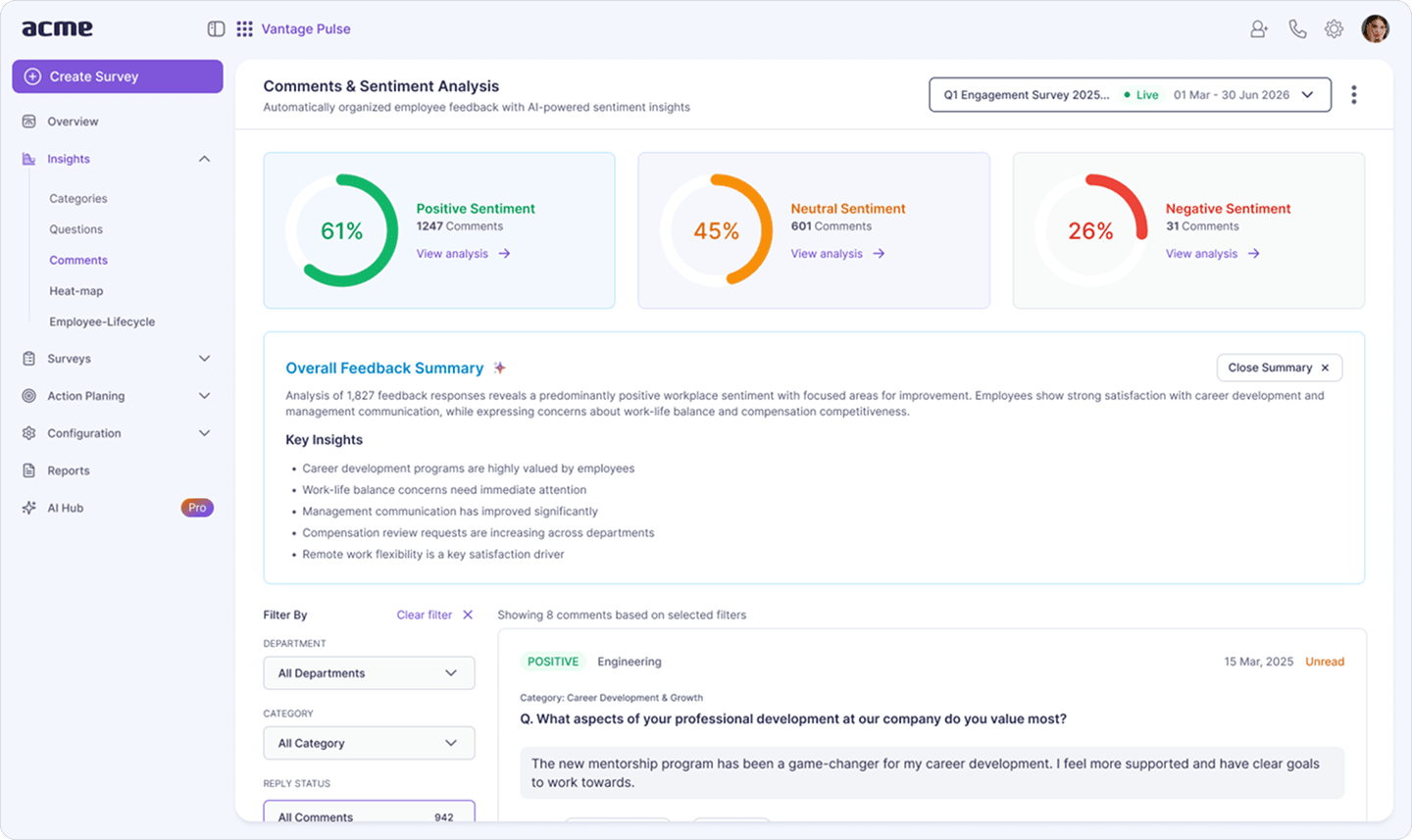
Here's the catch: most of your people won't say any of this out loud. Anonymous pulse surveys with open-text responses give them a channel to flag "no time" or "fear of failure" language without exposing who said it, and sentiment analysis on that data can catch blocker language trending upward before it turns into disengagement. Vantage Pulse runs this as a standing eNPS check, not a once-a-year survey, so you catch a rising signal while it's still small.
How to Build Creative Habits
The fastest way to build creative habits at work is to schedule the conditions that produce them: unstructured time, a structured brainstorming technique, and exposure to people outside your own team.
- Question the status quo on purpose. Instead of defaulting to how it's always been done, ask "why not" instead of "why." Run that prompt at the start of a planning session and you'll get noticeably more original options than an open-ended "any ideas?"
- Time-box a side project. Google's 20 percent time policy, one day a week for a self-directed project (Google's 2004 IPO filing), is the most cited example for a reason. The magic isn't the ratio. It's the boundary. A protected block of time kills the "I don't have time to be creative" excuse and gives an idea somewhere to actually go.
- Use a named technique, not just "brainstorm." SCAMPER (substitute, combine, adapt, modify, put to another use, eliminate, reverse) and mind-mapping both give your group a structure to follow instead of an open floor that always favors whoever talks first. A named technique also makes it easier to spot who's holding back, since the prompts create specific turns for quieter people.
- Build cross-functional exposure. Most of the connections behind a good idea come from watching how a different team solves a problem, not from spending more time inside your own function. World Economic Forum research found more than half of workplace friendships form within the first few weeks of meeting, so deliberate cross-team introductions are a fast way to widen that exposure instead of waiting for it to happen on its own.
- Protect unstructured time on the calendar. An empty block isn't wasted time. It's the space where a spontaneous idea, cognitive or emotional, the 2 unplanned types from Dietrich's framework above, actually gets room to surface. Fill every hour with meetings and you've optimized away the exact conditions creativity needs.
- Redesign the meeting format itself, not just the agenda. A stand-up that rotates one open question through the team, instead of running status updates only, gives your quietest person a structured turn. Small format changes like this surface ideas a fully open "any thoughts?" tends to miss.
An "Idea Sprint" works better as a time-boxed campaign than an open-ended suggestion box. It gives creative effort a deadline and a visible finish line, instead of an inbox that quietly fills up and never gets reviewed. Vantage Recognition's campaign management runs and tracks sprints like this without a spreadsheet behind the scenes.
Techniques like SCAMPER or structured brainstorming are learnable, not fixed traits some people have and others don't. Discounted access to online courses and certification programs through Vantage Perks makes it easier for someone to actually pick up a design-thinking or lateral-thinking course, instead of the idea getting stuck at "we should really do that training sometime."
The Physical and Mental Side of Creativity
Movement and mental rest change your creative output, not just your mood. Walking increases creative output by roughly 60 percent compared to sitting, across 4 separate experiments (Oppezzo and Schwartz, 2014, Stanford University), and the effect held whether people walked indoors, outdoors, or on a treadmill. The movement is the mechanism. The scenery isn't.
A walking meeting isn't just a wellness perk. It changes the kind of thinking that meeting produces. Swap one recurring sit-down meeting a week for a walking version and treat it as a default, not an occasional novelty, so the format change actually sticks.
Mental fatigue is one of the most common, and least talked about, creativity blockers, and it needs a different fix than movement does. Open-monitoring meditation improved divergent thinking, the exact kind of thinking creative idea generation depends on, more than focused-attention meditation did in controlled testing (Colzato et al., 2012, Frontiers in Psychology). Built-in meditation sessions through Vantage Fit give your people a short reset between deep-focus work and whatever creative thinking comes next.
Real Examples of Creativity at Work
Creativity at work is usually a small, individual-scale reframe, not a company-wide case study. Those everyday moments are where your next good idea actually starts. None of the examples below need a formal innovation lab or a dedicated budget. They just need someone who noticed a pattern and acted on it differently than the process technically called for.
| Role | Everyday Creative Action | Result |
|---|---|---|
| Anyone on the team | Turns the question they've answered five times into a shared doc instead of answering it again | Colleagues start self-serving; the same question stops landing in their inbox |
| New hire | Asks "why do we do it this way?" about a step nobody can explain | The team realizes it's leftover from a tool no one uses anymore and drops it |
| Admin/Ops person | Reorders a form so the confusing question comes last instead of first | Fewer half-finished submissions come in |
| Retail/Frontline employee | Notices customers walk past a product and moves it to eye level | Sales on that item pick up within the week |
| Remote employee | Replaces a written status update with a 90-second voice note | Cuts back-and-forth clarifying messages in half |
How to Recognize and Reinforce Creative Effort
Creative effort has to get recognized the moment someone tries, not only when it works out, or people quietly stop pitching the ideas that might not land. Recognize only the ideas that pan out, and you teach everyone watching to only ever share the safe ones.
A public recognition feed lets peers celebrate the attempt itself, separate from the outcome, which is what keeps the next idea coming even after one doesn't land. Vantage Recognition's peer-to-peer feed makes that visible company-wide, instead of leaving it to a manager who might never have seen the attempt happen.
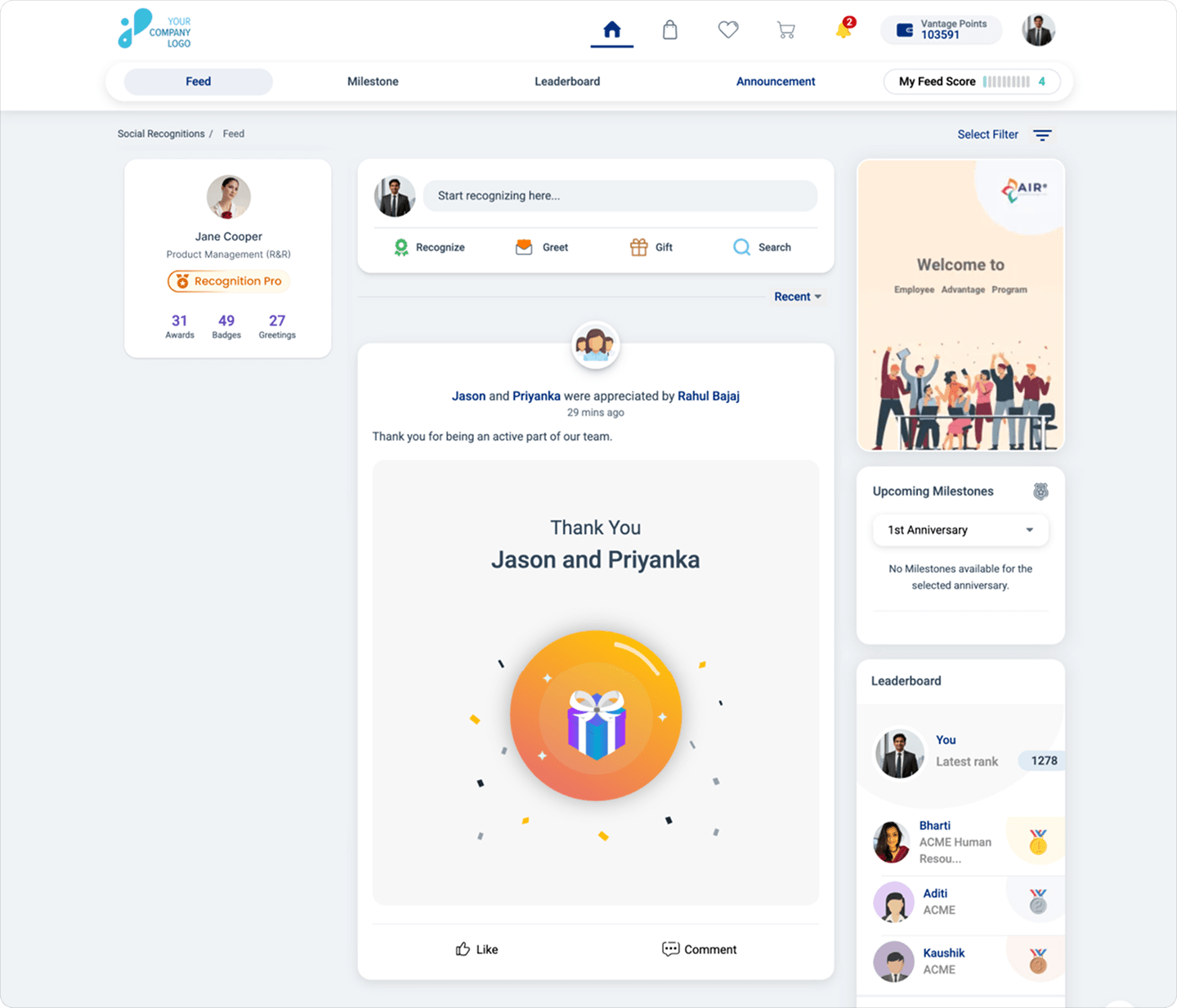
Recognition also has to reach further than the same handful of visible people. If you only recognize whoever presents at the all-hands, you'll miss the engineer who quietly tested the fix or the support rep who filed the reframed complaint without telling anyone. Tag recognition to a specific value, like "creative problem-solving," and you give peers a reason to nominate contributions you'd otherwise never see, while telling the rest of the company exactly what kind of thinking gets noticed here.
Frequently Asked Questions
1. What is creativity in the workplace?
It's your ability to connect ideas, reframe problems, and come up with original solutions in your everyday tasks. It's a skill you build, not a trait you're born with, and it shows up just as often in a reframed complaint or a redesigned meeting as it does in a formal innovation project.
2. What are some examples of creativity at work?
Think smaller than you'd expect: a support rep turning a recurring complaint into a product idea, a manager redesigning a meeting format so quieter voices get heard, an engineer time-boxing an unconventional fix outside the normal sprint. These everyday moves happen far more often than company-wide creative overhauls.
3. What are the 7 C's of creativity?
They're creators, creating, collaborations, contexts, creations, consumption, and curricula (Lubart, 2017). Together, they break creativity down by dimension: who's creating, how, where, what comes out of it, and how that gets adopted and taught.
4. What are the four main types of creativity?
Deliberate-cognitive, deliberate-emotional, spontaneous-cognitive, and spontaneous-emotional (Dietrich, 2004). It comes down to whether your thinking is intentional or unplanned, and whether it leans on analysis or emotion.
5. What are 10 ways to increase my creativity?
Question the status quo before defaulting to habit, time-box a side project, use a named technique like SCAMPER, build cross-functional exposure, take a walking meeting, try open-monitoring meditation to cut mental fatigue, remove process friction you don't need, get recognized for the attempt and not just the win, protect unstructured thinking time, and track your blockers with a self-diagnostic.
6. What causes lack of creativity?
Usually it's fear of judgment, no slack time in the schedule, a process with zero room to deviate, unclear ownership of an idea once it's raised, or plain mental fatigue. These are conditions you can change, not a personal shortfall in talent.
7. What blocks creativity?
Low psychological safety, a schedule with no unstructured time, a process that leaves no room to deviate, and no clarity on what happens to an idea once you've shared it. Fix these before you add one more creativity exercise.
8. What are the 7 habits of highly creative people?
They protect unstructured thinking time, question default assumptions, use structured techniques like SCAMPER instead of open-ended brainstorming, seek exposure outside their own team, treat movement as part of their thinking process, recover from mental fatigue on purpose, and keep pitching ideas even after one doesn't land.
To Wrap It Up
Creativity at work is a habit, built by removing what blocks it and practicing what produces it, not a talent some people have and others don't. The 4 blockers here, fear of judgment, no slack time, mental fatigue, and unclear ownership, are all things you can act on directly. None of them require hiring a different kind of person.
Start with the self-diagnostic above and find out which blocker is costing your team the most this quarter. Pick one habit from the techniques above, pair it with a recognition mechanic that rewards the attempt and not just the outcome, and watch whether idea submissions or eNPS sentiment move over the next 30 days. That's a faster path to a more creative team than any company-wide initiative you can't actually measure.

Susmita Sarma is a Digital Marketer at Vantage Circle, making employee recognition less of a checkbox and more meaningful - helping organizations say we value our people and truly mean it.
Connect with Susmita on LinkedIn.