Every leader makes decisions every day. Some are routine, like assigning tasks or approving timelines. Others are high-stakes, like hiring for a critical role, changing a policy, approving a promotion, or deciding how to respond to a dip in employee engagement.
The challenge is despite playing such a high pressure role, leaders are mostly never taught how to make decisions the right way. And an even bigger challenge is that many workplace decisions happen under pressure, with incomplete information, unclear ownership, and assumptions that are never tested.
That is why decision-making needs a repeatable structure.
McKinsey notes that executives spend nearly 40 percent of their time making decisions and believe much of that time is poorly used. This does not mean leaders should slow every decision down. It means they need a better way to decide which decisions need speed, which need analysis, and which need wider input.
This guide gives managers, HR leaders, and L&D professionals a practical framework for workplace decision-making. You will learn the 7-step decision-making process, 6 useful decision-making models, 10 cognitive biases that distort judgment, and 8 techniques you can apply in real situations.
What Is Decision-Making?
Decision-making is the cognitive and practical process of selecting one option from a set of alternatives to solve a problem, reach a goal, or move work forward. It turns information into action.
In the workplace, decision-making is rarely about choosing between one clearly right and one clearly wrong answer. Leaders usually work with trade-offs.
A hiring decision can improve team capacity but increase cost. A promotion decision can reward performance but create questions about fairness. A policy decision can improve consistency but reduce flexibility. A recognition decision can motivate one group while making another group wonder why their work was missed.
Decision-making is closely related to problem-solving skills, but both are not the same. Problem-solving identifies and analyzes an issue. Decision-making selects the path forward once the issue and options are clear.
Psychologist Daniel Kahneman popularized the distinction between fast and slow thinking in Thinking, Fast and Slow. In an excerpt published by Scientific American, System 1 is described as automatic and quick, while System 2 is associated with effortful mental activity, choice, and concentration. This distinction matters at work because some decisions benefit from fast pattern recognition, while others require deliberate analysis.
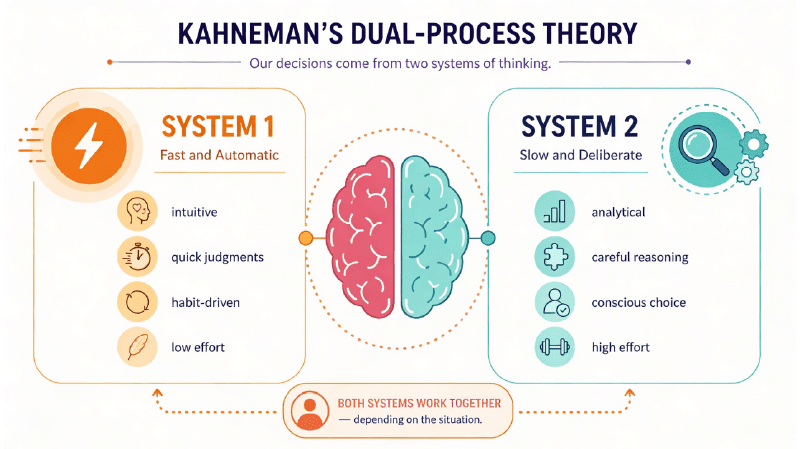
Good decision-making is therefore not about always being fast or always being analytical. It is about matching the method to the decision.
Why Decision-Making Matters at Work
Poor decision-making creates confusion. Delayed decision-making creates frustration. Unclear decision ownership creates politics.
When teams do not know who decides, why a choice was made, or how success will be measured, execution slows down. People either wait for direction or act based on assumptions.
Bain & Company has reported a strong relationship between decision effectiveness and business performance, based on a 10-year research program involving more than 1,000 companies. Bain also states that decision effectiveness and business performance correlated at a minimum 95% confidence level in that research.
For HR leaders and managers, decision-making directly affects:
A weak people decision does not affect only one employee. It sends a signal to the team about what the organization values. A fair and well-communicated decision strengthens trust, even when the decision is difficult.
This is why decision-making is not just a management skill. It is a culture skill.
Strong decision-making supports leadership skills for managers, manager effectiveness, and employee engagement. It helps leaders move from instinct-led choices to evidence-informed action.
The 7-Step Decision-Making Process
A structured decision-making process does not remove uncertainty. It reduces avoidable mistakes. The process below works well for workplace decisions that need clarity, accountability, and review.
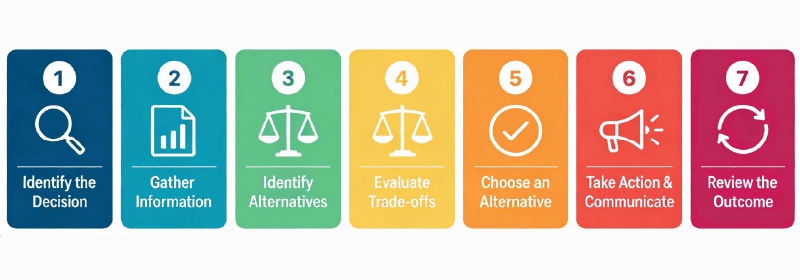
Step 1: Identify the Decision and Define the Problem
Name the decision before discussing solutions. A vague statement like “we need to improve retention” is not a decision. It is a concern. A clearer decision statement would be: “Should we launch a structured peer recognition program for the engineering team this quarter?”
That statement has a defined scope, audience, and timeline. It gives the team something specific to evaluate.
Workplace example: An HR leader sees attrition rising in one department. Before jumping to solutions, she defines the decision as: “Which first intervention should we prioritize to understand and reduce engineering attrition: manager training, career path redesign, pulse surveys, or recognition improvement?”
Step 2: Gather Relevant Information
Once the decision is clear, collect the information that will help you understand the issue.
This can include engagement scores, eNPS trends, attrition data, performance metrics, exit interviews, manager feedback, and open-text employee comments. The key is to define the information window in advance. Endless research delays decisions without always improving them.
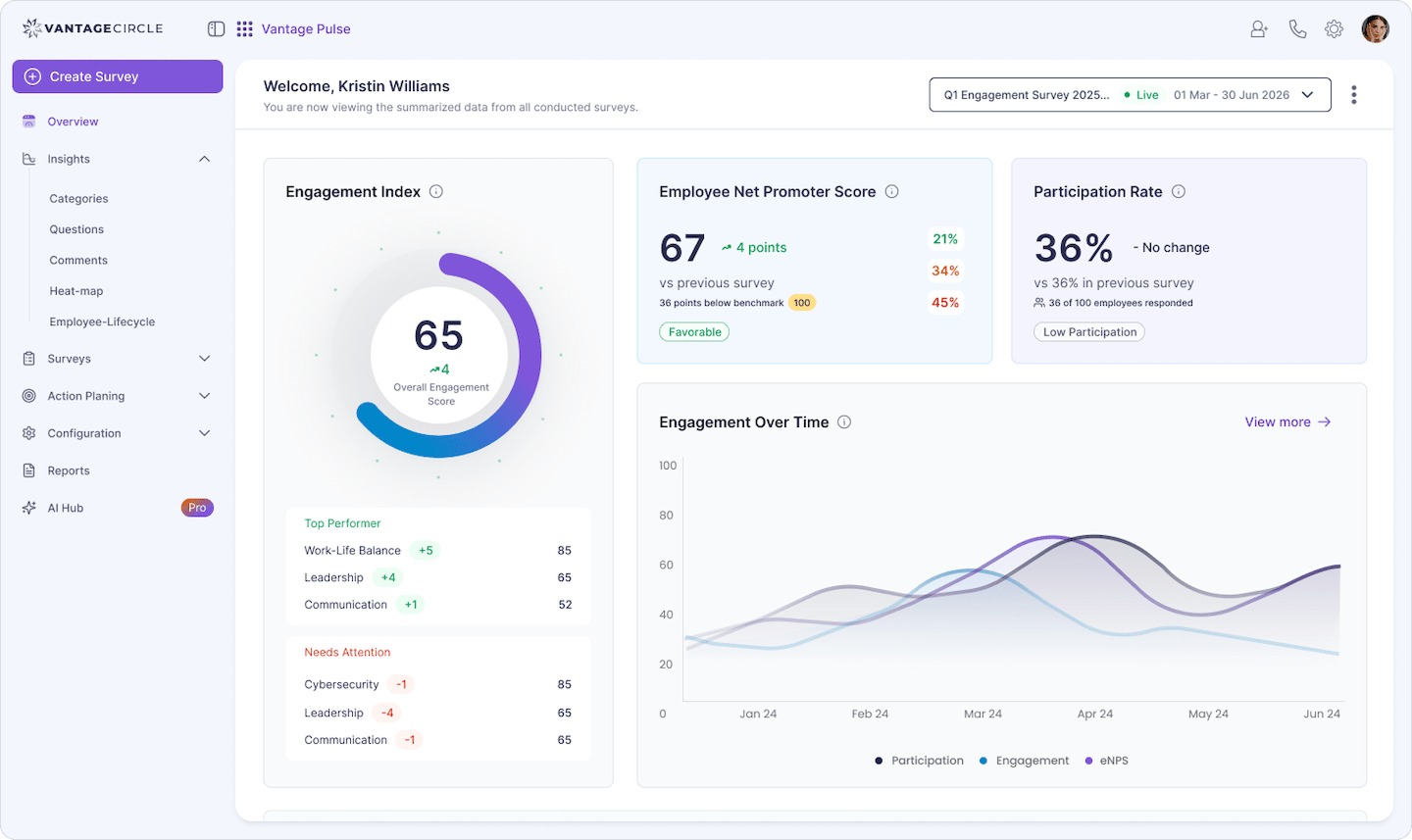
For people decisions, one of the most useful data sources is employee feedback. Pulse survey tools like Vantage Pulse can bring eNPS, benchmarks, trends, and essential employee metrics into a dashboard, helping HR teams understand how employees are doing.
This matters because leaders often over-rely on the most recent complaint, the loudest voice in the room, or a manager’s personal impression. Structured feedback gives the decision a stronger foundation.
Workplace example: Before changing a hybrid work policy, HR reviews survey results, anonymous comments, department-wise feedback, turnover patterns, and manager input. This gives leaders a clearer picture of the actual issue before choosing a response.
Step 3: Identify Alternatives
A real decision needs more than one option. If there is only one option on the table, the team is not deciding. It is approving. Generate at least three practical alternatives. These do not need to be equally attractive, but they should be meaningfully different.
Workplace example: If recognition participation is low, HR can consider three alternatives:
This prevents the team from treating the first visible solution as the best solution.
Step 4: Evaluate Evidence and Trade-Offs
Every decision has trade-offs. A good decision-making process makes those trade-offs visible before action is taken. Evaluate each option against the criteria that matter most. Common criteria include cost, speed, fairness, reversibility, employee impact, compliance risk, and implementation effort.
Workplace example: A promotion committee evaluates three candidates for a manager role. Instead of relying only on performance history, the committee reviews leadership behaviors, peer feedback, role readiness, team impact, and alignment with company values.
This is where HR analytics and recognition data can support better people decisions. The goal is not to replace human judgment. The goal is to prevent decisions from depending only on memory, recency, or personal preference.
Step 5: Choose the Best Option
After evaluating options, make the decision. A good decision is not always perfect. It is the best available choice based on the information, criteria, and constraints at that moment. Document the rationale and include the following:
- What was decided
- Why it was chosen
- Which alternatives were rejected
- What evidence mattered most
- What success will look like
- When the outcome will be reviewed
This creates accountability and helps the team learn later.
Workplace example: HR chooses manager recognition training as the first intervention because survey comments show inconsistent appreciation across teams, the cost is lower than a full program redesign, and the impact can be reviewed within 60 days.
Step 6: Communicate and Act
A decision that is not communicated clearly becomes a rumor.After choosing the option, explain the decision to the people affected by it. The communication should answer four questions:
- What was decided?
- Why was it decided?
- What changes now?
- What happens next?
Clear communication protects trust. Employees do not only judge the decision. They judge the fairness and clarity of the process behind it.
Workplace example: If leadership changes the recognition budget, managers need to understand whether the change is based on program usage, fairness, business conditions, or a shift in reward strategy. Without that explanation, people create their own interpretation. A decision also needs ownership. Assign a named owner, timeline, and success measure. This connects decision-making with goal setting for employees and team accountability.
Step 7: Review the Outcome
Decision-making does not end once the choice is implemented.Review the outcome against the original goal. Did the decision solve the problem? Did it create another issue? Did employee sentiment change? Did the team understand the decision? What should be adjusted?
For people decisions, this review needs more than anecdotal feedback. Pulse surveys, eNPS movement, recognition trends, and engagement data can help leaders understand whether the decision produced the intended result.
Workplace example: After running manager recognition training, HR reviews recognition frequency, manager participation, employee comments, and eNPS movement across the affected department. The decision is then refined based on what changed and what did not.
6 Decision-Making Models Every Leader Should Know
No single decision-making model fits every workplace situation. A routine operational decision does not need the same process as a restructuring decision. A cross-functional policy change needs more role clarity than a simple team-level task decision.
Use the table below to match the model to the decision context.
| Model | Origin | When to Use | Best For | Main Risk |
|---|---|---|---|---|
| Rational | Herbert Simon | When enough information is available | Structured business decisions | Can stall waiting for perfect data |
| Intuitive | Experience & pattern recognition | When the leader has deep expertise | Fast operational calls | Can amplify bias in new situations |
| DACI | Atlassian | When decision ownership is unclear | Projects and roadmap decisions | Slows if too many approvers |
| RAPID | Bain & Company | When many stakeholders are involved | Strategic enterprise decisions | Too heavy for small decisions |
| OODA Loop | John Boyd | When conditions are changing fast | Crisis response and fast iteration | Can rush decisions needing review |
| Vroom-Yetton | Victor Vroom & Philip Yetton | When deciding how much team input is needed | People and change decisions | Feels complex under time pressure |
Rational Decision-Making Model
The rational model works best when the problem can be clearly defined and the decision can be evaluated against known criteria.
Herbert Simon’s 1955 paper, “A Behavioral Model of Rational Choice”, challenged the idea that decision-makers always have perfect information and unlimited ability to process it. This is the foundation of bounded rationality: people make decisions under limits of time, information, and cognitive capacity.
For leaders, the lesson is practical. Use rational analysis for high-stakes decisions, but do not pretend every variable can be known.
Intuitive Decision-Making
Intuitive decision-making relies on experience and pattern recognition.
It works best when the decision-maker has deep expertise in a familiar context. A senior manager who has handled many customer escalations can often recognize the right first response quickly. An HR leader who has managed several change programs can sometimes identify early warning signs before the data fully confirms them.
The risk is obvious. Intuition becomes unreliable when the situation is new, emotionally charged, or shaped by hidden bias.Use intuition as an input, not as the entire process.
DACI
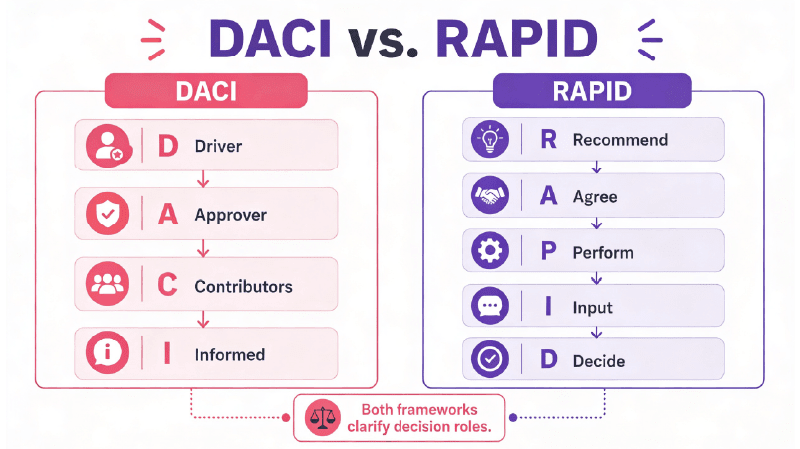
DACI stands for Driver, Approver, Contributors, and Informed. Atlassian’s DACI playbook describes it as a way to clarify roles in decision-making.
The Driver moves the decision forward. The Approver makes or approves the final decision. Contributors provide expertise or input. Informed stakeholders are kept updated because the decision affects their work. DACI is useful when projects stall because everyone has input but no one has ownership.
Workplace example: HR is redesigning the performance review process. The HR operations lead is the Driver. The CHRO is the Approver. Legal, finance, and department heads are Contributors. Managers and employees are Informed once the structure is finalized.
RAPID
RAPID is a decision-making framework created by Bain & Company. Bain explains that RAPID stands for Recommend, Agree, Perform, Input, and Decide. Its purpose is to clarify decision accountabilities when multiple stakeholders are involved.
RAPID works well for large organizations where decisions cross functions and business units.The most important part of RAPID is the “D” role. One person must ultimately Decide. Without that, a group discussion can look collaborative while still avoiding accountability.
Workplace example: A company is choosing a global recognition platform. HR recommends. Finance gives input on budget. IT agrees on security and integration requirements. The CHRO decides. HR operations performs the rollout.
OODA Loop
OODA stands for Observe, Orient, Decide, and Act. It is associated with U.S. Air Force Colonel John Boyd. The Government of Canada describes OODA as an iterative feedback model developed by Boyd and widely used in military and professional contexts. OODA is useful when situations change quickly and waiting for perfect information creates greater risk.
Workplace example: During a sudden engagement crisis after a major policy change, HR can observe employee feedback, orient around the most urgent themes, decide on an immediate communication response, act, and then repeat the cycle as new feedback comes in.
Vroom-Yetton Decision Model
The Vroom-Yetton model helps leaders decide how much participation a decision needs.
Victor Vroom and Philip Yetton’s book *Leadership and Decision-Making* describes a decision-tree approach that helps leaders determine how much decision power to share with subordinates based on the situation. This model is useful because not every decision should be made democratically, and not every decision should be made alone.
Workplace example: A manager deciding a routine meeting time can decide alone. A manager changing team roles after a restructuring needs more input because commitment and trust matter to execution.
Types of Decisions Leaders Make
Leaders make different types of decisions. Each type needs a different level of process.
Strategic Decisions
FrequencyQuarterly or annually
Best methodRAPID, DACI, or the full 7-step process
Operational Decisions
FrequencyDaily or weekly
Best methodIntuition, simple scoring, or manager judgment
People Decisions
FrequencyMonthly or quarterly
Best methodStructured criteria, feedback, recognition data, and engagement data
Tactical Decisions
FrequencyWeekly
Best methodOODA loop, Eisenhower matrix, or team-level decision rights
Strategic Decisions
Strategic decisions affect direction, budget, structure, and long-term outcomes.Examples include entering a new market, restructuring a team, approving a major technology platform, or changing a workforce policy. These decisions need stronger documentation, clear ownership, and cross-functional input.
Operational Decisions
Operational decisions keep work moving. Examples include scheduling, workflow adjustments, short-term resourcing, and process changes. These decisions should not get stuck in committees. Too much process around low-stakes decisions creates unnecessary delay.
People Decisions
People decisions include hiring, promotion, recognition, performance management, and exits.
These decisions carry cultural weight. Employees observe who gets promoted, who gets recognized, who gets coached, and who gets ignored. That is why people decisions need both structured criteria and human judgment.
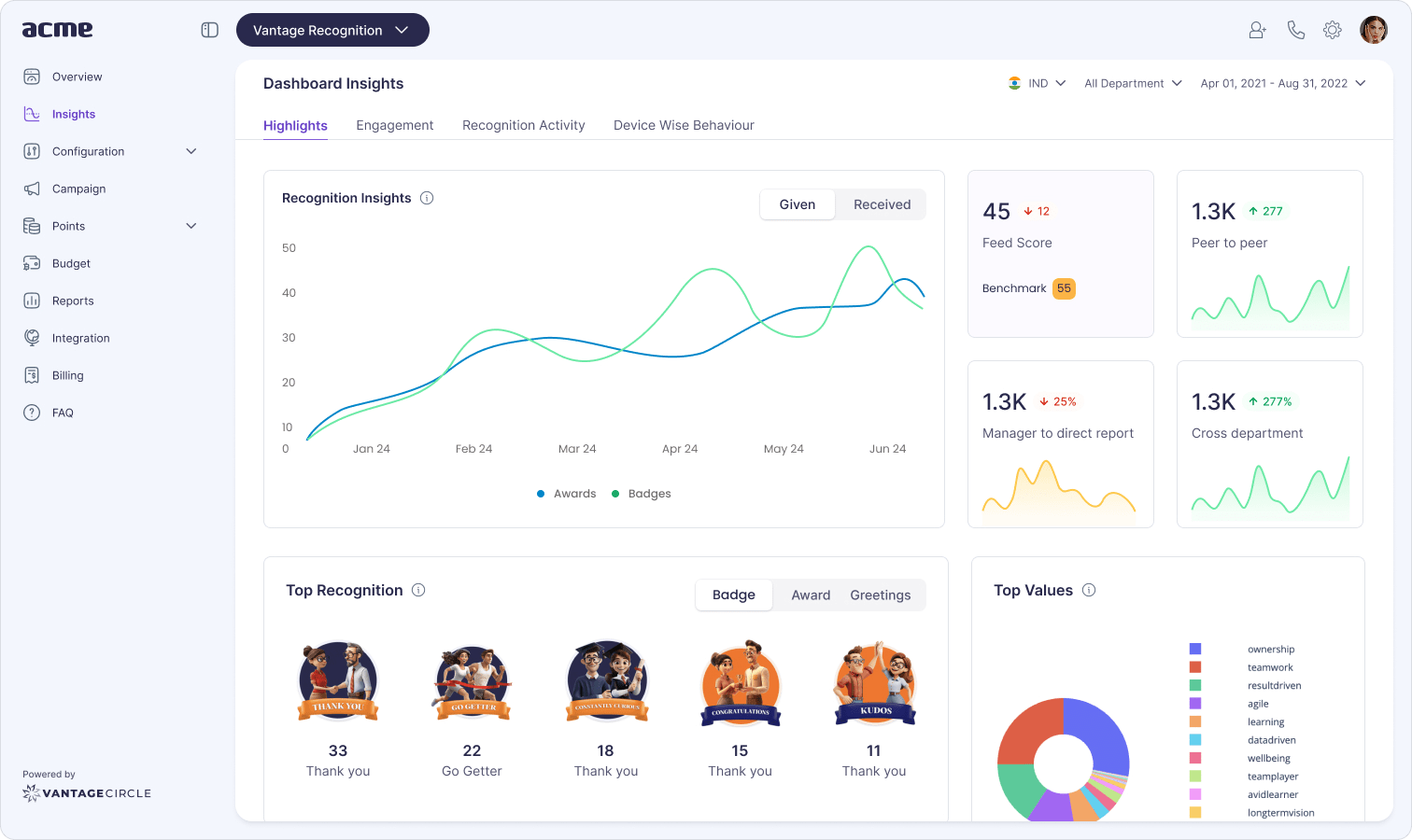
People decisions become stronger when leaders look beyond formal performance records. With tools like Vantage Recognition, HR teams can review recognition patterns such as peer-to-peer appreciation, manager-led recognition, cross-team acknowledgments, and sentiment around recognition moments. Used alongside performance and engagement data, these insights create a more balanced view of workplace behavior and employee recognition.
Tactical Decisions
Tactical decisions are short-horizon choices that shape execution.
Examples include sprint priorities, meeting formats, task assignments, and weekly project adjustments. These decisions need clarity, speed, and local ownership.
For tactical decisions, team collaboration matters. The people closest to the work often have the best context.
10 Cognitive Biases That Distort Workplace Decisions
Cognitive biases are mental shortcuts that influence judgment. The goal is not to eliminate them completely. The goal is to notice when they are likely to distort a decision and build checks into the process.
Britannica explains that heuristic reasoning can help people make decisions efficiently, but it can also lead to errors when people rely too heavily on shortcuts.
Anonymous feedback can reduce some of these risks. Vantage Circle’s knowledge base states that Vantage Pulse survey responses are anonymous and respondent identities are not shared with company admins. This matters because employees who self-censor in open forums can provide more honest input when anonymity is protected.
This is especially useful when leaders are dealing with groupthink, availability bias, and status quo bias. Honest employee input helps decision-makers see what is being missed by the people already in the room.
For related reading, see decision fatigue and unconscious bias examples.
8 Practical Decision-Making Techniques
Models provide structure. Techniques help leaders apply that structure in real situations.
1. Pros-and-Cons Matrix
Use a pros-and-cons matrix when there are two or three clear options and the stakes are moderate. List benefits and drawbacks side by side. This technique is simple, but it forces the team to make trade-offs visible.
2. Weighted Scoring
Use weighted scoring when multiple criteria matter. Assign each criterion a weight, then score each option. For example, cost can carry 30 percent, employee impact 30 percent, speed 20 percent, and reversibility 20 percent.This is useful for vendor selection, policy decisions, and promotion committee discussions.
3. Decision Tree
Use a decision tree when one decision leads to several possible outcomes.This works well for sequential processes such as hiring, performance improvement plans, or phased rollouts.
4. Eisenhower Matrix
Use the Eisenhower matrix to separate what is urgent from what is important. This is useful when leaders face too many decisions at once. It protects time for high-value work and prevents urgency from becoming the only filter.
5. Pareto Analysis
Use Pareto analysis when a small number of causes are driving most of the issue. For example, if engagement complaints are concentrated in two departments, a company-wide intervention may not be the best first decision. A targeted response could be more effective.
6. Six Thinking Hats
Edward de Bono’s Six Thinking Hats is a structured thinking method that helps teams look at a decision from different angles, including facts, risks, benefits, emotions, creativity, and process.
Use it when group discussion is dominated by one type of thinking, such as only risk, only optimism, or only emotion.
7. SWOT Analysis
Use SWOT analysis when the decision involves strategy. It helps teams evaluate strengths, weaknesses, opportunities, and threats before choosing a direction.
8. Pre-Mortem
Use a pre-mortem before a high-stakes decision is finalized.In Harvard Business Review, Gary Klein describes the pre-mortem as a method where a team imagines that a project has failed and then works backward to identify what likely caused the failure. This gives people permission to surface risks before the decision is executed.
A pre-mortem is especially useful when the team feels unusually confident. High confidence can hide weak assumptions.
How to Make Better Decisions as a Leader
Better decision-making comes from repeatable habits, not one-time frameworks.
Build a Decision Rhythm
Batch similar decisions into regular cadences. Strategic decisions need scheduled leadership reviews. Operational decisions need clear local ownership. Tactical decisions need fast team-level authority. This reduces decision overload and protects attention for the decisions that actually need deeper thinking.
Document the Decision Intent
Write down why the decision was made. This helps later reviews stay fair. Without documentation, teams judge old decisions based on what they know now, not what was known at the time. That creates hindsight bias. Decision documentation also helps new leaders understand the reasoning behind past choices.
Use Diverse Input Intentionally
Diverse input improves decision quality when it brings relevant information into the process. For HR leaders, this means reviewing segmented employee feedback instead of relying only on aggregate scores. Department-wise insights can show whether a policy affects sales, engineering, and operations differently.
This is where tools like Vantage Pulse can support better people decisions by helping HR teams review feedback across groups instead of treating one loud pattern as the full story.
Match the Model to the Stakes
Do not over-engineer small decisions. Do not under-process high-stakes decisions. A reversible scheduling decision does not need RAPID. A promotion decision that affects morale and fairness should not be made in a five-minute conversation.The simplest rule is this: The higher the impact, the more structure the decision needs.
Why Effective Decision-Making Matters
Effective decision-making matters because decisions compound.One delayed decision slows a team. One unclear decision creates confusion. One unfair people decision damages trust. One well-made decision creates clarity, momentum, and confidence.
The research supports this connection. Bain connects decision effectiveness with business performance. McKinsey shows that leaders spend a large share of their time making decisions and that much of this time is perceived as poorly used.
For HR leaders, the lesson is direct. People decisions need better inputs.
Engagement data, recognition patterns, survey comments, and sentiment signals can help leaders understand what employees are experiencing before a decision is made. Vantage Circle brings recognition, feedback, and engagement capabilities into one employee engagement ecosystem, helping organizations move from assumption-led action to more informed people decisions.
Frequently Asked Questions
What are the 5 keys of decision-making?
The 5 keys of decision-making are clarity, information, alternatives, accountability, and review. A leader must define the decision clearly, gather relevant data, compare realistic options, assign decision ownership, and review whether the outcome matched the original intent.
What are the 4 stages of decision-making?
The 4 stages of decision-making are identifying the problem, developing alternatives, choosing an option, and implementing the decision. These stages align closely with Herbert Simon’s broader work on decision processes and bounded rationality, which explains why people make decisions under limits of information, time, and cognitive capacity.
What are the 3 C’s of decision-making?
The 3 C’s of decision-making are clarity, criteria, and commitment. Clarity defines the decision. Criteria define what a good outcome looks like. Commitment ensures someone owns the decision and communicates it clearly.
What are 5 ways to make a decision?
Five ways to make a decision are using a pros-and-cons matrix, weighted scoring, a decision tree, a pre-mortem, and a decision-rights framework such as DACI or RAPID. The right method depends on the stakes, reversibility, number of stakeholders, and time available.
What are the 7 C’s of decision-making?
The 7 C’s of decision-making are clarity, criteria, creativity, consequences, choice, communication, and check. They help leaders define the problem, generate options, evaluate trade-offs, select a path, explain the decision, and review the outcome.
What is the 5-5-5 rule of decision-making?
The 5-5-5 rule asks whether a decision will matter in 5 minutes, 5 months, or 5 years. It helps leaders match the level of effort to the importance of the decision. A 5-year decision deserves a structured process. A 5-minute decision usually needs a faster call.
Final Thoughts
Decision-making is a leadership skill that improves with structure.
The goal is not to make every decision slow, formal, or data-heavy. The goal is to know which decisions need speed, which need input, which need documentation, and which need review.
For managers and HR leaders, this matters most in people decisions. Hiring, promotion, recognition, feedback, and policy decisions all shape trust. Employees do not only remember what leaders decide. They remember whether the decision felt fair, informed, and clearly explained.
A stronger decision-making process helps leaders move from assumption to evidence, from confusion to ownership, and from one-time choices to continuous learning.
Make people decisions with confidence. See how Vantage Circle supports HR leaders with recognition, feedback, and engagement insights.

Shaoni Gupta is a content marketing specialist at Vantage Circle, with expertise in scriptwriting and copywriting in the field of employee rewards and recognition.
Connect with Shaoni on LinkedIn.