
Ask five HR leaders why their benefits program looks the way it does, and you'll get five different, mostly improvised answers: a perk added because a competitor had one, a plan kept because switching felt risky, a stipend nobody quite remembers approving. Most employee benefits programs aren't built. They accumulate. This 5-step framework is for building one on purpose instead, covering what to fund first, what to ask employees before deciding anything, and how to know afterward whether any of it actually worked.
What Is an Employee Benefits Program?
Employee benefits program: the structured package of non-wage compensation an employer offers on top of salary, health coverage, retirement contributions, paid leave, and voluntary perks like discounts or wellness stipends.
Every company has some version of this. Few sequence it well.
For the full taxonomy, the standard categories, statutory versus voluntary status, and 2025 cost benchmarks for each one, see our employee benefits guide. That guide assumes you already know roughly what benefits exist and walks through what to offer. This one assumes you've got that list and focuses on something the taxonomy doesn't cover: how to actually build and sequence the program without overspending in year one or under-delivering on what employees actually want.
That distinction matters more than it sounds like it should. A benefits program is not the same thing as a benefits strategy. A strategy sets the total budget envelope and the workforce philosophy behind it, before anyone picks a single benefit. A program is what gets built inside that envelope, in what order, and how you know afterward whether it worked.
Core and Voluntary Benefits, at a Glance
Every benefits program is built from two buckets: core benefits employees expect by default, and voluntary benefits that differentiate the offer from the next company's.
Core benefits are the ones most workers assume exist before they even ask: health coverage, retirement contributions, paid time off. Skip one and candidates notice immediately, usually before the second interview. Voluntary benefits sit on top, funded or subsidized rather than fully covered, and this is where most of the actual differentiation happens. Fringe benefits like commuter stipends and home-office allowances fall into this second bucket. They're usually the cheapest line items to add relative to how visible they are to employees day to day.
| Category | Core or Voluntary | Typical Cost Signal |
|---|---|---|
| Health and Medical | Core (ACA applies at 50+ FTEs) | ~$3.52/hour worked (BLS ECEC, Q1 2025) |
| Retirement and Financial | Core | ~$1.72/hour worked (BLS ECEC, Q1 2025) |
| Paid Time Off and Leave | Core, partially statutory | ~$2.93/hour worked (BLS ECEC, Q1 2025) |
| Life and Disability Insurance | Core | ~$0.46/hour worked (BLS ECEC, Q1 2025) |
| Wellness and Wellbeing | Voluntary | ~$200 to $600/employee/year (SHRM, 2025) |
| Voluntary and Lifestyle Perks | Voluntary | $0 to $300/employee/year, varies |
Source: BLS Employer Costs for Employee Compensation (ECEC), Q1 2025; SHRM 2025 Employee Benefits Survey.
Benefits spending runs about 30% of total compensation for private-industry workers, rising to roughly 32% once public-sector employees are counted in. Source: BLS Employer Costs for Employee Compensation, Q1 2025
One category most legacy "4 types of benefits" lists still leave out entirely: financial wellness. Salary advances, budgeting tools, and savings support used to be treated as a nice-to-have add-on. They aren't anymore, and they rarely show up in the taxonomy above because they're new enough that most cost-benchmark surveys are still catching up. Vantage Perks' financial wellness module puts this in the voluntary tier without touching the health or retirement line, which matters because that's usually the easiest place to find room in a constrained budget.
The 5-Step Framework for Building a Benefits Program
Building a benefits program comes down to five sequential steps: set a goal, ask employees before deciding, tier the budget, choose the voluntary layer, then communicate and measure.
This assumes the total budget envelope and the underlying philosophy behind it are already decided. If they aren't, that's a strategy question, not a program question, and it's worth solving first: our guide to building a benefits strategy walks through the audit, workforce segmentation, and budget-envelope steps that come before any of this. What follows here is the execution layer. Once that number exists, which benefits actually get funded first, and in what order, is a separate and much more concrete problem.
Step 1: Set Clear, Measurable Goals
A benefits program without a stated goal turns into a list of things that seemed reasonable at budget time.
Before any specific benefit gets chosen, decide what the program is actually for. Attracting a particular kind of candidate. Reducing regretted attrition inside the first year. Closing a competitive gap your recruiters keep hearing about in exit interviews. These are different goals, and each one points toward a different mix of benefits, not the same generic package with a new cover page.
McKinsey's 2025 HR Monitor found pay and benefits is the single largest reason employees cite for changing jobs, 38% on average, rising to 42% in Germany. I'd push back a little on reading that as a green light to just spend more. The same research points to training, flexibility, and manager relationships as close runners-up, and a program built purely to compete on pay is usually the first thing cut when budgets tighten the following year.
A stated goal also gives HR a way to say no later, when a specific request lands on the desk in October and there's no clean answer for why it didn't make this year's list. Without a goal, every "no" looks arbitrary. With one, most of them explain themselves.
33% of HR leaders now say benefits are the primary reason employees join or stay, outranking bonuses and even location. Source: PSCA/Grant Thornton, 2024
Step 2: Survey Employees Before Deciding
Guessing what employees want is how programs end up funding perks nobody uses.
The easier instinct is to look at what competitors offer and roughly match it. That produces a benefits program that looks competitive on paper and gets quietly ignored in practice, because your workforce isn't your competitor's workforce, and a package built for someone else's demographics rarely lands the way it's supposed to.
A pulse survey run before the budget is finalized, not after benefits are already chosen, turns "we think they'll like this" into an actual answer. Just 36% of employees say they fully understand the benefits they're already enrolled in, even though 91% of employers assume their people do, according to Aon's benefits engagement research. That's partly a communication problem, covered in Step 5. But it's also, further upstream, a selection problem. Benefits chosen without asking first tend to be the ones nobody understands later, because nobody explained why they exist in the first place.

Vantage Pulse's eNPS surveys, employee Net Promoter Score surveys, are built for exactly this moment: a short, structured read on what a workforce actually values before budget gets committed to it, not a 40-question annual engagement survey that half the company never finishes.
Step 3: Apply Budget Tiering
Budget tiering means sorting every candidate benefit into one of three tiers before funding anything, so the sequencing decision gets made once, deliberately, instead of benefit by benefit as requests happen to arrive.
Most benefits programs get built request by request. Someone asks for a specific perk, it sounds reasonable in the moment, it gets added. Eighteen months later nobody can fully explain why the program includes what it includes, and the annual renewal conversation turns into a kind of archaeology nobody enjoys.
70% of HR professionals say they struggle with the rewards and benefits process, and compensation and benefits ranks as the single biggest HR challenge for 17% of respondents overall. Source: Vantage Circle, Industry Report on Employee Engagement Strategies
Budget tiering fixes the sequencing problem specifically. It doesn't replace Step 2's selection problem, it comes after it. Sort every benefit under consideration into one of three tiers.
(Source: Vantage Fit)
Gartner's research on workplace wellbeing found that organizations see diminishing returns from simply adding more wellbeing programs on top of what they already offer. More options is not automatically more value, and past a certain point it isn't even perceived as more generous. Harvard Business Review made a version of this argument nearly two decades ago in Barry Schwartz's "More Isn't Always Better", and the underlying logic still holds for benefits design: additional choice past a certain threshold creates decision fatigue rather than a stronger sense of being taken care of.
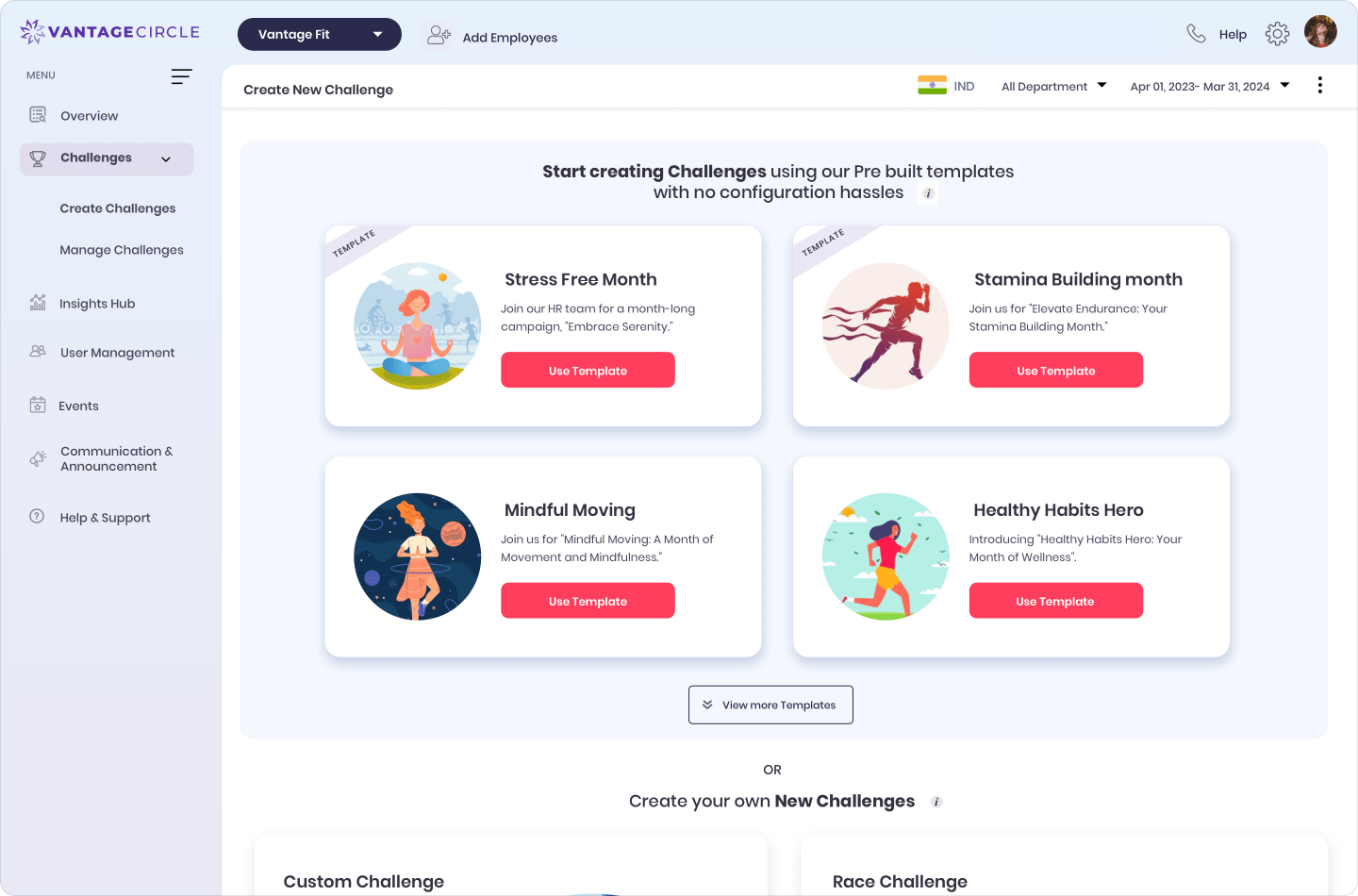
Tiering forces the harder conversation earlier, while it's still a planning exercise on a whiteboard, instead of later, when it's a budget cut nobody wants to own. Vantage Fit's wellness challenge module is a common candidate for the second tier precisely because it's inexpensive to run and difficult for employees to overlook once it's live.
Step 4: Choose Voluntary Benefits That Fit Your Workforce
Once the must-have and high-impact tiers are funded, voluntary benefits are where a program actually starts to feel tailored instead of standard-issue.
This is the layer most "4 types of benefits" lists skip entirely, because it doesn't fit neatly into health, retirement, insurance, or paid time off. It includes non-monetary incentives like flexible scheduling, recognition programs, and discount marketplaces: benefits funded or subsidized rather than fully paid, chosen because they fit a specific workforce rather than because every company in the industry already offers them.
The mistake runs in two directions, and they don't look anything alike from the inside. One is skipping voluntary benefits entirely, so the package reads as wallpaper next to a competitor's job posting: present, technically compliant, forgettable. The other shows up eighteen months later as a spreadsheet with a dozen-plus line items, most sitting under 20% utilization, because every available voluntary benefit got switched on the same quarter and nobody circled back to check. Different failure. Same result: a budget nobody can defend out loud at renewal.
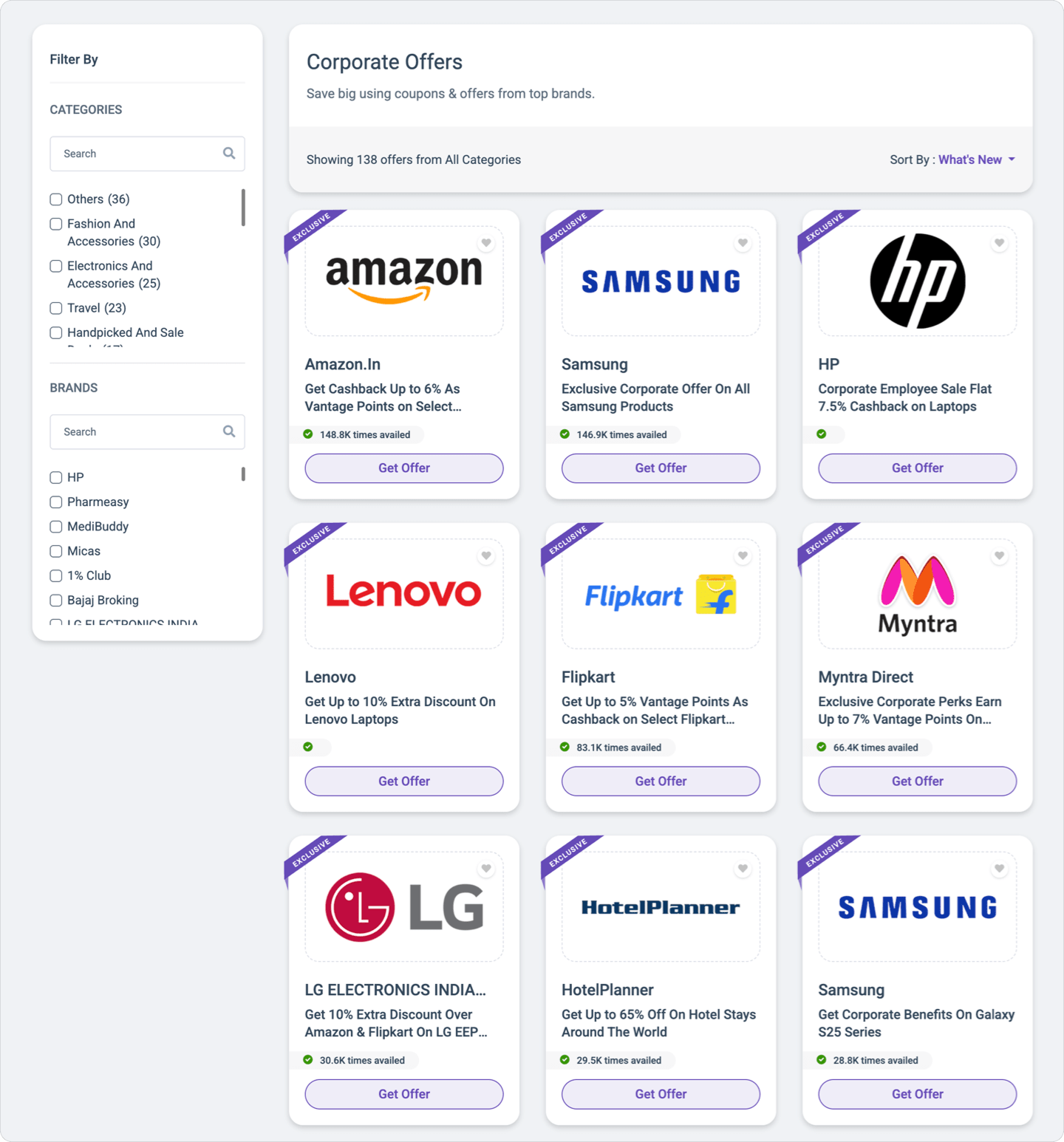
Employee discount programs are usually the easiest voluntary benefit to justify adding first, because the cost to the company stays close to zero while the perceived value to employees stays genuinely real. It's a reasonable default when a company is adding its first voluntary benefit and wants something low-risk to test the mechanism, the communication, the enrollment flow, before expanding into anything more expensive.
(Source: Vantage Perks)
Step 5: Communicate and Measure, Don't Just Launch
A benefits program that launches without a communication plan fails quietly, one unused line item at a time, until the renewal audit turns up numbers nobody can explain.
Ninety percent of organizations call this a priority. Just 36% have an actual communication strategy behind it, according to Aon's Benefits and Trends research. Sit with that gap for a second: more than half the companies that say communication matters have done nothing structural about it. That's usually where the wasted budget in a benefits program hides. Not in the benefits chosen. In the ones employees never fully learned they had.
Communication has to survive past open enrollment, which is where most companies quietly let it stop. A benefit explained once in October and never mentioned again is a benefit most employees will have forgotten by March, through no particular fault of their own. Gartner's research on wellbeing benefits found the same gap elsewhere: 87% of employees have access to mental and emotional wellbeing offerings, but only 23% actually use them. Access isn't adoption. Relevance has to be actively and repeatedly communicated in terms that connect to something an employee is actually dealing with that month.
Measurement closes the loop. Track participation by individual benefit, not as one blended engagement figure. A benefit with 80% enrollment and 12% active use isn't a success story on the dashboard. It's an inert line item, present in the budget and doing nothing for anyone. Recognition Analytics gives HR a way to show, in numbers leadership actually reads, whether the employee satisfaction tied to the program is real or simply assumed because nobody has complained yet.
| Step | What It Looks Like in Practice | Common Mistake |
|---|---|---|
| 1. Set Clear Goals | A one-sentence objective the whole program maps back to | Building the benefits list before deciding what it's for |
| 2. Survey Employees | A short pulse survey run before the budget is finalized | Copying a competitor's package instead of asking your own workforce |
| 3. Apply Budget Tiering | Every candidate benefit sorted into must-have, high-impact-low-cost, or aspirational | Funding benefits in the order requests happen to arrive |
| 4. Choose Voluntary Benefits | A small, deliberate set of voluntary perks matched to workforce needs | Adding every available voluntary benefit at once and diluting utilization |
| 5. Communicate and Measure | A year-round communication plan plus per-benefit participation tracking | Treating open enrollment as the only moment benefits get explained |
How to Know If Your Benefits Program Is Working
A working benefits program shows up in three places: participation, retention, and what employees actually say when nobody's grading the answer.
Enrollment is the weakest signal in the building. Employees enroll in things by default during onboarding, often without meaningfully evaluating whether they'll ever touch them. Participation is harder to get and far more honest: how many enrolled employees actually use a given benefit at least once a quarter.
Track participation per benefit, not as one blended figure across the whole program. A benefits program can show strong overall engagement numbers while two or three specific line items sit at single-digit usage, quietly costing money and delivering close to nothing back. Cost per utilized benefit, total spend on a benefit divided by the number of employees who actually used it, surfaces this faster than a participation percentage on its own usually does.
87% of full-time private-industry workers have access to employer-sponsored medical plans, but only 65% actually take up the offer. Access and participation are two different numbers, track both. Source: BLS Employee Benefits in the United States, 2025
Retention is the lagging indicator, and a messy one. Benefits alone rarely explain a stay-or-go decision on their own, and crediting a retention bump entirely to the program is claiming more credit than the program earned. Compare voluntary turnover between high-benefit-utilizers and low-utilizers over a rolling 12-month window instead of a single snapshot. A gap that holds up across three or four consecutive quarters is a far closer read on reality than an engagement survey score collected right after open enrollment, when sentiment runs artificially high for reasons that have nothing to do with the benefits themselves.
Employee retention strategies that connect benefits participation data to actual departure patterns tend to catch problems a standalone benefits audit misses entirely, mostly because the two data sets rarely get compared inside the same spreadsheet, let alone the same conversation.
None of this needs to be complicated to run. It needs to happen at all, which, for most benefits programs right now, it currently doesn't.
Get Started
A program built in that order, goals, survey, tiered budget, voluntary layer, measurement, tends to survive budget season better than one built request by request. Every choice inside it traces back to a stated reason instead of a guess made under deadline pressure. Worth circling back to Step 1's goal here: if a company can't explain why a given benefit is funded without pointing back to that original goal, the budget tiering from Step 3 probably sorted it into the wrong pile to begin with.
Which benefits a company funds first says something real about what it actually values, not just what it can currently afford. Vantage Rewards' core values alignment feature ties benefit and recognition decisions back to what the organization says it stands for, which makes the program legible to employees instead of just generous in the abstract.
The Bottom Line
Most employee benefits programs don't fail on benefit selection. They fail on sequencing: funding everything at once, funding nothing until the budget quietly disappears, or adding benefits in the order requests happen to land on someone's desk.
Five steps fix that. Set a goal. Ask before deciding. Tier the budget on purpose. Add voluntary benefits that fit the actual workforce, not the industry average. Communicate and measure well past the first month.
None of this needs a bigger budget than most companies already have sitting in the line item. It needs that budget spent in an order that can be explained out loud, to a CFO, a year later.
FAQs on Employee Benefits Programs
What is an employee benefit program?
Non-wage compensation on top of salary: health insurance, retirement contributions, paid leave, voluntary perks. That's the whole definition. What trips people up is confusing it with a benefits strategy, which is the budget and philosophy decision that happens before any of this gets built.
What are examples of employee benefits?
Health, dental, vision. 401(k) matching. PTO. Life and disability coverage. Wellness stipends, tuition assistance, discount programs. A list like this is a starting point, not a shopping list. Copy it wholesale and you'll end up with a package built for an average workforce that doesn't actually exist anywhere.
What's typically included in an employee benefits package?
Core coverage first: health, retirement, paid leave. That's the layer nobody negotiates on. Then a smaller voluntary layer on top, usually wellness support, discount marketplaces, financial wellness tools, sized to differentiate the offer without blowing the budget. Which specific voluntary benefits show up depends entirely on who's actually on the payroll.
What are voluntary employee benefits?
The benefits nobody's legally required to offer. Discount programs, financial wellness tools, wellness challenges, funded or subsidized rather than fully paid, and picked because they fit a specific workforce rather than because a law or an industry norm demanded them.

He has worked in the human resources environment and has elevated recognition and rewards through his insightful and detailed writing. He aims to enhance the practice of Recognition in the workplace with new ideas and innovation that will help shape the work culture. For any related queries, contact editor@vantagecircle.com


