
Employee engagement and job performance are positively related. A 2023 meta-analysis by Corbeanu and Iliescu puts the correlation at .37 across 166 samples. A 2022 meta-analysis by Neuber and colleagues puts it at .48 across more than 139,000 employees.
The relationship is reciprocal rather than one-directional. Engagement predicts later performance more strongly than performance predicts later engagement, and that effect weakens the longer the gap between measurement and outcome.
That is a more specific claim than most articles on employee engagement will make. Most of them say engagement drives performance and move straight to a list of benefits.
The specific version is more useful. It tells you which part of the claim you can defend in a budget meeting, which part you cannot, and what separates the organizations where engagement turns into results from the ones where it stays a survey score.
Key Takeaways
- What the meta-analyses actually found about engagement and performance
- Where the research evidence stops
- Why the engagement effect fades over time
- What converts engagement into measurable performance
- How to tell whether it is working in your organization
Does employee engagement actually improve performance?
Yes, at the individual level. Meta-analyses consistently find work engagement related to individual job performance. At the organizational level, the evidence is much weaker.
That distinction matters more than it sounds. It is the difference between a claim you can take to a CFO and a claim that will not survive follow-up questions.
What the meta-analyses agree on
Four large evidence reviews point the same direction, and they were conducted independently of each other.
| Study | What it measured | Effect size | Sample |
|---|---|---|---|
| Corbeanu & Iliescu, 2023 | Work engagement and job performance | r = .37 | 166 independent samples, drawn from 174 studies |
| Neuber et al., 2022 | Work engagement and task performance | ρ = .483 | N = 139,182, across 179 unique correlations |
| Bailey et al., 2017 | Engagement and in-role performance | r = .36 | 214 studies |
| Gallup Q12 meta-analysis, 2024 | Business-unit engagement and business outcomes | 18% higher sales productivity, 23% higher profitability | 183,806 business units, 347 organizations |
The Neuber meta-analysis also found engagement negatively associated with absenteeism at ρ = -.171. The Corbeanu and Iliescu review broke engagement into its three components and found vigor, dedication and absorption all performing similarly.
Read the effect sizes correctly. A correlation of .37 means engagement accounts for roughly 14% of the variation in performance. That is a real and meaningful relationship. It is not the whole story, and anyone who presents it as the whole story will lose the room.
Where the evidence stops
The research is solid on individual performance and thin on organizational performance. Two independent evidence reviews say so directly.
The Enterprise Research Centre's review of the quantitative evidence concluded that at the individual level there is relatively solid evidence of a positive association with task performance. At the business unit and organizational level, it found the number of studies too small to draw valid conclusions, with the causal order unclear.
The CIPD evidence review reaches a similar place from a different angle. It notes that definitions and measures of engagement are many and varied, and that the research base is often weak.
There is a second limitation worth knowing. Most studies in these reviews are cross-sectional and rely on self-reported performance. That design can show association. It cannot establish cause.
The link is real, but it is not the straight line most articles describe
A 2026 meta-analysis found the engagement-to-performance effect weakens over time, while the burnout-to-performance effect strengthens over the same period. Most writing on this topic assumes the relationship is stable. It is not.
The study, presented at the Academy of Management by Xiaohong Xu, Peng Zhao, Hope Jeanes, Christian Dormann and Jie Ma, used meta-analytic cross-lagged panel analysis. That method tests which variable comes first rather than just whether two things move together. It reported three findings that change how the link should be read.
The relationship runs both ways, unevenly. Engagement predicts later performance more strongly than performance predicts later engagement. So engagement is the better lever of the two. But performance feeding back into engagement is real, which means a team that starts winning tends to become more engaged.
The effect decays. The influence of engagement on subsequent performance decreased as the time lag grew. Burnout moved the opposite way. Its effect on subsequent performance increased over time.
It differs by what you are measuring. The dynamics diverged across task performance, citizenship behaviors, deviance behaviors, creative performance and proactive performance. Engagement does not lift every kind of performance equally.
Put those together and one common practice looks weaker than it should. An annual engagement survey, read twelve months later, is measuring the point where engagement's predictive power is at its weakest and burnout's is at its strongest.
What actually converts engagement into performance
Engagement becomes performance when organizations consistently reinforce specific behaviors. Reinforcement is the conversion mechanism, and it is the part most engagement programs skip.
This is where most of the writing on this topic stops short. It establishes that engaged employees perform better, then recommends raising engagement. It never explains what makes engagement translate in one company and evaporate in another.
Reinforcement, not one-off appreciation
Reinforcement is the systematic strengthening of desired behaviors through feedback, recognition and consequences. What separates it from appreciation is repeatability. Appreciation is a moment. Reinforcement is a pattern.
In the AIRe framework, which Vantage Circle uses to assess recognition programs across Appreciation, Incentivization, Reinforcement and eMotional Connect, Reinforcement is the bridge. It keeps momentum alive after a bonus has been paid or a campaign has ended. It answers the question every employee quietly asks: am I still on track, and does it matter?
The practical distinction is culture-by-design versus culture-by-default. In default cultures, recognition is ad hoc. Some managers notice, others do not. Employees in one department feel appreciated while people doing identical work elsewhere feel invisible. Culture fractures along managerial lines.
In designed cultures, the organization names the behaviors it wants to multiply and reinforces them consistently, through processes rather than individual managerial style. A program that scores well on appreciation and poorly on reinforcement produces goodwill without behavior change. That is the gap where engagement scores rise and performance does not follow.
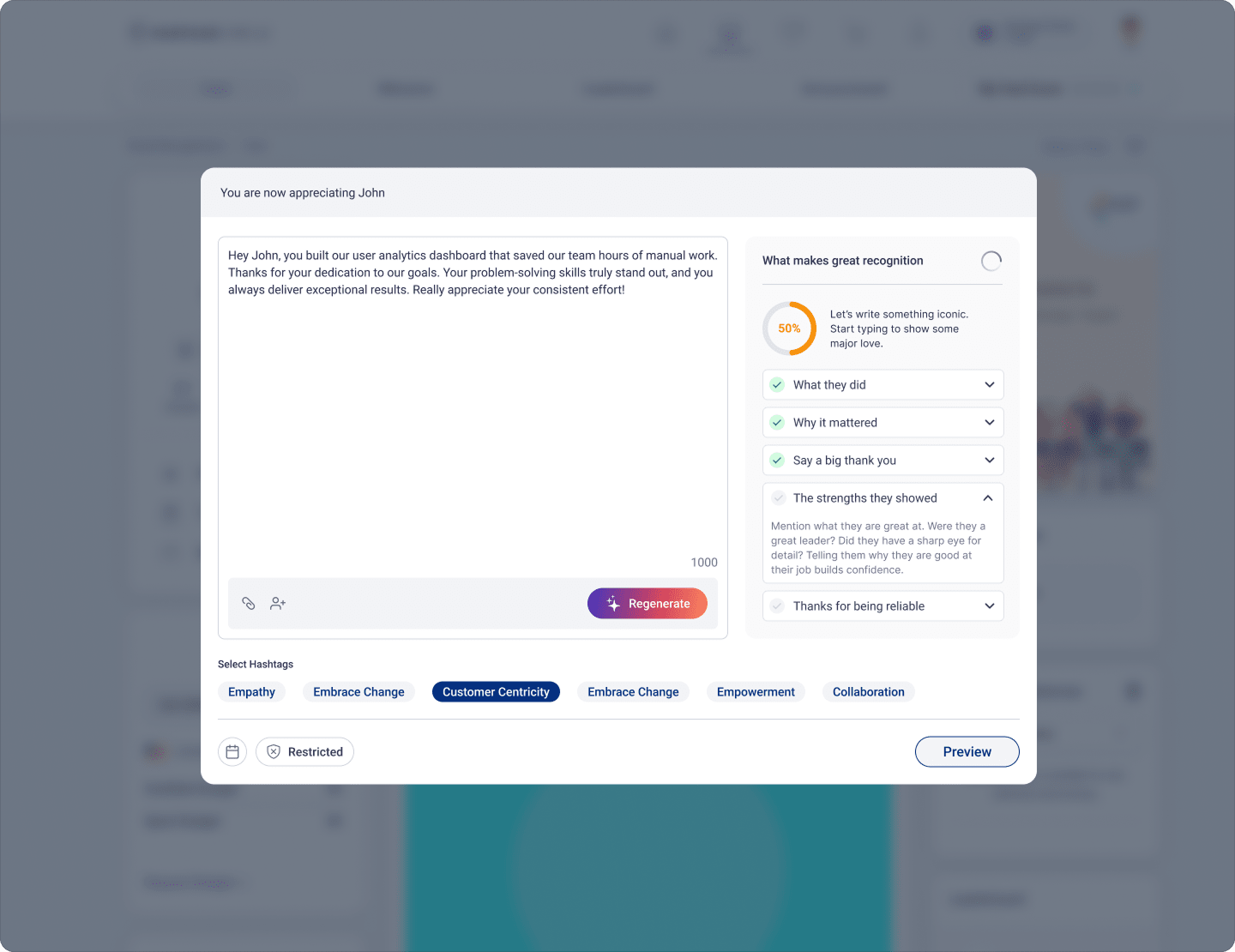
Specificity: naming the behavior, not the person
Recognition that names a behavior reinforces it. Recognition that only names a person flatters them. The difference decides whether the moment changes what happens next week.
"Great job this quarter" tells an employee they are liked. "The way you rewrote the onboarding doc cut new-hire ramp time" tells them exactly which behavior to repeat, and tells everyone reading it what the organization values.
Tying each recognition moment to a named company value turns scattered praise into a consistent signal. Over a quarter, that signal is what builds a recognition strategy into something employees can actually read. There is good evidence for why this works at the individual level, and it is worth understanding the psychology behind why recognition changes behavior before designing a program around it.
Managers are the transmission layer
Engagement varies more between teams inside a single company than it does between companies. That makes manager behavior the variable that matters most, and the company-wide average the number that hides it.
Two teams in the same business, under the same policies, with the same pay bands and the same benefits, routinely report very different engagement. The policies are identical. The manager is not.
This is the practical reason engagement initiatives stall. They are designed centrally and delivered through managers who were never measured on whether they delivered them. If you want to know whether engagement is converting into performance, look at manager-level recognition activity before you look at the company score. It is usually the better predictor, and it points at what actually drives engagement in a specific team rather than in the abstract.
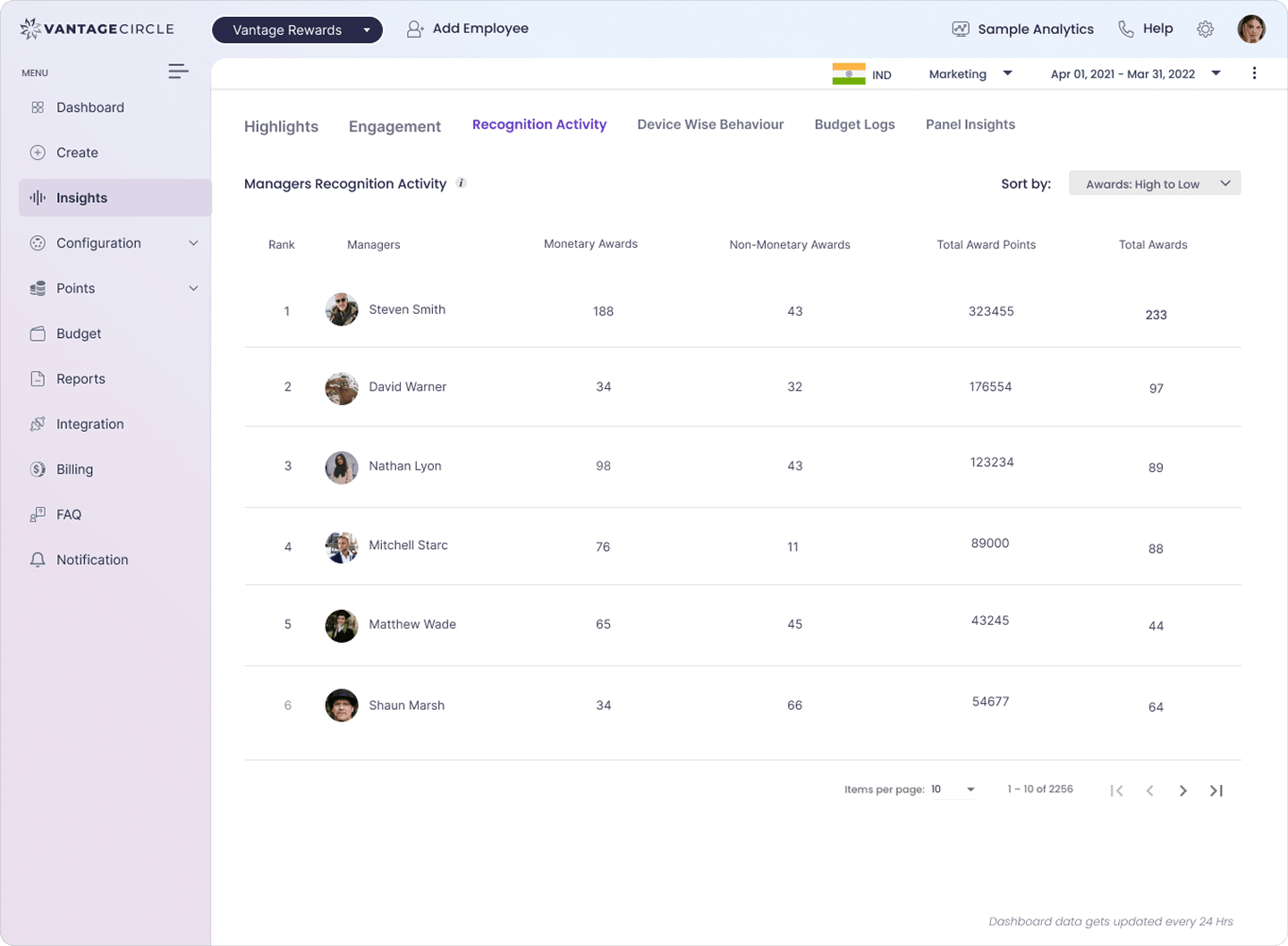
How to tell whether engagement is moving performance in your organization
Measure at team level, not company level, and measure burnout alongside engagement. Company averages hide the variance where the relationship actually lives, and burnout is the variable that grows while engagement's effect fades.
| What to measure | Why it matters | How often |
|---|---|---|
| Engagement score by team | The company average hides the between-team variance that carries the real signal | Quarterly |
| Recognition frequency per manager | Shows which managers are reinforcing behavior and which are not | Monthly |
| Time lag between engagement shift and performance shift | The engagement effect decays, so a long lag understates it | Per cycle |
| Which performance dimension you are tracking | Engagement does not lift task, creative and proactive performance equally | Set once, review annually |
| Burnout indicators | Burnout's effect on performance grows over the same window engagement's fades | Quarterly |
| Participation rate in recognition | Low coverage means the program is reaching a subset, not the organization | Monthly |
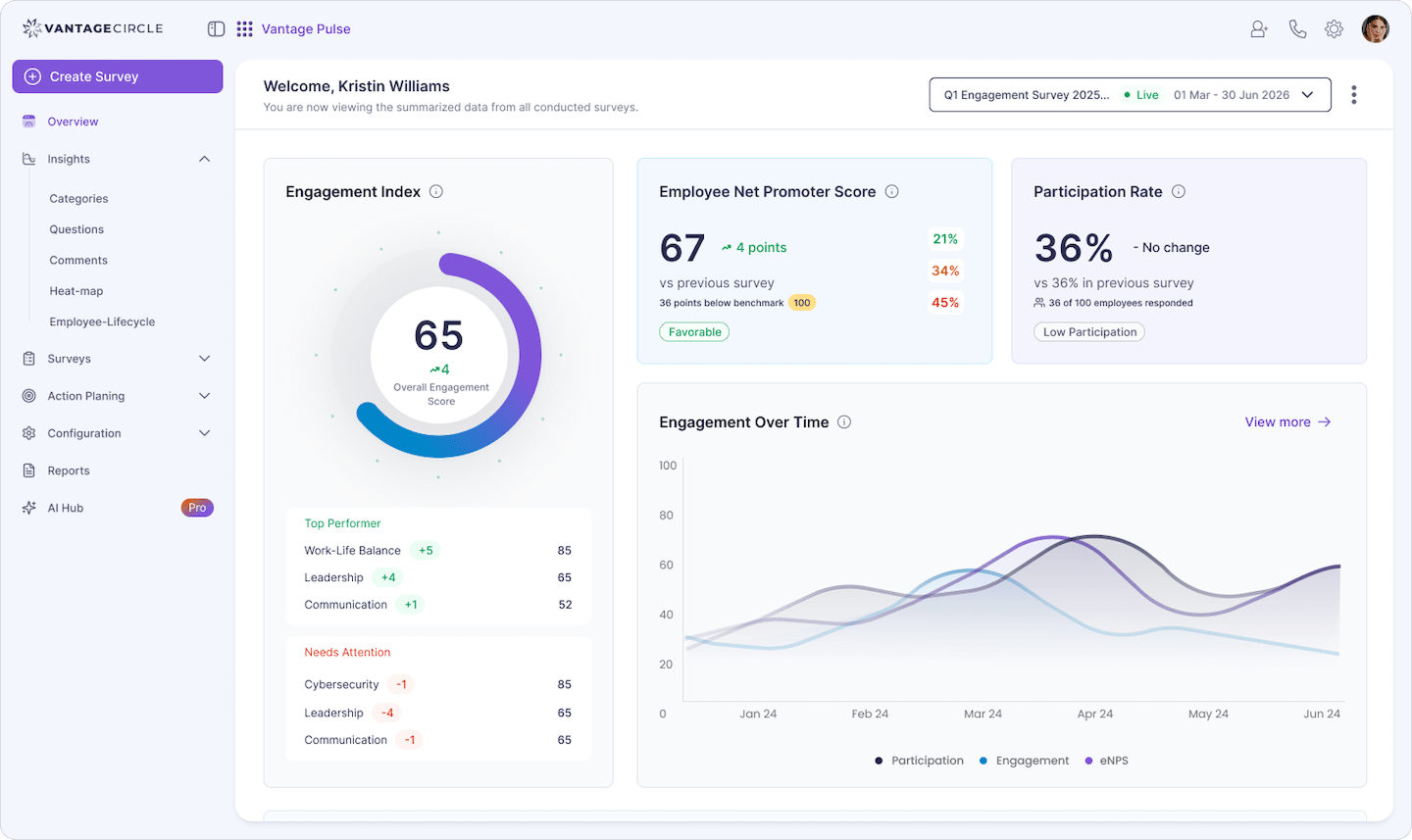
Vantage Pulse, Vantage Circle's employee engagement and pulse survey tool, tracks engagement movement by department over time, which is what lets you attribute a shift to a specific intervention instead of guessing. Pairing that with burnout indicators matters for the reason the 2026 research gives. The two move on different clocks.
If you want a starting set of measures rather than building from scratch, these engagement KPIs worth tracking cover the operational layer.
A single company-wide engagement score is the least useful version of this data. It averages away the team-level variance that carries almost all of the signal, and it arrives too infrequently to catch the window where engagement actually predicts performance.
What this means for your engagement budget
Defend the individual-level claim, qualify the organizational one, and make the case on reinforcement rather than on survey scores. That is the position the evidence actually supports.
The business-unit evidence
Gallup Q12 meta-analysis, 2024.
Three things hold up under scrutiny:
- The individual-level link is well evidenced. Four independent meta-analyses, tens of thousands of employees, consistent direction. This is a defensible basis for investment.
- The organization-level claim needs care. Gallup's business-unit data is real and large, but the broader academic reviews find the organizational evidence inconclusive on causation. Claim association confidently. Claim causation carefully.
- Reinforcement is what separates programs that convert. The organizations where engagement shows up in performance are not the ones with the highest survey scores. They are the ones where recognition is consistent, specific and tied to named behaviors.
Low engagement is expensive. Gallup estimates it cost the global economy approximately $10 trillion in lost productivity in 2025, equal to 9% of GDP. That number is useful for establishing scale. It is not a substitute for showing what your own program changed.
If the harder conversation is internal rather than analytical, the practical problem is usually getting stakeholder buy-in rather than finding another statistic.
Before the budget meeting, answer one question: what percentage of your employees received recognition last quarter, and from how many distinct managers? If you cannot answer it, the engagement score will not save the conversation.
Summing It Up
Employee engagement and performance are genuinely linked. The individual-level evidence is strong, consistent and independently replicated. The organizational-level evidence is real but thinner than the confident version you will read elsewhere.
The more useful finding is that the effect is not static. Engagement's influence on performance fades as time passes, while burnout's grows. That argues for measuring more often, at team level, and for treating reinforcement as the mechanism rather than the engagement score as the goal.
Build the pattern, not the moment. The score follows the behavior, not the other way around.
Connect recognition activity to engagement movement
See which managers are reinforcing which behaviors, and how engagement moves by team in the weeks after.
Book a demoFAQ
What are the 5 C's of employee engagement?
The five C's are commonly listed as care, connect, coach, contribute and congratulate. They describe manager behaviors rather than employee states. The framework is a useful prompt for manager training, though it is a practitioner model rather than a research-validated construct.
Does employee engagement improve business performance?
The evidence supports a positive association, with stronger proof at the individual level than the organizational level. Meta-analyses consistently find engagement related to individual task performance. Reviews of organization-level studies find the number of rigorous studies too small to confirm causation.
What is the impact of employee engagement on employee performance?
Meta-analytic correlations between work engagement and job performance range from roughly .37 to .48. That means engagement accounts for somewhere between 14% and 23% of the variation in individual performance. The effect is strongest over shorter time lags and weakens as the gap widens.
What is the link between employee engagement and performance?
The link is reciprocal and uneven. Engagement predicts later performance more strongly than performance predicts later engagement, which makes engagement the more useful lever. The relationship also varies by the type of performance being measured, so task performance and creative performance do not respond identically.
How does employee engagement affect organizational performance?
Business-unit research finds higher-engagement units outperform lower-engagement units on productivity, profitability and absenteeism. Independent academic reviews are more cautious, noting that most organization-level studies are cross-sectional and too few in number to establish causation. Association at this level is well documented. Causation is not settled.

Nilotpal M Saharia is an Assistant Manager, Content Marketing at Vantage Circle and a recognition-and-rewards (R&R) strategist with 9 years of experience spanning Marketing, HR, and content strategy. He helps HR leaders turn employee recognition and leadership research into practical workplace programs.
Connect with Nilotpal on LinkedIn.