
Employee engagement and well-being are not separate metrics tracked on separate dashboards. They are a feedback loop. Engagement and wellbeing influence each other: when people find meaning in their work and have the energy to contribute, wellbeing tends to benefit. When wellbeing declines, the capacity to engage can decline with it. This guide breaks down that loop, the research behind it, and where HR teams can actually intervene.
What Is Employee Engagement?
Employee engagement is the degree to which employees are emotionally invested in their work and committed to their organization's goals. It goes beyond satisfaction or happiness: an engaged employee is not simply content, they are actively contributing, taking initiative, and aligned with the organization's direction.
For a full breakdown of drivers and models, see our employee engagement guide.
An integrated employee engagement platform connects recognition, pulse surveys, and wellbeing data so you can act on both sides of the loop.
What Is Employee Well-Being?
Employee well-being is the overall state of an employee's physical, mental, financial, social, and professional health as shaped by their work environment and personal circumstances.
Well-being is not a perk or a wellness program. It is a condition. An employee can be highly engaged in a role that is slowly burning them out. An employee can have access to every benefit their organization offers and still feel financially stressed or socially isolated at work. The gap between engagement programs and wellbeing programs is exactly where organizations lose people.
The Mercer Global Talent Trends 2026 report, drawing on 12,000 respondents across 16 geographies, reports that 44% of employees describe themselves as thriving at work, compared to 66% in 2024. The report reinforces the importance of meaningful work in the employee experience. Recognition adds another dimension: employees need to see that their contributions matter, not simply that they are compensated for them.
The Engagement-Wellbeing Feedback Loop
Engagement and wellbeing reinforce each other through a bidirectional mechanism: engagement improves wellbeing, and wellbeing expands the capacity to engage.
This relationship has been described in academic literature as a moderation effect. Research by Shuck and Reio (2014), published in the Journal of Leadership and Organizational Studies, found evidence, in a 216-person healthcare study, that employee engagement moderates the relationship between workplace climate and wellbeing outcomes. The study suggests that engagement can shape how employees experience their work environment, including its effects on psychological wellbeing, personal accomplishment, and burnout. Engagement, in other words, is not only a product of wellbeing conditions. It may also buffer against the conditions that erode it.
The loop has two arms, each requiring a different type of HR intervention.
Arm 1: Engagement improves wellbeing. When employees find their work meaningful, feel recognized, and experience some control over how they do their jobs, they report lower stress, lower burnout risk, and stronger psychological safety. The engagement-to-wellbeing arm is primarily addressed through recognition programs, clarity of purpose, and manager behavior.
Arm 2: Wellbeing expands engagement capacity. When employees are physically healthy, financially stable, and not overwhelmed by unmanaged workload, they have the cognitive and emotional resources to engage. An employee carrying acute financial stress or working through untreated anxiety does not have the same discretionary effort available, regardless of how meaningful the work is. The wellbeing-to-engagement arm is addressed through structural benefits, workload management, and accessible mental health support.
The diagnostic implication is direct. When engagement scores decline, the first question should not be "how do we motivate people?" It should be "which arm of the loop broke first?" Did wellbeing decline and pull engagement down with it? Or did disengagement erode wellbeing over time? The answer determines whether you intervene with recognition and purpose-setting, or with structural wellbeing support.
*The Recognition Effect* (Vantage Circle x Great Place to Work India, 2025) illustrates what happens when the loop is intact: 91% of employees in high-recognition cultures feel motivated, compared to 73% in emerging recognition cultures. When employees experience all four recognition signals of Appreciation, Acceptance, Validation, and Accomplishment, 97% intend to stay with their organization. Recognition can function as a wellbeing input, particularly through social connection, belonging, and a sense of accomplishment.
Recommended Read: How to Build an Employee Recognition Program That Actually Works
What Are the 7 Pillars of Wellbeing?
A practical way to understand workplace wellbeing is through seven interconnected pillars: physical, mental, social, financial, career, community, and environmental wellbeing.
| Pillar | What it looks like at work |
|---|---|
| Physical | Adequate rest, access to health resources, absence of chronic stress-related illness |
| Mental | Psychological safety, low burnout risk, access to mental health support |
| Social | Strong peer relationships, belonging, low isolation |
| Financial | Absence of financial anxiety, access to financial planning tools and employee discounts |
| Career | Sense of growth, purpose, and visibility in one's professional trajectory |
| Community | Connection to organizational mission and to the wider community through shared initiatives |
| Environmental | A physical or digital work environment that supports focus, comfort, and productivity |
Well-being examples that map across these pillars: flexible scheduling (Physical), anonymous pulse surveys (Mental), peer recognition (Social), financial wellness benefits (Financial), mentorship and development programs (Career), community service initiatives (Community), and hybrid workspace design (Environmental).
How Engagement Drivers Show Up in the Wellbeing Loop
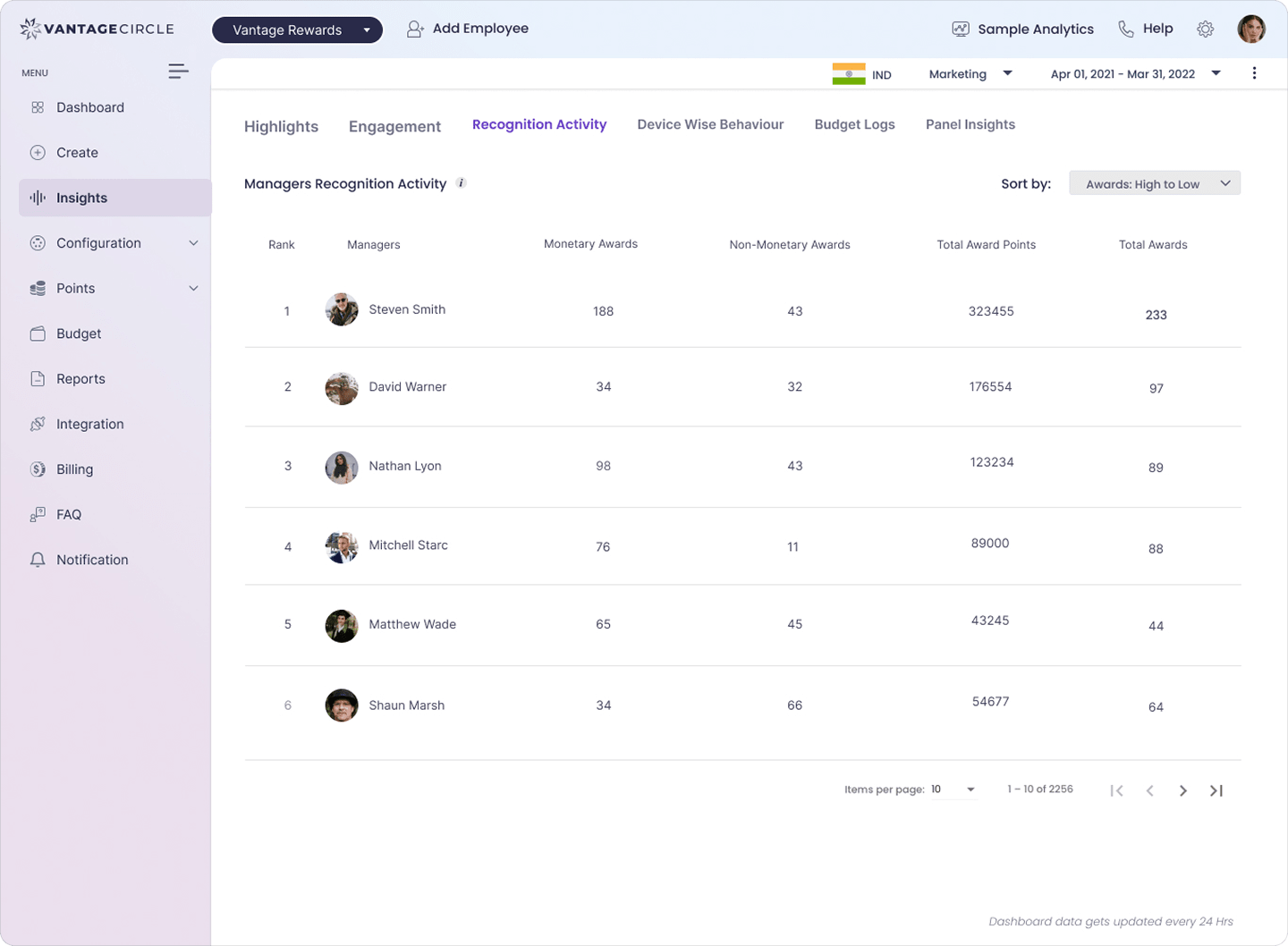
The strongest engagement drivers also function as wellbeing inputs. Manager support, purpose, and recognition do not just raise engagement scores. Through the first arm of the feedback loop, they directly address specific pillars of wellbeing.
Manager support is the highest-leverage intervention point. Gallup estimates managers account for around 70% of the variance in employee engagement scores across business units. A manager who recognizes effort, not just results, can create greater psychological safety around taking initiative and making mistakes. A manager who sets clear expectations reduces ambiguity, directly supporting the mental wellbeing pillar.
Purpose connects to career wellbeing. Employees who understand how their role contributes to organizational outcomes report stronger career wellbeing and lower disengagement risk. The engagement mechanism (sense of contribution) and the wellbeing mechanism (sense of professional worth) are closely connected.
Recognition addresses social and career wellbeing simultaneously. Being seen by peers reduces the isolation that compounds burnout. Being seen by a manager validates professional contribution, which reinforces career wellbeing. According to Gallup's State of the Global Workplace (2024), engagement is more closely associated with whether employees feel their contributions are meaningful and recognized than with compensation alone.
For the full breakdown of all engagement drivers, see our guide to employee engagement drivers.
Source: Vantage Rewards
Practical Ways to Strengthen the Loop
Strengthening the engagement-wellbeing feedback loop requires intervention at both arms. The following approaches address different points in the loop.
Run Diagnostic Pulse Surveys, Not Just Engagement Surveys
A standard annual engagement survey measures engagement level but does not isolate the cause or direction of decline. A quarterly eNPS survey with anonymous response options adds two capabilities: anonymity increases honest reporting of wellbeing concerns (employees tend to soften wellbeing complaints when their name is attached), and higher frequency catches decline before it becomes a retention problem.
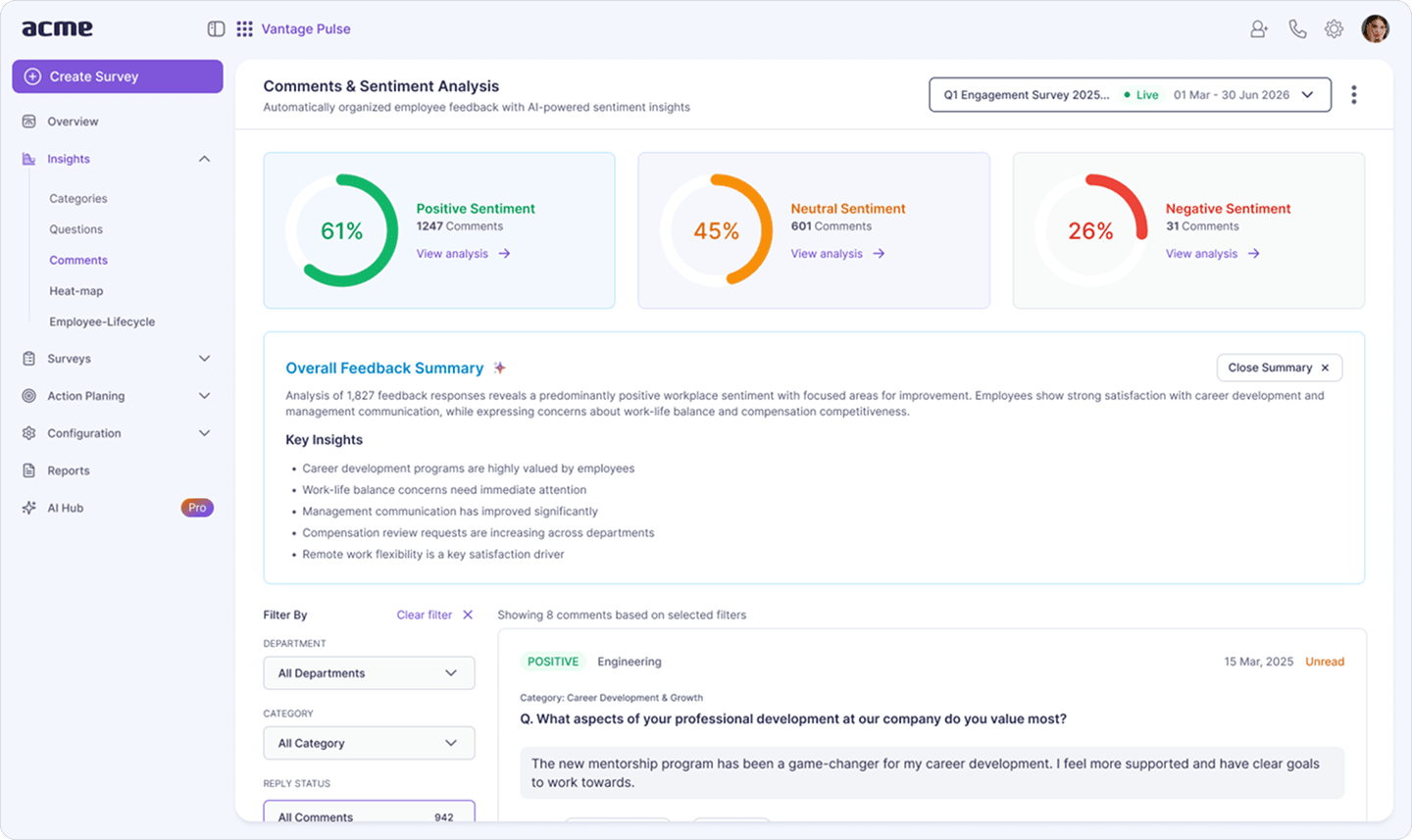
Vantage Pulse sentiment analysis on open-text responses identifies whether declining scores are tracking language around workload and pressure (a wellbeing-to-engagement signal) or around recognition, fairness, or purpose (an engagement-to-wellbeing signal). The value of pulse data is not simply knowing that sentiment has fallen. It is identifying what changed, and that distinction determines where HR intervenes.
Source: Vantage Pulse
Use Recognition as a Wellbeing Input
Recognition is routinely framed as a motivation and engagement tool. Its connection to wellbeing deserves equal attention. Peer-to-peer recognition directly addresses the social wellbeing pillar by reducing the isolation that compounds burnout. A peer who names specifically what you did and why it mattered gives the same signal as belonging: your effort is visible to the people around you, not just to a manager or a performance review.
The *Recognition Effect* report (Vantage Circle x Great Place to Work India, 2025) found that only 55% of employees experience the full emotional impact of recognition. The remaining 45% may receive recognition that is too infrequent, too generic, or too one-directional to create the same sense of connection and accomplishment. Building peer recognition into the regular cadence, not just manager-to-employee recognition, closes that gap.
Address Financial Wellbeing as an Engagement Input
Financial stress is one of the most prevalent and least discussed threats to employee wellbeing. An employee managing acute financial anxiety does not have the same discretionary effort available for work, regardless of how meaningful the role is. Structural financial wellbeing support, including access to financial planning resources, employee discounts on everyday purchases, and transparent compensation frameworks, addresses the financial pillar directly.
For a full list of wellbeing program approaches, see our guides to benefits of employee wellness programs and corporate wellness program ideas.
For manager-specific tactics on supporting team mental health, see how managers can support employee mental health.
Read More: The Real Cost of Disengaged Employees
FAQs on Employee Engagement and Well-Being
What are the 5 C's of employee engagement?
The 5 C's of employee engagement are Care, Clarify, Connect, Contribute, and Congratulate. Care means employees feel genuinely supported by their managers and organization. Clarify means goals and expectations are clear. Connect means employees have strong relationships at work. Contribute means they see how their work makes a difference. Congratulate means their effort is recognized consistently.
What are the 7 pillars of wellbeing?
The 7 pillars of wellbeing are physical, mental, social, financial, career, community, and environmental wellbeing. Each represents a domain of employee health and functioning that employers can directly influence. Interventions can address multiple pillars simultaneously, such as recognition supporting social and career wellbeing or pulse surveys supporting mental wellbeing.
What are the three P's of employee engagement?
The three P's of employee engagement are Purpose, People, and Progress. Purpose means employees understand why their work matters. People means they have supportive relationships with their manager and peers. Progress means they can see growth in their skills and contribution over time. When all three are present, discretionary effort increases significantly.
What are the top 5 drivers of employee engagement?
The top five drivers of employee engagement are manager support, meaningful work, recognition, growth opportunities, and psychological safety. Manager behavior is consistently the highest-leverage factor; Gallup estimates managers account for around 70% of the variance in engagement scores across teams. For the full breakdown, see our guide to employee engagement drivers.
What are the 10 C's of employee engagement?
The 10 C's of employee engagement are Connect, Career, Clarity, Convey, Congratulate, Contribute, Control, Collaborate, Credibility, and Confidence. This expanded framework is used in organizational development contexts to diagnose which engagement dimensions are weakest in a given team or department.
What are the four main types of employee engagement?
Three widely recognized types of employee engagement are cognitive (mental focus and alignment with organizational goals), emotional (sense of meaning, pride, and belonging), and behavioral (discretionary effort and initiative beyond minimum requirements). Some frameworks add a fourth, social engagement, as a distinct dimension covering the quality of relationships with colleagues and managers. For definitions and examples, see our guide to types of employee engagement.
How to improve employee engagement?
Improving employee engagement starts with diagnosing which drivers are weakest. Run a pulse survey with anonymous responses to surface honest feedback, then prioritize manager training, recognition consistency, and clarity of purpose. Sustainable improvement requires addressing the wellbeing side of the loop: an employee experiencing burnout or financial stress cannot engage at full capacity regardless of motivation programs.
What are some fun activities for employee engagement?
Effective engagement activities include peer recognition moments (shout-outs in team meetings or on a shared recognition feed), values-based hackathons, cross-departmental project assignments, team wellness challenges, and milestone celebrations that name what someone has accomplished. The most effective activities combine social connection with visible contribution, addressing two wellbeing pillars simultaneously.
Conclusion
Engagement and wellbeing are not two separate HR programs. They are a feedback loop, and they need to be managed as one. When engagement is high, employees draw purpose and meaning from their work, which supports mental and social wellbeing. When wellbeing is strong, employees have the cognitive and emotional capacity to engage fully, to take initiative, and to stay.
The organizations that get this right do not treat wellbeing as a perk layered on top of an engagement initiative. They understand that recognition, transparent feedback, and structural financial support are all wellbeing inputs, and that every wellbeing investment expands the capacity for engagement.
The loop is already running in your organization. The question is whether you are measuring it.
Recommended Read: Employee Happiness in the Workplace: What HR Leaders Need to Know

Supriya is a Content Marketing Lead at Vantage Circle, where she writes on employee engagement, recognition, workplace communication, and culture. Her work on remote team recognition draws on primary research from Vantage Circle's platform data and customer deployments across distributed workforces. She spent the earlier part of her career in corporate communications at Burson, ESPN Star Sports, and CBRE, advising organizations on the messages employees actually hear.
Connect with Supriya on LinkedIn.