An employee rarely wakes up one morning and decides, "I'm disengaged."
It usually happens in smaller moments. A manager who stops checking in, a promotion that never comes, a new hire who still doesn't know what success looks like after 30 days. By the time an annual engagement survey captures the problem, the most important moments may have already passed.
I've found that employee experience is less a snapshot than a trail of breadcrumbs. The trick is knowing where to look.
That is what employee lifecycle surveys are designed to do. Instead of asking everyone the same broad questions once a year, they listen at the moments that can change an employee's experience.
If done well, these employee surveys don't just tell you what employees think. They show you where the experience started to change, why it changed, and whether you caught it early enough to matter.
What are Employee Lifecycle Surveys?
Employee lifecycle surveys are short, targeted surveys sent at key moments in an employee's journey, rather than relying on one annual engagement survey to tell the whole story. These moments can include onboarding, work anniversaries, promotions, role changes, and exit.
The idea is simple. Ask employees about their experience while it is still fresh. A day-30 onboarding survey can uncover confusion about the role before it becomes frustration. A work anniversary survey can reveal whether an employee still sees a future with the organization.
When these surveys are connected over time, they give HR more than isolated feedback. They create a clearer picture of how an employee's experience evolves and where leaders have an opportunity to improve it.
Benefits of Employee Lifecycle Surveys
Improved Recruitment
Identifies weaknesses in the hiring process so companies can streamline recruitment and strengthen employer branding.
Increased Engagement
Shows employees their feedback is valued, fostering empowerment that improves the work environment and productivity.
Enhanced Onboarding
Pinpoints pain points early so organizations can smooth the transition and clarify policies for new hires.
Reduced Turnover
Surfaces the real reasons employees leave, such as limited career growth, so leaders can act before attrition happens.
Key Stages of Employee Lifecycle Surveys
| Stage and Timing | What It Reveals |
|---|---|
| Onboarding (Day 30, 60, 90) | Whether the role, the tools, and the team match what was promised, while there is still time to fix it |
| Milestones and Promotions | Whether growth feels real and recognized, or whether ambition is quietly stalling |
| Tenure / Stay (Year 1, 3, 5) | Why long-tenured people stay, and the early signals that they are starting to look elsewhere |
| Offboarding / Exit | The honest reasons people leave, and the patterns you can prevent for the next person |
1. Onboarding
The first 90 days tell you more about an employee's future than most leaders realize. It is when expectations meet reality and when small frustrations can quickly become lasting impressions.
A new hire who is unclear about their role, missing the right tools, or hearing little from their manager may not raise a hand and say, "Something isn't working." But a short, well-timed survey can surface it while there is still time to fix it.
That is why the 30/60/90-day cadence matters. Day 30 reveals early friction. Day 60 shows whether the employee is finding their footing. Day 90 tells you whether they are truly settling in. Instead of waiting for an annual survey to expose a problem months later, leaders can spot the warning signs when a simple conversation or intervention can still change the outcome.
Five sample onboarding questions you can use are:
- Do you have the tools, access, and information you need to do your job well?
- Has the role so far matched what was described to you during hiring?
- How connected do you feel to your team after your first few weeks?
- Is there anything you expected support with that you have not received yet?
- On a scale of 0 to 10, how likely are you to recommend this company as a place to work?
That last question is a classic eNPS item, and it belongs here for a reason.
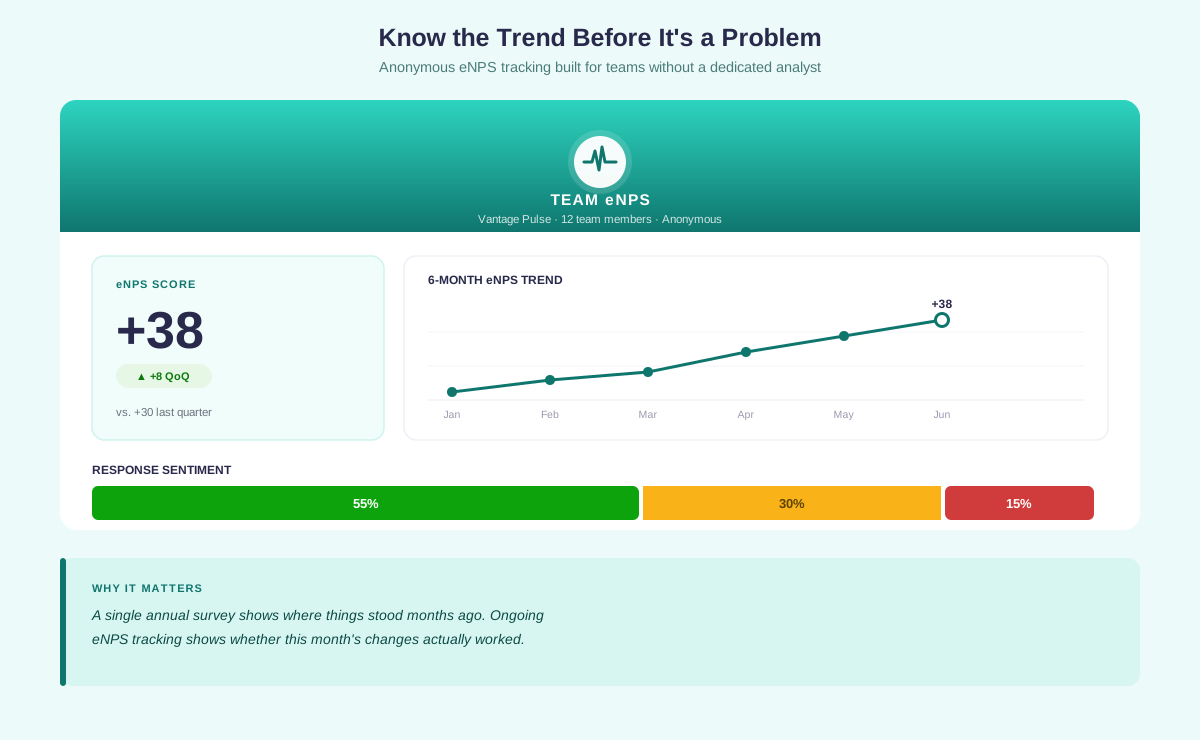
This is where eNPS Surveys earn their keep. A short, automatically triggered pulse at day 30 catches problems while there is still time to fix them—something a single annual survey, arriving at the exit interview, simply cannot do.
Source: Vantage Pulse
Recommended Read: 45 Employee Onboarding Survey Questions To Ask Your New Hires
2. Milestones and Promotions
A promotion looks like a success story on paper. But after years of watching careers unfold, I've learned that what looks like progress from the outside can feel very different from the inside.
A new title can bring pride, but it can also bring heavier responsibilities, unclear expectations, or the nagging question: What happens after this? The same is true when someone takes on a new role or completes a major project.
That is why these moments deserve closer listening. A well-timed milestone survey can reveal whether employees see their growth as meaningful or simply as more work with a different title.
More importantly, it gives leaders a chance to address career concerns while the employee is still invested. Growth should not just move someone forward on an org chart; it should make them want to stay for what comes next.
Five sample milestone and promotion questions:
- Did this promotion or role change come with the clarity you needed about your new responsibilities?
- Do you feel your recent contributions were recognized fairly?
- What would make the next stage of your career here feel worth staying for?
- Do you have a manager or mentor who is genuinely invested in your growth?
- How confident are you that there is a real future for you at this company?
The value of these questions is that they surface ambition before it curdles into resentment. A high performer who does not see a path forward does not usually complain. They just leave, and they leave for a competitor.
U.S. employees say they lack opportunities for career advancement.
3. Tenure / Stay Surveys (1, 3, 5 Years)
The best time to ask why a good employee might leave is before they start thinking about leaving. That is the value of stay surveys. Run them at first, third and fifth-year marks to understand what is keeping employees engaged, what has changed, and what might eventually push them out.
Unlike an exit interview, a stay survey gives you something far more valuable. It gives you time to do something about the answer.
Tenure milestones are natural moments for employees to take stock. At first year, the honeymoon is usually over and employees have a clearer view of the job they actually signed up for. By third and fifth years, questions around career growth, recognition, compensation, and what comes next become harder to ignore.
Here are five sample tenure and stay survey questions:
- What keeps you here, and what would tempt you to leave?
- Do you still find your work meaningful after this much time?
- When did you last feel genuinely recognized for good work?
- Is your compensation in line with what you believe you could earn elsewhere?
- If you could change one thing about working here, what would it be?
The real value of a stay survey is not in the rating. It is in the open text answer to that first question. The score tells you there is a problem. The written response tells you what it is.

Vantage Influencers Podcast
There's probably nothing that discredits an HR department faster than using an off-the-shelf survey.
Dr. Wayne Brockbank · Clinical Professor of Business, University of Michigan's Ross School of Business
Listen to the Episode4. Offboarding / Exit
People are often most candid about an organization when they no longer have to worry about how their answer will be received. That makes the exit one of the most valuable listening moments in the employee lifecycle.
Offboarding is more than collecting equipment, completing paperwork, and saying goodbye. It is the final opportunity to understand what the employee experienced, what influenced their decision, and what the organization may have missed along the way.
A well-designed exit survey can surface patterns that are difficult to see from inside the business. One employee mentioning poor manager support may be an isolated issue. Ten employees saying the same thing over six months is a signal.
The real value is not in knowing why one person left. It is in using their experience to make sure the next ten have fewer reasons to do the same.
Here are five offboarding and exit questions:
- What is the single biggest reason you decided to leave?
- Was there a specific moment when your decision became final? What was it?
- Did you feel your manager supported your growth while you were here?
- Is there anything the company could realistically have done to keep you?
- Would you recommend this company to a friend looking for work? Why or why not?
Exit feedback is only honest if the employee believes it is truly anonymous and will not follow them into a reference check. That belief has to be built into the process, not just promised in the intro paragraph.
Why Employee Lifecycle Surveys Matter
Employee lifecycle surveys matter because most turnover is preventable, and you can only prevent what you catch in time.
An annual engagement survey is useful, but by the time the results come back, the employees who were already disengaging may have moved on or made up their minds to do so.
The numbers are difficult to ignore. Gallup found that 42% of employees who voluntarily left said their manager or organization could have done something to prevent it. The Work Institute's 2025 report, based on more than 120,000 exit interviews, put preventable departures even higher at 75%. In other words, many of the people organizations lose were not inevitable losses.
And the cost of waiting is substantial. Gallup estimates that replacing an employee can cost 50% to 200% of their annual salary, while voluntary turnover costs U.S. businesses roughly $1 trillion a year. For an employee earning $80,000, that could mean $40,000 to $160,000 in replacement costs once lost productivity, ramp-up time, and institutional knowledge are factored in.
Meanwhile, engagement itself is under pressure. U.S. employee engagement fell to a 10-year low at the end of 2024, with just 31% of employees engaged and 17% actively disengaged, according to Gallup. When engagement is this fragile, waiting 12 months to ask how people are doing is a long time.
Lifecycle surveys change the timing. They put targeted questions in front of employees when their experiences are taking shape—30 days into a new job, after a promotion, at a major tenure milestone, or before they leave. That gives leaders a chance to spot friction, start a conversation, and act while there is still something to save.
They also make listening more practical. Automated triggers can send a survey on day 30 or a one-year anniversary without HR having to remember. Managers get signals they can act on, rather than a report explaining what went wrong six months ago.
An annual survey can tell you the building is on fire. A lifecycle survey can tell you which room is heating up while there is still time to grab the extinguisher.
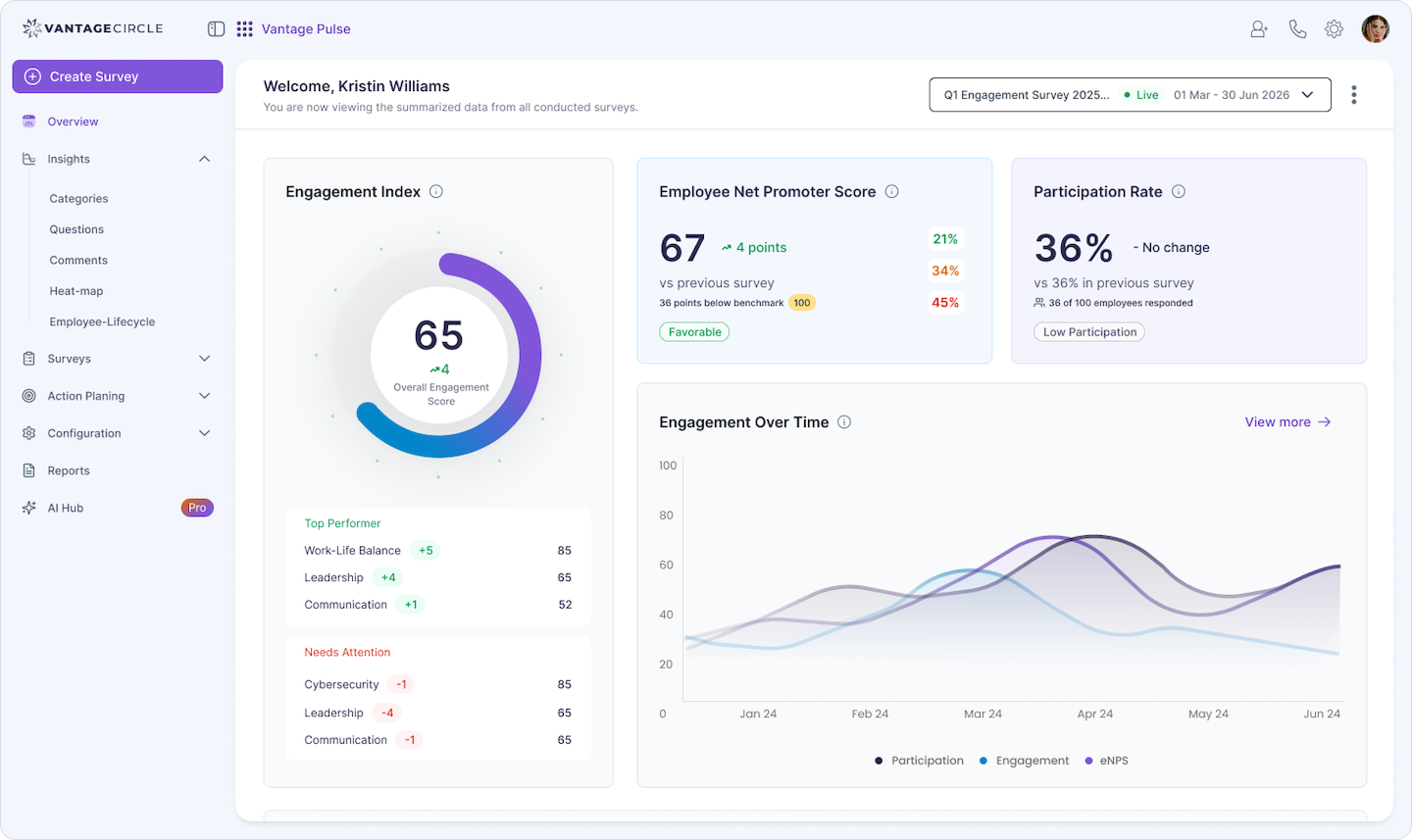
Knowing that engagement dips at a particular milestone is useful. Knowing exactly when it dips, by how much, and where it happens is what gives leaders evidence to change the program.
Source: Vantage Pulse
How to Conduct Employee Lifecycle Surveys
Start by mapping your survey triggers to real moments in the employee experience, then automate them so the right survey fires at the right time without manual effort. The most common mistake is not the questions. It is running surveys on a calendar the company controls instead of the milestones the employee actually lives through.
Here is a practical sequence for you to conduct employee lifecycle surveys:
-
1
Map the Moments
List the points in your lifecycle worth surveying: day 30, 60, and 90 of onboarding, promotions and role changes, the 1-year, 3-year, and 5-year tenure marks, and exit. Do not survey everything. Pick the 6 to 8 triggers that carry the most retention risk.
-
2
Keep Each Survey Short
A lifecycle survey should take under 3 minutes. Anything past 10 questions invites survey fatigue, and fatigue lowers your response rate exactly when you need honest answers most.
-
3
Automate the Triggers
This is where the program either scales or quietly dies. Manual sending fails because someone always forgets. Automated triggers fire on the milestone itself, so the day-30 pulse actually goes out on day 30.
-
4
Segment the Results
A company-wide average hides the story. One team's onboarding can be excellent while another's quietly bleeds new hires. Break results down by department, manager, and location before you draw any conclusions.
That segmentation is where Department-wise Insights come in. A company-wide lifecycle result hides what is actually happening on the ground, while a department-level breakdown shows whether a stage-specific problem is isolated to one team or spread across the business.
-
5
Close the Loop
This is the step most companies skip, and it is the one that matters most. Employees lose trust fast if they answer survey after survey and see nothing change. Report back what you heard and what you are doing about it. A listening program with no visible action is worse than no program at all, because it teaches people that feedback is theater.
Conclusion
In conclusion, employee lifecycle surveys are invaluable tool for understanding and improving the employee experience at every stage. By actively seeking feedback at key stages of employee lifecycle you can enhance recruitment, increase engagement, reduce turnover, and foster a thriving company culture.
While the questions presented here can serve as a foundation, it's important to continuously refine and adjust surveys according to your changing requirements.
FAQs
What are the 7 Stages of an Employee Life Cycle?
The 7 stages most commonly cited are attraction, recruitment, onboarding, development, retention, and offboarding, with some frameworks adding advocacy from former employees and alumni.
What are Good Employee Survey Questions?
Good employee survey questions are short, specific, and tied to a real moment. They ask about one thing at a time, avoid leading language, and mix rated scales with open text so you capture both the score and the reason behind it.
What are the Five Stages of the Employee Lifecycle?
The 5 stages of the employee lifecycle are recruitment, onboarding, development, retention, and separation or exit.
What is Offboarding in HR?
Offboarding in HR is the structured process of managing an employee's departure, covering the exit interview or survey, knowledge transfer, return of equipment and access, and final administrative steps.
What is the Most Well-known Employee Survey?
The most well-known employee survey metric is eNPS, or employee Net Promoter Score, which asks how likely an employee is to recommend the company as a place to work on a scale of 0 to 10.

Shikha Gogoi is a Content Marketing Specialist focused on SEO-driven content around employee engagement, recognition, and workplace culture, helping build people-first workplaces.
Connect with Shikha on LinkedIn.