
A positive work environment is one where employees trust their manager, get recognized regularly for good work, and feel safe raising concerns without fear of repercussions.
Most advice about improving a work environment starts with the office: better lighting, a nicer break room, more plants by the window. None of that is wrong, just incomplete.
A positive work environment comes down to three things working together: honest communication, consistent recognition, and a physical and social space people actually want to be part of. When workplace improvement efforts stall, look past the furniture. Usually, one of those three pieces is missing, and that is the real fix.
Here is what each pillar looks like in practice, for employees and for the managers building it, plus eight practical ways to act on all three:
- Share information openly
- Build real channels for feedback
- Avoid micromanagement
- Make appreciation a daily habit, not an annual event
- Support growth and development
- Protect real time off
- Get comfort and design right
- Encourage natural, unforced team connection
What Makes a Work Environment Positive vs. Negative?
You can't always spot a negative work environment from the outside. Long hours and an open floor plan aren't automatically signs of a toxic workplace. What actually matters is how people get treated day to day: whether feedback happens out in the open, whether good work gets noticed, and whether leaders lead through trust or through fear.
"Creating cultures of respect and civility is what gets you walking into a positive work environment. That means getting rid of leaders who lead through fear and toxicity." Natasha Bowman, JD, SPHR, Founder & President, Performance ReNEW, on How To Retain Your Employees During The Great Resignation?
Only 23 percent of employees worldwide are engaged at work. That means the other 77 percent are either doing the bare minimum or have mentally checked out already, according to Gallup's State of the Global Workplace 2023 report. That gap isn't mainly about pay. It tracks closely with the day-to-day conditions below.
Here is the practical difference between the two:
| Sign of a Negative Work Environment | What a Positive Work Environment Looks Like Instead |
|---|---|
| Feedback only happens once a year, at a performance review | Feedback happens in the normal course of work, from managers and peers alike |
| Good work goes unnoticed until something goes wrong | Contributions are acknowledged consistently, in public and in private |
| Employees hesitate to raise concerns for fear of repercussions | People have an anonymous, low-risk way to flag what isn't working |
| Time off comes with guilt or a backlog to dread | Time away from work is treated as genuinely off, not something to make up for later |
| Leaders manage through fear or control | Leaders build trust through respect, consistency, and fairness |
None of the five items on the right happen by accident. Each one comes down to a specific choice a company makes about communication, recognition, and physical and social space, which is exactly what the next three sections cover.
Communication and Feedback: The First Pillar
Open communication is the first pillar of a positive work environment, and you will see it less in formal town halls and more in whether people feel safe raising a concern on an ordinary Tuesday.
Share Information Openly
Employees who understand why a decision got made are far more likely to support it, even when they disagree with the outcome. Withhold the context, and you get speculation, plus trust that quietly erodes. You don't need to make every internal detail public. Just explain the reasoning behind decisions that affect people's day-to-day work, restructuring, priority shifts, policy changes, instead of only announcing them.
In practice, this can be as simple as a manager spending five minutes in a team meeting explaining why a project got deprioritized, instead of letting the team find out secondhand. Leave people to guess at the reasoning, and they'll usually assume the worst version of events. A short, honest explanation almost always lands better than silence, even when the news itself isn't good.
Leadership style plays a direct role here too. Leaders who default to explaining their reasoning build far more trust over time than leaders who just issue instructions. You don't need more meetings for this. Just treat explaining your reasoning as a normal part of managing, not an extra step you save for the big announcements.
Build Real Channels for Feedback
An open-door policy only works if people actually believe walking through the door is safe. Some issues, like a manager's behavior or a conflict between two colleagues, rarely surface through a direct conversation, no matter how open the policy claims to be.
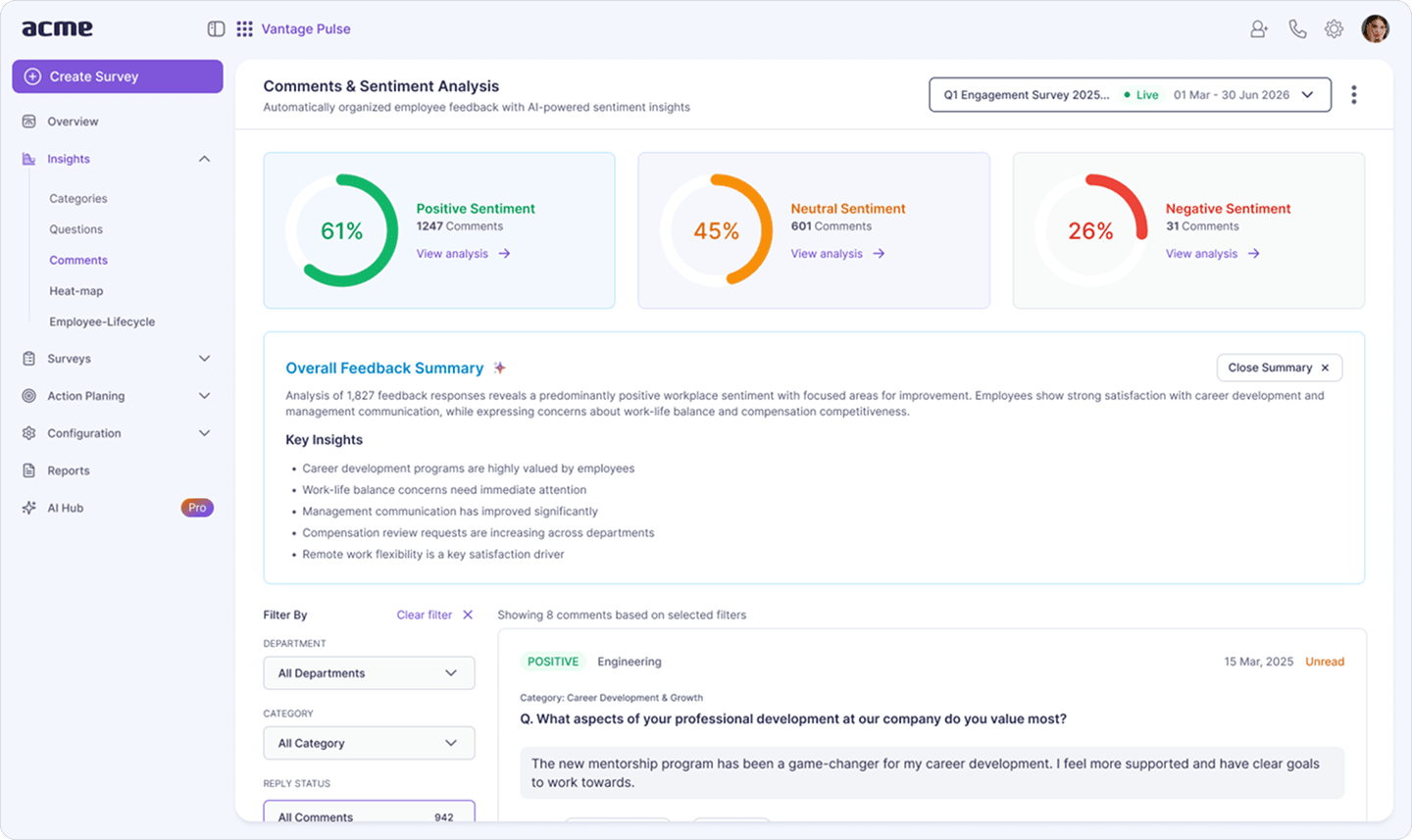
This is where a structured, recurring channel beats a general promise to listen. Platforms like Vantage Pulse run eNPS and pulse surveys on a regular cadence, and anonymous response options give employees a way to flag what is actually affecting morale without attaching their name to it. Sentiment analysis on open-text responses can surface patterns too, a specific team's frustration, a recurring complaint about workload, that a manager might otherwise miss until it shows up as an exit interview.
Avoid Micromanagement
Constant check-ins and approval steps are the hallmark of micromanagement, and employees notice. That doesn't mean ditching oversight altogether. Agree on clear outcomes upfront, then give people the room to reach them their own way. Managers who default to control over autonomy tend to build teams that wait for instructions instead of teams that solve problems on their own.
Here's a practical test: if a manager needs a daily status update to feel comfortable, that's usually a sign the goal was never made clear enough to delegate with confidence, not a reliability problem with the employee. Swap daily check-ins for a weekly outcomes review, focused on results instead of activity, and you'll usually surface real problems faster while giving people room to work the way that suits them.
Recognition and Support: The Second Pillar
Recognition is the second pillar, and the pattern holds across every company that gets it right: how often appreciation happens matters more than how big any single gesture is.

Make Appreciation a Daily Habit, Not an Annual Event
Annual awards and year-end bonuses matter, but they can't carry the full weight of making people feel valued. One big gesture a year doesn't make up for months of going unnoticed.
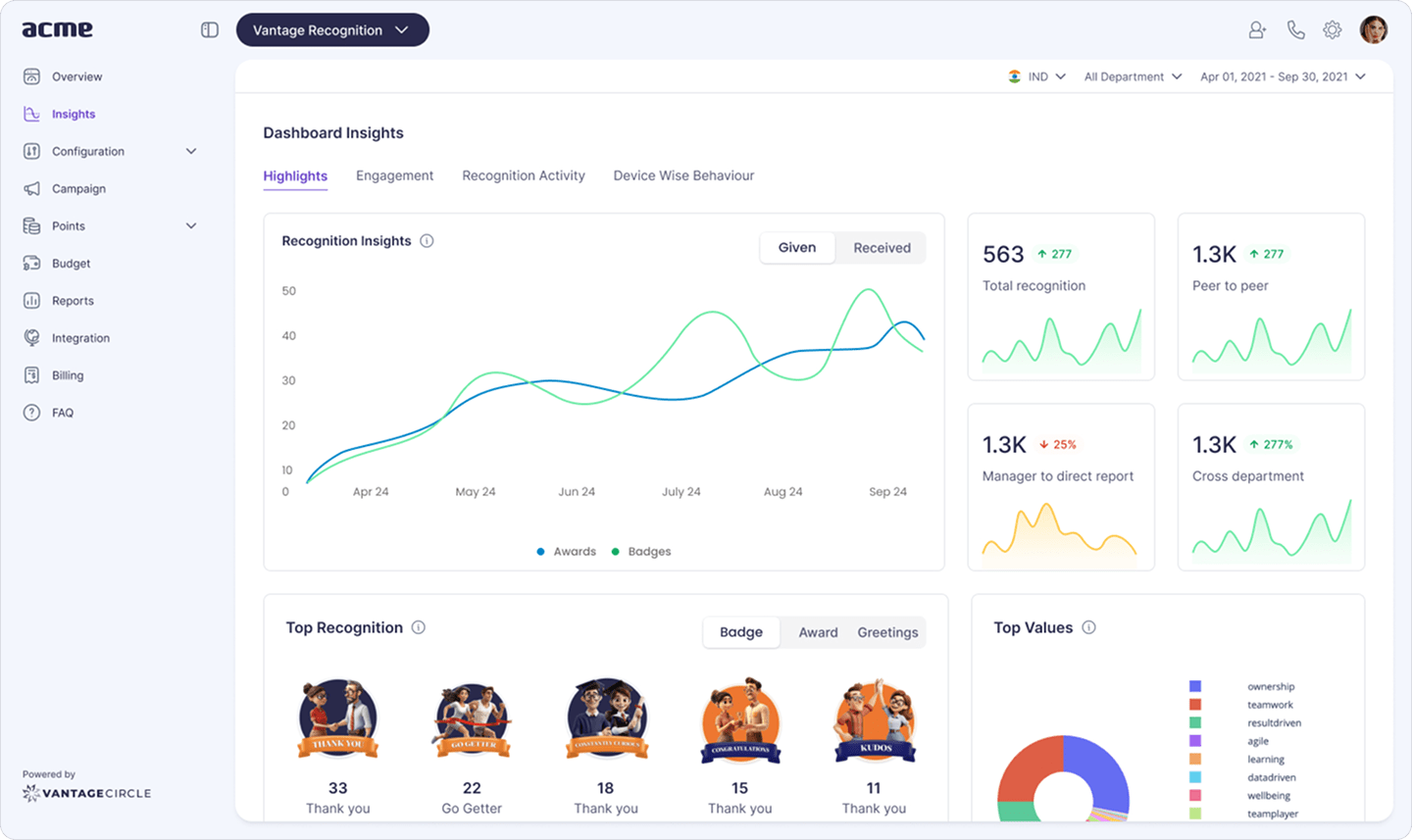
At Wipro, recognition now happens once every 1.2 minutes across the company's global workforce, according to Vantage Circle's 2024 case study with Wipro. That kind of pace only happens when recognition is built into daily work through peer-to-peer appreciation and manager recognition, not saved for a quarterly ceremony. Platforms like Vantage Recognition make that frequency visible and repeatable. A social recognition feed turns a private thank-you into something the whole team sees, and a manager who calls out specific behavior consistently shapes day-to-day morale more than any single policy ever could.
What the data says about recognition In recognition-driven cultures, 92 percent of employees stay with their organization compared to 76 percent in low-recognition cultures, and 91 percent report feeling motivated compared to 73 percent elsewhere, according to The Recognition Effect Report, Vantage Circle's 2025 report with Great Place To Work India.
Support Growth and Development
Recognition without a path forward eventually feels hollow. If people can't see how their work connects to something bigger, a new skill, a stretch project, an eventual promotion, they'll disengage even if you thank them every week. So pair the two: recognition with a real employee development plan. When you call out a specific behavior, name what it opens up next. That's what keeps appreciation from feeling like a participation trophy.
It's easier to build into a routine than most managers assume. Once a quarter, sit down and cover three questions: What has this person gotten noticeably better at? What's the next skill worth building? What would need to be true for them to take on more? That one conversation does more for retention than an annual development plan nobody looks at again. Growth talks that only happen during the review cycle feel like paperwork. The ones that happen alongside regular recognition feel like someone's actually paying attention.
Protect Real Time Off
Recognition also means respecting the line between work and rest, the foundation of real work-life balance. If people are expected to check email on vacation, or come back to a backlog so big that being away felt worse than staying, you're telling them rest doesn't actually matter, no matter what the vacation policy says. A positive work environment treats time off as genuinely off, with coverage planned ahead so nobody returns to a mess they could've avoided.
A few habits make this real instead of aspirational. Assign a backup for every role before someone leaves, so questions land with a colleague instead of piling up in an inbox. Let mental health days stand on their own instead of folding them into sick leave, so nobody has to invent a stomach bug to justify a break. And keep the first day back light, no wall of overdue meetings waiting the second someone logs in, so coming back doesn't erase the point of having left.
Physical and Social Space: The Third Pillar
Physical and social space is the third pillar, and it works best as a support system for the first two, not a replacement for them. No amount of office design saves a team that doesn't trust its manager.
Comfort and Design
Comfortable furniture, functional meeting spaces, and decent lighting are baseline expectations, not perks. Employees spend a huge share of their waking hours at work, and a workspace that is uncomfortable to sit in for eight hours will wear people down no matter how good the culture is otherwise. Flexibility matters too. A mix of quiet space and collaborative space lets people choose the setting that fits the task in front of them.
Accessibility deserves the same attention as aesthetics. Adjustable desks, clear walkways, and quiet rooms for people who need to step away from noise are basic design decisions, not niche requests. They determine whether a space works for everyone who has to use it, not just the average employee. For hybrid and remote teams, the same principle applies to home setups. A modest stipend for a proper chair or monitor often does more for daily comfort than a redesigned break room most people visit twice a week.
Natural, Unforced Team Connection
Forced fun, mandatory happy hours, prescribed icebreakers, usually produces eye-rolls instead of real team building. What works better is giving teams a recurring, low-pressure reason to interact that doesn't depend on anyone's calendar. A shared wellness challenge through something like Vantage Fit is one example. It gives colleagues a reason to check in with each other regularly without it feeling like a mandatory event.
Interest-based groups tend to beat top-down social calendars for the same reason. A lunchtime walking group, a book club, a small fantasy sports league, these work because people opt in voluntarily, which makes the connection feel genuine instead of assigned. None of this needs a big budget. It just needs a few employees given the room and a little support to organize something they already care about, instead of HR designing every social touchpoint from the top down.
Creating a Positive Work Environment as an Employee vs. as a Manager
Building a positive work environment isn't only a manager's job, and it looks different depending on where you sit.
What You Can Do as an Employee
You can't single-handedly fix a toxic culture, but you have more influence than it feels like day to day.
- Give recognition as often as you would like to receive it. Peer recognition often lands harder than recognition from a manager, precisely because nobody is requiring it.
- Raise concerns through whatever structured channel exists, an anonymous survey, a skip-level conversation, instead of letting frustration build silently until it turns into disengagement.
- Respect colleagues' time off the way you want your own respected. Don't message someone on leave unless it's genuinely urgent.
- Be honest in feedback conversations instead of defaulting to polite agreement. A manager can't fix what they don't know is broken.
- Protect your own boundaries on purpose. A positive environment depends on people modeling healthy limits, not just managers granting them.
What You Can Do as a Manager
Managers set the tone more than any single policy does.
- Recognize specific behavior, not just outcomes, so people know exactly what to repeat. "Great work this quarter" teaches a lot less than "the way you handled that client escalation on Tuesday."
- Ask for feedback in a way that makes it safe to disagree with you, then act visibly on at least some of what you hear. Even small changes signal you took the input seriously.
- Model the boundaries you want your team to keep. If you are emailing at midnight and expecting a reply, no work-life balance policy will land.
- When someone raises a concern, treat it as information, not a complaint to manage away. The instinct to defend the status quo is usually the biggest barrier to fixing it.
- Check in on workload distribution regularly. Burnout concentrated on one or two people tends to stay invisible until it shows up as a resignation, not before.
How Vantage Circle Supports a Positive Work Environment
A positive work environment gets built through daily habits, not a single tool, but the right platform makes those habits a lot easier to keep up. Most HR teams already believe in recognition, open feedback, and reasonable boundaries. Where programs actually fall apart is consistency. Recognition that's strong at launch and fizzles out by quarter two. A survey that goes out once a year instead of on a real cadence. No easy way to tell whether appreciation is actually reaching frontline teams or just staying in head office. A connected platform closes that gap. It makes these behaviors visible enough that HR can track them instead of just hoping they're happening.
| Vantage Circle Feature | How It Supports the Environment |
|---|---|
| Peer-to-peer and manager recognition | Makes daily appreciation visible and repeatable across teams, not just at review time |
| eNPS and pulse surveys | Gives employees a structured, regular channel to flag what is actually affecting morale |
| Anonymous responses | Catches honest feedback on issues employees won't raise through an open-door policy |
| Sentiment analysis | Surfaces environment-quality signals from open-text feedback that a manager might otherwise miss |
| Recognition analytics | Tracks recognition frequency and participation over time, so HR can see whether appreciation is actually happening, not assume it is |
FAQs About Improving Your Work Environment
1. How do you fix a negative work environment?
You fix a negative work environment by identifying the specific behavior causing it, not by treating "bad culture" as one vague issue. If the problem is a lack of feedback, build a regular, structured channel for it. If the problem is a manager who leads through fear, deal with that manager directly, don't paper over it with a wellness perk. Fixing a negative environment almost always means changing specific behaviors, not adding a new benefit.
2. What are some examples of working conditions?
Working conditions cover both the physical and the relational side of a job: office comfort and safety, workload and hours, how feedback and recognition get handled, management style, and how much autonomy employees actually have over their own work. Two companies can offer identical pay and still have very different working conditions based on these factors alone.
3. What are the signs of a toxic work environment?
Common signs of a toxic work environment include feedback that only flows downward, high turnover concentrated under specific managers, and meetings that mainly exist to assign blame rather than solve problems. Employees in toxic environments often describe having to manage their manager's mood before they can manage their own work.
4. What are the three F's of workplace culture?
The three F's of workplace culture are Future, Fun, and Fortune: career growth and development, day-to-day enjoyment of the work itself, and fair compensation. Together they cover the concrete drivers that keep people engaged, growth, day-to-day satisfaction, and pay, instead of treating culture as one abstract idea.
Conclusion
A positive work environment builds up from how communication, recognition, and physical and social space get handled every ordinary day, by employees and managers both, not from a single initiative you launch once.
The best place to start is usually the pillar with the clearest evidence of a problem, not the one that is easiest to act on. If exit interviews keep surfacing the same complaint about feeling unheard, that points to communication. If recognition only shows up once a year at an awards ceremony, that points to recognition. Fix the pillar the data points to first, measure whether it moves anything, then move to the next one. Start with whichever pillar is weakest in your organization instead of trying to fix all three at once, and if you want to see how a platform can support that work, you can book a demo with Vantage Circle.

Susmita Sarma is a Digital Marketer at Vantage Circle, making employee recognition less of a checkbox and more meaningful - helping organizations say we value our people and truly mean it.
Connect with Susmita on LinkedIn.