
A toxic work environment is a workplace where harmful patterns, such as bullying, fear-based leadership, exclusion, and chronic overwork, are normal rather than exceptional, and where speaking up carries a cost. It is different from a merely demanding job: the harm is persistent, it runs through the culture, and leadership tolerates it instead of fixing it. Fifteen percent of U.S. workers describe their workplace as toxic, according to the American Psychological Association's (APA) 2024 Work in America Survey, and the health effects for that group are real and documented.
This guide covers the signs to look for, how to tell toxic from simply hard, what a toxic culture does to your health, and what to do next, whether you decide to push for change or plan your exit. It also has a section for managers and HR on how to confirm it with data and fix it, because in our own Vantage Pulse data, the earliest sign of a culture turning toxic is usually a quiet drop in recognition activity and survey participation on one team, weeks before resignations start.
What Is a Toxic Work Environment?
A toxic work environment is one where harmful behavior, such as bullying, favoritism, fear-based leadership, or chronic overwork, has become the norm rather than an occasional bad stretch, and where raising it comes at a personal cost. The defining feature is not any single incident. It is the pattern, and whether leadership tolerates it once it is pointed out.
That second part matters more than people expect. A single bad manager or one rough quarter does not make a workplace toxic. What does is the absence of psychological safety, the sense that you can flag a mistake, disagree with a decision, or raise a concern without being punished for it. Where psychological safety is missing, small problems stay small only until they compound into the pattern that defines a toxic culture.
Toxic Work Environment vs a Demanding Job
Is your workplace toxic, or are you overreacting to a job that is simply hard? The honest test is whether the difficulty is temporary and shared fairly, or persistent and applied unevenly. A demanding job asks a lot of you during a defined stretch and eases up afterward. A toxic workplace asks the same of you every week, with no end in sight, and adds fear or humiliation on top.
| A Demanding Job | A Toxic Work Environment |
|---|---|
| Heavy workload during a busy season, then it eases | Heavy workload every week, indefinitely, with no acknowledgment |
| Direct, sometimes tough feedback tied to your actual work | Personal attacks, or feedback that shifts with the manager's mood |
| Occasional conflict that gets resolved | Persistent tension, gossip, or cliques that never get addressed |
| High standards applied consistently to everyone | Favoritism or rules that only apply to some people |
| You feel stretched but supported | You feel unsafe raising a mistake, concern, or disagreement |
| Leadership listens when something isn't working | Leadership denies, minimizes, or retaliates when something is raised |
If most of your experience sits in the right-hand column, you are not overreacting. Communicating specific, consistent expectations is what separates a manager who runs a hard job from one who runs a toxic one.

8 Signs of a Toxic Work Environment
The most common signs of a toxic work environment are fear-based or absent leadership, poor or withheld communication, chronic overwork with no boundaries, gossip and cliques, no recognition, high turnover, bullying or harassment, and a persistent feeling of dread before work.

| Sign | What It Looks Like | Why It's Toxic (Not Just Annoying) |
|---|---|---|
| Fear-based or absent leadership | Managers rule through intimidation and blame, or vanish and let problems fester | Fear blocks the honest feedback and error-reporting that actually improve a team |
| Poor or withheld communication | Decisions land with no explanation, or you learn about changes affecting your job secondhand | Uncertainty compounds into chronic stress even when the news itself isn't bad |
| Chronic overwork with no boundaries | Workloads never shrink, after-hours messages are routine, taking paid time off (PTO) draws quiet disapproval | Sustained overwork, not a one-off busy stretch, is the biggest predictor of burnout |
| Gossip and cliques | Information and opportunity flow through an informal in-group instead of open channels | It turns colleagues into competitors for belonging instead of collaborators on work |
| No recognition | Good work goes unacknowledged while mistakes get amplified | People repeat what gets noticed; silence reads as "it doesn't matter if I try" |
| High turnover | People leave quickly and quietly, with exit interviews that go nowhere | Turnover is expensive to replace and is usually a lagging signal HR already had data on |
| Bullying or harassment | Targeted humiliation, exclusion, or intimidation aimed at a specific person | This is the sign most likely to cross into a legal hostile-work-environment claim |
| A sense of dread before work | Sunday-night anxiety or physical symptoms tied to the people and culture, not the work itself | Often the first thing you notice and the last thing you say out loud |
A single toxic colleague can make a team miserable without making the whole environment toxic, especially if leadership acts on it fast. Workplace bullying is one sign on this list, not the whole definition; a toxic environment is what you get when bullying, fear, and silence are allowed to stack up unaddressed.
Toxic Work Environment Examples
Toxic environments tend to take a few recognizable shapes, even though the details differ from company to company.
- The always-on team. Weekend and late-night pings are routine, there is no real difference between a workday and any other day, and setting a boundary reads as a lack of commitment.
- The blame culture. Every mistake gets a name attached before it gets a fix, so people spend more energy avoiding blame than doing good work.
- The clique-run office. A small in-group controls information, invitations, and opportunity, and everyone outside it learns to work around them instead of with them.
- The protected high performer. Someone hits their numbers and gets away with behavior that would get anyone else managed out, because leadership values the output more than the harm.
- The silent-treatment freeze-out. Disagreement gets punished with exclusion instead of conversation: left off invites, cut out of decisions, or quietly frozen out of the group.

Cliques and freeze-outs both thrive in a culture with no real commitment to inclusion, where "fitting in" quietly replaces being treated fairly.
Is My Workplace Toxic? A Self-Check
Answer honestly, then count how many statements feel true for your workplace right now.
- I feel physically tense or anxious before work most days, not just before a big deadline.
- My manager's mood decides whether feedback feels helpful or personal.
- I have watched a coworker be publicly humiliated, excluded, or blamed for something that wasn't fully their fault.
- Raising a concern with my manager or HR has gone nowhere, or made things worse for me.
- Information about decisions that affect my job reaches me last, if at all.
- Good work on my team goes unacknowledged, while mistakes get amplified.
- People on my team are leaving quickly, and nobody seems to ask why.
- I have changed my personality, opinions, or work style to avoid becoming a target.
- I dread Monday specifically because of the people or culture, not the workload itself.
- I would not be comfortable disagreeing with my manager in front of others.
0 to 2: this sounds more like a demanding stretch than a toxic pattern, worth watching but not yet an emergency. 3 to 5: several toxic patterns are present; start documenting and setting boundaries now, covered below. 6 to 10: this reads as a toxic work environment rather than a rough patch; treat your health and your exit timeline as the priority, not just the job.
This is a quick, informal check, not a clinical or legal assessment. If your physical or mental health is suffering, talk to a doctor or licensed professional, not just a checklist.
How a Toxic Culture Affects Your Health
A toxic workplace has measurable health effects: elevated daily stress, disrupted sleep, and a real risk of burnout, and the gap between a healthy and a toxic workplace is stark once you look at the data behind it, not just the individual complaints.
Sourced figures. The APA's 2024 Work in America Survey, its most recent edition, found workers with low psychological safety were 10 times more likely to call their workplace toxic (30% versus 3%), and far more likely to feel tense or stressed daily (61% versus 27%), to say their work harms their mental health (57% versus 18%), and to intend to quit within a year (41% versus 19%). A 2025 study in Cogent Business & Management, which matched 257 nurses' self-reports against ratings from their own supervisors rather than relying on self-report alone, found toxic leadership and workplace bullying both significantly reduced employees' innovative work behavior and their emotional commitment to the organization. Mental Health America (MHA) groups toxic cultures into three types: dictatorial, led by a bully; disjointed, with no shared values and no real conflict resolution; and stable, the type every workplace should be aiming for.
Physical and Mental Strain
Chronic workplace stress is not "in your head," it shows up in the body: a racing heart, disrupted sleep, tension headaches, and a nervous system that stays braced for the next problem instead of resetting overnight. Workers reporting low psychological safety are more than twice as likely to feel tense or stressed every day (61% versus 27%, APA 2024), and more than three times as likely to say their job is actively harming their mental health (57% versus 18%).
Burnout
Toxic conditions do not cause burnout overnight; they wear a person down through repetition until baseline exhaustion becomes the norm, and one of the clearest early markers is a drop in what researchers call affective commitment, the emotional investment someone still feels in their job. A 2025 study spanning 257 nurses and their supervisors found toxic leadership and workplace bullying both significantly reduced that commitment, the quiet disengagement that tends to show up well before a full burnout diagnosis does. Burnout is what happens when that gap closes for good and the stress response stops resetting between one hard day and the next.
The Spillover Into Life Outside Work
The effects rarely stay contained to office hours. Workers with low psychological safety were more than twice as likely to say they intend to quit within the next year (41% versus 19%, APA 2024), a strong sign that the strain is already reshaping decisions outside of work, from sleep and relationships to how much energy is left for anything after 6pm.
What to Do When Work Is Toxic
Start by protecting yourself: set firm boundaries, document specific incidents, use your support network, and decide on a timeline for staying or leaving before the situation decides it for you.

Set Boundaries and Protect Your Time
The fastest protective step is also the simplest: decide what you will and won't do outside of working hours, and hold that line consistently instead of only when you have the energy. Work-life balance is not a perk you earn by proving your commitment first; it is the baseline that keeps the rest of your coping strategies possible.

Document What Happens
Write down what happened, when it happened, exactly what was said or done, and who else was present, as close to the moment as you can. Keep these notes somewhere outside your work email or work laptop, since access to both can disappear the moment you need them most. A dated, specific record is far more useful later, whether to human resources (HR), a new manager, or a lawyer, than a general sense that things have been bad for a while.
When Toxic Behavior Crosses a Legal Line
Toxic behavior becomes a legal hostile-work-environment claim, under U.S. law, when the conduct is tied to a protected characteristic (such as race, sex, age, disability, or religion), is severe or frequent enough that a reasonable person would find it abusive, and the employer knew and failed to act. A boss who is simply unpleasant to everyone equally does not meet that legal bar; a pattern of targeted harassment tied to who you are, that HR ignored, likely does. This is not legal advice; if you believe your situation may qualify, consult an employment attorney with your documentation in hand.
Use Your Support System and Your Rights
You do not have to carry this alone. Lean on people outside the situation, whether that is a mentor, a trusted colleague on a different team, or friends and family who can tell you honestly whether what you are describing sounds normal. If your company offers one, an employee assistance program provides confidential counseling and support at no cost to you, often including sessions with a licensed counselor who has no reporting line back to your manager.
How to Decide Whether to Stay or Leave
Leave when the behavior is directed at you personally and unlikely to change, when it is affecting your health, or when leadership itself is the source of the problem. Consider staying and pushing for change only when the problem is contained to one person or team, and leadership has shown it is actually willing to act on it.
Planning Your Exit
If you decide to go, plan it deliberately rather than reactively. Line up your finances for a gap if one is possible, update your resume and references before you need them urgently, and avoid announcing your decision before you have a plan, since morale and treatment can shift the moment people know you are leaving. Resign in writing, keep the conversation professional regardless of how the workplace has treated you, and give the standard notice period unless staying that long would cause you real harm.
For Managers and HR: How to Fix a Toxic Work Environment
You fix a toxic work environment by naming it with data, holding the people responsible accountable regardless of their performance, and rebuilding the basics: psychological safety, recognition, clear communication, and reasonable workloads.

| Driver of Toxicity | What HR Can Change | How to Measure the Fix |
|---|---|---|
| Fear-based leadership | Hold managers accountable for how they lead, not only what they deliver | Pulse survey scores on relationship with manager, tracked by team |
| Unrealistic workloads | Rebalance headcount and deadlines instead of rewarding "hustle" | Overtime hours and PTO usage trending back toward normal |
| No recognition | Build recognition into the weekly rhythm, not just annual reviews | Recognition frequency by team, tracked over time |
| Withheld or unclear communication | Share the reasoning behind decisions, not only the decision itself | Survey participation rate, which rises when people trust their input matters |
| Bullying or exclusion | Investigate every report and act on it regardless of the person's performance | A drop in repeat complaints from the same team, not just total complaint volume |
Confirm It With Data, Not Vibes
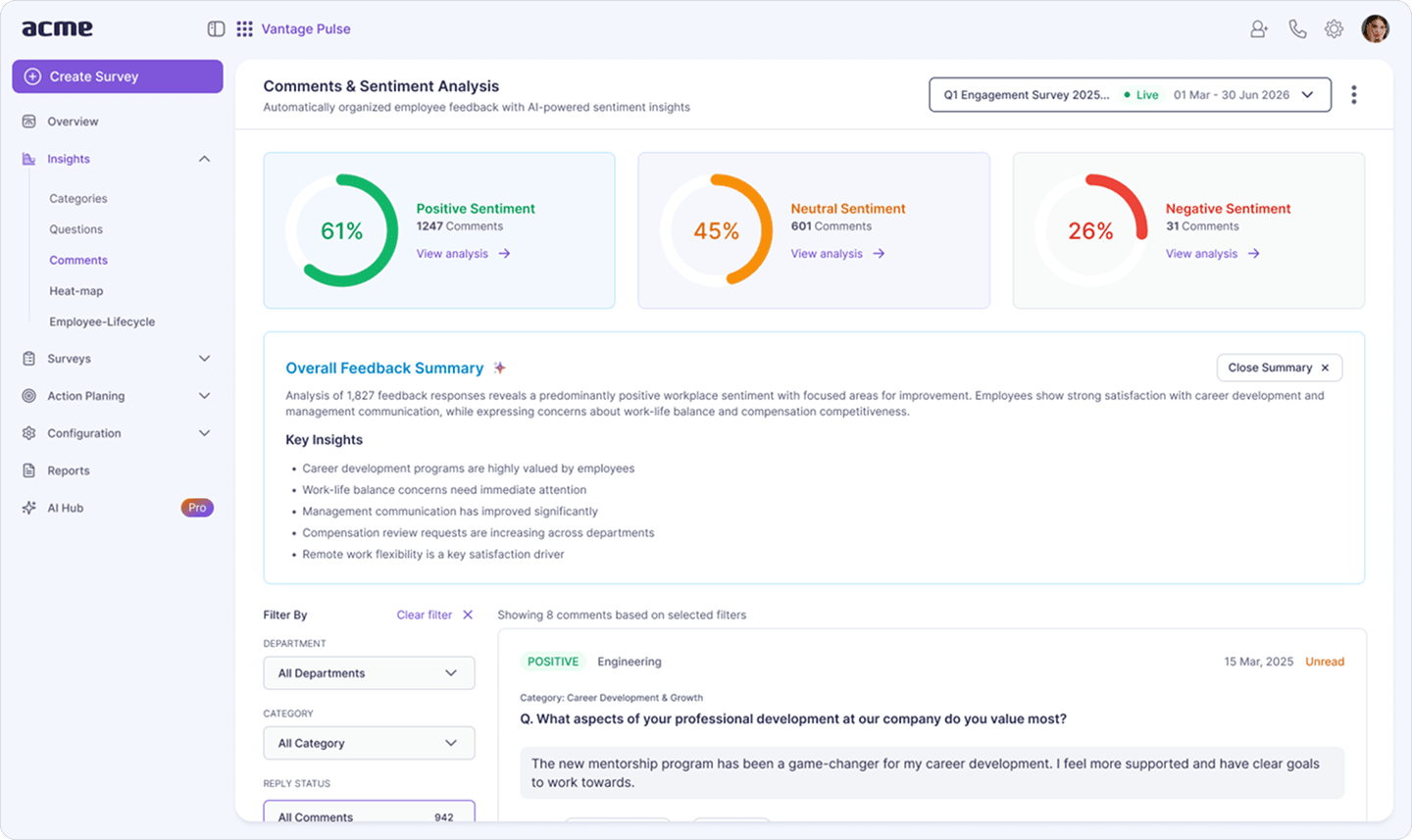
HR usually finds out a team has gone toxic from exit interviews, which is the most expensive way to learn it, since by then the damage is done and the people who could explain it best have already left. A regular pulse survey changes that. Vantage Pulse tracks eNPS (employee Net Promoter Score) and participation by team, and anonymous responses give people a channel to name what they would never say in a meeting or a one-on-one. Sentiment analysis on the open-text comments then shows what the falling score actually means, whether that is fear, exhaustion, or favoritism, before it turns into a formal complaint. That pattern tends to show up quietly: recognition activity and survey participation slide on one specific team for weeks while the rest of the company's numbers look completely normal, so nobody notices until someone finally says it out loud in an exit interview.
Address a Toxic Manager
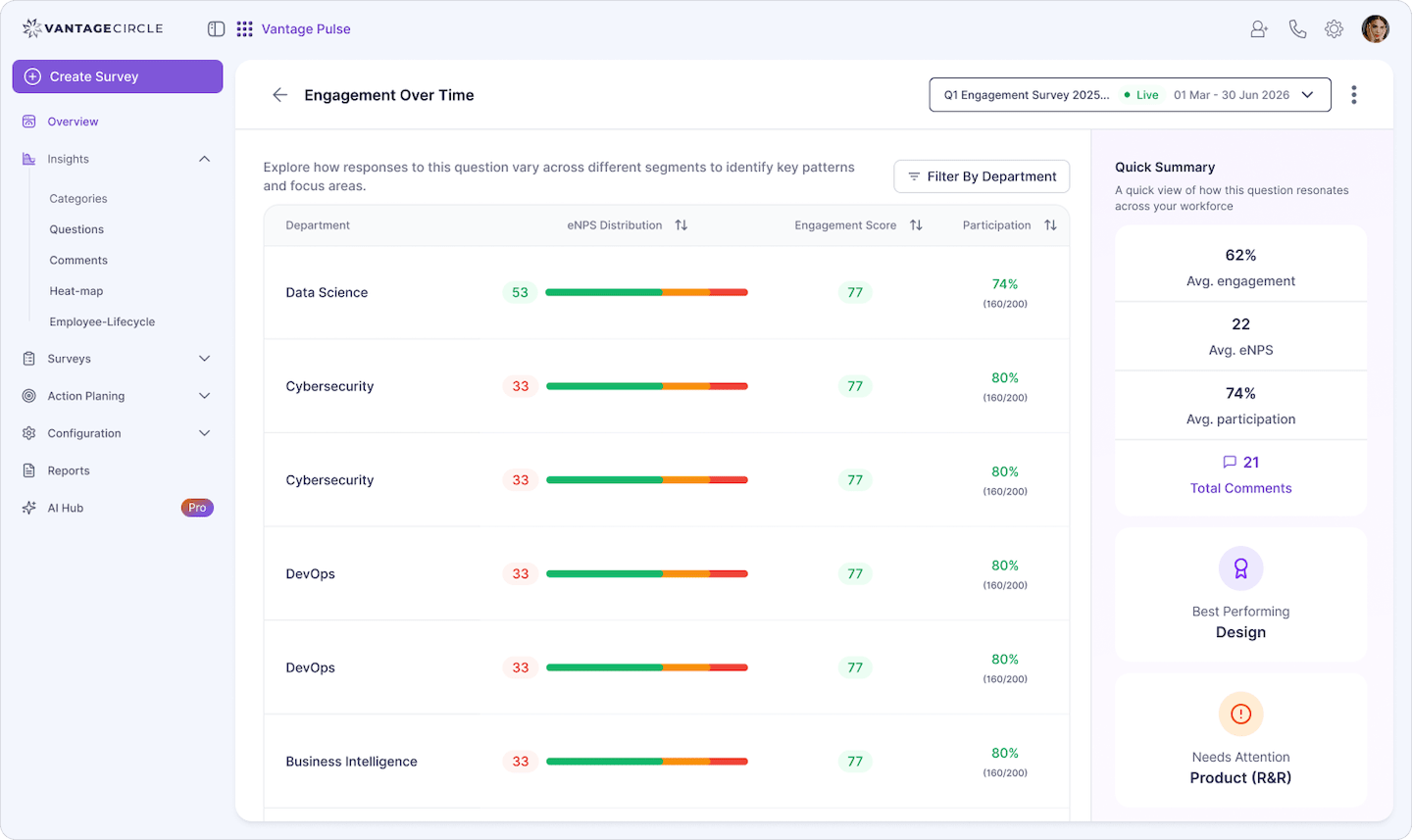
A single toxic manager shows up in the data as one team whose scores diverge sharply from the rest of the company, even while the company-wide average looks fine. Department-wise insights make that pattern visible instead of anecdotal, since a team stuck with a fear-based leader rarely files a joint complaint, it just quietly disengages one person at a time. Once the data points to a specific manager, leadership sets the tone for the whole culture, so the fix has to start with that person's own behavior, not another all-hands email about values.
Rebuild Trust and Recognition
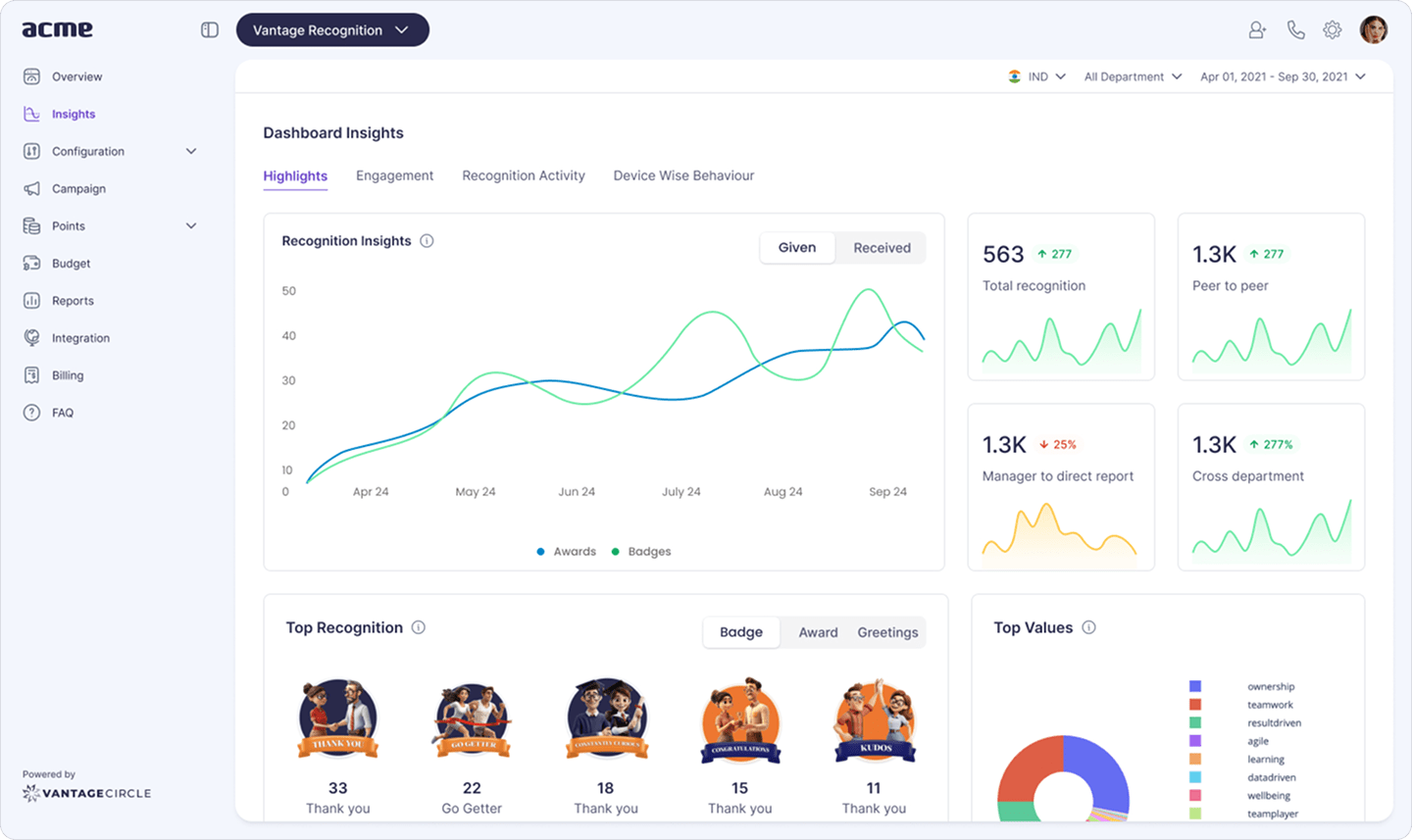
Recognition is usually the first thing that stops when a culture turns toxic, and rebuilding it is one of the more concrete early steps available to HR. Manager recognition prompts get people acknowledging specific work again instead of letting it go unnoticed, and peer-to-peer recognition rebuilds the sideways support a toxic manager erodes, without waiting for leadership to change first. This work sits inside the broader company culture you are trying to repair, and it is worth the effort: replacing someone who leaves due to employee turnover costs far more than the recognition program that could have kept them.
Frequently Asked Questions
What qualifies as a toxic work environment?
A workplace qualifies as toxic when harmful patterns, such as bullying, fear-based leadership, favoritism, or chronic overwork, are normal rather than occasional, and leadership tolerates them once they are raised. A single bad day or a difficult project does not qualify; a persistent, unaddressed pattern does.
What to do when work is toxic?
Set clear boundaries around your time, document specific incidents as they happen, use any support available to you such as an employee assistance program, and decide on a realistic timeline for pushing for change or planning your exit. Acting deliberately, rather than reactively, protects both your health and your options.
What are five signs that a workplace is toxic?
Five common signs are fear-based or absent leadership, poor or withheld communication, chronic overwork with no boundaries, gossip and cliques, and a lack of recognition for good work. Any one of these on its own can happen in a healthy workplace occasionally; together and unaddressed, they define a toxic one.
What are 7 signs that a work environment might be toxic?
Seven signs to watch for are fear-based or absent leadership, poor communication, chronic overwork, gossip and cliques, no recognition, high turnover, and bullying or harassment. The eighth sign covered above, a persistent sense of dread before work, is often the one you notice first even before you can name the other seven.
Is my workplace toxic or am I overreacting?
You are not overreacting if the difficulty is persistent, applied unevenly, and paired with fear of speaking up; that is what separates a toxic workplace from one that is simply demanding. A demanding job eases up eventually and treats people consistently; a toxic one does neither.
What are the signs that you are being quietly fired?
Being quietly fired usually looks like a shrinking role rather than a formal conversation: your responsibilities get reassigned, you are left off meetings you used to attend, growth or promotion conversations stop, and feedback turns critical after a long stretch of no feedback at all. It is often a manager's way of pushing someone out without ever naming the reason.
Conclusion: Name It, Then Act
A toxic work environment rarely announces itself, it accumulates: one unaddressed comment, one overlooked pattern, one manager who never gets held accountable, until the culture and the damage are the same thing. Naming it clearly, whether through the signs above, a documented incident, or a survey score that finally makes the pattern visible, is what turns a vague sense that something is wrong into something that can actually be fixed.

Lupamudra is a content marketing specialist at Vantage Circle, where she has written 50+ articles on employee recognition, rewards, and workplace culture, alongside employee engagement, diversity and inclusion, and HR compliance topics, including how India's tax rules apply to recognition and rewards programs.
Connect with Lupamudra on LinkedIn.