
As HR experts, you strive tirelessly to build a work atmosphere and an organizational culture that increases profitability, improves loyalty, and encourages employee happiness. It is fundamental for maintaining an active business as long as possible. However, despite all your stunning endeavors, you can't control individuals' intrinsic perspectives and practices. Whether you like it or not, you'll eventually have to interact with employees who bring their bitterness, personal troubles, and other problems to work every day.
In other terms, from time to time, you'll need to find out how to cope with a toxic employee. Because the longer a bad apple stays in your company, the more it will hurt your culture (and your team). Toxic employees generate chaos, kill confidence, and undermine the effectiveness of coworkers.
Identifying toxic employees is the first step to handling the problem. There are some common traits that can identify whether an employee is toxic.
Key Takeaways
- A single toxic employee costs more than a bad hire: avoiding one saves $12,489, nearly double what a top performer adds (Harvard Business School)
- Toxic behavior shows up in 12 recognizable patterns, from the Bully to the Gossiper, long before it shows up in your attrition numbers
- Toxic micro-cultures rarely surface in company-wide engagement scores. Watch specific teams for attrition spikes, performance dips, or too much office grapevine instead
- Feedforward, not feedback: coaching a toxic employee on what to do next works better than dwelling on what they did wrong
- Anonymous, real-time sentiment tracking catches toxic patterns while they're still contained to one team, before they spread
Common Types Of Toxic Employees
- The Bully- Employees with domineering behavior who throw you under the bus so that they can shine in the spotlight and get all the promotions.
- The Micro-managers- The kind of managers who need to learn EVERYTHING that's going in the office. Thus, they add a lot of tension to the workers. In simple words, they are control freaks.
- The Pessimist- The one who always feels negative about a project or customers. They keep the constant habit of disagreeing, criticizing, and complaining.
- The Grumpy Nay-sayer- They are hot-tempered and outright dangerous. Nothing can put a smile on his or her face. It appears that they have a problem with anything new being implemented within the organization.
- The Volcano- They have huge anger issues and use it quite often. They may explode at their coworkers and clients, creating a fearful environment for everyone else around them.
- The Upstart- They always think they know how to do everything, considering their way is a better way to do it.
- The Hyper-competitive- They soak up all new opportunities, demotivating their coworkers.
- The Slacker- They roam around the office and usually only make an effort to get their job done when they know that the boss is watching.
- The Gossiper- They love to gossip about juicy workplace scandals now and then. They can make their own hush-hush stories and spend a lot of time socializing with others.
- The Procrastinator- The one who always says, "I will do it tomorrow." They are full of distractions from time to time.
- The Excuse maker- They are the 'that is not my job,' person. They show a lack of interest, motivation, and higher absenteeism.
- The Workaholic- They are the over-timers who never take time off. They are more prone to stress and burnout.
The Real Cost of a Toxic Employee
A toxic employee costs more than the tension they create on your team. Harvard Business School research covering roughly 60,000 workers across 11 companies found that avoiding one toxic hire saves a company an estimated $12,489, nearly double the $5,303 a typical top-1%-performer adds through extra output. Most managers put their energy into hiring a superstar. Turns out getting rid of one toxic person pays off more.
The damage is also hard to spot from the top. On the Vantage HR Influencers Podcast, Rashi Ramani, Head of Human Resources at Care Health Insurance, explains how her team catches it early:
We look at different parameters to understand the pulse at the micro level, and we also equip our leaders with information to identify red flags, which could be high-attrition areas, a dip in performance, or too much office grapevine.
~ Rashi Ramani, Head of HR, Care Health Insurance
She adds that encouraging one-to-one chats with team members "reveal[s] a lot about what's really going on."
5 Tips For Dealing With Toxic Employees In The Workplace
For the full step-by-step process, documentation, the private conversation, setting expectations, and knowing when to escalate, see how to manage a difficult employee.
1. Gather the right information
Most toxic people may not realize that they have a problem. Before firing, the manager should go to the individual and understand the root cause of his or her behavior. Some of them might have emotional or psychological issues attached to their workplace. You should talk out all the details and explain how that behavior causes difficulties for others in the workplace.
It can turn into difficult conversations. But every individual needs to consider the consequences of going on with poor conduct and understand the value of good behavior.
A keynote speaker and workforce consultant, Jeff Butler, wrote in his blog:
Without this step, the toxic employee will have no reason to improve their past behavior. Usually, a good benchmark is stating, 'If your behavior on x, y, z does not approve in 30 days, you will be put on performance review.' Sometimes a toxic employee after being approached would approach other team members and confront them ... thinking they are negative. Make sure to address this when setting boundaries.
~ Jeff Butler, keynote speaker and workforce consultant
2. Establish a feedforward plan
One strategy advocated by business educator and coach Marshall Goldsmith to deal with toxic employees is "feedforward." Feedforward is the opposite of feedback. Rather than dwelling on what occurred in the past, feedforward addresses actionable ways workers should take to tackle negative behaviors.
On his blog, Goldsmith explains:
Feedforward is especially suited to successful people. Successful people like getting ideas that are aimed at helping them achieve their goals. They tend to resist negative judgment.
~ Marshall Goldsmith, business educator and executive coach
3. Amend the wrong behavior
Considering a great company culture, managers should update the office policies and reflect the new expectations. You should keep a list of behaviors or activities that would welcome disciplinary actions.
There may be a specific process that the organization follows with the toxic employees. That process can include training or a course that can help in making bad behavior better. It can happen over a book and can even need the help of a counselor. Then, daily sessions held with the person can ensure that he or she is learning and growing.
4. Get ready to make hard decisions
A toxic person can drag everyone down. A manager needs to find means to minimize the amount of time that he or she spends interacting with the coworkers, who might get influenced.
In extreme cases, when an individual is intolerable in the workplace and can not be talked out of the behavior, there is a risk that you may require full punitive measures, up to and including firing. Removing the toxic person can act like immunizing your team.
5. Catch It Early With Anonymous Feedback
Usually, by the time this lands on a manager's desk, it's already cost a few good people. Anonymous check-ins done regularly catch the problem while it's still one team's issue, instead of something you piece together later from exit interviews.
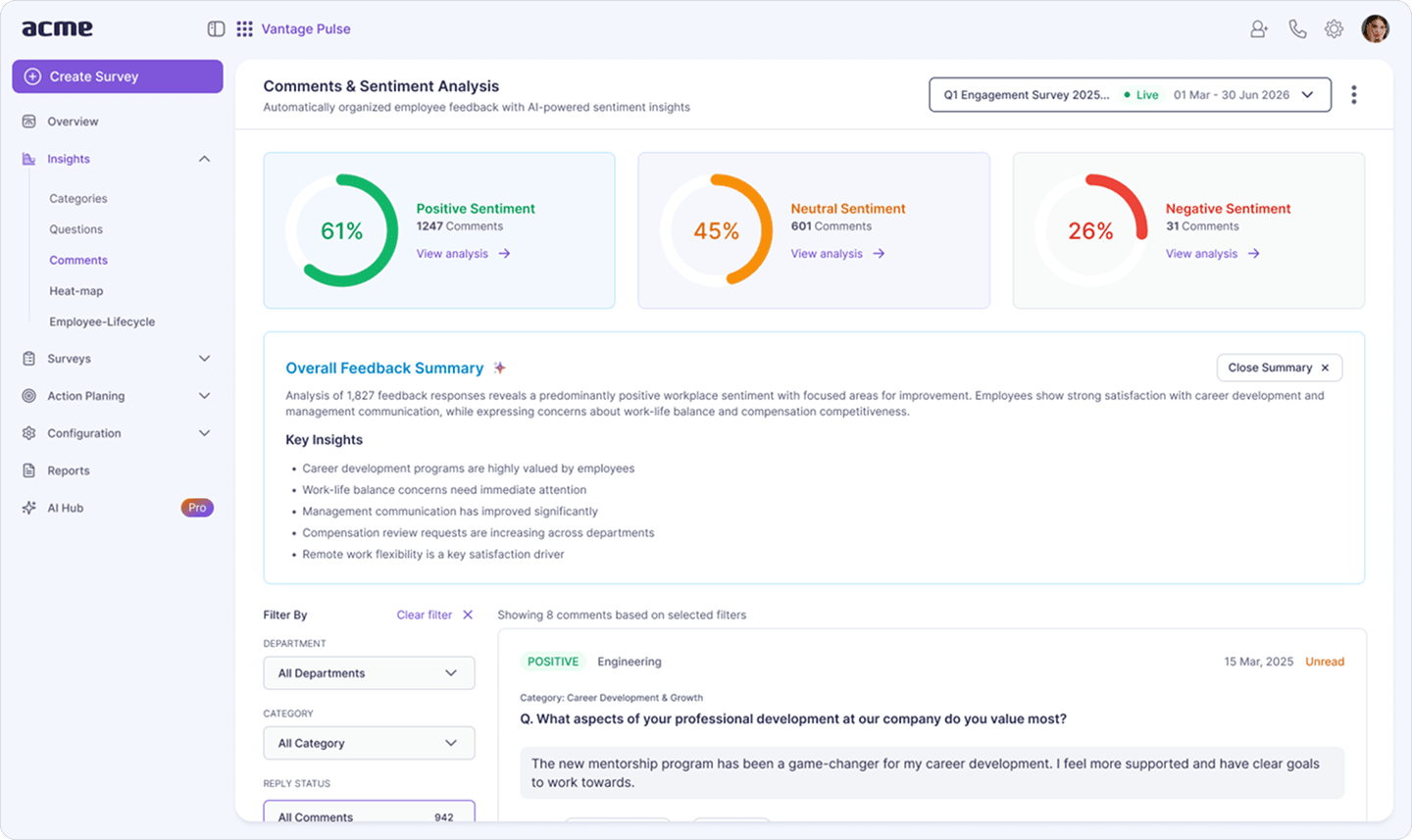
A platform like Vantage Pulse uses sentiment analysis to flag negative trends tied to a specific manager or team as they happen, so HR can step in before the damage spreads.
If you address the above things head-on, you'll find dealing with toxic employees much more comfortable than you could imagine. And when you find a solution, give it some time because behaviors are not easy to change. And remember, all these come at the price of a robust and productive workplace environment.
Frequently Asked Questions
1. What are the early signs of a toxic employee?
Look for patterns, not a bad day. Chronic complaining, taking credit for other people's work, gossip, pushing back on every single change, or a teammate's morale dropping the moment they start working closely with this person. One rough week doesn't count. What counts is everyone else quietly adjusting how they act around this person, that's the real tell.
2. Should you coach a toxic employee or let them go immediately?
Coach first, in most cases. Serious stuff like harassment, threats, or misconduct should go straight to HR, and if it's bad enough, that can mean firing right away. For everything short of that, have a documented conversation, set a feedforward-style improvement plan, and give the person an actual chance to change before you jump to discipline or firing.
3. Can one toxic employee really affect the whole team?
Yes, and faster than most managers expect. It almost never shows up in company-wide engagement scores first. It shows up as one team suddenly losing people, a performance dip, or a lot more grapevine chatter than usual, all in one specific team. That's why you have to watch individual teams closely, not just the company average.
4. How do you address toxic behavior if there's no formal policy for it yet?
Start with a direct conversation anyway, and write down what was said. Name the specific behavior, explain how it's affecting the team, and set a timeline, say 30 days, for things to change. You can use that first case to actually build the policy, so the next time this happens, you're not starting from zero.
5. What's the difference between toxic behavior and someone going through a rough patch?
Someone going through a rough patch is usually still self-aware about it. They'll apologize, ask for help, or bounce back once whatever's going on resolves. A toxic employee keeps doing the same damaging thing over and over, barely acknowledges how it affects other people, and doesn't change even after you've told them directly.

Susmita Sarma is a Digital Marketer at Vantage Circle, making employee recognition less of a checkbox and more meaningful - helping organizations say we value our people and truly mean it.
Connect with Susmita on LinkedIn.