Ask a leader to describe their style and you will usually get something flattering. Collaborative. Hands-off. People-first.
Ask the people who report to them and the answer is often different.
That gap matters more than the label does. Your style is not what you intend. It is the pattern your team reads in how you decide, how you delegate, and what you do when a project goes sideways. Plenty of leaders carry a self-image for years that nobody around them shares.
Nine styles are worth knowing, and all nine are below with the conditions where each one works and where it fails. The harder questions come after the list. Which one is actually yours? And does it still fit the team you have now, rather than the team you had three years ago?
Good leadership is a choice you make repeatedly, not a trait you were issued.
Key Takeaways
- What a leadership style is, and what it is not
- The 9 main leadership styles compared in one table
- The characteristics, pros and cons of each
- How to identify which style is yours
- How leadership style changes over a career
- Which style is most effective, and why that depends
What is a Leadership Style?
A leadership style is the consistent way a leader directs work, makes decisions and responds to their team. It shows up in behavior rather than intent, which is why the people you manage can usually name your style faster than you can.
It is worth separating three things that often get confused. Personality is who you are. Competency is what you are capable of. Style is what you actually do in front of a team, and it is the only one of the three your reports experience directly.
A good leader also provides a clear vision of the company's goals and mission. Beyond the profits or the numbers at year end, a leader gives a sense of purpose behind the work. Style is the mechanism through which that purpose reaches people.
Very few leaders operate in a single style. Most run a dominant one with two or three others available, and switch according to pressure, team maturity and the stakes of the decision.
Style is a pattern, not a label. If you cannot point to three recent decisions that demonstrate it, you have described an aspiration rather than a style.
The 9 Leadership Styles at a Glance
The nine styles below differ mainly in where decision-making authority sits and how much the leader invests in developing people. This table is the short version. Each style is covered in full underneath.
| Style | Core behavior | Works best when | Fails when |
|---|---|---|---|
| Transactional | Rewards and penalties measured against clear standards | Work is repetitive and goal-oriented, and the team responds to perks | The work needs invention, or relationships matter more than throughput |
| Transformational | Sets a vision and pushes people to grow into it | The business needs continuous innovation | Detail and consistency matter more than change |
| Servant | Removes obstacles so the team can do the work | The team is diverse and needs individual support | Speed or visible authority is required |
| Democratic | Gathers input, then decides and owns the outcome | Buy-in matters and there is time to consult | A crisis demands an immediate call |
| Autocratic | Decides alone and directs | Crisis, safety-critical work, or a very inexperienced team | Retention and creativity are the priority |
| Laissez-Faire | Sets direction, then steps back | The team is senior and genuinely self-directing | The team is new, or accountability is unclear |
| Bureaucratic | Follows fixed procedure regardless of who is asking | Compliance, safety and consistency are non-negotiable | The environment changes faster than the rulebook |
| Charismatic | Leads through personal conviction and energy | Change needs emotional momentum to start | The organization has to outlast the individual |
| Coaching | Develops each person's capability deliberately | You have time to invest and the team wants to grow | Immediate output is the only thing being measured |
Read the last column first. Most leadership failures are not the wrong person, they are the right style applied in the wrong conditions.
The greatest leader is not necessarily the one who does the greatest things. He is the one that gets the people to do the greatest things. – Ronald Reagan.
Now as we have a gist of how a leader impacts the organization as a whole, let's look at the different types of leadership.
Transactional Leadership Style
Transactional leadership runs on a clear exchange: meet the agreed standard and you are rewarded, miss it and there is a consequence. It suits predictable work with measurable output.
The task of leadership is not to put greatness into people, but to elicit it, for the greatness is there already.
– John Buchan
What comes to your mind when you see the word “transaction”? In literal terms, it means the agreement to buy or sell something. In this case, the deal is between the leader and followers.
Transactional leadership is a "give and take" scenario. Reward or penalize your employees according to the organization's standards. Everyone knows what to do, why to do it, and to what standard. Evaluation of employee performance happens with predefined criteria and goals.
This style can be effective if the employees are also motivated by perks and benefits. It works best where the tasks are repetitive and goal-oriented.
Key Characteristics of Transactional Leadership Style
- Focuses on concise goal setting and communicating clear expectations to the employees.
- The employees need to be equally motivated by getting the proper amount of rewards and recognition.
- Ideal for large corporations with global teams.
- Transactional leaders prefer typical workflow and satisfy the daily quota.
Pros and Cons of Transaction Leadership Style
Pros
- Favorable in crisis management
- Achievable short term goals
- Clear structure
- Systematic and easy to understand
- Sense of fairness
Cons
- Motivation only through rewards
- Lack of focus on building relationships
- Discourage innovation and creativity
- Lacks long-term goals
- No scope of further development
Works best with large corporations with routine jobs where the team is already motivated and are experts who need a little direction.
Transformational Leadership Style
Transformational leadership sets an ambitious vision and develops people toward it, prioritizing growth and change over steady-state delivery. That makes it a natural fit for change leadership, where the job is getting people to believe in a new direction.
If you want something new, you have to stop doing something old.
– Peter Drucker
This leadership style believes in the concept of transforming anything into something better. Transformational leaders provide team members with opportunities to explore different ideas and approaches. They let their creative juices flow.
You make your team feel that you care about them by putting them first. You express care and concern for your team members and their problems. It fosters a sense of bonding, belonging, and loyalty toward the organization.
However, relying on praise and nurturing can also lead to mediocre performance over time. It can also result in a lack of strong, clear direction for the company. Leaders should establish a balance to ensure that people don't get too comfortable.
Key characteristics of Transformational Leadership Style
- Works best when you need fresh ideas or new perspectives.
- There is also a particular appetite for risk in this leadership style. It is because leaders are always on the lookout for better ways. It means going out of one's comfort zone.
- This style encourages both the professional and personal growth of the employees.
Pros and Cons of Transformational Leadership Style
Pros
- It gives a lot of freedom to the team members
- It encourages creativity
- It breaks monotony
- It encourages learning and development
- It encourages change
Cons
- Too much focus on the bigger picture
- Regular feedback is essential
- Too much freedom can also be risky
- Not always detail oriented
- It can result in employee burnout
Use this style when your business requires constant innovation and moving ahead of the crowd, such as the internet or IT industries.
Servant Leadership Style
Servant leadership inverts the usual order. The leader's first job is removing obstacles for the team, and authority follows from that service rather than from position.
The first responsibility of a leader is to define reality. The last is to say thank you. In between, the leader is a servant.
– Max De Pree
The servant leaders operate on the idea of service first, lead later.
This style of leadership runs on the motto, “You manage other people the way you would like to be managed.” You ensure that everyone knows their job. Ensure that they have all the tools and supplies they need before they begin. If they don’t, you offer them everything they need to succeed.
This style is a favorite among the workers. It works wonders for employee morale and employee experience. But if you don’t balance it, this can lead to your team running the show. It can result in a lack of authority, a little direction, and vision.
Key Characteristics of Servant Leadership Style
- This style has a high degree of awareness toward the team. Leaders of this category are great listeners. It gives them a better understanding of the team’s strengths and weaknesses.
- Great for building respect, trust, and loyalty.
- Helpful in building a solid company culture.
Pros and Cons of Servant Leadership Style
Pros
- It promotes ownership and responsibility
- It increases employee morale and confidence
- It builds trust within the team
- Team members feel valued
- Leaders consider and prioritize employees’ opinion
Cons
- Servant leaders can be perceived as incompetent sometimes
- It can sometimes create confusion
- Slow decision-making
- Team members might not be competent to take decisions
- Leaders lose their authority
Works best for a diverse team, where personalized management is required for each member.
Democratic Leadership Style
Democratic leadership gathers input from the team before the leader makes and owns the final call. It trades speed for buy-in and better-informed decisions.
A functioning, robust democracy requires a healthy educated, participatory followership, and an educated, morally grounded leadership.
– Chinua Achebe
Democratic leadership style has what you call the "two is better than one" philosophy. Democratic leaders emphasize the inputs and ideology of workers. The business world also calls it "participative leadership”.
This type of leader makes the final decision. But at other times, democratic leaders may delegate power to followers. Having said that, a democratic leader is not off the hook. They are still accountable for all the outcomes.
This is the decentralized approach to power and authority. (Contrasts with the centralized approach of autocratic leaders, which we will address later.)
Key characteristics of Democratic Leadership Style
- A democratic leader seeks inputs and feedback from followers to make decisions.
- The leader believes that they can make the best decision with lots of inputs from followers.
- Not the best approach for a crisis when there is high pressure and time is short.
- This leadership style emphasizes the aspect of equality in the workplace. Followers of this style take all inputs into account, irrespective of ranks.
Pros and Cons of Democratic Leadership Style
Pros
- Increased staff productivity
- Increased job satisfaction
- Supports diverse ideas
- Improved awareness about company values
- Builds a strong team
Cons
- Shows a lack of expertise
- Chances of dealing with rejection
- Every opinion does not get valued
- Not effective in a crisis
- Results in slow decision-making process
Works best with all kinds of organizations. Although places where strict procedures are required, such as manufacturing industries, democratic leadership is not the best choice.
Autocratic Leadership Style
Autocratic leadership concentrates decisions with the leader, who directs rather than consults. It is fast and unambiguous, and expensive if used as a default.
Nobody is going to delegate a lot of power to a secretary that they can’t control.
– Micheal Bloomberg
How do you picture an autocratic leader?
We picture someone barging into the room and telling people what to do.
As the name hints, autocratic leadership is a boss-centered approach to leadership. The leader has absolute control over the entire operation. They have a top-down approach to communication. They dictate instructions, policies, and activities and expect the followers to comply. You can see high power dynamics going on between the leader and the followers.
Autocratic leaders give little to no importance to socializing and team-building activities. These leaders take no input or feedback from group members. They assess a situation from their own perspective.
Key Characteristics of Autocratic Leadership Style
- Works best when a quick decision needs to be made.
- An autocratic leadership style might help suppress a conflict in the short run. But it does not solve the conflict.
- There occurs a colossal lack of trust in this leadership style on the subordinates. It is why the power to make all the decisions lie in the hands of the leader.
Pros and Cons of Autocratic Leadership Style
Pros
- Leaders have a systematic goal-setting
- They go strictly by the rules
- Highly structured environment
- Good for quick-decision making
- It can help in conflict situations
Cons
- It restricts creativity and innovation
- It can lead to low morale within the team
- Not suitable for companies having a collaborative culture
- It can lack work relationships and connection
- Leaders can lack agility
Best approach when consensus is not possible and the leader is required to make a judgment call.
Can you think of someone who projects such qualities as a leader? Please feel free to drop us a mail and let us know if you have any more traits we may have overlooked.
Laissez-Faire (Delegative) Leadership Style
Laissez-faire leadership sets the direction and then steps back, leaving execution decisions with the team. It works with senior people and fails with new ones.
If you pick the right people and give them the opportunity to spread their wings and put compensation as a carrier behind it, you almost don’t have to manage them.
– Jack Welch
"Laissez-Faire" is a French term meaning let do or let them do it. Some critics call it the “Zero leadership” style. It is a philosophy of non-interference. Leaders will give directions or goals and are less likely to check on you. They have fewer meetings and expect you to do it on your own.
Key characteristics of Laissez-Faire Leadership Style
- A laissez-faire leader places a lot of trust in their members and their abilities.
- This management style works by allowing greater employee autonomy. It subsequently adds to more creativity in the workplace.
- Constructive feedback is a vital component of this leadership style.
Pros and Cons of Laissez-Faire Leadership Style
Pros
- Employees get ample room for personal growth
- It encourages learning and development
- It gives employees the freedom to work in their own way
- There is no micromanagement
- Faster decision-making
Cons
- Confusion in the team due to unclear goals
- Too much freedom can lead to isolation and hamper team-building
- It can make leaders less accountable
- It can cause passivity in leaders
- Must have competent team members
Works best if the leader has a group of people who already excel at their skills.
Bureaucratic Leadership Style
Bureaucratic leadership follows established procedure regardless of who is asking or how urgent it feels. It exists to make outcomes consistent and auditable.
The bureaucracy is a circle from which no one can escape. Its hierarchy is a hierarchy of knowledge.
– Karl Marx
Bureaucratic leaders live by the rules. There are certain times that you expect to get things done by “the book.”
You want to get a tattoo and expect the tattoo artist to follow the original procedure. You want to get your car repaired, and you want the mechanic to fix the problem by the rules. Likewise, you want to lead your team by the laws of the book.
Bureaucratic leaders always follow specific rules and stick to those at all times. Yet, this leadership style can be very rigid at times. This rigidity restricts the level of creativity in the process.
Key Characteristics of Bureaucratic Leadership Style
- A bureaucratic leader loves rules, policies and follows procedures meticulously. Decision-making processes are typically slow-paced.
- There is no room for new ideas or innovations. Employees follow routine methods of problem-solving.
- A management approach of this sort is also very well-organized. Leaders here delegate the tasks as per ranks for better results and accountability.
Pros and Cons of Bureaucratic Leadership Style
Pros
- Rigid leadership style
- It does not encourage change and improvisation
- Best suited for large manufacturing organizations
- Quick completion of tasks
- It is predictable
Cons
- No room for creativity
- Lack of competition
- Difficult to adapt to change
- Must follow and go by the rules
- Slow personal growth and development
Works best for large industries such as manufacturing plants where the employees perform routine tasks.
Charismatic Leadership Style
Charismatic leadership moves people through the leader's own conviction and energy. It starts change quickly and creates a dependency risk if nothing outlasts the individual.
Charisma is the intangible that makes people want to follow you, to be around you, to be influenced by you.
– Roger Dawson
Charismatic leaders are the ones who can walk the talk. The leaders of this style are masters of communication and persuasion with a sense of charm. They have a specific type of appeal, attraction, and magnetism. It helps them gain people to follow their lead. They inspire, excite, and spark enthusiasm among the team members.
Some charismatic leaders that we can think of are Dalai Lama and Obama. They exude warmth and presence when they walk into a room. It is, what they call, the aura!
Some people are born charismatic, and some acquire it with time and experience.
(Recommended blog- What is Charismatic Leadership? Definition, Characteristics, and Benefits! )
Key characteristics of Charismatic Leadership Style
- Charismatic leaders are very confident in their approach. They rarely have any self-doubt about their decisions and possess a very influential personality.
- They have an influence over a large group of followers.
- They fuel the motives of the employees and believe in the ability of the employees.
- They place high expectations and competence and act as a role model for the employees.
Pros and Cons of Charismatic Leadership Style
Pros
- It motivates and inspires the team
- It encourages teamwork and collaboration
- Employee opinions are considered
- It creates a sense of positive change
Cons
- Leaders can be slightly narcissist
- It is often viewed as shallow
- The leaders might become self-centered
- It can sometimes lead to over-promising and under-performing
Works best for social activists, motivational speakers, or political leaders. Anyone who needs to inspire and gain the trust of their followers.
Leaders like Late Princess Diana, Mahatma Gandhi, Will Smith exude a spark and sense of charm.
Coaching Leadership Style
Coaching leadership treats developing each person's capability as the primary job, accepting slower short-term output in exchange for a stronger team later.
Leadership is about making others better as a result of your presence. And make sure that impacts last in your absence.
– Sheryl Sandberg
This style of leadership believes in coaching the workers toward greatness. They are usually experts in their field of interest and are great communicators. This type of leadership is most prevalent in sports teams. Yet, it can get troublesome at times as it takes time to mentor and coach the employees.
Key characteristics of Coaching Leadership Style
- Coaching leadership works best with people who have a coaching mindset and are willing to learn from their leaders.
- Leaders also should be ready to spend time and energy coaching their employees to improve them in the long run.
- Empathy and trust are the pillars of this style of leadership.
Pros and Cons of Coaching Leadership Style
Pros
- It gives employees constructive criticism to help them
- It promotes a healthy work environment
- It gives employees the opportunities to become future leaders
- Encourages innovation
Cons
- The leaders must be skilled and competent
- Not all employees can take mentorship positively
- It is time-consuming
- It is applicable only in certain situations
Works best for teams who need to be trained thoroughly to perform to the best of their abilities.
How to Identify Your Leadership Style
You identify your leadership style by examining what you actually do under pressure, not by taking a quiz. Four behaviors give it away: how you decide, how you delegate, how you give difficult feedback, and what you do when something goes wrong.
Work through these four questions honestly. The pattern across your answers matters more than any single one.
- When a decision needs making, what happens first? If you consult the team, you lean democratic. If you decide and announce, autocratic. If you hand the decision down entirely, laissez-faire.
- When you delegate, what do you hand over? Tasks only suggests transactional. Tasks plus the reasoning suggests coaching. The whole outcome, including how to reach it, suggests transformational or laissez-faire.
- When someone underperforms, what is your instinct? Restate the standard and the consequence is transactional. Ask what is blocking them is servant. Turn it into a development conversation is coaching.
- When a project fails, where does your attention go? To the process suggests bureaucratic. To the people suggests servant. To what the failure teaches suggests transformational.
Most leaders find their answers split across two or three styles. That is the normal result, and the dominant one is usually whichever showed up in question four, because failure strips away the style you perform and leaves the one you default to.
Self-report has an obvious limit though. You are grading your own behavior, and the gap this article opened with is exactly the gap a self-assessment cannot see.
Free Tool · 6 Minutes
Which leadership archetype are you?
The HR Leader Simulator runs you through a year of recognition decisions, four quarters of trade-offs with consequences that carry forward, then names the archetype your choices actually land on. It scores what you do, not what you say you would do.
As a leader, you are unlikely to display a single characteristic in your leadership style. You are more likely to carry a mix of the styles above.
According to David Rooke and William R. Torbert, leaders can be differentiated based on ‘Action Logic’ rather than their personality or management style. So, what is this action logic?
Action logic, as per the duo, is “how leaders interpret their surroundings and react when their power or safety is challenged.” It is based on research conducted by the duo using a psychometric assessment tool called the Leadership Development Profile.
The framework identifies seven distinct "action logics" or leadership styles -
- Opportunist
- Diplomat
- Expert
- Achiever
- Individualist
- Strategist
- Alchemist
These 7 action logics can be sequenced based on their effectiveness. Regarding leading organizations, the least effective types are the Opportunist and Diplomat, while the most effective are the Strategist and Alchemist. Understanding your own way of thinking and acting can be the initial step in creating a more effective leadership approach.
Leaders can evolve from one action logic to the next as they develop greater cognitive and emotional complexity. However, transformation to later action logic like Strategist and Alchemist is rare.
The table below sets out the characteristics and strengths of each action logic, so you can see which are already yours and which belong to the stage ahead.
| Action Logic | Characteristics | Strengths |
|---|---|---|
| Opportunist | Egocentric, manipulative, rejects feedback | Can take risks, thinks outside the box |
| Diplomat | Avoiding conflict, supports group norms | Provides social glue, ensures others' needs are met |
| Expert | Rules through logic and expertise, seeks perfection | Improves quality continuously, high individual contributor |
| Achiever | Collaborates, focuses on organizational objectives | Implements strategies effectively, manages performance |
| Individualist | Questions assumptions, communicates across mindsets | Innovates, ignores irrelevant rules |
| Strategist | Focused on organizational perceptions, creates shared vision | Effective change agent, deals with complexity |
| Alchemist | Reinvents themselves and organizations | Integrates material and spiritual, comfortable with ambiguity |
How Leadership Style Changes Over Time
Leadership style is developmental rather than fixed. The action-logics sequence above is the clearest evidence of this: leaders move through stages as their cognitive and emotional complexity grows, and the later stages are genuinely rare.
Three forces move a leader along that sequence.
- Team maturity. A team that needed direction two years ago may now need space. Leaders who do not notice the shift keep applying a style that has stopped working.
- Scale. What works with six direct reports rarely survives sixty. Most leaders are forced out of a hands-on style by headcount rather than by choice.
- Crisis. Pressure reliably pulls leaders toward autocratic behavior. That is appropriate briefly and corrosive if it persists after the pressure lifts.
The practical implication is that style should be reviewed, not declared once. A leader who describes themselves the same way they did five years ago has usually stopped paying attention.
Which Leadership Style is Most Effective?
No single leadership style is most effective in all conditions. This is the core argument of situational leadership: the right style depends on the task, the team and the moment, so leaders who can read the situation and switch tend to outperform leaders committed to one approach.
That said, the choice is not arbitrary. Three variables decide it:
- Time pressure. The less time available, the more autocratic the appropriate response.
- Team capability. The more capable and experienced the team, the further you can move toward delegative and coaching.
- Stakes of being wrong. High-consequence, safety-critical or regulated work pushes toward bureaucratic, whatever your natural preference.
The link to output is not abstract either. Style is the main lever a leader has over day-to-day employee motivation, which is why two managers running the same process can get very different effort from comparable teams.
Leaders who struggle usually have one style and apply it everywhere. Leaders who do well have a dominant style and two credible alternatives. Building the second and third is a more practical development goal than trying to change the first, and it lifts overall leadership qualities faster than a personality overhaul.
Developing Leadership Styles Across a Management Team
For an HR leader the question is not which style one person has. It is whether the management population has enough range between them, and whether anyone is measuring the effect.
Style is visible in outcomes long before it appears in a competency framework. It also shows up in the habits a leader builds around employee recognition, since how often and how specifically someone acknowledges work is one of the clearest style tells there is. Engagement scores that differ sharply between two teams doing the same work are usually a style signal, not a talent signal.
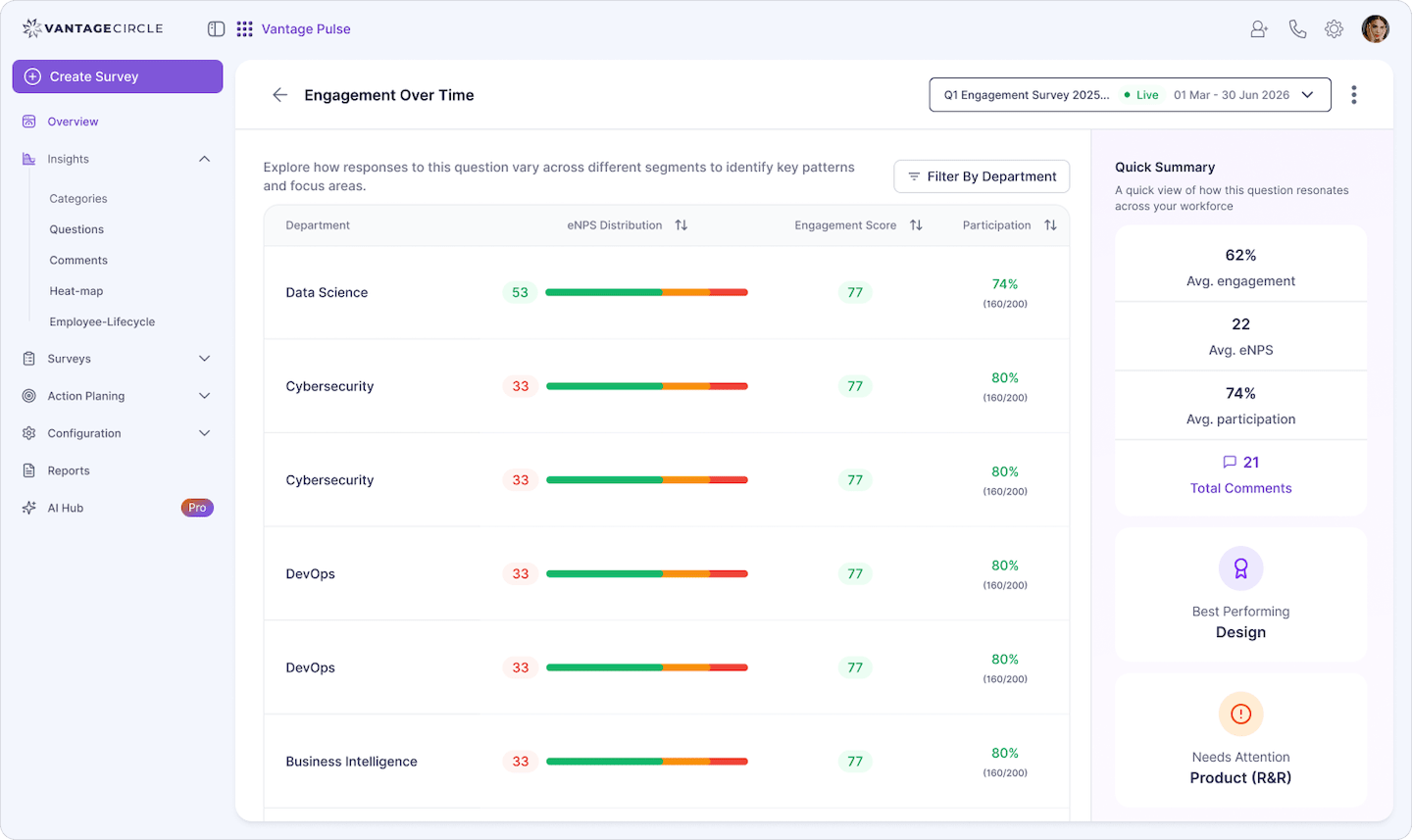
Vantage Pulse, Vantage Circle's employee engagement and pulse survey tool, breaks engagement down by department, which turns an abstract debate about leadership style into a comparison between two teams and two managers. Open-text sentiment adds the part a score cannot: how the style is actually experienced by the people under it.
Three things are worth tracking across a management team. Whether the range of styles matches the range of situations the business faces. Whether any manager's team is consistently an outlier. And whether style shifts after a promotion, which is where most leaders are quietly under-supported. The same logic applies to team leader skills more broadly, since style is the visible expression of those skills.
Summing It Up
An effective leadership style is not carved in stone. Anyone can pick up, drop or combine styles depending on the situation and the people in front of them.
Three things are worth carrying away. Your style is the pattern others observe, not the one you intend. It will change as your team, your scale and your pressures change. And range tends to matter more than having the perfect single style, because a credible second and third give you somewhere to go when conditions change.
Start with the four questions above. Name your dominant style, name the one you reach for least, and pick one situation this quarter where the second would serve you better than the first.
FAQ
What are the 7 main leadership styles?
Most lists of seven combine transactional, transformational, servant, democratic, autocratic, laissez-faire and bureaucratic. Charismatic and coaching are the two most commonly added to reach nine. The count varies by framework rather than by disagreement about the underlying behaviors.
What are the four basic leadership styles?
The four most often cited are autocratic, democratic, laissez-faire and transformational. These come from the classic Lewin studies of the 1930s, which identified the first three, with transformational added by later research. Four is the smallest useful grouping.
What leadership style is most effective?
No single style is most effective in all conditions. Effectiveness depends on time pressure, the capability of the team and the cost of being wrong. Leaders who can move between two or three styles consistently outperform leaders who apply one style everywhere.
What are 15 different leadership styles?
Longer lists of 15 usually subdivide the core nine. They add variants such as situational, pacesetting, affiliative, visionary, strategic and adaptive leadership. These are useful distinctions but most describe a blend or a context-specific application of the nine covered here rather than a genuinely separate style.
Can a leader have more than one leadership style?
Yes, and most do. The typical pattern is one dominant style with two or three others available depending on the situation. Having only one style is a limitation rather than a strength, because it means the leader responds identically to conditions that call for different approaches.
How do leadership styles differ in management versus nursing?
The styles themselves are the same. What changes is which ones dominate. Clinical settings weight more heavily toward bureaucratic and autocratic because procedure and speed are safety-critical, while general management has more room for democratic and coaching approaches. Context sets the appropriate default.

Nilotpal M Saharia is an Assistant Manager, Content Marketing at Vantage Circle and a recognition-and-rewards (R&R) strategist with 9 years of experience spanning Marketing, HR, and content strategy. He helps HR leaders turn employee recognition and leadership research into practical workplace programs.
Connect with Nilotpal on LinkedIn.