Ask ten HR leaders what an ineffective team looks like, and they'll answer in seconds: missed deadlines, tense one-on-ones, decisions that take three meetings to make. Ask what an effective team looks like, and most go quiet. That's the harder question, because effectiveness isn't the absence of a problem. It's a specific, buildable pattern. This guide breaks it down: the eight characteristics research keeps pointing to, the steps that build them, the five models practitioners use to diagnose a struggling team, and real companies, from Google to Pixar, that actually got it right.
An effective team, also called a successful team or a high-performing team, is a group with a shared goal whose members trust each other, communicate openly, and consistently produce better results than the same people would working alone. It's built through clear purpose, psychological safety, and strong leadership.
Key Takeaways
- "Effective team" and "successful team" mean the same thing: a group that trusts each other, shares a goal, and consistently outperforms the same people working alone.
- Effective teams share 8 defining characteristics: shared purpose, psychological safety, open communication, defined roles, mutual accountability, diversity of thought, constructive conflict, and strong leadership.
- You build one in 10 deliberate steps, from setting the vision to leading by example.
- Five models help you diagnose a struggling team: Tuckman, Lencioni, GRPI, Katzenbach & Smith, and Hackman.
- Measure effectiveness against a baseline with a short recurring survey, not an annual one.
What Is an Effective Team?
An effective team is a group of people with a shared goal who trust each other enough to be honest, communicate without friction, and consistently outperform what they'd manage individually. That's the core of it. Everything else is detail.
"Effective team" and "successful team" describe the same thing. This guide uses the two interchangeably, the way most HR practitioners already do in a meeting room, even though Google treats them as two separate search queries with two different sets of competing pages.
Here's where most definitions go wrong. They confuse "effective" with "busy" or "harmonious." A team can hit every deadline and still be ineffective if the work only happens because one person is quietly compensating for the other four. A team can also disagree constantly, even loudly, and still be one of the most effective units in the building. Pixar's Braintrust runs on exactly that kind of conflict, and nobody would call it dysfunctional.
Effectiveness isn't a feeling. It's a pattern you can actually observe. Goals get hit on a predictable basis. The team recovers fast when something breaks. The people inside it aren't burning out just to make the numbers work. A team that looks good on paper while everyone's quietly job-hunting isn't effective. It's borrowed time.
Google's own research backs this up. Google's Project Aristotle studied 180 teams over two years. What it found surprised a lot of leaders. Talent and tenure barely moved the needle. What actually predicted performance was how teammates interacted, structured their work, and saw their own contributions. That single finding reshapes almost everything else in this guide.
Effective Team vs. Group vs. High-Performing Team
A group shares a space, nothing more. A team shares a goal, and each person's results depend on someone else's. A high-performing team takes that a step further. It hits the shared goal on a predictable basis, and does that without burning out the people responsible for delivering it.
The difference matters because HR teams often build "teams" that are really just groups sharing a manager. No one owns a common outcome, and one person's results rarely hinge on what anyone else does. That gap is really team cohesion missing, under a different name.
| Group | Team | High-Performing Team | |
|---|---|---|---|
| Goal | Individual, loosely shared | Shared, mutually accountable | Shared, exceeded consistently |
| Accountability | Personal only | Mutual | Mutual and self-correcting |
| Output | Sum of parts | More than the sum | Reliably more, under pressure too |
Why Effective Teams Matter
Effective teams raise productivity, engagement, retention, and innovation, and they absorb change better than individuals or loose groups ever do.
Start with the case that actually gets budget approved. Companies that build effective teams report measurably higher output per employee and lower attrition, which is the importance of team building argument in a single sentence. The return shows up as a headcount-cost number, the kind a CFO tracks, well before it shows up in a morale survey.
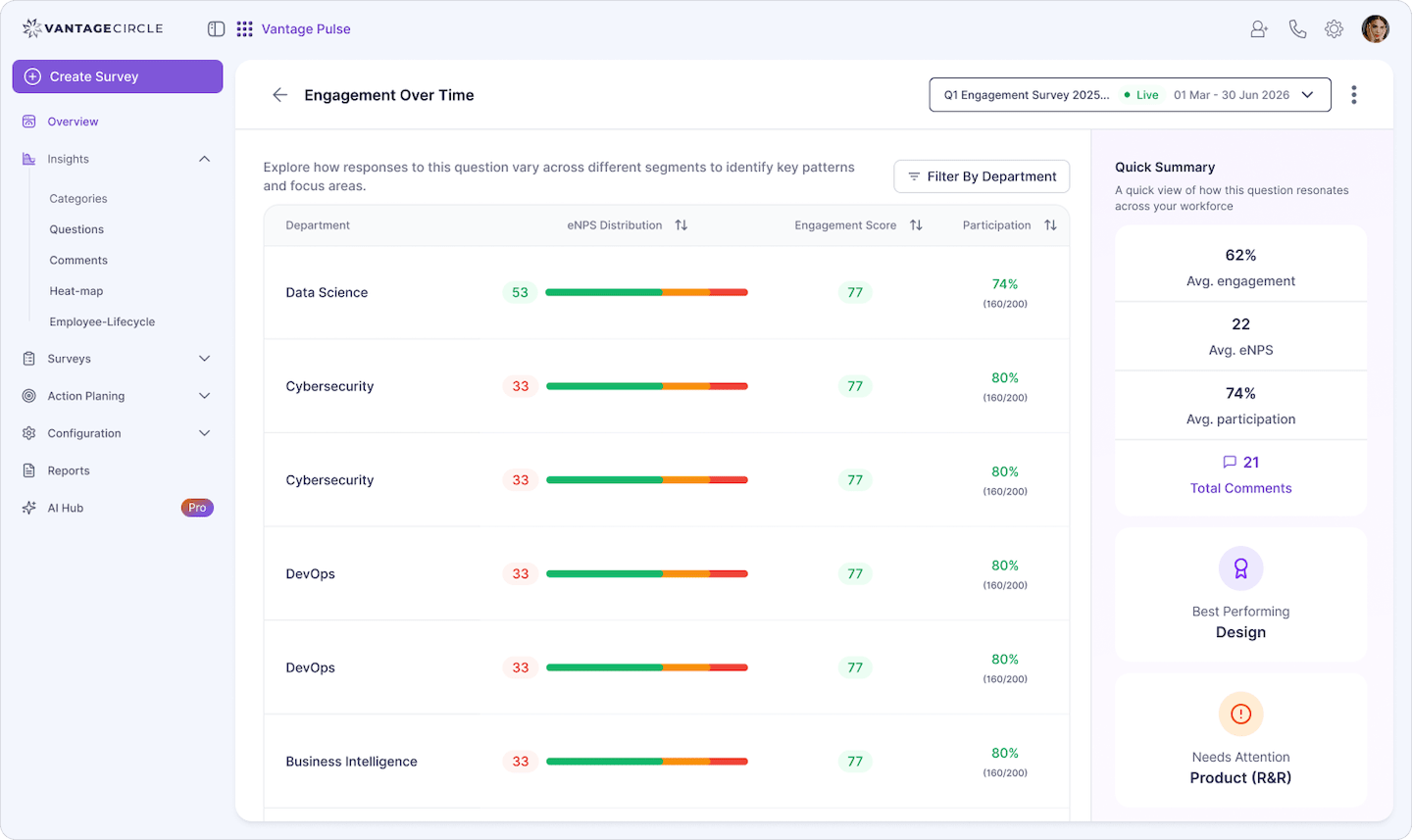
But a company-wide number hides something real. An overall engagement score can look fine while one specific team is struggling underneath it. Averages smooth over exactly the problem you need to see.
(Source: Vantage Pulse)
That's why team-level data matters more than one company-wide rollup ever will. Vantage Pulse's department-wise insights break engagement scores down by team, so a struggling team surfaces early, before it becomes an exit interview. A company-wide average hides that split entirely.
Effective teams also innovate more. Reorganizations don't rattle them the way they rattle everyone else. Neither do bad quarters. None of that is soft. One team ships. The other explains why it didn't.
Characteristics of an Effective Team
Effective teams share eight defining characteristics, laid out in the table below. Miss two or three of these and the team survives. Miss five and it's just a group with a shared calendar.
| Characteristic | Why It Matters | Evidence |
|---|---|---|
| Shared purpose | Aligns effort without constant management | 3.6x more likely to feel their work matters when purpose is clear (Gallup, 2025) |
| Psychological safety | Lets people flag problems before they become failures | The top factor across 180 teams studied (Google, Project Aristotle) |
| Open communication | Removes the guesswork that slows execution | 20-25% more productive when well-connected (McKinsey, "The social economy", 2012) |
| Defined roles | Prevents duplicated work and dropped ownership | Role ambiguity is the most common reason good people underperform |
| Mutual accountability | Makes commitments stick without a manager chasing them | Teams that build it catch their own slips before a manager steps in |
| Diversity of thought | Produces measurably better decisions | 19% higher innovation revenue for diverse teams (BCG, 2018) |
| Constructive conflict | Surfaces problems the polite version hides | Pixar's Braintrust runs on structured disagreement |
| Strong leadership | Sets direction and absorbs pressure so the team doesn't have to | A leader who hides mistakes teaches the team to hide theirs |
Four of these deserve more than a table row.
Psychological safety
Gets talked about constantly and understood rarely. Being nice to each other has nothing to do with it. What actually matters is whether someone can say "I don't know" or "that was my mistake" without paying for it later. I watched a whole room exhale once, right after someone finally admitted a miss out loud in a meeting. Everyone else in that room had been carrying the exact same fear alone. Anonymous pulse data tends to catch this before an exit interview does, mostly because nobody puts "I don't feel psychologically safe here" on a form with their name attached. That's the entire reason Vantage Pulse's anonymous responses exist.
Open communication
Gets filed under soft skills more often than it should. It isn't one. A well-connected team runs roughly 20 to 25 percent more productive than a poorly connected one (McKinsey, "The social economy," 2012). That's a number a CFO reads twice. I'd push back a little on blaming this purely on communication, though. Most of what looks like a communication problem is really a role-clarity problem. People go quiet for a specific reason. They don't know whose call something actually is.
Mutual accountability
The quiet one on this list, and usually the first thing to go missing. Nobody gets blamed the moment it breaks down. The team just quietly stops catching its own slips before a manager has to step in. Teams that treat accountability in the workplace as a daily habit tend to fix problems on their own, long before anyone above them even notices.
Diversity of thought
Almost always gets hired for and then wasted. Teams bring in different perspectives. Then they run meetings where the loudest voice wins anyway. Diverse teams with above-average representation report 19 percent higher innovation revenue (BCG, 2018). That number doesn't show up automatically. People have to feel safe disagreeing out loud, actually out loud, in the room. An org chart alone doesn't create that.
Effective Team Member: Qualities of a Good Team Member
An effective team member is reliable, communicative, accountable, and willing to give and receive feedback without getting defensive about either direction.
Reliability sounds basic until you've worked with someone who isn't. It means what you commit to on Monday is still true on Friday. Some of the most effective team members barely talk at all. They just mean every word they do say. Accountability means owning the miss before someone else points it out. Feedback fluency works the same way. Hearing "this didn't land" without getting defensive about it decides whether someone improves or just digs in.
None of these are personality traits. They're habits. People pick them up with practice.
How to Build an Effective Team
You build an effective team in ten deliberate steps. Skip step three and step nine quietly cancels itself out.
Set the vision and purpose
Start here, before any kickoff deck gets built. A team that knows why the work matters makes better calls when nobody's watching. That's most of the time. Write down what success actually looks like in six months. A mission statement alone won't do that.
Define roles
Ambiguity is the single most common reason good people underperform. It's rarely a skill problem or an effort problem. Nobody was sure whose job it actually was. Write the role down, and revisit it every time the team grows.
Set goals
Vague goals produce vague effort. Specific, time-bound goals work far better when the team actually helps set them. A goal just handed down rarely gets the same buy-in. Set goals collaboratively wherever the role allows it.
Assemble complementary skills
A team of five identical strengths is a team with four blind spots. Hire and assign for what's actually missing. Don't just pick whoever's easiest to manage.
Build relationships and trust
This is the step teams skip because it doesn't show up on a project plan. Trust doesn't build in a single offsite. It builds in small moments, someone covering for a sick colleague, someone admitting a mistake without it turning into blame.
Establish communication norms
Decide, out loud, how the team actually communicates. Chat threads for routine updates. A call for anything urgent. A clear, stated expectation for how fast someone responds. Unstated norms create the exact friction the McKinsey data above is measuring.
Create a feedback culture
Feedback has to flow in both directions, on a schedule. The annual review nobody looks forward to doesn't count. Teams that build this early handle conflict better later, because disagreement stops feeling personal.
Manage conflict, don't avoid it
Every effective team fights. The difference is whether the fight stays about the work. Set the norm early. Disagree with the idea, leave the person out of it, and say so out loud the first time someone breaks the rule.
Recognize wins
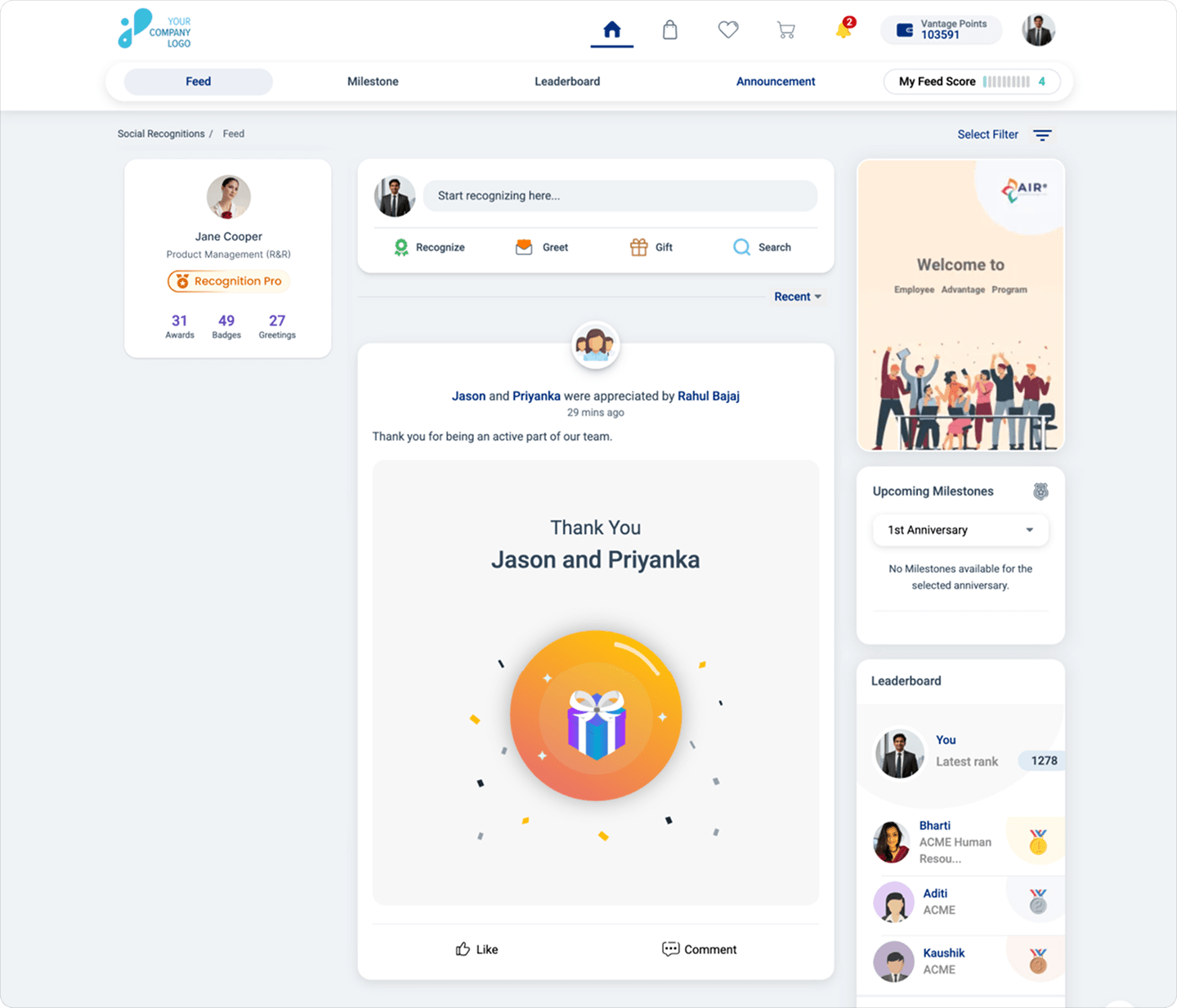
Most teams treat this step as optional. It's the one with the fastest payoff. An annual awards ceremony doesn't build a habit. Weekly recognition does. Vantage Rewards' peer-to-peer recognition turns "good work, team" from an occasional manager comment into something the team does for each other by default, which is a very different signal to send.
Lead by example
Nothing above works if the leader doesn't model it first. A leader who hides mistakes teaches the team to hide theirs. There's no single right leadership style for this. The consistency matters more than the style.
Do team building on purpose. Structured activities work when they're chosen for a specific gap. Running one just because it's Thursday doesn't count. See types of team building and team building activities for work for options that map to an actual need.
(Source: Vantage Rewards)
Team Effectiveness Models
Five models explain how teams become effective, and most practitioners only know one or two of them. Each one, listed in the table below, answers a slightly different question. Most people get more value from combining two of them than from leaning on one favorite.
| Model | Core Idea | Best Used For |
|---|---|---|
| Tuckman's Stages (1965) | Forming, storming, norming, performing | Mapping where a new or reorganized team currently sits |
| Lencioni's Five Dysfunctions (2002) | A trust gap causes the other four dysfunctions | Explaining why a mature team has stalled |
| GRPI Model (Beckhard, 1972) | Goals, Roles, Processes, Interpersonal, in priority order | Root-causing team friction before assuming it's a personality clash |
| Katzenbach & Smith's Team Basics (1993) | Five traits define a real team | Deciding whether a group actually qualifies as a team |
| Hackman's Conditions (2009) | Five conditions set teams up before they even start | Designing a new team's conditions before it launches |
A closer look at each:
Tuckman's Stages 1965
Bruce Tuckman's four stages, forming, storming, norming, performing, are still the fastest way to explain why a new team feels chaotic before it feels good. Storming isn't failure. It's the team working through real disagreement out loud, and tying that back to the constructive-conflict point above, it's usually a sign things are on track.
Lencioni's Five Dysfunctions 2002
Patrick Lencioni flips that logic around. Most managers assume a stalled team's problem is accountability. It's almost always trust, sitting quietly underneath everything else, unaddressed. Fix the trust gap and the other four dysfunctions tend to unwind on their own.
GRPI Model Beckhard, 1972
The GRPI model is the boring one, and that's exactly why it earns a place on this list. Richard Beckhard built it to force teams past the personality-clash explanation. It checks three duller things first: unclear goals, undefined roles, or a process nobody actually agreed to. Nine times out of ten, that's where the problem is. The personality clash everyone blames first is usually a distraction.
Katzenbach & Smith's Team Basics 1993
Katzenbach and Smith set the bar highest of the five. A real team needs small size, complementary skills, a shared purpose, specific goals, and mutual accountability, all five, together. Skip even one and what's left is a working group with a nicer title.
Hackman's Conditions 2009
Hackman's research at Harvard didn't look at teams after they'd already struggled. It looked at what made teams work before they even started: a real team, a compelling direction, an enabling structure, a supportive context, and coaching that's genuinely expert. The finding held up across decades. Fixing a badly designed team after launch is brutally hard. Designing it right the first time is not.
Real Examples of Effective Teams
Google, Amazon, Microsoft, Netflix, and Pixar are studied examples of deliberately built effective teams, and each got there through a different lever.
Project Aristotle: two years, 180 teams. The answer wasn't talent density. It was psychological safety, by a wide margin. That single study reshaped how Google itself builds new teams, and it's probably the most cited piece of team research from the last decade.
Built into a leadership principle: act on behalf of the whole company, protect long-term value even when a shortcut looks better this quarter. Sounds like a poster line. It stops sounding like one the first time you watch a team behave that way under real pressure.
Satya Nadella pulled the company out of an internally competitive, siloed culture and pointed it toward collaboration and a growth mindset. Most of the credit for Microsoft's comeback through the 2010s goes to that shift, though the structural changes underneath it mattered just as much.
Reed Hastings cut rules, gave people more context, and built a hiring bar around talent density. The culture memo comes down to one line: a small team of fully engaged people will always outperform a larger one carrying passengers.
The Braintrust: unfinished films go in front of a small group of peers for blunt, structured feedback. The peers can't mandate a single change, and the director keeps creative control. Its only job is making sure nothing weak survives unchallenged.
Tools for Building and Measuring an Effective Team
The right tools cover three jobs, communication, project management, and measuring team health. Most teams have the first two covered and skip the third completely.
Communication tools like Slack, Microsoft Teams, and Zoom handle the daily back-and-forth. Step six's norms only matter if the tool actually supports them. Project management tools like Asana, Trello, and Jira put roles and goals somewhere everyone can see them. The alternative is all of that living in one person's head, which doesn't scale. Both categories are table stakes at this point. Most teams already have one of each.
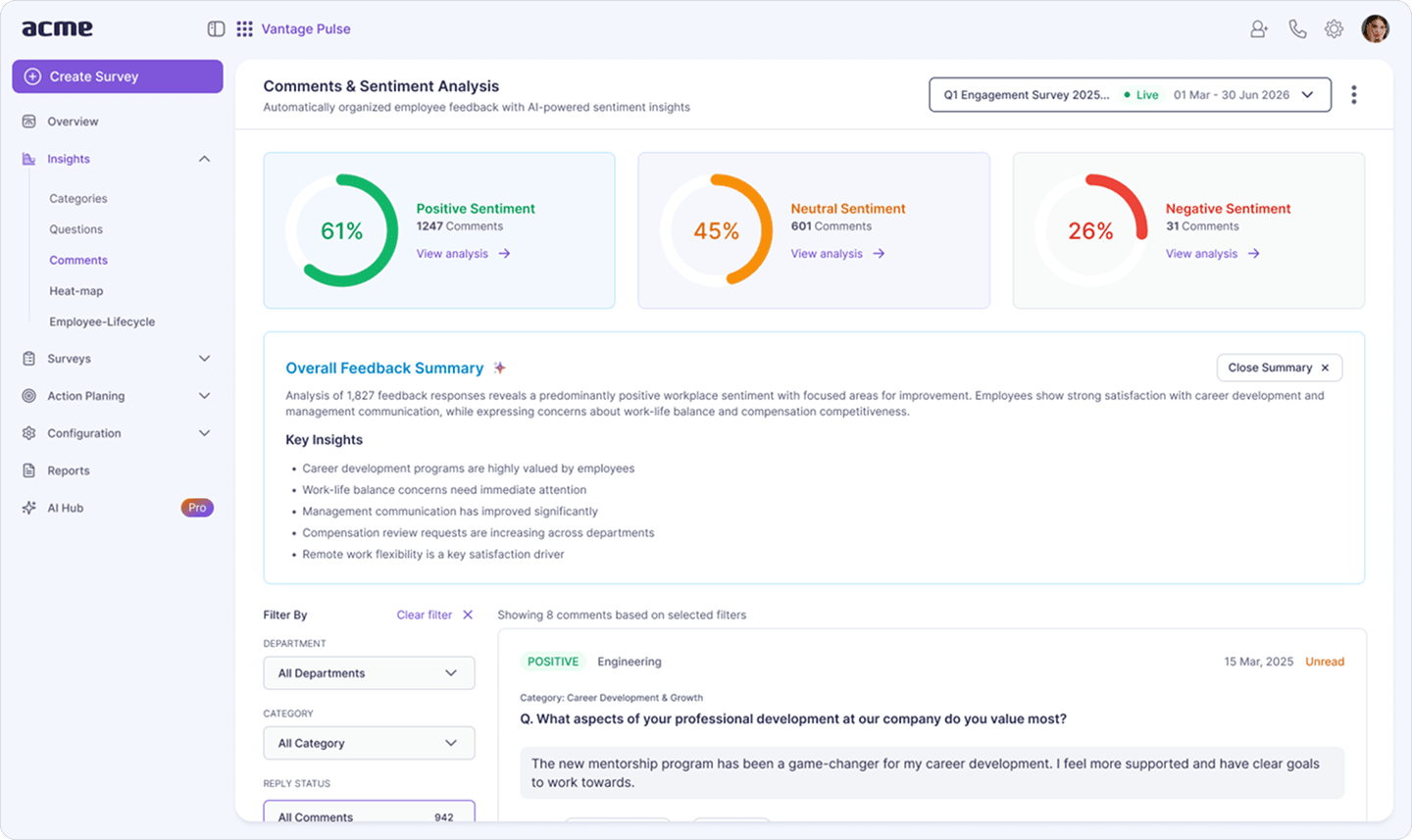
The third job is measuring whether the team is actually healthy. Most tool stacks skip it completely, and busy quietly gets mistaken for healthy. Communication and project tools show you what happened. They don't show you how the team felt about what happened. That gap is where attrition usually starts.
(Source: Vantage Pulse)
Vantage Pulse's sentiment analysis closes that gap by turning open-text feedback into themes, so recurring friction inside a team shows up without someone manually reading every comment. Knowing a team hit its deadlines is one thing. Knowing what hitting them actually cost the team is another. See more employee pulse survey tools if Vantage Pulse isn't the only option on your shortlist.
How to Measure Team Effectiveness
Measure team effectiveness against a baseline. Run a short, recurring survey. Track engagement and output over time. Re-check after any real change, a new hire, a reorg, a rough quarter. Effectiveness isn't a single number. It's a trend line.
Start with a short pulse survey, monthly or quarterly. Skip the annual version. By the time it lands, the moment it was measuring is long gone. Pair the survey score with a hard output number, like deadlines hit or cycle time, whatever the team's actual work produces. A team can score well on sentiment and still be missing targets, and that gap is worth investigating on its own.
Vantage Pulse's eNPS surveys give that recurring baseline without building a survey process from scratch. The number by itself doesn't mean much. What matters is the change over time. Did whatever you tried actually move it, or did it just feel like it should have?
Conclusion
Effective teams and successful teams are the same team, and they get built the same deliberate way, one decision at a time. The characteristics are learnable. The steps are repeatable. The models exist so you're not diagnosing a team problem from scratch every time one shows up, and over time that consistency is what a high-performance culture actually is.
None of this happens by accident, and it definitely doesn't happen overnight. Google, Amazon, Microsoft, Netflix, and Pixar each put real, ongoing effort into getting this right. None of it happened automatically.
Pick one characteristic your team is missing. Work on that one first.
Frequently Asked Questions
Q. What do you mean by an effective team?
A. It's a group with a shared goal, real trust between the people in it, and output that beats what the same people would manage working alone. Some people call this a "successful team" or a "high-performing team." Same thing. What makes it real is repetition, hitting goals again and again without burning anyone out to do it.
Q. What are the 7 main characteristics of an effective team?
A. Most lists name some mix of a clear shared purpose, psychological safety, open communication, defined roles, mutual accountability, diversity of thought, and strong leadership. This guide adds an eighth: constructive conflict. Effective teams tend to argue, openly and often. Usually that's a healthy sign.
Q. What makes a successful team?
A. The same eight traits that make a team effective, listed in the table above. "Successful" and "effective" are just two names for the same list.
Q. What are the 5 C's of a team?
A. Communication, Collaboration, Commitment, Cohesion, and Conflict resolution. It overlaps heavily with the eight characteristics above, just a shorter, easier-to-remember version.
Q. What are the 5 keys to a successful team?
A. Clear goals, defined roles, mutual trust, open communication, and accountability. Miss one and the team compensates with longer hours instead.
Q. What are the 5 roles of an effective team?
A. Teams typically need someone driving direction (a leader), someone executing the work (a doer), someone challenging assumptions (a critical thinker), someone maintaining relationships (a connector), and someone tracking whether the team is actually hitting its goals (an accountability owner). One person can hold more than one role. The roles matter more than the headcount.
Q. How do you build an effective team?
A. Follow the ten-step process above, starting with setting a clear vision and ending with leading by example.

He has worked in the human resources environment and has elevated recognition and rewards through his insightful and detailed writing. He aims to enhance the practice of Recognition in the workplace with new ideas and innovation that will help shape the work culture. For any related queries, contact editor@vantagecircle.com


