Recognition programs rarely fail because employees dislike them.
They stall because finance can't get comfortable with the tax implications.
It follows a predictable sequence. HR wants to launch or expand a recognition program. Finance asks whether gift cards are taxable. Payroll asks how points redemptions should appear on W-2s. Procurement asks who owns compliance reporting. Nobody has a clear answer, the evaluation slows down, and what started as an employee experience initiative turns into a tax governance discussion.
This post exists to make that conversation easier and shorter.
The IRS rules around employee recognition aren't complicated once you see the framework. The rules are scattered across multiple tax provisions, rarely explained in HR-readable language, and almost never built into how recognition platforms work. Most organizations don't find these gaps during program design. They find them during payroll reconciliation, vendor implementation, or an audit.
This is where most recognition programs discover whether they were designed for engagement, or designed for governance too late.
This article is for informational purposes only and does not constitute legal or tax advice. Consult a qualified tax professional for guidance specific to your organization's recognition program.
Key Takeaways
- Why Recognition Taxation Has Become a Buying-Cycle Issue
- The IRS Framework: Not All Recognition Is Treated Equally
- De Minimis: The Rule That Breaks Down at the Gift Card Counter
- Gift Cards: Disproportionate Risk, Consistent Misunderstanding
- Points-Based Programs: When Can Recognition Points Become Taxable?
- Peer-to-Peer Recognition: Employer Reporting Responsibility
- Service Awards: The §274(j) Exemption Most Programs Leave on the Table
- W-2 Reporting: Where Culture Strategy Meets Operational Execution
- Where Recognition Programs Usually Break Down
- What to Ask Your Recognition Vendor
- The Rules, Plainly
Why Recognition Taxation Has Become a Buying-Cycle Issue
A decade ago, recognition programs were relatively simple. A service award here. A holiday gift there. Spot bonuses processed through payroll. Tax handling was straightforward because the programs were.
That is no longer the case.
According to Vantage Circle's AIRe Benchmarking Report, organizations have moved away from periodic rewards toward continuous recognition: peer-to-peer nominations, instant redemptions, points economies, milestone automation, and global rewards catalogs all running at once. Recognition became always-on. Tax handling didn't keep pace.
The result: what once sat quietly in payroll as a footnote now pulls HR, finance, payroll, and procurement into the same room. Most of those conversations still happen without a clear framework to guide them.
The deeper shift is that recognition programs are no longer operating as lightweight culture initiatives. They increasingly sit inside broader compensation, retention, and employee experience ecosystems, which means finance scrutiny was always going to follow eventually.
The IRS Framework: Not All Recognition Is Treated Equally
The biggest misconception in employee recognition tax is assuming all awards work the same way. They don't. The IRS evaluates recognition based on what was given, why it was given, how it was delivered, and whether it functions like compensation. Most programs fall under two provisions.
IRC §132(e): De Minimis Fringe Benefits covers small, infrequent non-cash benefits that are administratively impractical to track. Classic examples: a holiday turkey, occasional event tickets, office snacks. Cash and cash equivalents are explicitly excluded, meaning gift cards, prepaid cards, and points redeemable for cash-equivalent rewards can never qualify as de minimis benefits, regardless of their value.
IRC §274(j): Employee Achievement Awards creates a narrow but real tax exclusion for service awards and safety achievement awards, with strict qualification rules around award type, employee eligibility, presentation format, and annual dollar limits.
These two provisions are the most commonly relevant for recognition program design, but they are not the only ones that matter. Other recognition payments may be taxable compensation unless a separate statutory exclusion applies. Knowing how your program maps to these rules before launch is what separates a scalable strategy from a compliance problem that surfaces three years later.
De Minimis: The Rule That Breaks Down at the Gift Card Counter
The de minimis rule is among the most misapplied provisions in employee recognition. Most HR teams assume that small-value awards don't need to be reported because the amount feels insignificant. The IRS doesn't evaluate it that way.
The de minimis exclusion exists because of administrative impracticality. If tracking a small, infrequent, non-cash benefit would create unreasonable administrative burden, the IRS may allow it to be excluded from taxable income. That reasoning holds for a birthday cake or a bouquet of flowers. It breaks down the moment a reward starts to resemble cash.
Gift cards, digital wallets, prepaid balances, and cash-equivalent points don't qualify for de minimis treatment at any value. Cash-equivalent benefits are trackable by definition. You can't claim administrative impracticality for something with a clear dollar amount attached. A $10 coffee gift card distributed company-wide creates taxable income and W-2 reporting obligations for every single recipient. There is no floor below which a gift card becomes tax-free.
Most HR teams aren't intentionally creating compliance exposure here. Recognition often feels cultural. The IRS evaluates it economically. Those aren't always the same thing.
Gift Cards: Disproportionate Risk, Consistent Misunderstanding
Gift cards get their own section because the compliance risk here is disproportionate to how casually they tend to be used.
The IRS position is clear: employer-provided gift cards that function as cash equivalents are taxable and do not qualify for the de minimis exclusion, regardless of denomination. A $5 digital code is taxable. A retailer-specific card is taxable. The holiday appreciation cards your team distributed to every employee in December, taxable to every one of them. This is the position in IRS Technical Advice Memorandum 200437030 and it has held consistently.
From a payroll perspective, taxable gift cards are generally treated as taxable wages; federal income-tax withholding may be handled under the supplemental-wage rules. They require withholding at the 22% federal supplemental rate, W-2 reporting, and employer FICA handling. At scale, the numbers are concrete. Consider two companies, both spending $400 per employee to mark five-year milestones across 400 employees.
| $400 Amazon gift card | $400 engraved watch (§274(j) qualified) | |
|---|---|---|
| Supplemental wages | $160,000 | $0 |
| Employer FICA | ~$12,240 | $0 |
| W-2 line items | 400 | 0 |
Illustrative only. Actual FICA treatment depends on each employee's year-to-date wages relative to the Social Security wage base.
Same budget. Structurally different outcome.
The rule itself isn't hard to understand. Recognition workflows and payroll workflows are usually built by different teams with different priorities. That gap is exactly where the liability accumulates.
Points-Based Programs: When Can Recognition Points Become Taxable?
When employees accumulate points in your recognition program, HR and payroll need to understand how and when a tax obligation may arise.
Tax treatment of recognition points depends on how the program is structured, the nature of the points, the restrictions attached to them, and when the employee receives, or has access to, a benefit with economic value. The IRS has not issued comprehensive guidance establishing a single tax rule for employer recognition points. Employers should assess their specific program design with qualified tax counsel, particularly where points can be converted into cash or cash equivalents or have characteristics beyond a simple recognition currency.
That uncertainty creates real operational pressure at scale. Large programs process thousands of redemption transactions across business units every month. If redemption data can't flow cleanly into payroll systems, year-end reporting doesn't just get complicated. It becomes a crisis.
IBS Software, operating across more than 20 countries including the US, built its program around this distinction, separating monetarily-backed redemptions from social recognition at the platform level rather than running everything through a single points ledger. Simpler administration, less tax exposure.
Your platform needs to clearly separate:
- Social recognition from points accumulation
- Taxable redemption activity from non-taxable interactions
- Gift card redemptions from merchandise redemptions
If your vendor can't produce that data in a format your payroll team can actually use, that gap has a cost. It just doesn't show up in the pricing proposal.
On the program design side: How to Start a Peer-to-Peer Recognition Program: A 3-Phase Playbook
Peer-to-Peer Recognition: Employer Reporting Responsibility
 Source: Vantage Circle — Rewards & Recognition Platform
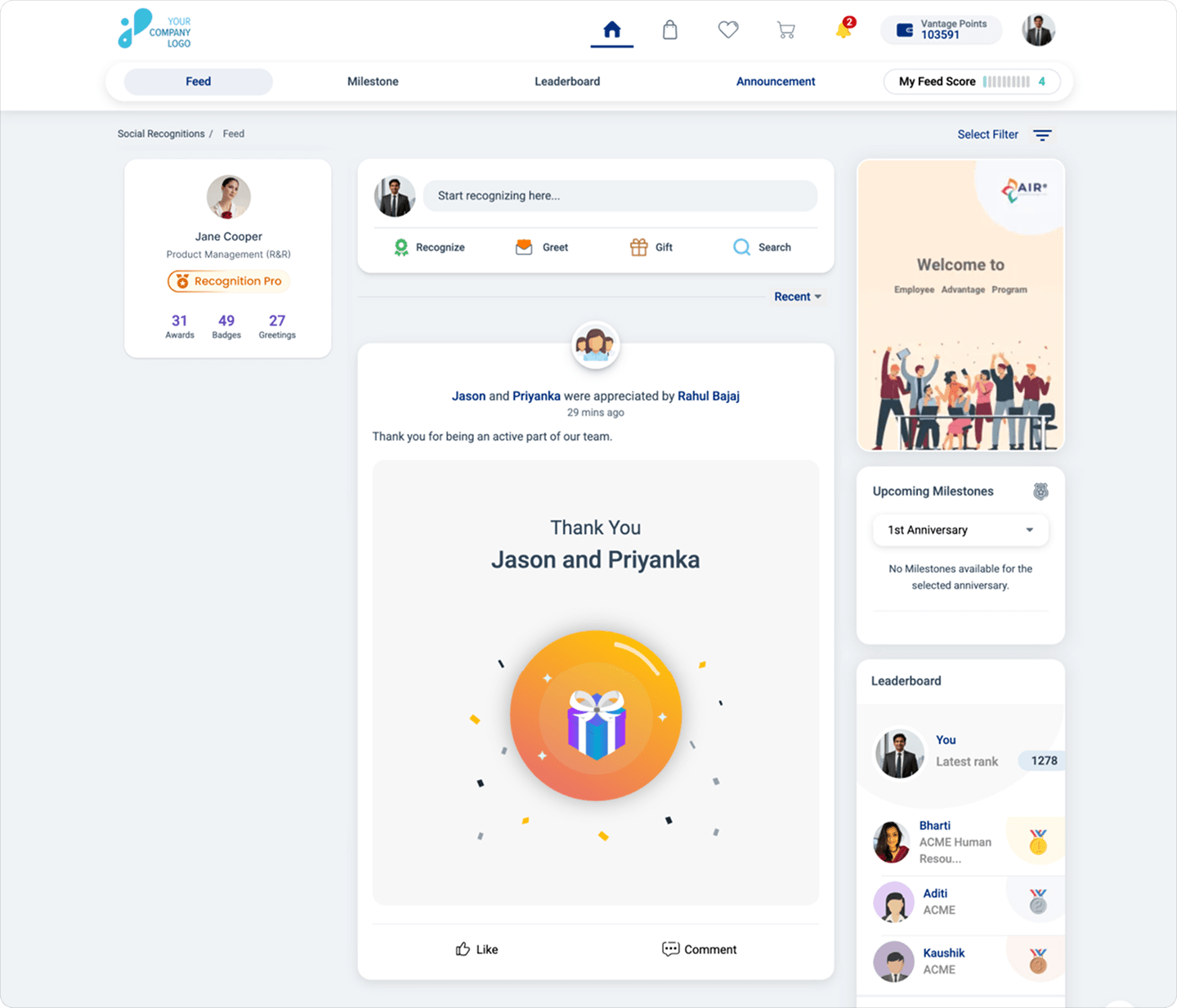
If you fund the rewards, operate the platform, and enable redemption, the employer generally bears the payroll withholding and reporting responsibility for taxable employee rewards. For a broader look at how peer-to-peer recognition functions as a program design element, including how it drives participation and culture, that context is worth reading alongside the compliance picture here.
That surprises some teams. Because the recognition originates between employees, they assume the reporting obligation sits somewhere outside employer responsibility. The fact that recognition is initiated by a peer does not, by itself, remove the employer's payroll and reporting responsibilities when the resulting award is taxable compensation.
Modern platforms blend social recognition, monetary rewards, points systems, and redemption catalogs into a single employee experience. Social recognition with no monetary value is generally not taxable. When recognition includes a taxable economic benefit, payroll and reporting requirements may follow.
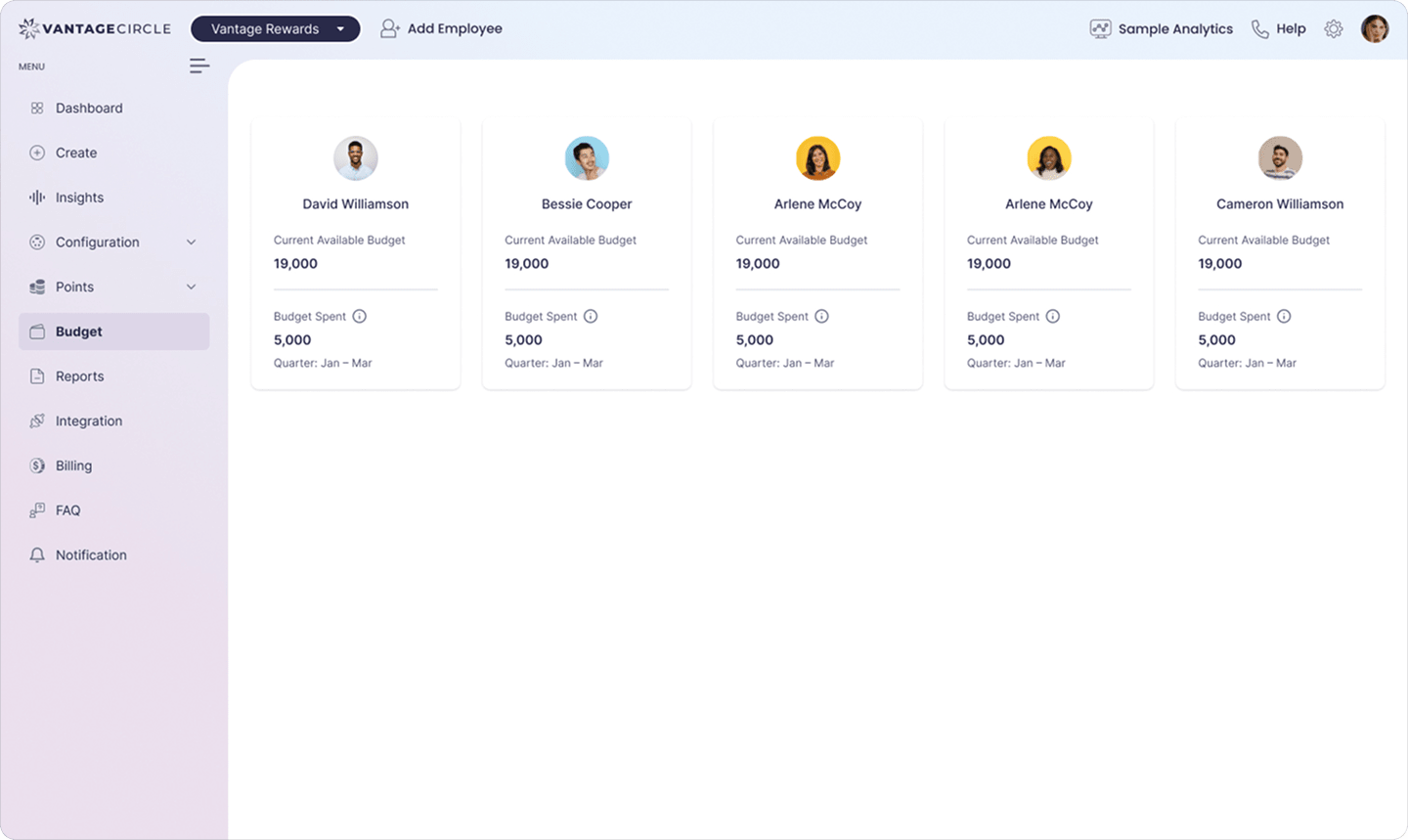
Platform architecture is a compliance decision, not just a product preference. A platform that can't separate social kudos from monetarily-backed awards in its reporting creates manual reconciliation work that compounds every time an employee hits the redeem button.
Service Awards: The §274(j) Exemption Most Programs Leave on the Table
Among all recognition categories, service awards offer the clearest opportunity for legitimate tax advantage, and it's consistently underused.
Under IRC §274(j), a length-of-service award given as tangible personal property in a meaningful presentation may be excluded from the employee's taxable income. Meaningful presentation is a distinct qualification requirement under §274(j): the award must be presented in a way that acknowledges the achievement and does not create a significant likelihood it is disguised compensation. What constitutes a meaningful presentation is a facts-and-circumstances determination. Simply dropping an award in the mail with no acknowledgment of the achievement is unlikely to meet the standard, but the IRS has not prescribed a specific ceremony format.
On the tax rules for service awards: Service Awards and Tax Benefits: What HR Needs to Know in the US and Canada
Exclusion limits:
- Up to $400 per employee per year under a non-qualified plan
- Up to $1,600 per employee per year under a qualified written plan
A qualifying award generally requires all of the following:
- Come after at least five years of service (first award), with subsequent awards at least five years apart
- Take the form of tangible personal property, not gift cards, cash, meals, travel, or securities
- Come from a plan that doesn't favor officers or employees earning above the highly compensated employee (HCE) threshold ($160,000 for 2025–2026, subject to annual IRS adjustment)
- Be documented in a formal written plan
The higher $1,600 limit applies to awards under a qualified plan: one that meets the nondiscrimination and other requirements of §274(j), including a formal written plan document.
For a full overview of how to structure years of service awards effectively, that post covers program design, milestone timing, and award formats in depth. While over 75% of companies report service or tenure-based awards as part of their recognition program (Vantage Circle Annual R&R Report, USA 2023-24), programs that default to gift cards or cash cannot use the §274(j) exclusion for those awards. Receiving a $1,600 engraved award under a qualifying §274(j) plan and receiving a $1,600 gift card may feel identical to an employee. The tax outcome is not. A qualifying tangible award may be excluded from the employee's wages, subject to the requirements and limits of §274(j). The gift card creates taxable compensation plus employer payroll tax.
W-2 Reporting: Where Culture Strategy Meets Operational Execution
Every recognition program eventually reaches payroll. That is where the cultural intent of recognition meets the operational reality of compliance.
| Recognition Type | Generally Taxable? | Generally W-2 Reportable? |
|---|---|---|
| Cash awards | Yes | Yes |
| Gift cards (cash equivalents) | Yes | Yes |
| Taxable points or rewards | Depends on program structure | If taxable, yes |
| Qualified service award §274(j) | Excess/nonqualifying portion | Correspondingly |
| Purely social recognition (no monetary value) | Generally no | Generally no |
| True de minimis non-cash items | Generally no | Generally no |
 Source: Vantage Circle — Rewards & Recognition Platform
Two mechanics matter beyond the table.
Withholding
How withholding is calculated depends on how the award is paid:
- Aggregate method: award combined with a regular paycheck; withholding calculated at the employee's effective rate based on their W-4
- Flat-rate method: award paid separately from regular wages; 22% federal supplemental withholding rate applies
For an employee whose supplemental wages from the employer exceed $1 million during the calendar year, the excess is subject to 37% federal income-tax withholding. Uncommon for most recognition programs, but relevant for organizations running high-value awards for senior executives.
Timing
Taxable fringe benefits are generally reportable for the period in which they are received, subject to IRS rules governing noncash fringe benefit timing and the employer's permitted accounting elections.
As a practical matter: taxable awards distributed in December must generally be captured in that year's payroll. Gift cards issued in December belong on that year's W-2. Holiday gift cards distributed after payroll closes create an off-cycle run or a January true-up. Companies that treat year-end appreciation as outside the payroll process create this problem for themselves reliably, every December.
State tax treatment can vary based on where an employee works and lives, the state's sourcing rules, and the nature of the award. For multi-state employers and remote teams, recognition awards may be subject to state income tax rules that differ considerably from federal treatment. If your workforce spans multiple states, verify compliance with each state's requirements rather than assuming federal rules apply uniformly.
Where Recognition Programs Usually Break Down
Recognition compliance failures are surprisingly predictable. The same gaps appear across organizations of every size.
Gift cards distributed without W-2 reporting. There is no amount at which a gift card becomes tax-free. If your recognition policy includes gift cards going out without payroll coordination, it's generating liability right now.
Points programs launched without payroll integration. Redemption data that can't flow cleanly into payroll doesn't stay manageable. It accumulates until year-end, when it becomes a problem that is both urgent and entirely avoidable.
Peer-to-peer recognition treated as outside employer responsibility. If you fund and operate the platform, the employer generally remains responsible for payroll withholding and reporting on taxable employee rewards, regardless of who initiated the recognition.
Using "recognition" framing to avoid withholding on what is functionally a bonus. Calling a payment a "recognition award" does not by itself make it tax-exempt. The applicable tax treatment depends on the nature of the benefit and whether a statutory exclusion applies.
The deeper pattern is that recognition programs tend to evolve faster than the operational processes around them. The program scales. The payroll integration doesn't. The year-end reconciliation is where that gap surfaces.
What to Ask Your Recognition Vendor
Tax compliance in recognition is not just a policy question. It's a platform capability question.
1. Can redemption data integrate directly into your payroll system, and in what format? A vendor who can't answer this specifically is leaving the integration work, and the compliance risk, with you.
2. Does the platform separate social recognition from monetarily-backed awards in its reporting? If everything runs through the same points ledger, your W-2 reconciliation will require manual intervention every single month.
3. Does the platform support a qualified §274(j) service award structure, and can it flag gift card redemptions separately? These aren't edge cases. They're the two categories where compliance errors are most common and most costly.
A platform that can't answer these questions is transferring compliance complexity back onto your team. That's a real operational cost that just doesn't show up in the pricing proposal.
On the business case: Why Employee Recognition Boosts ROI — and Why It Matters to You
The Rules, Plainly
For the CFO conversation, this is the one-page version.
- Cash and gift cards: Employer-provided gift cards are taxable because they are treated as cash equivalents and do not qualify for the de minimis exclusion, regardless of denomination. Cash awards are taxable compensation.
- Recognition points: Tax treatment depends on program structure, the nature of the points, and when the employee receives, or has access to, a benefit with economic value. The IRS has not issued comprehensive guidance establishing a single tax rule for employer recognition points. Confirm program-specific treatment with qualified tax counsel.
- Peer-to-peer recognition with redeemable monetary value generally creates employer payroll withholding and W-2 reporting obligations, regardless of who initiated the award.
- Service awards under §274(j) offer a narrow exclusion for qualifying tangible personal property, up to $1,600 under a qualified written plan that meets all §274(j) requirements.
- Purely social recognition with no cash or redeemable economic value generally does not create taxable income.
The organizations getting this right aren't necessarily spending more on recognition. They're building programs that HR can scale, finance can defend, payroll can operationalize, and employees can trust. According to Gallup, only 22% of employees strongly agree they receive the right amount of recognition at work, which means the investment case is real. The question is whether the program is built to last or built to create a problem nobody notices until it's expensive to fix.
Recognition now sits at the intersection of culture, compensation, payroll, and compliance. Tax governance is no longer a footnote. It's what turns a morale initiative into sustainable organizational infrastructure.
A related pattern: Recognition Fatigue: Why Your Appreciation Program May Be Backfiring
Frequently Asked Questions
Are gift cards taxable income for employees?
Employer-provided gift cards are taxable because they are treated as cash equivalents and do not qualify for the de minimis exclusion, regardless of denomination, retailer, or occasion. There is no floor below which an employer-provided gift card becomes tax-free. This position is confirmed in IRS Technical Advice Memorandum 200437030. Taxable amounts must be included in wages and reported on Form W-2.
When do employee recognition points become taxable?
Tax treatment of recognition points depends on how the program is structured, the nature of the points, the restrictions attached to them, and when the employee receives, or has access to, a benefit with economic value. The IRS has not issued comprehensive guidance establishing a single tax rule for employer recognition points. Employers should assess their specific program design with qualified tax counsel, particularly where points can be converted into cash or cash equivalents.
What is the IRS limit for tax-free service awards?
Up to $400 per employee per year under a non-qualified plan; up to $1,600 under a qualified plan that meets the nondiscrimination and other requirements of IRC §274(j), including a formal written plan document. To qualify, the award must take the form of tangible personal property (not gift cards, cash, meals, travel, or securities) and come after at least five years of service, with subsequent awards at least five years apart. The $1,600 limit requires a formally documented qualified plan, not just a documented award.
Are peer-to-peer recognition awards taxable?
Purely social recognition with no cash or redeemable economic value generally does not create taxable income. When an employee receives a taxable reward, whether initiated by a manager, peer, or the employer, the employer generally remains responsible for the applicable payroll withholding and W-2 reporting under IRS fringe benefit rules.

Supriya is a Content Marketing Lead at Vantage Circle, where she writes on employee engagement, recognition, workplace communication, and culture. Her work on remote team recognition draws on primary research from Vantage Circle's platform data and customer deployments across distributed workforces. She spent the earlier part of her career in corporate communications at Burson, ESPN Star Sports, and CBRE, advising organizations on the messages employees actually hear.
Connect with Supriya on LinkedIn.