
High-impact employee recognition programs are defined by design maturity, not budget. The best ones make people feel appreciated, accepted, validated, and accomplished. They recognize behaviors rather than just outcomes, run all year instead of only at review time, and measure their reach like any other business metric.
Most employee recognition programs do not underperform for lack of intent. They underperform because recognition is treated as a cultural accessory instead of a business mechanism. A global study, The State of Recognition & Rewards 2025, analyzed 352 programs across North America, the UAE, and India and found a clear split. The programs rated highly effective, which the study calls "Leaders," design and run recognition with roughly twice the maturity of everyone else.
Here is exactly what sets those programs apart, and how to measure your own.
What Makes an Employee Recognition Program High-Impact?
A recognition program is high-impact when it changes behavior and business outcomes, not just morale. Four things separate it from an average program: it delivers genuine emotional resonance, it recognizes behaviors rather than only results, it reaches everyone all year rather than a few at review time, and it is measured.
The payoff shows up in hard numbers. When employees consistently feel appreciated, accepted, validated, and accomplished, motivation rises 18 percentage points, intent to stay 16 points, agility 14, and customer excellence 11 (State of Recognition & Rewards 2025). When those signals weaken, the effect reverses fast: workplace sentiment falls from 98% to 83%, and discretionary effort nearly halves.
So effectiveness is about the experience recognition creates, not the number of awards handed out. The distance between recognition that is given and recognition that is actually felt is where most programs quietly lose their value. It is the same recognition gap that leaves engagement flat even when the awards keep flowing.
This is also why spend is a weak predictor of impact. Two companies can invest the same budget and see opposite results, because what moves the needle is how recognition is designed and delivered, not how much is spent. The Leaders in the study often run leaner budgets than their peers and still outperform, because their programs are built for consistency, specificity, and reach.
The 4 Signals Behind Every High-Impact Program
High-impact programs are built on four emotional signals. Employees need to feel appreciated, accepted, validated, and accomplished, and the four are interdependent. Remove one and the whole effect crumbles.
- Appreciated: "I am noticed for who I am, not just my role."
- Accepted: "I can show up as myself."
- Validated: "What I do has real meaning."
- Accomplished: "I see the difference I make."
The chain effect proves how tightly they connect. Among companies highly effective at engagement and behavioral reinforcement, 86% also achieve high productivity results (State of Recognition & Rewards 2025). Leaders embed these signals at three levels: organizational systems that ensure consistency, leadership behaviors that demonstrate authenticity, and cultural practices like equitable rewards that reinforce values. Get one level right and neglect the others and the signals wobble, which is why high-impact programs treat recognition as a system, not a gesture.
When leaders model authenticity, design for inclusivity, and build systems for continuity, recognition turns from a symbolic act into a sustained source of energy and alignment.
– Partha Neog (CEO, Vantage Circle)
What High-Impact Programs Do Differently: The AIRe Framework
High-impact programs score about twice the design maturity of everyone else. Measured on Vantage Circle's AIRe framework, which scores a program across Appreciation, Incentivization, Reinforcement, and eMotional Connect, Leaders average an AIRe of 64 versus 34 for others, and nearly 40% of Leaders cross a "modern design" threshold of 70 (State of Recognition & Rewards 2025).
In practice, that maturity gap is the difference between recognition that stays transactional, an award here and there, and recognition that becomes relational and daily, woven into how the work actually happens.
Here is how Leaders pull ahead on each AIRe pillar.
| AIRe pillar | Leaders | Most others |
|---|---|---|
| Appreciation | Up to 2x more recognition types, always-on across the lifecycle | A few occasional, manager-driven awards |
| Incentivization | Clear criteria, lean budgets, frequent rewards | Vague criteria and rare, larger awards |
| Reinforcement | Recognize behaviors (77%) and both teams and individuals (79%) | Recognize outcomes and the same top performers |
| eMotional Connect | Relational rewards, amplified publicly | Private, transactional rewards that fade |
- Appreciation: broader reach. Leaders deploy up to twice as many recognition types across the employee lifecycle, from onboarding and spot awards to peer-to-peer recognition, quarterly honors, and loyalty milestones. This "always-on" spread makes appreciation culture-wide rather than manager-dependent, catching real work in real time.
- Incentivization: clarity over cash. Leaders are two to three times more likely to codify and communicate recognition criteria through documentation, manager talks, and campaigns. Budgets stay lean, often under 100 US dollars per employee per year, yet impact rises because frequent, emotionally charged rewards beat rare big ones.
- Reinforcement: behaviors as the metric. 77% of Leaders recognize behaviors (how work gets done), not just outcomes, which makes success accessible to everyone. And 79% recognize both teams and standout individuals on collective wins, refusing the false choice between collaboration and individual excellence. When the same behavior is named again and again, it stops being a one-off and becomes the norm, which is how recognition shapes culture rather than just lifting the mood.
- eMotional Connect: amplified moments. Leaders favor relational rewards, then make them visible. 80% amplify recognition through town halls and 72% through formal events, turning individual moments into cultural momentum.
The State of Recognition & Rewards study links AIRe to Ecological Systems Theory (every reward sends signals that ripple across the workplace), Symbolic Interactionism (who recognizes you, and how, shapes the meaning of the moment), and Vroom's Expectancy Theory (people are motivated when they believe effort leads to performance and performance leads to valuable rewards).
How to Build a High-Impact Program: 5 Design Moves
You can raise a program's impact with five moves, drawn directly from what Leader programs do and organized by the AIRe pillars. None of them require a bigger budget. They require designing recognition on purpose instead of letting it happen by default.
- Design for meaning, not magnitude. Shift budget from rare big awards to smaller, frequent ones that carry emotional weight, and codify clear criteria so people trust the process.
- Build systems for consistency and scale. Use a platform for real-time, peer-to-peer recognition and participation tracking, and treat employee recognition as a strategic investment rather than a cost center.
- Reinforce the behaviors that drive your priorities. Tie recognition to specific actions like collaboration, innovation, or customer focus, and use badges for repeat performers so the right habits compound.
- Amplify emotional resonance. Favor symbolic, experiential, and relational rewards, then broadcast them through town halls and storytelling to turn private moments into culture.
- Make it always-on and lifecycle-wide. Weave recognition into onboarding, milestones, and daily work instead of saving it for annual events, so far more employees get recognized every year.
A practical example. Instead of an annual 500 dollar award for the top 10 performers (total spend 5,000 dollars, reaching 10 people), try a monthly 50 dollar spot award for anyone who shows collaboration, innovation, or customer focus. That is about 4,800 dollars a year, reaching 60 to 80 people. Lower total cost, eight times more people recognized, and continuous reinforcement of the behaviors you want.
How to Measure Recognition Program Effectiveness
Measure a recognition program the way you would any performance system: track reach and rhythm, not just spend. The core metrics are receiver coverage (the share of employees who were recognized), giver coverage (the share who gave recognition), frequency (how often recognition happens), the share of recognition tied to a specific behavior, and the engagement and retention it moves.
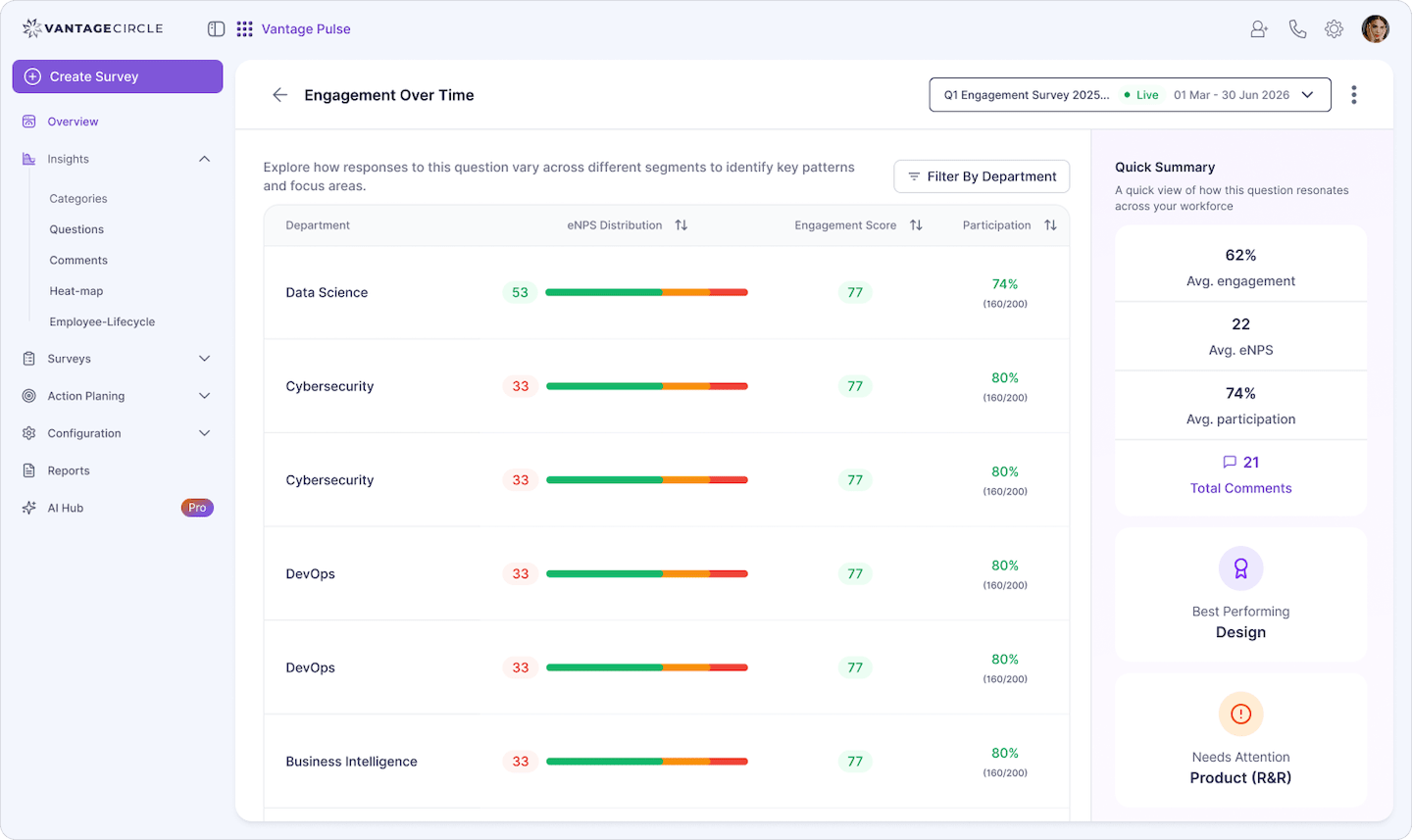
High-impact programs treat recognition as accountable business muscle. Nine in ten track participation and frequency, and many go further to measure recognition ROI and strategic impact (State of Recognition & Rewards 2025). Recognition analytics make these signals visible in real time by department and manager, so "effective" stops being a feeling and becomes a number you can report to the board.
The point of measuring is to act on it. A coverage gap tells you to extend reach to the teams recognition keeps missing; a frequency dip tells you to prompt managers before engagement slides. And the business case is concrete: organizations with recognition-driven cultures hold 92% retention versus 76% in low-recognition ones, according to The Recognition Effect (Great Place to Work and Vantage Circle, 2025). For the wider set of benchmarks, our employee recognition statistics round-up puts these figures in context.
Your Next Move: From Intent to Impact
High-impact recognition is engineered, not accidental. It comes from design maturity, the four signals, behaviors over outcomes, always-on reach, and measurement, rather than from a bigger budget. Leaders achieve it with double the AIRe maturity of everyone else, which is proof that recognition thrives on thoughtful design over spend. Whatever your budget, the programs that win are the ones that treat recognition as a designed system and check the numbers, not the ones that spend the most.
The fastest way to find your weakest pillar is to measure it. Request an AIRe assessment to see where your program's design and execution fall short, and start closing the gap between recognition given and recognition felt.
Frequently Asked Questions
What makes an employee recognition program effective?
An employee recognition program is effective when it changes behavior and business outcomes, not just morale. The strongest programs make employees feel appreciated, accepted, validated, and accomplished, recognize specific behaviors rather than only results, run all year, and are measured on coverage and frequency. Design maturity, not budget, is what separates them.
How do you measure the effectiveness of a recognition program?
Measure effectiveness with reach and rhythm metrics: receiver coverage, giver coverage, recognition frequency, the share of recognition tied to a specific behavior, and the engagement or retention it moves. Spend and award counts alone say little. High-impact programs track participation and connect recognition to real business outcomes.
What are the elements of a successful employee recognition program?
A successful program has four elements: genuine emotional resonance so people feel seen, behavior-based recognition, always-on reach across the whole workforce, and measurement. On the AIRe framework these map to Appreciation, Incentivization, Reinforcement, and eMotional Connect, the pillars high-impact programs score roughly twice as high on.
How much should a company spend on employee recognition?
Less than most assume: high-impact programs often run on under 100 US dollars per employee per year. What drives results is frequency and emotional resonance, not the size of individual awards. Reallocating one large annual award into small, frequent, behavior-based recognition reaches far more people for the same or lower cost.

Nilotpal M Saharia is an Assistant Manager, Content Marketing at Vantage Circle and a recognition-and-rewards (R&R) strategist with 9 years of experience spanning Marketing, HR, and content strategy. He helps HR leaders turn employee recognition and leadership research into practical workplace programs.
Connect with Nilotpal on LinkedIn.