The biggest leadership trends right now are AI fluency, a manager layer under growing strain, flatter teams that lead through influence, and human-centered management. That strain shows up clearly in the data: manager engagement fell from 27% to 22% in a single year, according to Gallup's State of the Global Workplace 2026.
In other words, the people expected to carry most of these trends are the ones checking out fastest.
Most trend lists treat leadership as personal growth and tell leaders who to become. This one looks at what it takes to make leadership work across an entire manager population, so every trend below ends with two things: what HR should do about it, and the signal that tells you whether it's working.
Leadership Trends at a Glance
Eight shifts define leadership today, and most of them land on managers first. Here's the short version before we get into the evidence behind each one.
| Trend | What's changing | What HR should do first |
|---|---|---|
| 1. AI fluency becomes a baseline skill | Leaders are expected to question AI output, not just use it | Run hands-on AI sessions for frontline managers before executives |
| 2. Managers lead people and AI agents | Teams are starting to include digital agents that need tasks and oversight | Help managers map which work goes to people and which goes to agents |
| 3. The manager squeeze becomes a business risk | Manager engagement is falling while stress climbs | Cut manager admin load and measure manager engagement on its own |
| 4. Flatter teams reward influence over titles | Fewer layers mean more people lead without formal authority | Build influence skills into development for individual contributors |
| 5. Human-centered management becomes a performance lever | Well-being and interpersonal skills shape how leadership is rated | Give managers a way to hear candid upward feedback |
| 6. Recognition has to become a leadership habit | Fewer than 1 in 5 employees are recognized in a given quarter | Track recognition by manager, not just company-wide |
| 7. Leadership development gets personalized | A mix of approaches beats a single annual program | Add coaching, assessments and practice to formal training |
| 8. Adaptability becomes the default | Change is no longer a project. It's the operating condition. | Treat change readiness as a core leadership competency |
8 Leadership Trends Shaping the Workplace
These eight leadership trends share one pattern: the work of leading is spreading out, speeding up and getting more human, all at once. Here's what each one looks like and the data behind it.
1. AI Fluency Becomes a Baseline Leadership Skill
AI fluency is now a core leadership skill: the ability to question AI output, spot its blind spots and decide when human judgment should overrule it. That doesn't mean learning to code, but it does mean knowing what good output looks like.
Leaders are already well ahead of their teams here. Microsoft's 2025 Work Trend Index, which surveyed 31,000 workers across 31 countries, found that 67% of leaders are familiar with AI agents, compared with 40% of employees.
But familiarity at the top doesn't translate into confidence in the middle. DDI's Global Leadership Forecast 2025 found that frontline managers are 3X more likely than senior leaders to be concerned about the impact of AI, and those are the managers who have to explain AI to their teams.
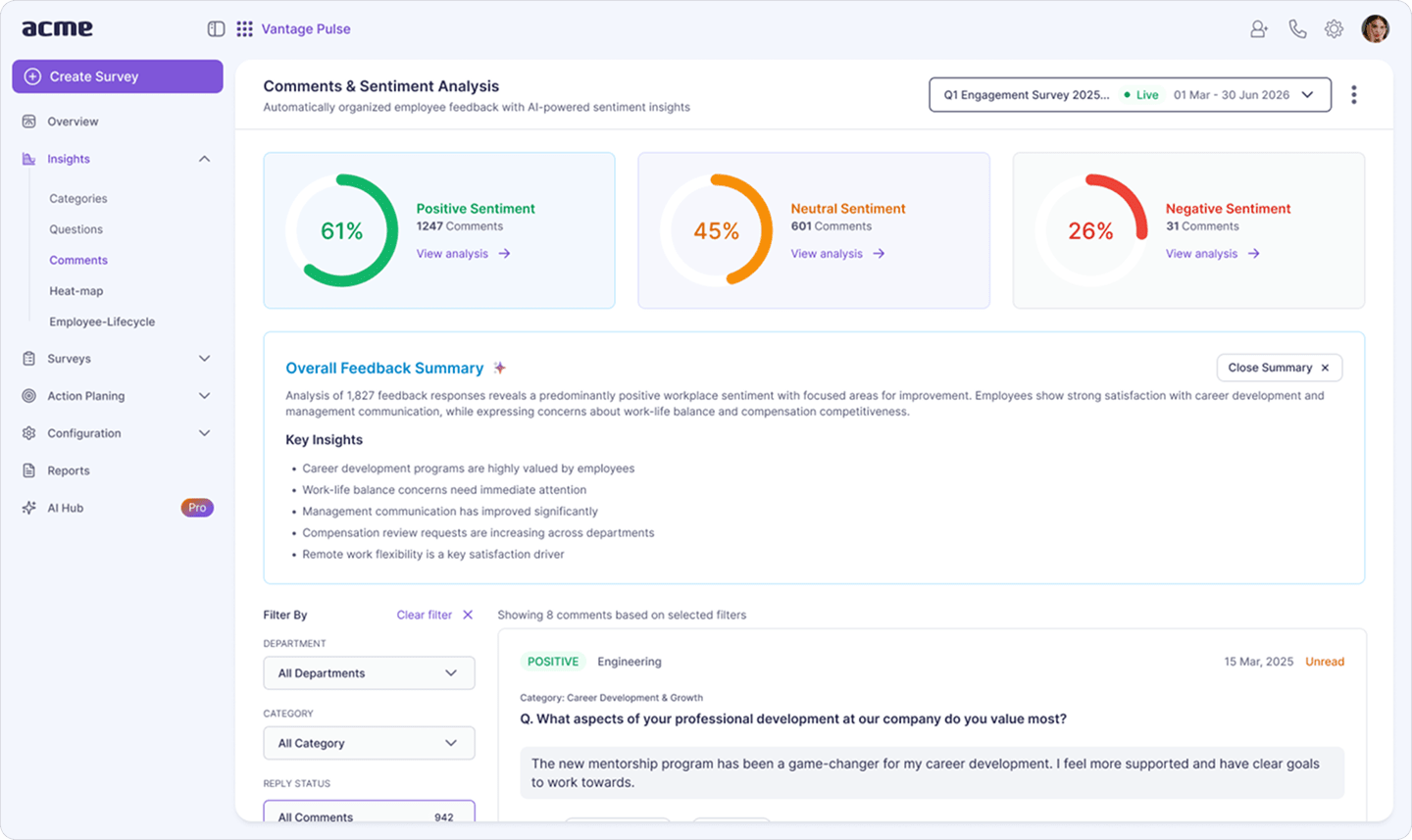
Fluency is also easier to build with tools leaders already use. For example, Vantage Pulse, Vantage Circle's employee engagement and pulse survey tool, uses AI to summarize hundreds of open-text comments into themes. A manager can act on those themes in minutes and check whether the summary matches what they hear in one-on-ones, which is AI fluency in practice.
What HR should do:
- Start AI training with frontline managers rather than executives, because that's where the concern sits.
- Teach evaluation, not just prompting. The core skill is answering "How would you know this answer is wrong?"
Signal to track: The share of managers who use an AI tool weekly and can name one time they overruled it.
2. Managers Start Leading People and AI Agents Together
Managers are starting to lead blended teams, where some of the work goes to people and some to AI agents, which makes deciding who does what a core leadership task.
The shift is closer than most org charts suggest. In the same Microsoft research, 82% of leaders say they're confident their organization will use AI agents to expand workforce capacity in the next 12 to 18 months. Over the next five years, 41% expect their teams to train agents and 36% expect them to manage agents. Microsoft calls this new role the "agent boss."
That changes what leaders need to know. Karie Willyerd, who leads strategic engagements at GP Strategies, explained why on our podcast:
Vantage Influencers Podcast
"Our workforce is no longer solely human. Our workforce is both human and digital. And to understand what tasks and assignment we give to humans versus what we give to our digital agents requires understanding the work."
— Karie Willyerd, Head of Strategic Engagements at GP Strategies Corporation
Listen to the EpisodeSo the generic leader who could manage any function is fading, while the leader who knows the process, the handoffs and the failure points is in demand.
What HR should do:
- Ask managers to map one team workflow and mark each step as human, agent or shared.
- Add "work design" to manager development, since splitting work between people and agents is a new skill for most managers.
Signal to track: The number of teams with a documented split of human and agent tasks.
3. The Manager Squeeze Becomes a Business Risk
The manager squeeze is the growing gap between what organizations expect from managers and the support they actually get, and it's now a business risk rather than just a well-being issue.
Start with Gallup. Its 2026 report, which surveyed 141,444 employees, found that global employee engagement fell to 20% and manager engagement fell from 27% to 22%. Gallup also estimates that low engagement cost the global economy about $10 trillion in lost productivity.
Now add DDI's view from inside the leadership ranks: 71% of leaders say their stress has increased significantly since they stepped into the role. Of those stressed leaders, 40% have considered leaving leadership entirely, twice the rate of their less-stressed peers.
Put those together and the picture is uncomfortable. Many of the managers who are meant to engage everyone else are less engaged and more stressed, and a large share of stressed leaders are weighing an exit. That's how leadership burnout turns into a pipeline problem.
What HR should do:
- Audit what's on a manager's plate, then cut or automate one recurring admin task per quarter.
- Report manager engagement as its own number, because it disappears inside company-wide averages.
Signal to track: Manager engagement, reported separately from team engagement, every quarter.
4. Flatter Teams Reward Influence Over Titles
Flatter organizations push more leadership onto people without a formal title, so influence, not position, matters more than it used to.
The structural shift shows up in the data. Gallup found that the average number of people reporting to each manager rose from 10.9 in 2024 to 12.1 in 2025, nearly 50% higher than when it first measured in 2013. Gallup links the rise to organizations downsizing or consolidating middle management roles, a pattern some call the Great Flattening.
With fewer managers covering bigger teams, more day-to-day decisions fall to the people closest to the work. Project leads, senior specialists and team coordinators end up steering outcomes without anyone reporting to them, so they have to lead through credibility, clarity and trust.
This doesn't make managers obsolete, but it does change their job. A manager in a flat structure spends less time approving and more time connecting people, removing blockers and growing the next set of informal leaders. Participative leadership styles fit this setup naturally, while directive styles are harder to sustain when nobody is formally required to follow.
What HR should do:
- Open leadership development to high-impact individual contributors, not just people managers.
- Recognize influence publicly, so people can see that leading without a title counts.
Signal to track: The share of leadership development seats that go to individual contributors.
5. Human-Centered Management Becomes a Performance Lever
Human-centered management treats empathy, psychological safety and well-being as performance tools rather than perks, and the data links that approach to how leadership is judged.
In DDI's research, leaders were 12X more likely to rate leadership quality as high when their organization prioritizes employee well-being, and 19X more likely when leaders in their organization show strong interpersonal skills.
The logic is practical. As AI absorbs more routine work, what's left for people is judgment, creativity and collaboration. None of those show up on command. Instead, they show up when people feel safe enough to speak up, push back and try something that might fail.
That's where psychological safety and empathy at work stop being soft topics and become part of a manager's core job.
But a manager can't act on what they never hear, and it's easy to overestimate how safe a team feels. Anonymous upward feedback, collected through a tool like Vantage Pulse, closes that gap by giving leaders an honest read before small frustrations become resignations.
What HR should do:
- Add one psychological safety question to every pulse survey and share results by team.
- Coach managers on how to respond to bad news, because their first reaction shapes whether anyone raises a second concern.
Signal to track: Team-level scores on "I feel safe to raise a concern."
6. Recognition Has to Become a Leadership Habit, Not an HR Program
Recognition has to move from an HR-run program to a daily leadership behavior, owned by the managers who see the work up close.
Most programs aren't there yet. Vantage Circle's AIRe Benchmarking Report (USA) 2023-2024, built on data from US companies, found that fewer than 20% of eligible employees received recognition in a given quarter. In other words, more than four in five employees went a full quarter without being recognized through their company's program.
The same report found that 54% of companies have no defined approach for recognizing repeated, consistent behavior. Without one, managers fall back on round-robin awards, where everyone gets a turn and the award stops meaning anything.
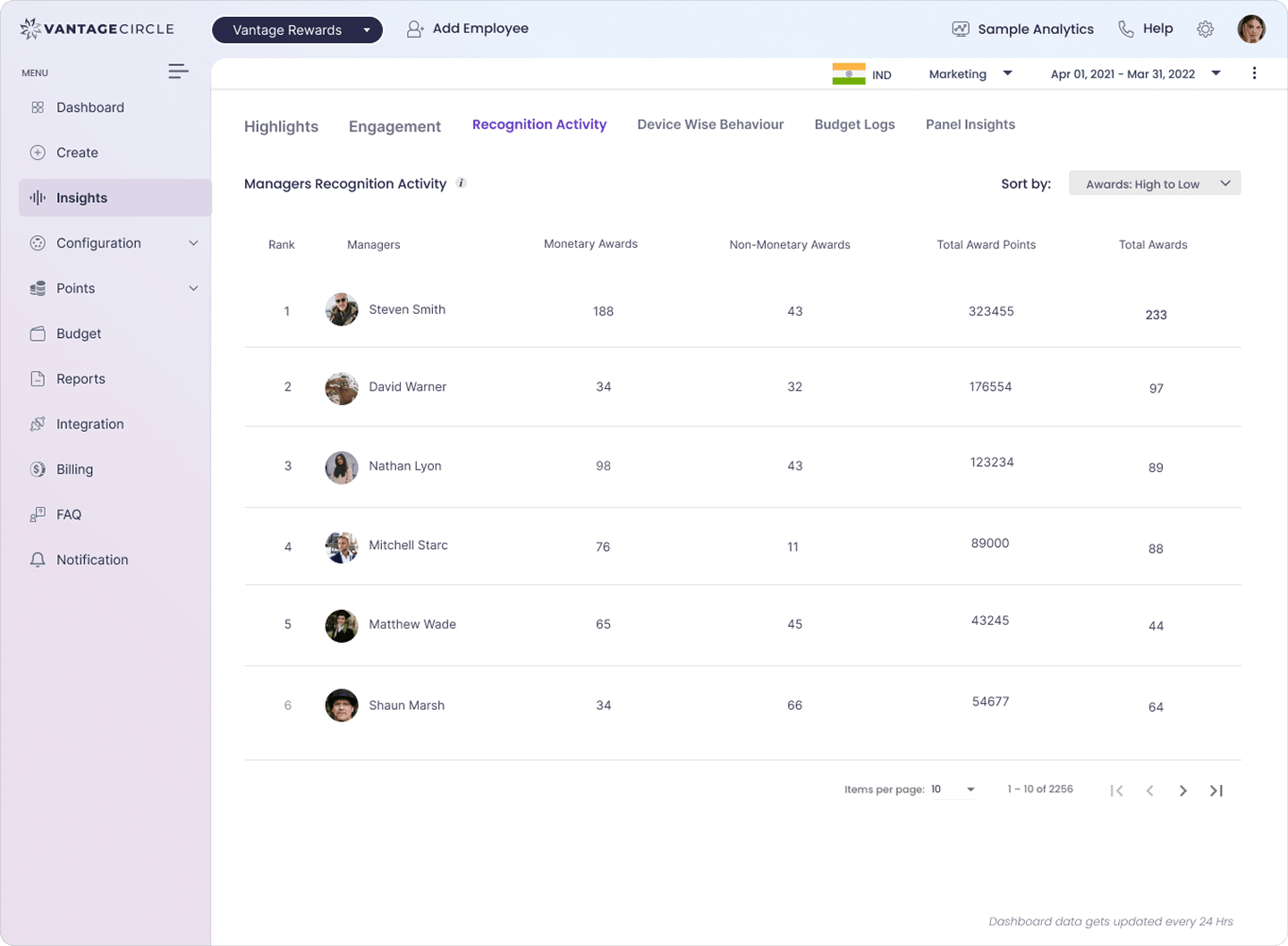
So the trend isn't "do more recognition." It's "make recognition a leadership skill you can see." Vantage Recognition, Vantage Circle's employee recognition platform, breaks recognition activity down by manager, so HR can spot which leaders recognize often and which have gone quiet, then coach the gap instead of guessing.
Visibility at the top matters too, because when senior leaders recognize people in public, they set the standard for everyone below them. That's the core of strong executive communication around recognition.
What HR should do:
- Report recognition frequency by manager every month, alongside engagement scores.
- Define what "repeated excellence" looks like, so awards escalate with consistency rather than rotation.
Signal to track: The percentage of employees recognized at least once per quarter, by manager.
7. Leadership Development Gets Personalized
Leadership development trends point to one clear shift: away from one-size-fits-all programs and toward a personalized mix of approaches tied to each leader's work. DDI describes leadership development as "transforming as leaders seek deeply personalized, timely experiences."
The pressure shows up in DDI's 2025 forecast, which surveyed 10,796 leaders across 2,014 organizations. Only 20% of HR professionals say they're confident in their leadership bench, and only 40% of leaders rate the quality of leadership in their organization as high. Meanwhile, high-potential employees are 3.7X more likely to leave when they don't get development.
Variety matters more than any single format. Organizations that use five or more development approaches are 4.9X more likely to report improved leadership capabilities, according to DDI. The approaches it found most effective include coaching from a leader's current manager, internal coaching, self-paced learning, assessments and AI practice simulations. That mix is also how core leadership skills for managers, like coaching, delegation and feedback, get built: through practice, not attendance.
What HR should do:
- Replace one annual program with a monthly cohort model and compare participation.
- Give every high-potential employee a named development plan with a 90-day review.
Signal to track: Retention of high-potential employees, measured against those without a development plan.
8. Adaptability Becomes the Default Operating Mode
Adaptability means leading well when the plan keeps changing. It's no longer a crisis skill but the normal operating condition for most teams.
The volume of change backs this up. Gartner research published in Harvard Business Review found that the average employee experienced 10 planned enterprise changes in 2022, up from two in 2016, from restructures to culture transformations to new technology systems. When changes overlap like that, leaders who wait for stability before making decisions can end up waiting indefinitely. The ones who do well set a clear direction, say openly what they don't know yet, and adjust in public.
This is where change leadership earns its place. It's less about managing one big transformation and more about helping a team absorb a steady stream of small ones without losing trust or momentum.
What HR should do:
- Add change readiness to leadership competency models and performance reviews.
- Run short "what changed and why" briefings after every major decision.
Signal to track: Engagement scores during and after major changes, compared with the baseline.
How These Trends Change Everyday Management
Across these trends, the common thread for managers is a shift from supervising work to coaching people and designing how work gets done. Here's how that plays out in day-to-day management practice.
| Area | Old practice | Where it's heading |
|---|---|---|
| Goal-setting | Annual goals set from the top | Quarterly goals, adjusted as priorities shift |
| Feedback | Once or twice a year, in formal reviews | Frequent, specific and two-way |
| Recognition | HR-run award cycles | Daily manager habit, tracked by team |
| Decision rights | Held by the manager | Pushed to the people closest to the work |
| Development | Annual training programs | A personalized mix of coaching, assessments and practice |
| Team composition | People only | People plus AI agents, with clear task ownership |
Look across the right-hand column and one theme stands out: every shift in that column asks more of the manager in judgment and less in control. That's exactly why the manager squeeze in Trend 3 matters so much.
What These Trends Mean for the Future of Leadership
The future of leadership is a capability spread across a team, not a role held by one person. That means titles will matter less, while judgment, influence and the ability to grow others will matter more.
Taken together, the eight trends point the same way: AI takes on more routine work, flatter structures spread decision-making, human-centered management raises the bar on how people get treated, and personalized development keeps everyone ready for the next change.
For HR, that changes the core question. It's no longer "Do we have enough leaders?" It's "Do enough people know how to lead?"
A 90-Day Leadership Trends Plan for HR
HR can act on all eight trends in one quarter by starting with managers: diagnose first, then equip, then embed.
Days 1 to 30: Diagnose.
- Run a pulse survey with manager engagement reported as its own segment.
- Pull recognition data by manager to see who recognizes and who doesn't.
- Benchmark your recognition program with the AIRe Assessment, which scores Appreciation, Incentivization, Reinforcement and eMotional Connect. That gives you a baseline before you ask leaders to own recognition.
Days 31 to 60: Equip.
- Launch hands-on AI fluency sessions for frontline managers.
- Give managers recognition prompts and a simple definition of specific, meaningful recognition.
- Remove one recurring admin task from every manager's workload.
Days 61 to 90: Embed.
- Move one development program to a monthly cohort format.
- Build a manager dashboard with the eight signals from this article.
- Share the results with leadership, by team, not just as a company average.
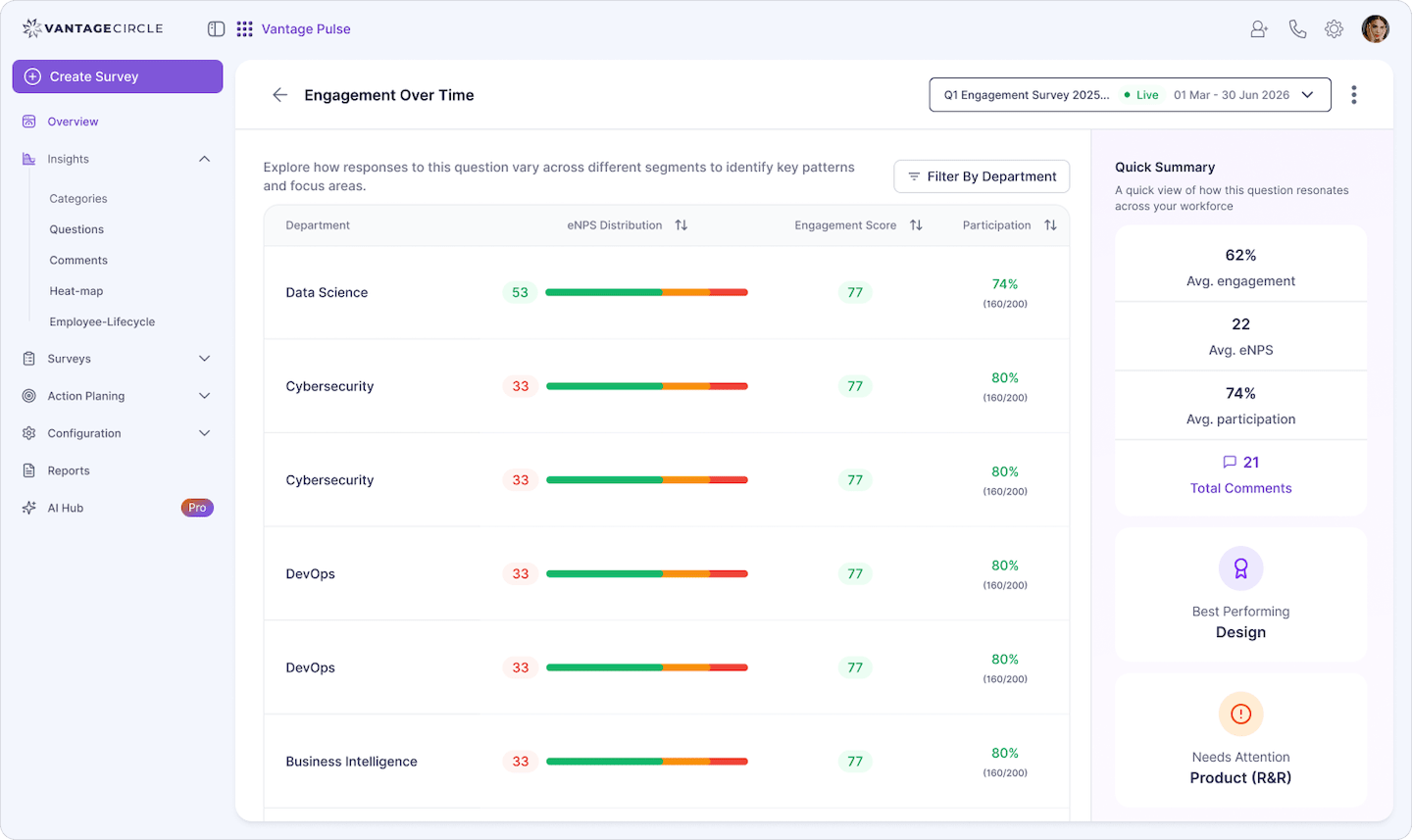
Comparing teams side by side is where the plan gets real, because engagement often varies by team. Department-level data shows where managers are stretched thin, so support reaches them before their people start leaving.
Free Download · 1-Page PDF
Leadership Trends: HR Action Checklist
All eight trends on one page, each with one move HR can make this quarter and one signal to track. No sign-up, no gate.
- 8 trends, each with one action and one signal
- A 90-day plan: diagnose, equip, embed
- Headline numbers from Gallup, DDI and Vantage Circle
- Print-ready on a single page
Summing It Up
Let's go back to the number we opened with. Manager engagement fell five points in one year, at the exact moment managers are being asked to adopt AI, lead without hierarchy, recognize more and develop faster.
That's the real leadership trend, because nearly every shift on this list runs through the manager layer. So HR's job isn't to chase eight separate trends. It's to make managers capable of carrying them.
Start with the signals: measure manager engagement on its own, track recognition by manager, and build development into the month rather than the year. The organizations that support their managers now will have the leaders they need later.
Want to see how leaders across your organization recognize their teams? Book a demo of Vantage Recognition.
FAQ
What are the current trends in leadership?
The current trends in leadership are AI fluency, managers leading people and AI agents together, rising manager strain, flatter teams, human-centered management, recognition as a leadership habit, personalized development and adaptability. Most of these land on frontline and middle managers first.
What are the latest trends in leadership development?
Leadership development is moving toward personalized, timely experiences that combine several approaches instead of relying on one annual program. The most effective mixes include coaching from a leader's own manager, internal coaching, self-paced learning, assessments and AI practice simulations.
What is Gen Z's leadership style?
There's no single Gen Z leadership style, but younger employees are often described as preferring collaborative, transparent leaders who give frequent feedback and explain the why behind decisions.
What are the top 10 recent trends in management?
Ten recent trends in management are AI-assisted decision-making, blended human and AI teams, flatter structures, continuous feedback, quarterly goal-setting, recognition as a manager habit, a focus on psychological safety, personalized development, distributed decision rights and data-driven people management.
What are the top 3 leadership styles?
There's no official ranking, but three of the most widely discussed leadership styles in modern workplaces are transformational, servant and democratic. Transformational leaders inspire change, servant leaders put their team's growth first, and democratic leaders involve the team in decisions.
What is the future of leadership?
The future of leadership is a shared capability rather than a single role. As AI handles more routine work and structures flatten, leadership will depend more on judgment, influence and developing others than on title or position.

Nilotpal M Saharia is an Assistant Manager, Content Marketing at Vantage Circle and a recognition-and-rewards (R&R) strategist with 9 years of experience spanning Marketing, HR, and content strategy. He helps HR leaders turn employee recognition and leadership research into practical workplace programs.
Connect with Nilotpal on LinkedIn.