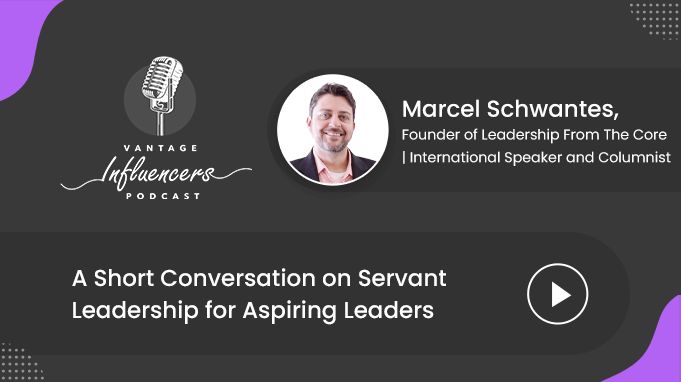
A Short Conversation on Servant Leadership for Aspiring Leaders
Episode Overview
In this episode of the Vantage HR Influencers Podcast, host Susmita Sarma speaks with Marcel Schwantes, founder of Leadership From The Core, about why servant leadership is more than a feel good philosophy. Marcel traces his own path from an HR generalist role into executive coaching, explaining that his company's name reflects a simple idea: leading from the core means leading from your most authentic self, prioritizing people first and letting business results follow as a natural consequence. He argues that most organizations still run on a top down, command and control model, while servant leadership flips that pyramid so leaders serve and develop the people who report to them instead of just issuing orders.
The sharpest point in the conversation is Marcel's response to the biggest misconception about servant leadership: that it is a soft, pushover style that invites people to take advantage of a manager. He pushes back hard, noting that servant leaders demand excellence and hold people accountable, and that the "servant" half of the term should never eclipse the "leader" half. He also connects servant leadership directly to employee engagement, citing decades of research showing that when employees have clear expectations, adequate resources, and support for their well being, engagement rises and that engagement flows through to customer experience. He closes with a practical challenge for leaders: sharpen your listening skills and seek input from frontline employees, because they often hold the answers to problems that never reach the top of the org chart.
Episode Highlights
- Marcel Schwantes explains that "leadership from the core" means leading from your most authentic self and your heart, not just from a job title.
- Servant leadership flips the traditional top down, command and control pyramid into a bottom up model built on serving employees first.
- Decades of engagement research show that clear expectations, adequate resources, and attention to employee well being are the throughline connecting servant leadership to stronger employee engagement.
- Happy, well supported employees translate into a better customer experience, creating a direct business case for servant leadership.
- The biggest misconception about servant leadership is that it is soft; in reality, servant leaders demand accountability and high performance from their teams.
- Marcel's top suggestion for leaders who want to become more responsive to employees is to radically improve listening, especially to frontline staff who are closest to customers.
About the Guest
Marcel Schwantes, Founder, Leadership From The Core
Marcel Schwantes founded Leadership From The Core to help organizations transform their leaders and work cultures through the business principles of servant leadership and positive psychology. He is an international speaker, executive coach, and syndicated columnist, attracting over 1.5 million readers monthly to his thought leadership, and his work has been featured in Inc., Time, Business Insider, Fast Company, The New York Daily News, CNBC, Forbes, and Chicago Tribune, among other global media outlets.
Connect with Marcel on LinkedIn
Host
Susmita Sarma, Vantage Influencers Podcast Host
What You Will Learn
- How to distinguish servant leadership from a traditional top down, command and control management style.
- Why leading from your authentic core, rather than from positional authority, changes the way people respond to you.
- How servant leadership connects directly to employee engagement and, in turn, to customer experience.
- Why the common perception of servant leadership as "too soft" is a misunderstanding of how it actually works.
- What it takes to hold people accountable while still leading from a place of service.
- A concrete first step (better listening) for leaders who want to become more responsive to their teams.
Key Topics & Timestamps
| Timestamp | Topic |
|---|---|
| 01:24 | Marcel's journey from HR into executive coaching |
| 02:25 | The story behind the name Leadership From The Core |
| 03:55 | Defining servant leadership and how it differs from other styles |
| 05:15 | The link between leadership style and employee engagement |
| 06:28 | Servant leadership's staying power through the pandemic |
| 09:29 | How challenging it is to become a servant leader |
| 10:11 | Real world brands known for servant leadership |
| 12:18 | The biggest misconception (the "con") about servant leadership |
| 15:27 | Marcel's advice for leaders who want to be more responsive to employees |
Full Transcript
Click to read the full episode transcript
Welcome to the Vantage HR Influencers Podcast. This podcast is sponsored by Vantage Circle, the simple and AI powered rewards and recognition platform for employee engagement. The servant leader is first and foremost a servant. It all starts with their innate desire to serve first. It is believed that if a company wants to boost employee engagement, servant leadership could be the key to success.
Susmita Sarma: Hi everyone, welcome to the Vantage HR Influencers Podcast. I am your host, Susmita, and to learn more about the relationship between employee engagement and servant leadership, today I have with me guest speaker Marcel Schwantes. Marcel is an international speaker, executive coach, and syndicated writer. Attracting over 1.5 million readers monthly to his thought leadership, his work has been featured in the New York Daily News, CNBC, Forbes, and many other global media outlets. His company, Leadership From The Core, is one of a handful worldwide that provides servant leadership training programs for leaders of all levels. Welcome to the show, Marcel.
Marcel Schwantes: Thank you very much. Good to be here.
Susmita Sarma: Yeah, thank you so much for joining me in this episode today. And let's begin then. So before we start with the topic, Marcel, please give us a brief about your journey in the corporate world.
Marcel Schwantes: Well, I started in human resources and kind of moved up into the management side of HR. And then started to develop leaders. Now we're going back to maybe, gosh, 20, 25 years ago. And then at some point, I decided to take everything that I knew and learned and bring that to a leadership practice. So I started to coach and train leaders of different organizations throughout America. And that's what I've been doing since 2014, helping to coach leaders, executives, managers on becoming more effective and helping them to lead better for business outcomes.
Susmita Sarma: So that's where I think your foundation, Leadership From The Core, comes in, isn't it? Tell us more about it and maybe about its objectives.
Marcel Schwantes: Well, so Leadership From The Core became the name of the company that I founded. The play on the name Leadership From The Core is when you lead from the core of who you are as a human being. You're leading from deep within you and you're leading from your heart. And so the core is really your most authentic self. So when you lead from the heart, you put the focus more on more noble objectives, rather than strictly business objectives. But when you focus on those noble objectives, like helping people to succeed and helping people to grow, naturally the business side of it also happens. And so you get the business side as well by focusing more on the people side. So those two go hand in hand. You take care of the people, they take care of the business.
Susmita Sarma: Right. So basically you help organizations to transform their leaders and their work cultures through servant leadership, right, and positive psychology, isn't it? So that's the topic of discussion today that we have taken up, servant leadership. So it will be very helpful for listeners if we can explain what servant leadership is, and how is it basically different from the other types of leadership?
Marcel Schwantes: Sure, and thank you for asking that question. That gets me excited to have to answer that because it's my life's passion. So servant leadership's main focus is really on empowering and uplifting the people that work for you if you're a servant leader. So the mindset of a servant leader is to serve first instead of commanding. Most organizations today, even today in 2021, are still led from a top down command and control approach. Servant leadership flips the pyramid upside down. It's a bottom up approach to leadership rather than the traditional top down command and control way of doing things, where people are just taking marching orders from above. So the servant leader seeks to develop and align an employee's sense of purpose with the company mission. So the end result is your organization's performance goes higher. And so that's again the business case for servant leadership.
Susmita Sarma: So also there is a direct relationship between a leadership style and employee engagement, isn't it so? Would you describe the role of servant leadership on employee engagement, the effect of servant leadership maybe?
Marcel Schwantes: Yeah, they go hand in hand. So there is probably 40 plus years of research by the Gallup organization that shows that when employees' needs are met, when they're given resources, when expectations for goal attainment and performance are communicated clearly and consistently, and these days with the pandemic, when your employee's mental health and well being is addressed, all of these things I just mentioned lend to high employee engagement. And so the correlation is really clear. When the employee experience is positive, your customer experience is going to be positive as well. So happy employees will always translate to happy customers. That's your link between servant leadership and employee engagement.
Susmita Sarma: Right. So as you correctly mentioned, various studies have also shown that during this pandemic, employees were less anxious when their managers or leaders demonstrated servant leadership. So would you like to add something to this by exploring the sustainability of servant leadership in the COVID-19 era?
Marcel Schwantes: Yeah, yeah. I think during the height of the pandemic, let's flash back to last year, maybe around March, April, May, you saw leaders becoming more sensitive to the needs of their employees and maybe even to their customers, because people were suffering, right? So as a natural human instinct, a lot of managers and leaders pivoted. They became better listeners, more empathetic, and more compassionate. And this is consistent with every major crisis that affects human beings: good leaders, they rise up and they provide assurance. They want to make sure people have hope, that hey, we're all in this together. So what happens is that when the crisis wears off, many leaders revert back to where they were. And in servant leadership, when the crisis kind of tapers off and things get back to a place of stability, servant leaders don't revert back to where they were, because that's the way they've always been. Their mindset has always been one of taking care of their people, meeting their needs, and giving them a purpose that gets them up in the morning. So I think that's the sustainability factor right there with servant leadership.
Susmita Sarma: Right. So I think a sudden shift to becoming a servant leader isn't quite possible, isn't it? So that has to be within the core values of a leader.
Marcel Schwantes: Yeah, and it does come through your core values. It also comes through your character. It also comes through how you carry yourself. A lot of studies have been done on integrity, in that when you lead through your integrity, you're always going to make the good decisions. That's not to say that servant leaders are perfect. They're not, they'll make mistakes too, but they will always admit their mistakes. And so that's the strength of the servant leader, because they're human beings. They're not afraid to communicate the good, the bad, the ugly in a state of crisis. They're not afraid of communicating the things that may be really tough for people to hear, whereas perhaps another manager that is only focused on self rather than others may not speak the whole truth, if you know what I mean.
Susmita Sarma: So it is like very challenging, I think, to be a servant leader.
Marcel Schwantes: I think it's possible for anyone to be a servant leader. However, it is challenging for the person that historically comes from a place of power and positional authority. So the challenge may be in making the jump, the shift from that kind of style of leading to a servant leader. It's easier to become a servant leader if you come from a mindset of growing and helping people to develop, that's going to be an easy transition for you.
Susmita Sarma: So it would be great, Marcel, if you can give some examples of some real life brands that have embraced servant leadership.
Marcel Schwantes: Okay, well, I'll just name off some companies, if that's okay with you, off the top of my head. One is, there's an airline company in America, I'm not sure if they're known outside of the US, but Southwest Airlines is one that comes to mind. A lot of these I'm naming off, I think they're US based. So there's a company called the Container Store. They made Fortune's list of 100 best companies to work for, for about 17 years. They're in retail. I think one that anybody worldwide would recognize is Marriott International, the hospitality hotel company. There is a company in software analytics. There's a supermarket chain in the US called Wegmans Food Market. Another one that comes to mind is Zappos, the online shoe company. Well, they're not just shoes now, they're retail clothing, etc. Then there's REI, the outdoor retail company. If you're into outdoor sports, hiking, etc., they're a big servant leadership company. And then I think the last example I want to give is WD-40. A lot of people have a can of WD-40 in their garage to help lubricate things. They are very much a servant leadership company. The list goes on and on, to be honest, but I think those are the ones that come to mind.
Susmita Sarma: Thank you so much for sharing these examples, Marcel. So we have talked about the benefits of this leadership style, we have talked about the challenges. So let's now talk about the cons. Are there any cons of this leadership style that you want to highlight?
Marcel Schwantes: The cons. Well, the only con I think is the public perception of what servant leadership is, or even what it's not. There's a lot of misconceptions, and I think the biggest one is that this is too soft for business. So people hear the word servant and they mistake it for subservience, or some kind of pushover leadership where people will take advantage of you. Well, it's contrary to that, it makes it completely the opposite. Servant leaders, they demand excellence and they demand high performance of others. So they expect integrity in how their workers conduct themselves. And so they hold people accountable. So the con would actually be wanting to become a servant leader, I guess that goes back to one of the previous questions, right? And that's because not everybody wants to be in a kind of leadership role where you have to be more nurturing and meet the needs of others and develop others. So I think that's sort of the con: really overcoming that misperception that you may have, that this won't work for my company, because my employees will take advantage of me. Well, you have to flip that perception and realize that the second part of servant leadership, servant, is sort of the servant part, which is the part that people really don't understand or jump to the wrong conclusions about. But don't forget, the second part of that is leader. And so the role of the leader is to hold people accountable and to make sure that the needs of the organization, yes, the needs of the employees are important, but everybody's accountable to making sure that the needs of the organization are being met. And so as a servant leader, you hold people's feet to the fire for lack of performance. And if they're not pulling their weight, even when you have provided resources, helping them to grow and develop, and they're still not performing up to standard, the servant leader will do what other leaders will do: they'll have to terminate that person at that point, because it's suffering, it's hurting the business at that point. So anyway, that's sort of how I would answer the question about cons: it's more focusing on, okay, I have the wrong image or the wrong idea about what servant leadership is, and then kind of getting the right information to inform you, oh okay, yeah, it's not what I thought it was.
Susmita Sarma: So lovely. Okay, so any suggestion you'd like to give to the leaders so that they can become more responsive to the needs of employees?
Marcel Schwantes: Suggestions. The one that I see in my role as a coach, when I coach leaders, is a lack of listening skills. So my suggestion is you really take your listening skills to a new level. Listening requires getting feedback, for example, so think of listening not just as sitting down with somebody and hearing the words coming out of their mouth, but it's getting feedback from multiple angles so that problems are solved. Like, for example, frontline employees, those employees that are customer facing, may hold the key to a solution, but you won't know until you come down from your ivory tower, so to speak, and solicit the ideas, the opinions, and the advice from those below you. And so that's my advice, my suggestion, to make you better.
Susmita Sarma: Brilliant. So finally, Marcel, how can listeners reach out to you if they want to?
Marcel Schwantes: Well, best place to go is my website, MarcelSchwantes.com, and I'm also very active on LinkedIn as well.
Susmita Sarma: Okay, thank you so much for sharing that.
Marcel Schwantes: Yeah, it was a great conversation with you, Susmita. Thanks a lot for joining me, for having me on the Vantage HR Influencers podcast.
Susmita Sarma: My pleasure.
Thanks for listening to the Vantage HR Influencers podcast. Please do subscribe to the Vantage HR Influencers podcast on Apple Podcasts, Spotify, and our YouTube channel for new episodes.
FAQ
What is servant leadership, according to Marcel Schwantes?
Marcel Schwantes describes servant leadership as a mindset focused on empowering and uplifting the people who work for you, with leaders serving first instead of commanding. It flips the traditional top down, command and control pyramid into a bottom up approach where the leader develops and aligns an employee's sense of purpose with the company's mission.
How does servant leadership affect employee engagement?
Marcel points to decades of Gallup research showing that when employee needs are met, resources are provided, and expectations are communicated clearly and consistently, engagement rises. He argues this creates a direct chain reaction: engaged employees produce a positive employee experience, which in turn produces a positive customer experience.
Is servant leadership too soft for business?
No. Marcel calls this the biggest misconception about the style. He explains that servant leaders demand excellence and high performance, expect integrity from their teams, and hold people fully accountable, including making the difficult call to let go of someone who consistently underperforms despite support.
What is Marcel Schwantes's top suggestion for leaders who want to be more responsive to their employees?
Marcel's core suggestion is to dramatically improve listening skills. He describes listening as more than hearing words in a conversation: it means actively soliciting feedback from multiple angles, especially from frontline, customer facing employees who often hold the key to solutions leaders can't see from the top of the organization.
Related Reading
Also listen on