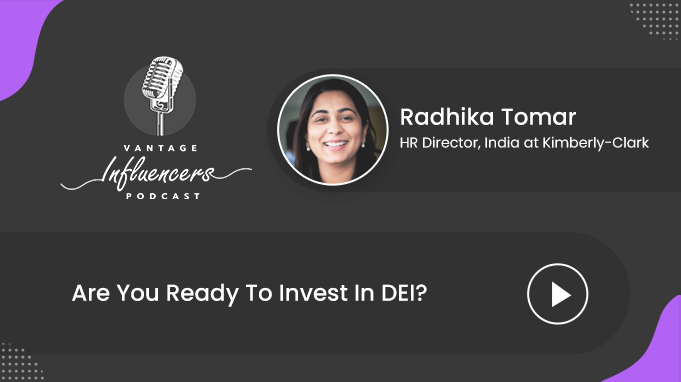
Are You Ready To Invest In DEI?
Episode Overview
Radhika Tomar, HR Director for Kimberly-Clark India, pushes back on the popular idea that the pandemic acted as a "great equalizer." She reframes it: everyone weathered the same storm, but not the same boat. Some had strong support systems and resources to stay afloat, while others had to row alone. That distinction, she argues, is why organizations cannot treat generic wellness perks as a substitute for structural inclusion work, and why Kimberly-Clark built its own DEI efforts around four deliberate pillars: creating community through employee resource groups, holding leaders accountable for diverse teams, embedding diversity checks directly into recruitment and succession processes, and accelerating action through policy change and sensitization programs.
Her sharpest, most concrete point is that most companies underinvest in the time it actually takes to shift behavior. She cites research showing that meaningfully addressing bias and inclusion requires roughly 18 to 24 hours of training, not the two or three hours most organizations budget for a single workshop. She applies the same rigor to hiring, pointing to real-world examples of bartenders succeeding at insurance claims roles because of their people skills, and consumer startups training sales talent that traditional FMCG companies overlook, and she closes with two habits any leader can start immediately: scheduling regular conversations with people outside their usual circle to escape professional echo chambers, and auditing who actually gets handed the high-visibility work on their team.
Episode Highlights
- Radhika Tomar rejects the idea that the pandemic was a great equalizer, arguing everyone weathered the same storm but in very different boats, with unequal support and resources.
- Kimberly-Clark's inclusion framework rests on four pillars: building employee resource communities, holding leaders accountable for diverse teams, embedding diversity checks into recruitment and succession, and running sensitization programs like bias training and inclusion weeks.
- She cites research showing that meaningful bias training takes eighteen to twenty-four hours, far more than the typical one-off workshop most companies run.
- Leaders should treat discomfort as part of the process, citing how Microsoft's Satya Nadella recovered from a widely criticized comment on women and promotions by apologizing and continuing the work.
- She recommends the "eight cups of coffee" habit borrowed from Microsoft: talking quarterly with people outside your usual circle to break out of professional echo chambers.
- Broadening where companies look for talent matters too, from hiring bartenders for insurance claims roles to recruiting sales talent from consumer startups instead of only competitors.
About the Guest
Radhika Tomar, HR Director, India at Kimberly-Clark
Radhika Tomar leads HR for Kimberly-Clark across its three businesses in India: professional, consumer, and the company's technology center in Bangalore. Before joining Kimberly-Clark, she spent about four years at Dyson in roles across India, Singapore, and Australia, followed by five years at Microsoft, and began her career with eight years in HR and organizational consulting at McKinsey & Company. She grew up moving across India as the child of two Indian Navy doctors, and is now based in Mumbai with her husband and two children.
Connect with Radhika on LinkedIn
Host
Susmita Sarma, Vantage Influencers Podcast Host
What You Will Learn
- Why the "pandemic as a great equalizer" narrative overlooks how unevenly people were actually supported through it
- How Kimberly-Clark structures its DEI work around four pillars: community, leadership accountability, embedded process checks, and accelerated action
- How much training it actually takes to shift bias and inclusion behavior, and why most corporate workshops fall short of it
- Practical ways to build comfort with discussing diversity, including how to recover from getting it wrong in public
- How to use the Great Resignation as an opening to recruit from talent pools your industry has traditionally overlooked
- Simple leadership habits, like scheduling conversations outside your usual circle, that build psychological safety and break echo chambers
Key Topics & Timestamps
| Timestamp | Topic |
|---|---|
| 00:00 | Cold open: why DEI has become a business priority |
| 01:15 | Radhika Tomar's background and career across McKinsey, Microsoft, Dyson, and Kimberly-Clark |
| 03:46 | Her role at Kimberly-Clark and how the pandemic reshaped DEI |
| 09:08 | Kimberly-Clark's four-pillar framework for an inclusive workplace |
| 13:59 | Tips for leaders anxious about discussing diversity and inclusion |
| 20:18 | The Great Resignation, untapped talent pools, and pay parity |
| 24:34 | Building psychological safety and breaking leadership echo chambers |
| 29:23 | Closing thoughts and how to connect with Radhika |
Full Transcript
Click to read the full episode transcript
Welcome to the Vantage HR Influencers Podcast. This podcast is sponsored by Vantage Circle, the simple and AI-powered rewards and recognition platform for employee engagement.
Diversity, equity, and inclusion programs are becoming increasingly important in the transformation of businesses today. Especially, the pandemic has prompted a quick shift in inclusive hiring. However, attracting and hiring diverse and inclusive candidates is never enough. Once onboard, those employees must feel involved to foster the conditions necessary for their success. As a result, it has generated a unique challenge for executives to comprehend why and how they should be investing in diversity, equity, and inclusion, as many of us still do not see the potential.
Susmita Sarma: Hi, everyone. I'm your host, Susmita. And in this episode, we'll talk about building a diverse and inclusive culture with my guest speaker, Radhika Tomar, HR Director, India at Kimberly-Clark. Welcome to our show, Radhika.
Radhika Tomar: Thank you very much, Susmita. How are you doing?
Susmita Sarma: I'm doing fine. I hope you're doing fine as well, Radhika.
Radhika Tomar: Yeah.
Susmita Sarma: And thank you for joining me today, or taking your time to join me today.
Radhika Tomar: It's my pleasure, Susmita. Thank you for having me.
Susmita Sarma: Welcome. So, please tell us about yourself, Radhika: your background, experiences, and your professional journey.
Radhika Tomar: Sure. Before I get into my professional experience, I think it will help if I give you a glimpse of who I am as a person very quickly. I actually grew up across different states in India. My parents were both doctors in the Indian Navy, and so, like any defense kid, we would move around every couple of years to different parts of India. And hence, for me, diversity, which is our topic of relevance today, was kind of automatically built into my childhood as well, because I experienced living across various different parts of India.
Susmita Sarma: Different parts of India, right?
Radhika Tomar: Yeah. So, I'm married to Desmond, who I met in business school many, many years ago. I won't tell you how many, I don't want to date myself. But again, we are both from very different parts of the country with different cultures. He is from the south of the country, I'm from the north. He's Christian, I'm Hindu. And so, we have a very diverse family as well, and we love and enjoy the diversity, as it comes across in food, in rituals, in traditions, and practices. So, we have a really fun time together. We have two little kids: a seven-year-old daughter and a three-year-old son. And between them and work and family, I'd say life is quite interesting and quite full in that sense. So, yeah, currently based in Mumbai.
So, Susmita, if I have to tell you a little bit about my professional journey, I currently lead HR at Kimberly-Clark in India across the three businesses that we have: professional, consumer, and then our technology center in Bangalore. Prior to Kimberly-Clark, I was at Dyson for about four years. I did a variety of different roles in India, Singapore, and then Australia, where I was based for two years, just before we moved back to India last year. And then prior to that, I was actually at Microsoft for five years. A lot of my learning and experience in inclusion actually comes from the great work we did there. And then the first half of my career, having eight years, I was in consulting, so I was at McKinsey and Company for a while, and I facilitated a few associates doing organization and people-related consulting work.
Susmita Sarma: Great. So, at Kimberly-Clark, Radhika, you are focused on attracting the best-in-class personnel, cultural development, talent management, diversity and inclusion efforts, and continued growth. So, before we get into how you and your team have contributed to that work, could you explain to us briefly how the concept of diversity, equity, and inclusion has changed since the pandemic? Or do you think it has remained the same?
Radhika Tomar: No, I think it has changed tremendously, and I'll talk about how my view is on how it's changed. So, the pandemic, many people say, was a great equalizer, because all of us were in the same boat for the last two years. While I agree to some extent, I actually like to reframe that and look at it a little differently. I think we were all in the same storm, but we all had different boats. Some of us had bigger, stronger boats, with a lot of support, that could weather through the different parts of the storm. Some of us had smaller boats, which perhaps we had to row on our own and didn't have any help with. So, we were all in different boats, but yes, we experienced the world with the same view for the last two years.
So, I think that realization, that all of us, through our virtual Zoom calls, opened up our personal lives to each other at work, that itself gave us an understanding, or a peek, into how each other's boats are, and what the different issues and conditions are that people are working with while still being productive and still bringing their best to work.
So, at a personal level, I think all of us have been forced to reflect on our choices, and many of us have reclaimed our lives. I think that's a great victory for all of us as individuals, not necessarily as professionals. We've really made different choices, and I love that we've expanded what is meaningful to us in our lives, apart from just work. So that's at the personal level.
If I think about the organizational level, I feel like the last two years have completely changed the talent dynamics, and because of that, organizations have been forced to look at inclusion and flexibility completely differently. I'll give you an example. We have Kimberly-Clark's largest tech center, situated in Bangalore, and over the last two years, our talent pool has just expanded. We haven't limited ourselves to Bangalore, so we've hired a lot of great talent outside of Bangalore as well. And today, almost 50% of our people at that center work outside Bangalore. So, we've had to really think deep and hard about how we create policies where we can make sure we're including all of this expanded talent pool, and how we're providing flexibility so that we continue to be productive. So, I think for organizations, they've had to really rethink their approach, because talent dynamics have changed.
Another organization-level change that I've noticed is that leaders are typically in a place of privilege, and typically have a lot of resources and access to resources that come with that privilege. But leaders have been forced to forgo privilege for a short period of time. In India, I remember a meme that circulated when the lockdown first started, poking fun at CEOs, startup founders, board members, and CFOs, now working from home and visible on camera just like everyone else. And I think creating that platform, or that equalizer, where all of us had to forgo any privileges we were working with, opened up everyone's mind to really understand each other's situation. So, I think for the world at large, what has been really heartening to see is that there has been a collective global effort to be as inclusive as you can in your efforts to help people.
Susmita Sarma: Very true, very true. So, basically, it has become a core business priority for every leadership team.
Radhika Tomar: Yeah, that's right.
Susmita Sarma: So, how do you and your team at Kimberly-Clark collaborate and elevate this commitment to creating an inclusive workplace? What are the initiatives that you have taken up?
Radhika Tomar: I think KC is one of those organizations that has a very strong commitment, not only to having a gender-equal workforce, but we have external commitments that we've made about being a gender-neutral workforce.
Susmita Sarma: Yeah, I was reading an article where I saw some of the recognition that KC has received. I think for 2021, best companies for multicultural women, and also 2020's top companies for executive women by Working Mother Media, and included on a national 2021 list of America's Best Employers for Diversity.
Radhika Tomar: That's right, and the fourth one is really kind of close to my heart, but all of them are important recognitions. I think KC is very committed. We've made an external commitment, just like we have on other business goals, whether it's growth, profitability, or sustainability. On diversity as well, we've made an external commitment to our board on a gender-neutral workforce. And to support that, we have a very well-structured framework to make the workplace more inclusive. We look at it in four aspects.
The first one is about creating community: how do we create groups of people who have common aspects that they can identify with, and how do we enable those groups to deepen understanding of those causes and activate action toward the causes they want to advocate for?
Susmita Sarma: So, are these people from the HR team, or can they be from any team?
Radhika Tomar: When we say creating community, it's really about bringing groups of people together. For example, many of our countries globally have women's inclusion networks, many have LGBTQ+ ERGs, and many of our countries have ERGs for people with disabilities and people of color. That's what I meant by creating community, so that we can understand those groups and have a common understanding of them, and then they drive a lot of initiatives to make it a vibrant community for themselves.
Susmita Sarma: Okay, understood. So that's one aspect.
Radhika Tomar: The second one is really leveraging leadership. KC is one of the companies that really holds its leaders to a very high standard and makes them accountable for building diverse teams. The third pillar for us is really about how we empower employees: how we create a shared understanding, how we sensitize people, and how, within our processes themselves, we define processes in a way that makes us more diverse and inclusive. For example, the way our recruitment process is designed, and at different checkpoints in that recruitment funnel, do we have checks for diversity, whether at the initial sourcing stage, the interview stage, or the final offer stage? When it comes to talent management, we've started a fairly robust succession planning process, which is focused on making sure we're being inclusive even when we're looking at successors, whether it's women, whether it's Asians, whether it's people of color, and then career development. So, across all of these processes, we've really embedded diversity checks and balances to make sure we're empowering people to do their best and grow to their potential.
And then the last pillar is about accelerating action, and that's about policies and sensitization. We have a whole host of programs that we run for managers and for individual contributors. We have things like Global Inclusion Week, power days, and rewards and recognition. So, we do a lot to sensitize our people, and we've also started to take a very hard look at policies, whether it's gender parity, benefits, or hybrid working policies that are designed to be inclusive.
Susmita Sarma: Yes, so Radhika, speaking out about diversity might be uncomfortable for a lot of people, isn't it? But for leaders who seriously want to build a diverse and inclusive workplace, it's one skill that is highly critical. So, would you like to give some tips to those leaders who want to overcome their anxiety about discussing diversity and inclusion in the workplace?
Radhika Tomar: That's a really good question, Susmita, and I think many of us have had our own learning curve and have been on our own journey over the last few years on this. I think the first step is research, research and educate yourself. Many of us might have probably done this, but even today, if you ask people how they define a simple term like privilege, which is an important part of recognizing bias and inclusion, you'll find a lot of people have different answers. One definition I like is that privilege is not the presence of an advantage; it's actually the absence of an impediment. If you haven't had something bad happen to you, you would never notice it. That's a really nice way of looking at it. But coming back to it, I think the first one is: educate yourself, research, immerse yourself in research.
The second step is, do you have a partner, a coach, somebody who can help you identify your own biases? Is there a way in which you can get feedback, or sit down and say, "in the past, these are possible biases that I may have carried, whether I've acted on them or seen them happen"? Recognize them, give a name to them, call them out, even if it's just to yourself. Research tells us that the moment you start to recognize privilege and bias, and put a name to it instead of just leaving it as an unknown, your ability to be comfortable with that and reflect on it increases significantly.
The third thing I'd say is spend time building your own capability. Many organizations have bias training and inclusion training, and research tells us that the impact of bias training improves significantly the longer you immerse yourself in it. What do you think is the average time that leaders spend on inclusion training or bias training?
Susmita Sarma: I would like to know that.
Radhika Tomar: Usually, most organizations will run a two-to-three-hour training, whether it's on unconscious bias or on inclusion. But research tells us that you need to spend at least 18 to 24 hours to truly uncover the complexity of bias and inclusion. So, leading organizations have their leaders go through almost a three-day immersive bias training that really makes them comfortable and educated about the topic. So, I think that's the foundation of it.
The second part is just being comfortable being uncomfortable, not letting the fear of saying the wrong thing keep you from trying. I don't know if you remember, but a few years ago, when Satya Nadella had just become CEO at Microsoft, he was at a large global diversity conference where they were talking about women in the workplace and growing women in the workplace, and he said a line which was something to the effect of, women shouldn't feel the need to ask for promotions, they should let their work speak for itself and karma will take care of the rest. He got a lot of flak for that statement, because there are so many things wrong with it, and for months after that, the international press and media were hard on him about it. But that didn't stop him from continuing his journey on inclusion. I'd say Microsoft is actually now one of the leading organizations when it comes to inclusive practices, processes, and policies on inclusion. So, even the best fall short sometimes, and that's okay. I remember he issued an apology a few days later and explained what he actually meant, and that's okay. If the CEO of one of the biggest companies globally can make mistakes, so can you. So, be comfortable being uncomfortable, educate yourself as much as you can, and spend time learning about those topics.
And then the last thing I'll say, and it's a little bit of a long-winded answer, but the last thing that's important is to think about, not only in your workplace but in your personal life, how are you introducing diversity?
Susmita Sarma: Yeah, I mean, in the metros today, it's quite important to see, your executives, in the corporate world, most of us will live in certain condominiums, certain societies, where actually we are interacting with just clones of ourselves.
Radhika Tomar: Everyone living in those societies are people like you. They have the same lifestyle, they do the same jobs, many of them would have even gone to the same list of 30 institutes in the country. And I feel that's a big loss of opportunity. So, even in your personal life, think about where you're living, how you can introduce diversity in your life, what classes your children are going to. For example, are you sending your kid to the most elite football club in the country, or are you actively trying to build diversity into their activities by sending them to a local neighborhood football class, which has a whole bunch of different children who come to that class? Does your children's school have people with disabilities? These are the small things you can start doing to truly embrace diversity in your personal life, and then in your professional life.
Susmita Sarma: That would make it more meaningful for sure. So, moving on, Radhika, we have all heard about the Great Resignation this year, and it has been trending in workplaces and on social media, and it's expected to continue. It is said that well-intended and well-implemented diversity, equity, and inclusion efforts can help workplaces retain their best talent. So, how do you believe you can make a difference with this opportunity?
Radhika Tomar: Yeah, I think the Great Resignation, and the pandemic in general, has, like I was saying, forced organizations to rethink their approach to flexibility and inclusion. I think today, flexibility is becoming table stakes. We all know that most of us would like to have much more control, much more flexibility, in the way we work, where we work, and what else we work on. So, I don't think I'd be wrong in saying that most organizations globally are now embracing some form of hybrid working. The extent of that differs, but the fact that we've had an opportunity, because of the Great Resignation, to rethink the way we work, is just an amazing opportunity. So, if you're not rethinking the future of work, or the way you work, you've already lost your best talent. That's one.
The second thing is the way you look at different talent pools. As an organization, as people are leaving, have you systematically sat down and explored talent pools that you may not have thought of before, either location-agnostic, so if you were hiring in one particular city, can you now expand that to different cities because of flexibility, or, more generally, when was the last time you re-looked at where you're hiring from? I'll give you an example. Most FMCG companies in India have big field sales force organizations, and most of them hire traditional salespeople, many from competitor organizations, grown through the ranks. We're very set in our ways of hiring these sales executives and sales officers, but why haven't we explored other industries, or very different talent pools, who we think might do well in sales? For example, there have been so many big unicorn startups that have built large sales forces and taught youngsters how to sell, how to engage, and how to influence external stakeholders. Why haven't FMCG companies started to tap into that kind of talent and bring them into FMCG sales? Similarly, I was reading another piece of research that said, in the insurance claims industry, a global company did a study to see which kind of talent was the most successful, and it turned out to be bartenders, because bartenders have the ability to talk to people and get them to open up. So, when you call someone to ask details about how they hurt themselves, or how they damaged their car, or what happened in an accident, to assess an insurance claim, bartenders had the most success.
So, I feel that given how competitive the market for talent is in this Great Resignation, it's an opportunity for us to really rethink our talent pools and embrace diverse talent. And then the last thing I'll say is, if you haven't yet examined whether you're paying men and women, or different diverse groups, at the same levels, that issue is going to impact not just resignations but engagement, growth, and the careers of how many women will be leaders in the future. So, I think that's a stable state. I can't remember the last time an Indian company actually published gender pay parity numbers. I think it's time that in India, we start to take responsibility for that and start working towards it.
Susmita Sarma: Great, Radhika, thank you for sharing your insights today. And before we sign off, is there anything you want to say, or any advice you have for leaders who want to be more inclusive?
Radhika Tomar: Yeah, some of the things we've talked about, but a few things still come to mind. For example, many of us lead large teams as senior leaders, or even if you lead small teams, one of the blockers to inclusion and making the most out of diverse ideas is people not wanting to speak up. All of us have team members who are quieter, who don't easily voice their opinions, especially in the Indian way of working, where hierarchy commands a lot of respect. But actually, we're stifling innovation, we're not letting the best ideas come forth. So, I think one habit that leaders can start creating almost immediately is examining whether you're creating psychological safety in your team. What kind of environment are you creating so that people feel safe to voice their ideas, and that's going to get the creative juices flowing? One of the big ways of creating psychological safety is to destigmatize failure, so be vulnerable yourself, talk about times when you've failed. If you made a mistake, say so, call it out, and that act itself will create a safer environment for people in your team to speak up. So, I think that's one, it's okay to fail and admit it.
The other one is, like I said, how actively are you introducing diversity in your personal life? Think about how actively you're introducing diversity in your professional life too. Most of us typically like to live in what I call echo chambers. We have the same set of people we talk to when we have an idea, and they give us feedback, typically a boss, a friend, or a colleague or two outside our immediate group. But what we haven't realized is that we're creating almost an echo chamber for ourselves, where they'll tell us what we want to hear so we can move forward on those ideas, because it's a safe environment, and these are people who want to see us succeed, who are invested in our agenda. How actively are you seeking perspective outside your echo chamber, and how systematically are you finding a way to do this, is one of the tips I've started to advise a lot of leaders on. Many companies have done this systematically. One example is Gucci, who a few years ago had somewhat stagnated growth, and because they were trying to expand into e-commerce and digital, they employed digital natives and youngsters on their board to advise them on how to do that. So, they systematically brought in diversity. That's at a very high level. At a simpler level, I love a practice that Microsoft used to encourage leaders to follow, called "eight cups of coffee": every quarter, have eight cups of coffee with people you wouldn't normally interact with, whether in person or virtually, and all leaders were encouraged to do this. It really helped us break out of our standard set of people, our standard echo chamber.
The last one is to check yourself on how you're distributing work in your team. As team leaders, all of us have standard go-to people, we always go to the same one or two people when we have a task, an opportunity, or a project. And there's a good reason for that: they do great work, they deliver things fast, they may already have experience working in that area. But what we're realizing is that we're actively excluding others who might be equally efficient from taking up these opportunities, and we're impeding their learning, because if you never give them that opportunity, they'll never learn. So, check yourself on how you're distributing work. If you're nervous about outcomes, pair up your go-to person with somebody you wouldn't normally go to, so both can have the learning experience, and find ways to distribute work more effectively. So, these are two or three very small things we can start doing today.
Susmita Sarma: So, knowing and understanding the topic today from our brief conversation, our audience might want to engage with you further, Radhika. Would you like to tell us how our listeners can reach out to you?
Radhika Tomar: Yeah, sure. So, I'm available on LinkedIn, you can easily find me, Radhika Tomar. I work at Kimberly-Clark in India, and I'd be more than happy to connect with any of our listeners and chat and have a dialogue, help, or brainstorm in any way I can.
Susmita Sarma: Thank you, Radhika. I sincerely appreciate you taking the time to join me today, and thank you so much for generously sharing your expertise. We look forward to welcoming you again here on the Vantage HR Influencers Podcast.
Radhika Tomar: Thank you. Susmita, it was lovely to talk to you, and I hope to continue chatting in the future.
Thanks for listening to the Vantage HR Influencers Podcast. Please do subscribe to the Vantage HR Influencers Podcast on Apple Podcasts, Spotify, and our YouTube channel for new episodes.
FAQ
Why does Radhika Tomar disagree that the pandemic was a "great equalizer"?
She argues everyone experienced the same storm, but not the same boat. Some employees had strong support systems and resources to weather the disruption, while others had to manage alone, so the pandemic exposed inequality rather than erasing it.
What framework does Kimberly-Clark use to build an inclusive workplace?
Kimberly-Clark's approach rests on four pillars: creating community through employee resource groups, holding leaders accountable for building diverse teams, embedding diversity checks into recruitment, succession, and career development processes, and accelerating action through policy changes and sensitization programs.
How much bias training does it actually take to change behavior?
Radhika Tomar cites research showing that meaningfully addressing the complexity of bias and inclusion requires around 18 to 24 hours of training, far beyond the two-to-three-hour sessions most organizations typically run.
How can leaders use the Great Resignation to build more diverse teams?
She recommends looking beyond traditional talent pools, whether that means hiring across new locations enabled by hybrid work or recruiting from adjacent industries, and auditing whether men, women, and other groups are paid equitably at the same levels.
Related Reading
Also listen on