Picture a company that ticks every box on the D&I checklist. A published commitment, an employee resource group, a heritage month post every year. Now look at who got promoted last cycle, who spoke in Monday's meeting, and whose work got recognized. It looks a lot like it did five years ago.
That gap between the program and the everyday is where most diversity and inclusion efforts stall. In McKinsey and LeanIn.Org's Women in the Workplace 2025 report, only 93 women were promoted to manager for every 100 men. Nobody wrote that into a policy. It built up in ordinary decisions.
To improve diversity and inclusion in the workplace, work across the whole employee lifecycle: remove bias from hiring, build an inclusive culture with employee resource groups and open feedback, give everyone fair access to growth and pay, adapt the workspace, and measure progress. Small daily practices matter as much as big programs. This guide covers 30 practical ideas across those stages, plus the metrics that show whether your efforts are working. If you want the definitions first, start with what diversity and inclusion mean.
Key takeaways
- Diversity and inclusion improve through everyday decisions about hiring, meetings, recognition, pay and promotion, not through one big program.
- Work across 5 lifecycle stages, hiring, onboarding, culture, growth and workspace, and start with a baseline so you know your biggest gaps.
- Measure six things over time, including who gets recognized, because uneven recognition is often the first visible sign of exclusion.
The 6 Stages of Improving Diversity and Inclusion
30 ideas, one lifecycle. Each number matches an idea below.
Hiring
Ideas 1 to 7Job descriptions, interviews, panels, sourcing and the funnel.
🎯Onboarding
Ideas 8 to 9Commitments, ERGs, buddies and access needs from day one.
🤝Culture
Ideas 10 to 17ERGs, meetings, fair recognition, feedback and language.
💬Growth
Ideas 18 to 23Pay, promotion, mentorship, sponsorship and flexibility.
📈Workspace
Ideas 24 to 30Timing, rooms, signage, comfort, gifts and leave.
🏢Measurement
Across all stagesRepresentation, pay parity, inclusion scores and recognition reach.
📊Start With a Baseline
Before adding programs, measure where you are: representation by level, pay and promotion gaps, and how included different groups feel. Without that, you will not know which of the ideas below matter most for your company.
Pull your headcount by level and group, your last two promotion cycles and your pay bands. Then ask people directly with a short anonymous survey built from D&I survey questions. The diversity management framework gives you a structure for audit, goals and review.
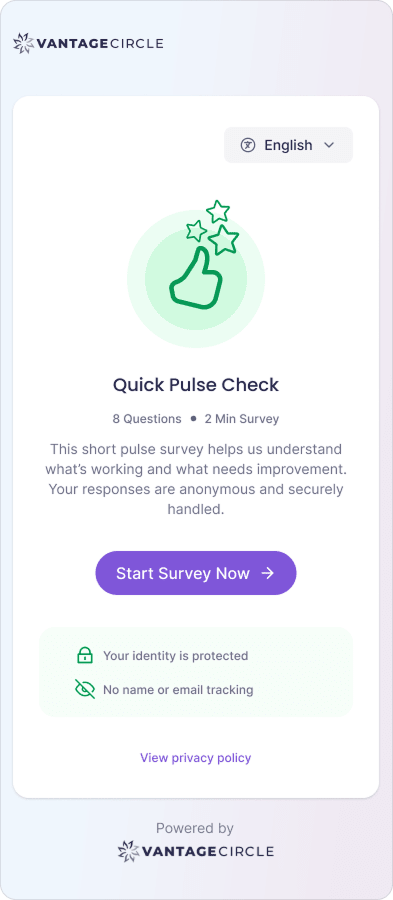
Employees from under-represented groups are the least likely to raise concerns openly, so anonymity matters here. Vantage Pulse collects anonymous responses and breaks them down by team, which shows where belonging is weak before it turns into attrition.
Hiring: 7 Ways to Build a More Diverse Talent Pipeline
Fair hiring starts before the first interview and continues until the offer is signed. These seven changes are where most companies see the quickest difference.
Legal requirements around hiring, data collection and workplace programs vary by country and sometimes by state, and this article is not legal advice. Check what applies to you with your legal team. The practices below are built around fairness and merit, so they hold up whatever the local rules are.
1. Write Inclusive, Results-Based Job Descriptions
Describe the outcomes the person will deliver, not a long checklist. In a widely cited 2014 Harvard Business Review piece, Tara Sophia Mohr wrote that men tend to apply when they meet about 60 percent of the listed qualifications, while women tend to apply only when they meet nearly all of them. Cut the "nice to haves" and use gender-neutral language.
2. Use Structured Interviews With Consistent Questions
Ask every candidate for a role the same core questions, in the same order, and score the answers against the same criteria. That's how Google's re:Work guide describes structured interviewing: the same questions, graded on the same scale, with decisions made against qualifications set in advance. Free-flowing conversations feel natural, but they let first impressions and shared backgrounds do the scoring.
3. Screen Blind Where You Can
Remove names, photos and other identifying details from resumes in the first round, so the first decision is about skills and experience. Be realistic about what it can do, though. A French field experiment by Behaghel, Crépon and Le Barbanchon, published in 2015 in the American Economic Journal, found that anonymous resumes did not help candidates from disadvantaged groups. They were called for fewer interviews, possibly because the employers who volunteered were already the ones inclined to look for them. Treat blind screening as one step, and pair it with structured scoring and a check on who reaches the interview. Learn the patterns in unconscious bias examples so your team knows what it is guarding against.
4. Diversify Interview Panels Without Tokenizing
Candidates want to see people like them on the panel, but asking one colleague to sit on every panel is a burden, not a solution. Build a trained pool of interviewers from different teams and levels, rotate them, and count the time as real work.
5. Replace "Culture Fit" With "Culture Add"
Culture fit often becomes a polite way of saying "reminds me of us." Ask instead what the candidate adds that the team doesn't already have, and have interviewers explain a rejection with evidence from the scorecard, not a feeling.
6. Widen Referral and Sourcing Channels
A referral program is only as diverse as the networks behind it. If your team looks similar, the people it refers probably will too. Keep the program, but pair it with new sources: community job boards, professional associations, returnship programs and colleges you haven't recruited from before. Track where each hire comes from.
7. Track Your Funnel by Stage
Look at who applies, who gets screened in, who reaches the final round and who gets the offer, by group where local rules allow. A drop at one stage points to a specific fix, whether it's the job post, the screen or the interview.
Onboarding: Make Inclusion Visible From Day One
The first weeks tell a new hire whether the commitments on your careers page are real. Two small steps make a large difference.
8. Introduce D&I Commitments and ERGs at Onboarding
Explain how your company defines diversity and inclusion, what policies back it up and who to talk to if something feels wrong. Introduce employee resource groups (ERGs, which are employee-led communities built around a shared identity or interest) in week one, so new hires know a community is waiting.
9. Assign a Buddy and Ask About Access Needs Early
Pair every new hire with a buddy outside their reporting line, and ask about accessibility or working-style needs before the first day. People who have to request adjustments later often feel they're asking for a favor. Asking up front makes it normal.
Culture: 8 Ways to Build an Inclusive Environment
An inclusive environment is one where people can bring their full perspective to work and be heard when they do. For a deeper look at the behaviors behind it, see our guide to inclusion at the workplace. These eight ideas are the practical starting points.
10. Launch Employee Resource Groups With Executive Sponsors
ERGs work best with a leadership sponsor, a small budget and a clear link to business questions, such as hiring or retention. Without a sponsor, they depend on volunteers who are already busy. Open them to allies too.
11. Run Inclusive Meetings
Send the agenda in advance, rotate who leads, and go round the room so everyone speaks before anyone speaks twice. Quieter colleagues and people working in a second language often have the sharpest points, and a fixed order gives them space to make them.
12. Recognize Contributions Fairly Across Every Team, Location and Shift
Exclusion often shows up first in who gets noticed. If recognition mostly reaches the people closest to leadership, remote and frontline employees quietly learn that their work does not count. Check whether recognition reaches every team, location and shift, then close the gaps you find.
When anyone can recognize anyone, contribution becomes visible beyond the loudest voices in the room. Vantage Recognition gives peers a shared social feed and recognition analytics that show who is being recognized and who is not, which turns a vague inclusion goal into something you can see and fix.
13. Celebrate Observances Thoughtfully, Not Performatively
A single social post during a heritage month does little. Plan observances across the year, involve the employees the day is for, and pair each with a real action, such as a policy review or a learning session. A DEI calendar helps you plan, and running it as a campaign gives people a way to take part.
14. Create a D&I Channel and an Anonymous Feedback Route
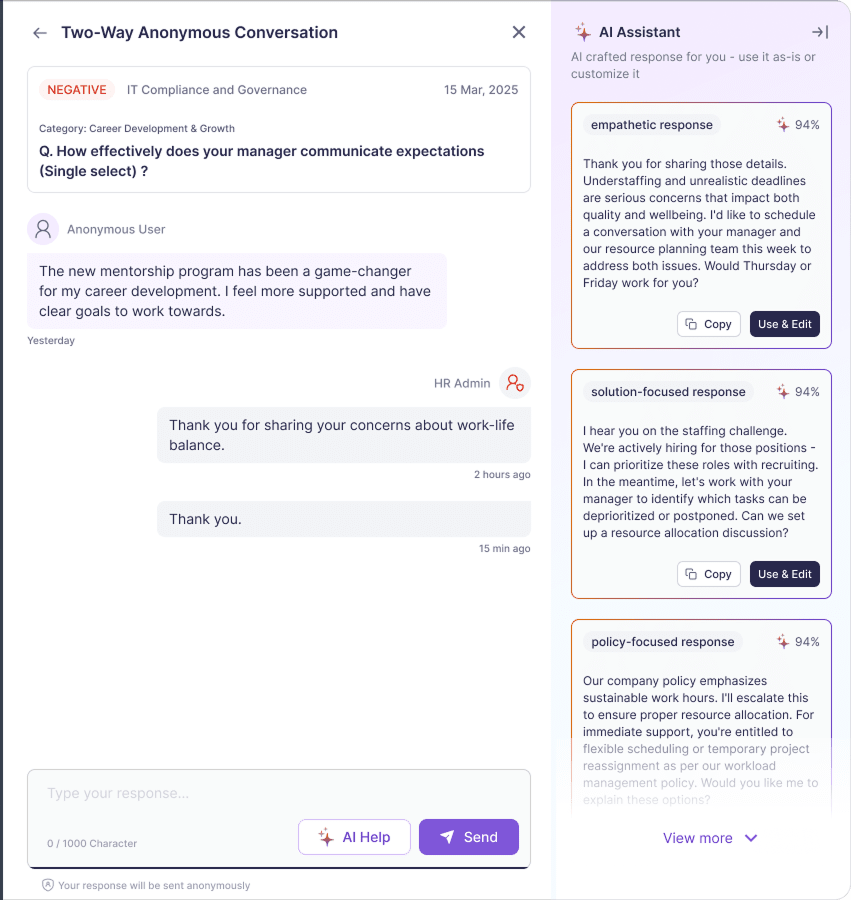
Open a channel where people can share articles, questions and news, and back it with an anonymous route for concerns people wouldn't raise in public. The open-text answers hold the specifics: a meeting format that shuts someone out, a policy that doesn't fit. Sentiment analysis in Vantage Pulse groups those answers by theme, which makes the next action obvious.
15. Use Inclusive Language and Respect Pronouns
Choose words that don't assume gender, age, family structure or ability. Say "partner" instead of "husband or wife" in your benefits documents, and "they" in job descriptions. Invite people to share their pronouns, never require it, and when you get one wrong, correct it simply and move on.
16. Accommodate Religious and Cultural Practices
Offer floating holidays so people can take the days that matter to them, and avoid scheduling key meetings on major festivals or during prayer times. In the US, the Supreme Court's 2023 ruling in Groff v. DeJoy raised the bar for refusing a religious accommodation: an employer has to show substantial increased costs, not a minor inconvenience. Think about food at events too, with options for different dietary practices.
17. Host Learning Moments
Book clubs, film discussions and guest speakers open conversations that are hard to start cold. Keep them voluntary and during working hours, and let employees pick some of the topics. For more formats, browse these diversity and inclusion activities, and read about how to create a sense of belonging.
Growth and Fairness: 6 Ways to Make Advancement Equitable
Hiring a diverse team only counts if people can grow once they are in it. The same McKinsey and LeanIn.Org report found that 45 percent of entry-level men had a sponsor, compared with 31 percent of women. These six ideas target that kind of gap.
18. Audit Pay and Promotion Rates by Group
Compare pay for similar roles and promotion rates across groups at least once a year, and write down what you find. Where gaps cannot be explained by role, performance or experience, fix them and say so. Our guide to workplace equity covers pay audits and other DEI initiatives in more detail.
19. Build Mentorship and Sponsorship Programs
A mentor gives advice. A sponsor uses their influence to open doors, such as a stretch project or a seat in a promotion discussion. Most programs stop at mentoring. Add sponsorship for under-represented talent, with leaders who agree to advocate for a specific person and report back on what happened.
20. Share Office Housework Fairly
Planning the party, taking notes and onboarding new joiners all take time and rarely lead to promotion. A 2017 study in the American Economic Review found that women, more than men, volunteer for, are asked to volunteer for, and accept the tasks everyone would rather someone else did. MIT Sloan's 2023 piece on workforce diversity adds that too much of this drudge work can stall a career. Rotate these tasks and track who ends up doing them.
21. Give Equal Access to Stretch Assignments and Learning
Fair growth needs funded growth. Offer learning budgets that every employee can use, not just the ones a manager nominates, and post stretch assignments openly instead of handing them to the usual names. Vantage Perks learning benefits can help widen who gets ready for the next role.
22. Train Managers on Inclusive Leadership
Managers shape daily experience more than any policy. Inclusive leadership means seeking out different views, giving credit fairly, and acting when someone raises a concern. Compare the types of diversity training and pick one that changes behavior, not just awareness.
23. Make Flexible Work a Policy, Not a Favor
When flexibility depends on a manager's mood, the people who feel least able to ask go without. Write the options down: flexible hours, remote days, compressed weeks. Parents, caregivers and people managing health conditions benefit most.
Workspace: 7 Everyday Changes Most Companies Miss
These are the small details that tell people whether a workplace was designed with them in mind. They cost little and rarely appear on a D&I plan.
24. Schedule Team Events Inside Working Hours
An event at 6 pm quietly excludes parents, caregivers and anyone with a long commute or a religious commitment. If the only time leaders relax with the team is after hours, the people who can't stay never get that time. Hold team lunches, offsites and celebrations during the working day, and make attendance optional.
25. Provide a Lactation or Quiet Room
Nursing employees need a private, clean space with a lock, a chair and a power point. In the US, the PUMP for Nursing Mothers Act gives most nursing employees the right to reasonable break time and a space that isn't a bathroom, shielded from view and free from intrusion, for up to a year after the child's birth (US Department of Labor). Elsewhere, check local rules. The same room can double as a quiet room for people who pray, meditate or need a break from noise.
26. Make Restrooms and Signage Inclusive and Accessible
Offer at least one all-gender or single-occupancy restroom, keep sanitary supplies stocked in every restroom, and check that signs, doors and lifts work for people with disabilities. Walk the office with someone who uses a wheelchair or has low vision. They'll see things you won't.
27. Check Office Temperature and Comfort
Office temperature standards were built around an average male metabolic rate. A 2015 study in Nature Climate Change by Boris Kingma and Wouter van Marken Lichtenbelt found that this can overestimate female metabolic rate by up to 35 percent, and that the women they studied had lower rates than the standard assumes. Ask people how they feel and adjust.
28. Choose Inclusive Merchandise and Gifts
Gendered welcome kits and festive gifts leave people out. Choose items most people can use, such as notebooks, bags or bottles, and offer sizes that fit different bodies. If you give food, include options for different diets.
29. Audit the People Shown on Your Website and Careers Page
Candidates read your photos and leadership bios as signals. Show real employees, and be honest where you're still building. On the Vantage Influencers podcast, Amrita Pandey, DE&I lead at Colgate Global Business Services, says in the episode Avoiding Tokenism in Diversity Initiatives that a company that openly admits it isn't diverse yet, and shows it's working on it, builds more trust than one that stages diverse imagery on its website.
30. Update Leave Policies
Look at sick leave, parental leave and caregiving leave, and add mental health days. In that same episode, Amrita Pandey suggests two simple fixes: renaming maternity leave as gender-neutral primary care leave, and extending medical coverage to a partner instead of only a spouse, since not everyone marries.
How Managers Can Promote Diversity and Inclusion
Managers promote diversity and inclusion through five daily behaviors: inviting quieter voices, rotating visible work, giving specific feedback, recognizing fairly and acting on concerns quickly. None of them need a budget.
Invite the quiet person into the discussion by name, and give them time to prepare. Rotate who presents to leadership. Tie feedback to the work, not the person. Notice who you recognize most and who you forget. And when someone raises a concern, act on it and tell them what happened.
Amrita Pandey also warned about a trap many companies fall into when they start. Here are her words from that episode:
"There is a huge difference between being diverse in your hiring efforts and seeming diverse in your hiring efforts."
She added that employees from under-represented groups are often made the spokesperson for their whole community:
"The lived experience of one employee will not be reflective of that entire group as a whole."
Her advice for managers: treat every person as an individual, and give people the power that comes with the title, not just the title.
How to Measure Whether D&I Efforts Are Working
You can tell your D&I efforts are working by tracking six numbers over time: representation by level, hiring funnel by stage, the pay gap, promotion rate parity, inclusion scores by group and recognition reach. Set a goal for each that is specific, measurable, achievable, relevant and time-bound (SMART), and give each goal an owner.
| Metric | How to measure | What good looks like |
|---|---|---|
| Representation by level | Headcount by group at each level, compared year on year | Groups are represented at senior levels in line with the pipeline below them |
| Hiring funnel by stage | Share of each group at apply, screen, interview and offer | No stage where one group drops sharply |
| Pay gap | Median pay for similar roles by group, after adjusting for role and experience | Unexplained gaps are closed within a set period |
| Promotion rate parity | Share promoted per cycle by group | Promotion rates are similar across groups at each level |
| Inclusion index by group | Anonymous survey scores on belonging, fairness and voice, split by group and team | Scores are high and the gaps between groups are narrowing |
| Recognition reach | Share of each team, location and shift that received recognition in the quarter | Recognition reaches every group, not only the people closest to leadership |
Recognition reach is the one most companies skip, and it often tells you the most. A team that goes a quarter without one recognition is telling you something.
The Vantage Pulse heat map shows where feedback is strongest and weakest across categories and departments, so you can compare teams and act on the biggest gap first. If progress stalls, read about the common barriers to diversity and inclusion to find out why.
Wrapping Up
Improving diversity and inclusion isn't one big program. It's a set of consistent decisions across hiring, onboarding, culture, growth and the workspace, measured over time. You don't need all 30 ideas at once. Start with your baseline, pick the three that match your biggest gaps, and check back in a quarter.
Frequently Asked Questions
How to create an inclusive environment?
Create an inclusive environment by making sure every employee can contribute and be heard. Run meetings so everyone speaks, recognize contributions fairly, offer an anonymous feedback route and give people flexibility. Then ask how included they feel, and act on the answers.
What is inclusive leadership?
Inclusive leadership is a way of leading that seeks out different views, shares credit fairly and makes people feel they belong. Inclusive leaders listen before deciding, notice who isn't speaking, and act on concerns. It's a set of habits, so it can be learned.
What is an inclusion tip of the day?
An inclusion tip of the day is one small action you can take today. Ask a quiet colleague for their view, share credit by name, check that a meeting time works for everyone, learn to pronounce a colleague's name correctly, or thank someone whose work usually goes unseen.
What are the different types of diversity?
Diversity covers visible differences such as age, gender, race and ability, and less visible ones such as religion, education, thinking style and socioeconomic background. Read our full guide to the types of diversity for examples of each.
What are the key trends in DEI for 2026?
In 2026, many companies are moving from standalone DEI campaigns to inclusion built into everyday people practices, with more focus on measurement, pay transparency and manager capability. Our post on diversity and inclusion trends goes through them in detail.


Lupamudra is a content marketing specialist at Vantage Circle, where she has written 50+ articles on employee recognition, rewards, and workplace culture, alongside employee engagement, diversity and inclusion, and HR compliance topics, including how India's tax rules apply to recognition and rewards programs.
Connect with Lupamudra on LinkedIn.