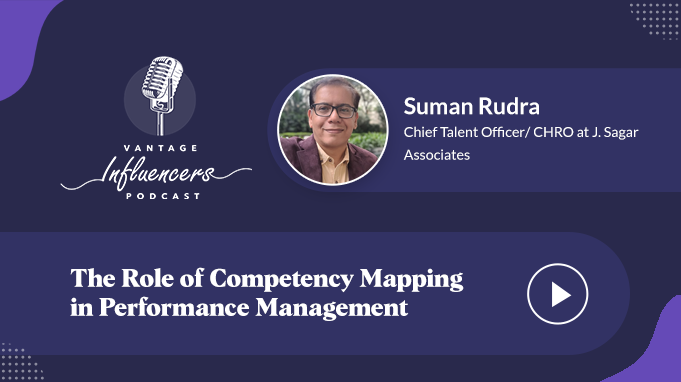
The Role Of Competency Mapping In Performance Management
Episode Overview
Suman Rudra brings over two decades of global HR experience, including India, the US, and parts of Europe and Asia, to his current role as Chief Talent Officer and CHRO at law firm J. Sagar Associates. He opens by distinguishing competency mapping from job analysis: job analysis is current and task-focused, while competency mapping is a 360-degree, futuristic view of the knowledge, skills, and attitude a role will require, not just what it requires today.
His most operationally useful point is on the scale of the exercise: mapping a single role properly requires interviewing three to four people connected to it (the role holder, their manager, and a level-two manager), and mapping 15-20 critical roles in an organization means roughly 150 interviews. He also flags a real ethical dimension often overlooked: because interview questions probe successes and failures, organizations should communicate the exercise's purpose transparently to relevant managers, and often run it through an external consultant so people answer more candidly.
Episode Highlights
- Competency mapping differs from job analysis by scope and timeframe: job analysis is current and task-focused, while competency mapping is a 360-degree, futuristic view of the knowledge, skills, and behavior a role will require.
- Competency mapping should be refreshed roughly every two to three years, and analyzing the resulting data across an organization's critical roles reveals which competencies most need organization-wide training investment.
- Mapping a single role properly requires interviewing three to four people connected to it — the role holder, their manager, and a level-two manager — so mapping 15-20 critical roles can mean roughly 150 interviews.
- A key ethical consideration: because competency interviews probe successes and failures, organizations should transparently communicate the exercise's purpose to relevant managers, and often run it through an external consultant so people answer more candidly.
- To stay aligned with business strategy, competency mapping needs to account for where the business is heading — new markets, new products, competitive pressure — not just what current role-holders do today.
- Competency mapping should feed into career planning and future role progression through structured, multi-source assessment (managers, peers, assessment or development centers), which employees tend to accept more readily than a single manager's judgment.
About the Guest
Suman Rudra — Chief Talent Officer / CHRO, J. Sagar Associates
Suman Rudra is a seasoned HR professional with over two decades of experience building talent for Indian and global businesses. As National and International HR Head, he has led India HR strategies across Sales, Services, R&D, Engineering, Manufacturing, and Offshoring for leading global technology companies. His expertise spans strategic business partnership, talent management, M&A HR transitions, organizational development, and employer branding, with a track record of partnering with CXOs at both country and global levels.
Connect with Suman on LinkedIn
Host
Sanjeevani Saikia — Vantage Influencers Podcast Host
What You Will Learn
- How competency mapping differs from job analysis: current and task-focused versus a 360-degree, futuristic view of a role
- Why competency mapping should be refreshed every two to three years, and how the resulting data should shape organization-wide training investment
- The real scale of a proper competency mapping exercise: multiple interviews per role, multiplied across an organization's critical roles
- The ethical considerations HR should address before running a competency mapping exercise, and why external consultants often produce more candid results
- How to keep competency mapping aligned with business strategy rather than treating it as a standalone HR exercise
- Why competency data should feed career planning through structured, multi-source assessment rather than a single manager's opinion
Key Topics & Timestamps
| Timestamp | Topic |
|---|---|
| 02:19 | Suman's journey so far |
| 03:32 | A brief introduction to competency mapping |
| 05:24 | Role of competency mapping in identifying skill gaps and developing a learning environment |
| 08:03 | Hurdles faced while implementing a competency mapping system |
| 11:15 | Potential ethical considerations |
| 14:37 | Alignment with overall business strategy |
| 17:10 | Role of competency mapping in the future of performance management |
| 19:23 | End note |
Full Transcript
Click to read the full episode transcript
Competency mapping will sound like a job for cartographers, but in the world of performance management, it's a vital tool for navigating the often choppy waters of employee development. Competency mapping sets the foundation for effective performance management by identifying the skills, knowledge, and behavior required for success in a particular role. Without this map, organizations may find themselves lost in a labyrinth of mediocre performance, struggling to distinguish between average and exceptional employees. Thus, it is imperative to have a meaningful dialogue on this topic, since understanding competency mapping can help leaders make informed decisions about talent management, career development, and succession planning, among other critical areas.
Sanjeevani Saikia: Hello listeners, welcome to another episode of the Vantage Influencers Podcast, where we explore a wide range of HR topics designed to grab your attention and inspire you. I'm your host, Sanjeevani Saikia, and today we'll be having a conversation on the role of competency mapping in performance management. I have with me Suman Rudra, Chief Talent Officer and Chief Human Resource Officer at J. Sagar Associates. Hi Suman.
Suman Rudra: Hi, how are you doing today?
Sanjeevani Saikia: I'm fine, how are you?
Suman Rudra: I'm good, Sanjeevani, thank you.
Sanjeevani Saikia: Wonderful. First of all, I'd like to thank you for giving your invaluable time and joining us in today's episode. Before we dive deeper into today's topic, competency mapping, could you walk us through your corporate journey so far?
Suman Rudra: Sure. I have around two decades-plus of HR experience, and I was lucky to have exposure across different kinds of organizations — technology, manufacturing, services. I've also been fortunate to work both in India and abroad, in the US, parts of Europe, and Asia, so I'd say a pretty well-rounded HR career with global exposure. And at this point, taking up the responsibility of CHRO at a premier law firm is definitely the icing on the cake — I'm pretty satisfied with the journey.
Sanjeevani Saikia: Wonderful, thank you for sharing your journey with us — truly remarkable. With that context in mind, we can dive straight into the topic. Since we'll be discussing competency mapping, for the benefit of listeners who may not be familiar with the term, could you explain what competency mapping is, and how it differs from job analysis in the context of performance management?
Suman Rudra: Sure. Competency mapping is one of the key HR fundamentals an organization should have. It's a mix of the knowledge required to do the job, the skills, and the attitude — almost a 360-degree perspective of what's needed to be successful in a role, both from a foundational or functional-skills level and from a behavioral aspect. What makes it different from job analysis is that job analysis is more focused on the core skills or tasks that need to be completed for a job or role to be successful — it's not as broad a term as competency. Overall, competency encompasses job analysis but is broader in application, and it accounts for things job analysis doesn't.
Sanjeevani Saikia: In today's rapidly evolving business landscape, organizations need to ensure their employees have the necessary skills and knowledge to adapt to new challenges and opportunities. Competency mapping has emerged as a valuable tool for identifying skill gaps. How can it help organizations identify those gaps and foster targeted training and development programs?
Suman Rudra: That's a good question, and very relevant given how fast things are changing — the pace of technological impact is so dynamic that we often feel a few steps behind. The way competency mapping helps is that the process itself should be refreshed roughly every two to three years — it's not something you do once and consider done forever. Refreshing it on that cadence gives you a view of what the organization actually needs in terms of training. Suppose you do competency mapping for, say, 20 important roles in a company — you learn all the necessary skills, both behavioral and functional, and when you analyze that data, you can identify which competencies need the most development attention at an organizational level. That data is very useful for creating training programs that benefit the maximum number of employees, and it's closely linked to the organization's overall learning and development plan — it helps create programs at an organizational level that would otherwise be difficult to figure out. So re-analyzing the competency mapping plan every couple of years is a good way to move forward.
Sanjeevani Saikia: I believe competency mapping is a complex process requiring significant time and resources to implement. While it can be an effective tool for identifying and developing employee capabilities, there may be challenges during implementation. Could you share some of the challenges organizations face when implementing a competency mapping system?
Suman Rudra: Very apt question. The competency mapping process itself is very time-consuming, and I think the most important challenge is getting the time of key role holders, because it requires extensive interviews with them. For one particular role, you typically need to interview a minimum of three to four people connected to that role in some way — one might be the role holder, one or two might be peers, one the manager, and one a level-two manager. So getting the time of the right people for these discussions is the most challenging part. If, for example, an organization has around 15 to 20 important roles, and each requires interviewing four people, you're looking at roughly 150 interviews.
The second part is how to capture the information accurately, because that also requires skill — the data doesn't always come from the person being interviewed very readily, so there's an art to asking the right questions so the person feels comfortable answering. It's also about the interviewer's capability to note the key behaviors that make a person successful, because many stories get told, and you have to separate those stories and evidence to pick out the key behavior being highlighted, while also finding patterns across different people interviewed for the same role. So a lot of the output of this exercise depends on the skill of the competency interviewer, and their ability to connect the dots across interviews for the same role.
Sanjeevani Saikia: A competency mapping system can have significant implications for employees' career development and opportunities. While this process can be beneficial for employees and the organization, it's important to consider the potential ethical implications. What are some ethical considerations organizations should account for while implementing a competency mapping system?
Suman Rudra: One of the key things is for the organization to communicate very clearly, to the right audience — certain levels of managers and above — why this exercise is being done. If it isn't communicated transparently, people will definitely notice something is happening, but without knowing the objective, and rumors can start floating around. So one key ethical step is sending a clear communication to relevant managers, laying out that the objective is to ensure the organization stays competitive with respect to the skills and capabilities it needs, so people feel confident the exercise is aligned to a legitimate purpose.
The second is winning the confidence of the interviewees, because when someone is asked what makes them successful, or about their failures, those questions can make a person a little uncomfortable, and they may wonder why such questions are being asked — especially if they're long-tenured role holders or high performers. So it's important to ensure a comfortable environment for this process, which is typically why it's often run through an external consultant — people tend to be more free, frank, and relaxed sharing data and information with someone outside the organization than they might be otherwise. So I think the two important factors are the overall communicated objective, and the interview environment, so the person can share free and frank feedback.
Sanjeevani Saikia: Absolutely — needless to say, organizations have to keep these ethical considerations in mind while structuring a competency mapping system. We've covered the meaning of competency mapping, the likely challenges, and the significant ethical considerations, and I've gotten some really interesting perspectives from you. So it's a good time to ask — how can organizations ensure the competency mapping system stays aligned with their overall business strategy?
Suman Rudra: Very relevant question. Competency mapping is fundamentally something done to keep the business moving ahead of the competition — it shouldn't be treated purely as HR work or HR strategy. It's part of the broader organization development exercise, where the objective is to make sure that if there's a business strategy — say, the company is moving into new markets, new products, new service lines, or facing a challenge in the external environment — the key aspects of that strategy are enlisted before the exercise, so they're kept in view while questions are being asked. This is especially essential for people in top management and key decision-making roles, because the objective of competency mapping is also futuristic. As I mentioned earlier about the difference between job and competency — job is current, competency is future. So the questions need to explore not just what a person does today to be successful, but what skills, knowledge, and attitude they'll need given tomorrow's business strategy and environment. That's why it's so closely linked to business strategy, and taking advantage of competency mapping aligned to that strategy is one of the best ways to implement it. The key takeaway is that competency mapping isn't just HR's concern — it should concern all the key decision-makers.
Sanjeevani Saikia: We're arriving at the end of today's episode, but before we let you go, there's one last thing both our listeners and I would love your take on — what role do you think competency mapping will play in the future of performance management? Are you optimistic about this tool, or do you have any apprehensions?
Suman Rudra: Competency mapping has always been part of the performance management process, though a large part of performance management deals with goals and targets a person has to deliver. Competency mapping provides the long-term view, or potential, of a person — everyone is interested in how far they can go, what different roles they can take on, what their future plan looks like, and those questions can really only be answered through competency mapping, because the process tells us the person's current status against what's needed. Competencies can be evaluated in many different ways — it's not just managers evaluating someone; it can be assessed through structured programs, assessment centers, or development centers using a variety of exercises. The process is very scientific — it's not one person deciding what someone's competency is, it's almost a multi-tier feedback approach, which means the person tends to accept the results in a much more open and acceptable way, because it's not coming from a single source but from a variety of structured exercises. As I said, it gives a fair indication of a person's capability to take on future roles, and career planning, career development, and future role progression should all be decided based on that — I think it's the fairest, most transparent way to provide opportunities to employees.
Sanjeevani Saikia: True. We've reached the end of today's podcast — do you have any message for our listeners? And how can our audience stay in touch with you after this episode?
Suman Rudra: What I'd like to say, even at the end of this podcast on competency, is that while we keep hearing about so many changes happening in our environment, it's important to also stay anchored to a few things that need to be done in the near term — the next one, two, or three years. Things do change, but certain parts of a job and role remain constant, and sometimes, in the frenzy of everything happening in the external environment, we forget to focus on the current, present, and immediate future. That immediate focus should be on understanding what role competencies you're supposed to deliver, at what level, and then ensuring someone gives you feedback on those competencies — that can come from your manager, your peers, or sometimes from someone on your team. Even if this isn't happening formally or in a structured way in your organization, you can create your own basic feedback form and identify the few things needed to make you successful, and gather feedback on your own. My advice is to take that feedback in a structured manner, so you can analyze it and plan your own self-development — following a methodology rather than chasing what's trendy today, and instead focusing on what's actually needed for you today, to prepare you for tomorrow. As for staying connected, my LinkedIn is the best way — I try to respond to whatever queries come through, so that's the way to stay connected.
Sanjeevani Saikia: Wonderful. Suman, it's been a pleasure to have you as our guest today. Your insights and expertise have been invaluable, and we're very grateful for the time you've taken to share your knowledge with our listeners. Thank you so much, thanks a lot.
Suman Rudra: Thank you, Sanjeevani. I really liked this podcast — it was a very relevant and nice topic to discuss. I'd like to stay connected and see how I can help your organization do more positive work in the future. Thank you.
Thanks for listening to the Vantage HR Influencers Podcast. Please subscribe to the Vantage HR Influencers Podcast on Apple Podcasts, Spotify, and our YouTube channel for new episodes.
FAQ
What is competency mapping and how does it differ from job analysis?
Suman Rudra describes competency mapping as a 360-degree view of the knowledge, skills, and behavior a role requires, both now and in the future. Job analysis, by contrast, is narrower and current-focused — it covers the core tasks needed to complete a job today, not what the role will demand as the business evolves.
How often should organizations refresh their competency mapping?
Suman Rudra recommends refreshing competency mapping every two to three years, since the resulting data reveals which competencies most need organization-wide training investment as business needs shift.
What are the biggest challenges in implementing competency mapping?
The two biggest challenges Suman Rudra identifies are securing enough interview time with key role holders (roughly three to four interviews per role) and the skill required to accurately capture and interpret what interviewees share, since data rarely comes through cleanly on the first attempt.
What ethical considerations should organizations account for in competency mapping?
Suman Rudra highlights transparent communication to relevant managers about why the exercise is happening, and creating a comfortable interview environment, often via an external consultant, so interviewees answer candidly about their successes and failures without feeling exposed.
Related Reading
Also listen on