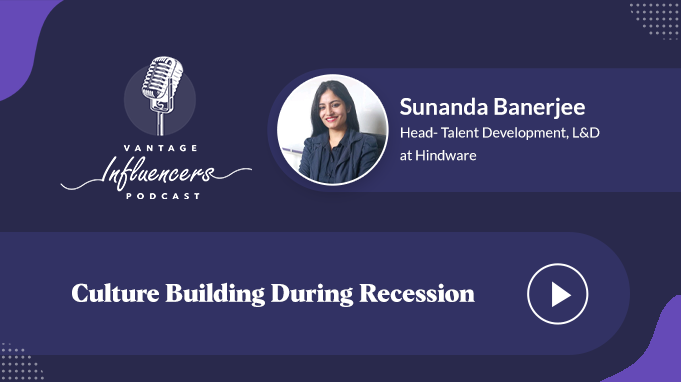
Culture Building During Recession
Episode Overview
Sunanda Banerjee came to HR from a marketing background, an MBA from KJ Somaiya, an MSc from Regent's University London, and eventually founding her own L&D startup, Coemerge, before joining Hindware to lead talent development and L&D. Her central argument is that mass layoffs are frequently a copycat reflex rather than a reasoned decision: companies watch competitors cut headcount and follow suit "for the heck of it," without weighing the long-term cost of re-recruiting and re-engaging talent once the market recovers.
Her most memorable framing is what layoffs actually damage: not just the people let go, but the "peer effect" on everyone who remains, where passive job-seeking rises purely from proximity to bad news, regardless of whether an employee's own role is at risk. Her practical playbook for leaders during a downturn deliberately avoids anything expensive: transparent communication, small no-cost recognition gestures, and leadership visibly sharing the pain (pay cuts, cutting business-class travel) to signal "we're all in the same boat."
Episode Highlights
- Layoffs are often a copycat reflex rather than a reasoned decision. Companies watch competitors cut headcount and follow suit "for the heck of it," without weighing the long-term cost of re-recruiting talent once the market recovers.
- Layoffs damage more than just the people let go. The "peer effect" on remaining employees drives passive job-seeking purely from proximity to bad news, regardless of whether their own role is actually at risk.
- Rampant hiring during a funding high, followed by rampant layoffs during a downturn, damages employer brand on platforms like Glassdoor, which candidates now check before joining regardless of company size or brand recognition.
- Culture building during hard times doesn't require big budgets: transparent top-to-bottom communication, small no-cost recognition (a public "thank you," a kudos card, a small voucher), and continuing low-cost team engagement activities.
- Culture is not solely HR's job. Sunanda Banerjee argues every level of the organization, especially managers, has ownership of it, with HR facilitating rather than owning it alone.
- Leadership visibly sharing the pain (pay cuts, cutting business-class travel) signals "we're all in the same boat" and builds the psychological safety employees need to voice fears and concerns during uncertain times.
About the Guest
Sunanda Banerjee, Head of Talent Development, L&D, Hindware
Sunanda Banerjee helps organizations bring out the best of their human capital through reskilling and upskilling in behavioral and cognitive aspects of business, with end-to-end synchronization of learning interventions that create real opportunities for professional growth. With around 14 years of experience across pivotal roles spanning multiple domains and industries, she is also a blogger and reading enthusiast who sees her career as driven by merit, intellect, and a belief in disruption.
Connect with Sunanda on LinkedIn
Host
Susmita Sarma, Vantage Influencers Podcast Host
What You Will Learn
- Why mass layoffs are often a copycat reflex rather than a considered decision, and what that costs a company long-term
- The "peer effect" of layoffs, why remaining employees start passively job-hunting even when their own role isn't at risk
- Why rampant hiring-then-layoff cycles damage employer brand on platforms like Glassdoor
- A low-cost playbook for culture building during hard times: transparent communication, small recognition gestures, and continued low-cost engagement
- Why culture building is everyone's responsibility, not just HR's
- Why visible leadership sacrifice builds the psychological safety employees need during uncertain times
Key Topics & Timestamps
| Timestamp | Topic |
|---|---|
| 01:20 | About Sunanda and her corporate background |
| 02:40 | Impact of recession on the workforce and morale |
| 05:50 | Quick fixes for a company facing uncertainty |
| 09:27 | Tips for leaders to maintain a positive culture in trying times |
| 12:40 | Sunanda's final thoughts |
| 14:22 | How to connect with Sunanda |
Full Transcript
Click to read the full episode transcript
The US and the rest of the globe are becoming more aware of an approaching recession. Large-scale layoffs are being discussed in the headlines, with organizations suspending recruitment attempts or reducing employees through mass layoffs. As employees grow more apprehensive about the stability of their positions, and about what's coming up in the near future, this only serves to increase their insecurity. To avoid an environment of mistrust, businesses must work on improving their culture, employee morale, and ensure they are upfront and honest about their intentions.
Susmita Sarma: Hi everyone, welcome back to another episode of the Vantage HR Influencers Podcast. I'm your host, Susmita, and today I have with me the Head of Talent Development, L&D at Hindware, Sunanda Banerjee. Hi Sunanda, welcome to the show.
Sunanda Banerjee: Hi Susmita, thank you so much for having me here.
Susmita Sarma: Thank you for your time joining me in this episode of the Vantage HR Influencers Podcast. Before we get into the topic, I'd like to know a little more about you and your corporate background.
Sunanda Banerjee: Sure. Interestingly, I come from a marketing background. I did my MBA at KJ Somaiya Institute of Management in Bombay, then my MSc at Regent's University London, and I'm currently pursuing my PhD. I've been in corporate for around 13-plus years, across various strategic roles including business growth and marketing, and in the last few years, primarily in learning and development and people development roles. I headed marketing for a couple of startups, and before joining Hindware, my current assignment where I lead talent development and L&D, I was running my own startup called Coemerge, again an L&D organization, catering to multiple MNCs and corporates. I'm also a certified life and executive coach through ICF, which pretty much covers my background, academically and professionally.
Susmita Sarma: Thanks for sharing that. On today's topic, recession and talent management, many experts are already anticipating a recession, which will have a huge impact on the workforce and their morale. Could you walk us through the effect this might have on existing workplace culture?
Sunanda Banerjee: That's a very pertinent and timely question, because the last few months have been brutal, especially around the startup economy and the economy more broadly. When you look at the biggest brands and the best-known tech names, you see that even companies not doing particularly badly, or not really hit hard by the recession, are actually leading the trend rather than being pushed into it by it. At the end of the day, it's people who get impacted, an organization is its people, you can't separate the two. Morale and engagement are tightly linked terms, so every time you open the paper and see headlines about layoffs, hundreds or thousands of them, across domains, and losing good people is costly even in good times, it becomes catastrophic in worse conditions.
The biggest effect shows up even among people not directly impacted by layoffs, the peer effect becomes very strong, because you're constantly hearing about it, becoming insecure, wondering if you're next. Passive job-seeking rises sharply, a term you'll hear often these days, where people think, "why should I wait to get laid off, let me start looking for something better myself, rather than let them push me out." That's essentially where the whole "Great Resignation" phenomenon, coined by a professor about a year and a half ago, started. Culturally speaking, it shows up as lack of trust in management and lack of transparency, and productivity naturally declines, because people feel there's no point putting in extra effort if something bad is going to happen anyway, so they just do the bare minimum, hit the hygiene KRAs, and stop there. Engagement hits rock bottom, and people feel this unnecessary, indirect exhaustion even if layoffs aren't happening in their own organization, everyone ends up in a "down mode" collectively.
Susmita Sarma: We're already seeing that companies are quick to lay off employees during a recession. Do you think that's really a quick fix for a company facing uncertainty, or are there other places to cut costs first?
Sunanda Banerjee: Absolutely, and this is something you hear discussed a lot, it's easy to talk about, but implementation becomes very difficult, especially at the grassroots level. A lot of organizations don't just have people sitting in offices; they have people meeting clients, working across vendor relationships, and so on. Layoffs also badly impact brand equity, no matter what. So when organizations just follow the lead of others, like how repo rate changes ripple through every bank once the central bank moves, because that's a benchmarked, centuries-old institution, private companies following suit "for the heck of it" are actually being catastrophic for themselves. Doing a layoff right now might improve the balance sheet in the short term, but in the long term, the cost of re-acquiring that talent, finding them again, re-engaging them, is a slow, expensive process, and it's a gamble whether you can even find people as good as the ones you lost.
As a quick fix, sure, a lot of companies do it because investors, especially in startups, want to see it, "why did you hire 100 people for sales, let's trim it to 20", without thinking through what happens five or six months down the line when the market improves and you need to ramp sales back up while competitors are already doing so. That thought process often isn't considered, and hiring costs increase too, the cost of re-acquiring that same talent you just let go. Talent bank management is the key thing people lose sight of chasing short-term numbers. And it cuts both ways, a lot of newer, hyped brands do rampant hiring the moment they get new funding, without thinking whether they'll actually need those people a year down the line, and then end up laying them off. Beyond thinking about those employees' careers, there's also the brand equity of being an "employer of choice", other employees, or potential employees, will think twice before joining you once they read your Glassdoor reviews or see discussions about you on Quora. Glassdoor is such a powerful tool now, people across levels, not just senior management, check it before joining. It's no longer a monopoly where being a big brand guarantees people will come running.
Susmita Sarma: Rightly said. Beyond that, what would be your tips for managers, HR leaders, and leaders listening in, on how to maintain a positive culture in these trying times?
Sunanda Banerjee: Sure, let me cover culture building quickly in a few bullet points. Building a positive culture doesn't need a lot of fanfare or big culture announcements, small, consistent initiatives give you results in the long term. First, transparent communication, whenever things aren't going right, whether you're doing layoffs or not, or planning to, clarity of communication flowing from the top down, so people understand what's happening and aren't left guessing. People shouldn't live in fear of job security all day; if they do, they can never work productively or give you the ROI on the salary you're paying them. Second, empathy is key, and that's not solely top management's job, it's a manager's job too. My view is that every level of the organization has ownership of culture building, it's not just HR's job. HR can facilitate it, but it has to be carried out through the business, through the people who are part of it. That might mean recognizing that if layoffs are happening, you can adjust someone's travel costs or incentives and give them the flexibility to work three days from home.
One important thing from an HR standpoint: small recognition initiatives that don't cost much. Reports and surveys consistently show it's not just money that motivates people, every company can throw in a 5-10% raise here and there, but what matters more is feeling that your work is valued, that you matter to the company. Those small recognitions can be a simple email sent to the whole team, a public shoutout in front of colleagues, a small "kudos" card, or a modest movie voucher for the kids. These don't cost anywhere near what a family holiday would. Keeping smaller engagement initiatives going, small team-building activities, "Friday fun" sessions, matters too, and again, none of this needs to be heavy on the budget. These are small, low-cost things that genuinely matter to people, and they go a long way toward building better culture and engagement.
Susmita Sarma: Thank you for sharing that expertise. Would you like to give your final thoughts to wrap up today's conversation?
Sunanda Banerjee: Sure. To wrap up quickly, there are two or three things to focus on when building culture during a downturn or maintaining morale. First, understanding what people actually want, listening becomes very important. People who stay shouldn't be penalized for staying; rewarding them for standing by you in tough times matters just as much, and the reverse holds true too, that's how you create brand evangelists, employees who stand by you and say, "I want to stay here because my company values me." Second, when leadership speaks, it matters, you'll hear leaders in these situations say things like, "we've taken a pay cut," or "we've stopped business-class travel," and small gestures like that tell employees, "it's not just me, we're all in the same boat." That builds the psychological safety for people to speak up about their fears, worries, and insecurities. Building an ecosystem of transparency and open communication is what keeps the boat sailing, even through turbulence.
Susmita Sarma: A lot more could be said on this topic, but given time constraints, we'll have to wrap up here. Our audience might want to connect with you, we'll add your LinkedIn profile link to the show notes. How can people reach out to you?
Sunanda Banerjee: Absolutely, I'm available on LinkedIn, I'm quite active there, and interestingly it's the only social media platform I use, so I'm definitely reachable. Happy to answer questions or support in any way I can.
Susmita Sarma: Thank you, Sunanda, for the time you gave me today and for joining the conversation.
Sunanda Banerjee: Thank you so much, Susmita. It was a pleasure talking with you about a topic that's supremely close to my heart, and thank you for building this ecosystem where people can communicate with each other and reach a larger part of the world.
Thanks for listening to the Vantage HR Influencers Podcast. Please subscribe to the Vantage HR Influencers Podcast on Apple Podcasts, Spotify, and our YouTube channel for new episodes.
FAQ
Are layoffs an effective quick fix during a recession?
Sunanda Banerjee argues layoffs are frequently a copycat reflex rather than a reasoned decision, and while they may improve a short-term balance sheet, the long-term cost of re-recruiting and re-engaging talent once the market recovers often outweighs the initial savings.
How do layoffs affect employees who aren't let go?
Sunanda Banerjee describes a "peer effect," where employees not directly impacted by layoffs still become insecure and start passively job-hunting purely from proximity to bad news, driving up voluntary attrition even without any personal risk.
How can companies build culture during a downturn without a big budget?
Sunanda Banerjee's playbook is deliberately low-cost: transparent top-to-bottom communication, small no-cost recognition gestures like a public thank-you or kudos card, and continuing low-cost team engagement activities like informal Friday sessions.
Is culture building HR's responsibility alone?
No, Sunanda Banerjee argues every level of the organization, especially managers, has ownership of culture building, with HR facilitating the effort rather than owning it in isolation.
Related Reading
Also listen on