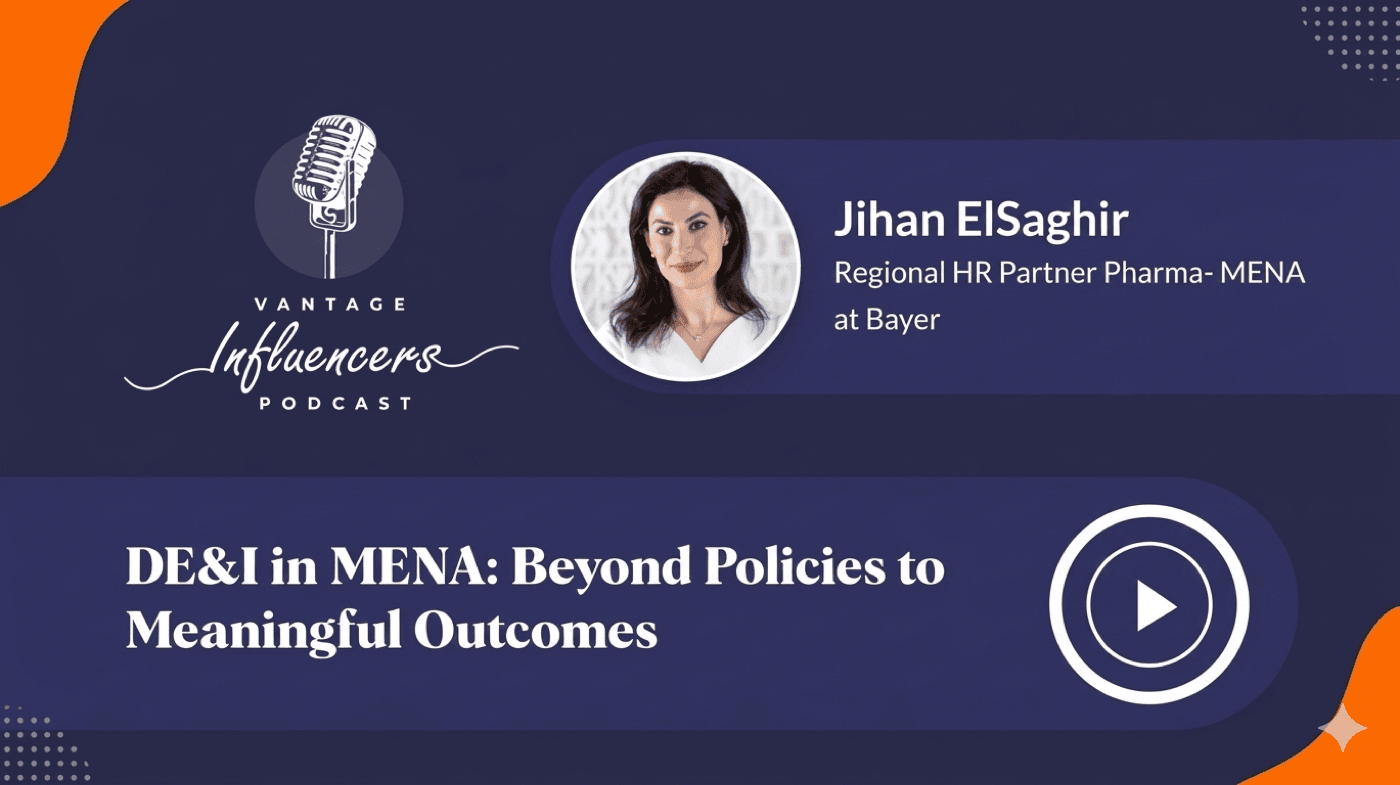
DE&I in MENA: Beyond Policies to Meaningful Outcomes
Episode Overview
In this episode of the Vantage Influencers Podcast, host Sanjeevani Saikia sits down with Jihan ElSaghir to unpack what real inclusion looks like inside MENA workplaces, once the policies and position statements are stripped away. Jihan argues that global DEI frameworks often miss the local lens when they land in the region, and that the real gap between MENA and the West isn't intent, it's enforcement: without a legal mandate pushing companies toward diversity ratios, progress depends almost entirely on how proactive an individual organization chooses to be.
The conversation moves from framework to floor level quickly. Jihan points to small leadership moments, like who gets excused for a family emergency and who doesn't, as the real test of whether inclusion is lived or just decorative, and she makes the case for measuring equity through signals like turnover rate and exit interviews rather than headcount ratios alone. She closes with a personal challenge for listeners: don't wait for HR or leadership to start a DEI initiative, because in her experience the region's DEI movement has always been built by individuals who simply decided to begin.
Episode Highlights
- Jihan ElSaghir traces her HR path from operations in Lebanon and Dubai to a regional HR business partner role covering the MENA market.
- She describes today's DEI momentum in MENA as blurry: more intentional action from some companies, alongside growing uncertainty driven by shifts inside global multinationals.
- Global DEI frameworks often miss the local lens, and HR's job is to translate global values into a local flavor that still earns genuine buy-in.
- Unlike Western markets, MENA has no legal mandate enforcing diversity ratios, so real progress depends on how proactive each organization chooses to be.
- Inclusion shows up in small leadership moments, like who gets excused for a family responsibility and who doesn't, more than in DEI decks and ratios.
- Turnover rate, exit interviews, and employee surveys can reveal more about equity and belonging than representation numbers alone.
About the Guest
Jihan ElSaghir, Regional HRBP Pharmaceuticals - MENA and the Country HRBP – KSA at Bayer
Jihan ElSaghir is an HR professional with 15 years of experience across pharma and other multinational industries, currently serving as Regional HRBP Pharmaceuticals - MENA and Country HRBP - KSA at Bayer. She began her HR career in Lebanon before relocating to Dubai, where she built her path from HR operations through country-level HR business partnering to her current regional remit. Her portfolio spans culture-building programs, end-to-end talent development, workforce planning, and accelerating DEI agendas across diverse MENA markets, with an approach that blends strategic planning with hands-on execution and a focus on aligning people strategy to business priorities.
Connect with Jihan on LinkedIn
Host
Sanjeevani Saikia, Vantage Influencers Podcast Host
What You Will Learn
- Why DEI progress in MENA depends more on organizational proactiveness than on legal mandate, unlike in many Western markets.
- How to spot the gap between DEI policies that exist on paper and DEI that leaders actually role model day to day.
- How to build a diversified candidate pool at the hiring stage without trading off skills or fit.
- How to use turnover rate, exit interviews, and employee surveys to measure equity and belonging beyond headcount ratios.
- Why the business case for DEI goes beyond employer branding, touching creativity, healthy competition, and growth mindset.
- What it takes at an individual level to start a DEI initiative before HR or leadership does.
Key Topics & Timestamps
| Timestamp | Topic |
|---|---|
| 00:00 | Cold open and sponsor introduction |
| 01:17 | Jihan ElSaghir's HR journey from Lebanon and Dubai to a regional HRBP role |
| 02:24 | The current, blurry state of DEI momentum across the MENA region |
| 03:22 | MENA's regional diversity and where global DEI frameworks fall short |
| 05:34 | The biggest MENA-versus-West difference: enforcement, not intent |
| 07:08 | Everyday leadership behaviors that build (or break) psychological safety |
| 10:07 | The three buckets organizations fall into: no action, paper policy, and real ownership |
| 11:22 | Measuring equity and belonging through turnover, exit data, and employee surveys |
| 14:45 | What organizations risk by ignoring DEI: creativity, competition, and growth |
| 16:28 | What meaningful DEI progress could look like in MENA in the years ahead |
| 18:07 | Closing message: "If you want to see the change, be the change" |
Full Transcript
Click to read the full episode transcript
Welcome to the Vantage Influencers podcast. This podcast is sponsored by Vantage Circle, the simple and effective recognition platform for employee engagement.
Sanjeevani Saikia: DEI conversations in the MENA region are often shaped by a wide mix of local realities, organizational priorities, and global influences. And because the region is so diverse, inclusion can mean very different things depending on the context. So before jumping into solutions or best practices, I think it's useful to first pause and explore how inclusion is actually understood and experienced within MENA workplaces today. So to help us unpack this from a grounded regional perspective, I'm really glad to be joined by Jihan ElSaghir. Jihan works as a regional HR partner for pharma across the MENA region, where she's closely involved with people strategy, leadership, and inclusion across diverse markets. So let's welcome her. Hi, Jihan. It's a pleasure to have you on the show. Thank you so much for joining us today.
Jihan ElSaghir: Hello, Sanjeevani. Nice to meet you.
Sanjeevani Saikia: Same here. Thank you so much once again. Before starting our conversation, would you like to walk us through your corporate journey so far? I'm sure our listeners would love to know that.
Jihan ElSaghir: Sure, and thank you for that. So I'm an HR professional by choice. I have entered the career field almost 16 years ago, after I finished my university studies. Initially, it was back home in Lebanon. And then 14 years ago, I moved to Dubai. I have been a generalist almost all of my career. I've been through HR operations, starting at the bottom of the ladder and moved steadily towards an HR business partner, first with local country responsibility. And now, as you have mentioned, with a more regional scope. I have been through different functions of HR. I have worked through that. But most importantly, I enjoy the aspects of talent development, change management, and, as you have already mentioned, diversity and inclusion.
Sanjeevani Saikia: Wonderful. Thank you so much for sharing your journey with us. Before starting, I'd like to ask you, how does the DEI scene really look like currently, according to you?
Jihan ElSaghir: Well, I would say it's a little bit blurry. Currently, we have been seeing a steady kind of enhancements and more intentional actions over the past few years, especially within the MENA region. I think more ownership has been taken over by the companies in the MENA region. Yet globally, and since many of us work in multinational companies, we have seen many changes over the past few months, which has led to kind of uncertainty within the areas of diversity and inclusion. I do not personally see that we need to tackle this topic from a policy perspective or through a political perspective, rather than really owning it as a matter of equality within our corporate environments.
Sanjeevani Saikia: True. Building on that, the MENA region, as we all know, isn't a single uniform environment. It's shared by diverse cultures, nationalities, languages, regional influences, again, also gender norms. Because of this complexity, DEI approaches that are designed elsewhere may not land the same way when applied in this particular region. From your experience, where do global DEI frameworks tend to fall short when applied particularly in MENA workplaces?
Jihan ElSaghir: Yeah, that is right. As I already mentioned, we mainly are belonging, or working, at multinational companies. Often multinationals do kind of miss the local lens. It is very important that we do actually fall under a bigger umbrella, where the values of the company that we work for is still kind of cascaded into the local organizations. Yet it is very important for the local organization to keep its local sense and to really reflect what matters for the organization locally. And here is where the role of HR comes, to act as a bridge, to be vocal, to really cascade or transfer the messages to global, while also ensuring that the two-way communication is going. It is not only the responsibility of HR here, but also the local leadership responsibility, to emphasize this messaging. And the importance of, while we do definitely understand the global frameworks that the company has set for us, that also we need to have that accompanied with a local twist, or with a local flavor, as we say. It's kind of also showing respect to our local organizations, and definitely ensures more buy-in and support within the transformation while we are working on it.
Sanjeevani Saikia: Yes. So, Jihan, if I ask you to name one particular major difference you see between DEI policies, if I may put it that way, in regions other than MENA, what is it? A major difference, I think that might just be a distinguishing factor.
Jihan ElSaghir: At this point of time, I would say maybe the enforcement of DEI kind of policies. While in the previous years we have seen that, be it not only gender, it could be something that is related to minorities, to people with disabilities, to specific race or ethnicity and background. In other countries, more of the Western side, we would see that there is a legal mandate to abide by certain ratios that really helps ensure that the organization internally is really diverse and has that diversified flavor. While in the MENA region, we are still behind on that element. This is left to the proactiveness of the organization itself, and to the initiatives of the organizations. This is one of the reasons why we see a gap. Some companies are really taking the lead and are really introducing new initiatives that are new within our local markets in MENA, while some companies are way behind, still working in a very traditional mindset without any reference or any exposure to diversity and inclusion.
Sanjeevani Saikia: So, if we move away from frameworks and models for a moment, I believe policies alone don't create psychological safety. Often, inclusion is felt in the smallest leadership moments: who gets heard, who gets protected, and who gets overlooked. So I guess that human layer is where DEI either comes alive, or it kind of quietly fails. As I said, and you mentioned as well, policies aside, what everyday leadership behaviors make employees in MENA feel genuinely included and safe at work?
Jihan ElSaghir: Yeah, you got that so right. Actually, it's not about policies. It's not about DEI decks that we present with ratios and with graphs, and to celebrate and say, well, today we are 50% females and males. It's actually about role modeling, and it's about the cultures, the small talks that happen in the office. It's about, for example, females not having to worry if she has to leave the office, or the perception that she would be, the way she would be perceived, if she has to leave the office, for example, early, to take her son to a doctor's appointment, versus a male who could be excused for a similar situation. It is not about excluding, again, females from job opportunities just because she has a family and she has a responsibility, believing that she cannot take over leadership roles because of having a family, while males are, by default, considered that this is a strength, they are committed, and they are definitely in a place to lead. So it is these kind of role modeling that we expect our leaders, and we encourage our leaders to show, in our day-to-day lives in the organization, besides the policies, where it really makes a difference. In our recruitment policy, for example, it is a mandate to make sure that when a position is being filled, that we start from a diversified base. We never kind of prioritize diversity over quality. We definitely want to make sure that the person selected is the right fit and has the right skills and qualifications, but if we start from a diversified pool of candidates rather than through a one-size kind of pool, then we are in a very much stronger position in ensuring that we have diversified talent at the end filling the role. So the policy is not about ensuring a 50%, for example, female versus male ratio. It's about really doing the right thing well before that, so that we end up at the desired outcome after that.
Sanjeevani Saikia: Yes, well said. In your previous response, you did mention that DEI, largely right at this point in time in MENA, depends mostly on the proactiveness of the organizations. So it's not on pen and paper, as it is in the West, for that matter. So how proactive do you see the organizations currently? How willing are they to really put this on pen and paper? What do you see? What's the difference you feel?
Jihan ElSaghir: As I mentioned, I still see a gap between the ways that companies are working. I would say we have three levels, or maybe three buckets, into which companies sit. One is where there's no initiative whatsoever towards diversity, equity, and inclusion. One that is doing it on pen and paper, as you've mentioned: maybe we have some policies, but not real ownership and real accountability from the leaders, from HR, that is being committed towards delivering. And then the third bucket, where maybe not many companies yet sit, but we have quite a few that are really taking the lead and pushing barriers, challenging the status quo, introducing new initiatives, and really taking ownership on making diversity and inclusion, on role modeling diversity and inclusion, within their organizations locally.
Sanjeevani Saikia: I understand. Now, shifting gears, let's talk about measurement. I'm sure you will agree with me that representation numbers are often celebrated as wins, but they don't always tell the full story, like you mentioned in your previous response. You can have diversity in the room without equity in voice, growth, or influence. So the real question becomes, how can organizations move beyond headcount to measure equity and belonging more meaningfully? So, as you said, not just about how many males or how many females we have, but beyond that. What do you have to say about that, Jihan?
Jihan ElSaghir: Yeah, definitely. There are several ways, and I can give you examples from my own organization currently in MENA. Employee surveys really matter, and there are still some numbers and some ratios that we can look into, which are not related directly to diversity ratios, but, for example, I would say turnover rate. So, for example, our turnover rate is quite low compared to the market, and from our employee surveys and from our exit surveys, which we do our analysis on, and we spend time and effort to analyze, we have found that our culture is one main reason why employees would love to stay. And the main reason, the culture, I mean the definition of culture, is the inclusion that our employees feel they have within Bayer MENA, that really plays a very important role in their decision to stay employed within this corporation. And that has, I can give you some examples, from flexible working arrangements, empowerment of employees to decide when to work, where to work, while having full accountability for the way they do their job, to our inclusive care package, where we support our colleagues who have kids with the ability to take care of their kids, for example, to our very generous maternity packages and PTOs, and even after coming back from maternity, the flexibility shown to our female colleagues to ensure that they are transitioning swiftly into their roles, as well as taking care of their families back home. So all of that plays a very important role in ensuring that our employees feel satisfied, feel included, and that they are not being excluded because of the situation they are in: because I have a family, because I am a female, because I am disabled, for example, a person with disability, or because I have a need to work from home to care for my elderly parent. As long as I am delivering, and as long as I am doing the job, and I'm playing my role in the organization, I am still being included, and my impact is still being seen, and I am still being heard. So these are some ways where we see that we can measure the impact of our policies internally.
Sanjeevani Saikia: Okay, so at this point, I think it's important for me to ask you, what are the implications if a person or an organization doesn't really follow DEI policies? What are the implications? What do they have to face?
Jihan ElSaghir: Definitely, we are talking about business impact. Okay, maybe it is a bit difficult to measure that at the beginning, or to really feel the impact of that at the beginning, but on the long run, when you have a team that is like-minded, when you have a team of employees who are all from the same background, from the same ethnicity, you really limit creativity, you really limit thinking out of the box, you really limit healthy competition between the team, you really limit the opportunities to strive, to go above and beyond. People would feel more in their comfort zones, doing things the way that they have been doing it forever, and they have a very sound and legit justification: why should I do something different? Whatever has been working for us can still work. While being in a more diversified environment could really trigger healthy competition, healthy creativity, looking into solutions from a different perspective, looking into problems from a different perspective, it could trigger a growth mindset that eventually reaches a growth in business.
Sanjeevani Saikia: I'm glad that you have mentioned something other than branding, because most of the time, the first implication that people mention is the branding thing. So yeah, it's a good start to that. We are reaching the end of today's episode, but before we let you go, I need to ask you something again. As the year continues to evolve in the MENA region, what kind of progress do you think will matter most to organizations and employees in the years ahead?
Jihan ElSaghir: As I maybe have been consistently mentioning, it is the accountability and the ownership. It is the role modeling of leadership. HR definitely plays a very important role in the organization, to set the policies, to set the standards and the way of working, but it would remain pen on paper if no leadership takes the accountability and the ownership of these initiatives. If we don't role model, if we don't take the lead and really be in the driver's seat as leaders to make sure that we want to transform the organizations, as I mentioned, we will be in bucket number two, where we are just having some very nice decks with nice colors and graphs, and there is no real impact on employee lives or on the business outcome eventually. So this is a key driver to the growth of the business. We really need, or leadership teams really need, to own these initiatives and to walk the talk, as we say, and this is what is going to make the huge transformation in DEI in the region.
Sanjeevani Saikia: So you have rightly pointed out the significance of accountability here. So again, great. You have wonderfully and very lucidly explained all the questions asked today. Thank you so much once again. We have arrived at the end of today's episode. Is there any message for our listeners, anything that you'd like to say to all the people hearing you out?
Jihan ElSaghir: Thank you so much for hosting me. Maybe one last message for myself: if you want to see the change, be the change. So it is not about a company. Most probably, and if I remember, you know, 10 years ago, these initiatives, at least in the MENA region, were individual initiatives. I may have been one of those employees at the junior level who decided that this is something that matters to me, and I want to make this visible. And there are so many other examples of me, of other colleagues who took these initiatives and who tried to really make them matter in the organizations that they work at. So let's not wait for an HR manager, an HR team, or for the leadership to, you know, start introducing these initiatives. Take the lead yourself. You can start with small steps, but small, steady steps will really matter, and will really help you be part of the change that you want to see.
Sanjeevani Saikia: Yes. So if you want to change, then be the change. So that's again a wonderful thought that you have left our listeners with. So, Jihan, thank you so much for joining us today. It was a pleasure hosting you, and best of luck for your future.
Jihan ElSaghir: Thank you so much. Thank you so much. Bye-bye.
Thanks for listening to Vantage Influencers podcast. Be sure to subscribe on Apple Podcasts, Spotify, and our Vantage Circle YouTube channel for the latest episodes.
FAQ
What makes DEI in the MENA region different from the West?
Unlike many Western markets, MENA has no legal mandate enforcing diversity ratios. According to Jihan ElSaghir, progress in the region depends largely on how proactive individual organizations choose to be, which is why some companies lead on DEI while others still work with almost no exposure to it.
How can organizations measure equity and belonging beyond headcount numbers?
Representation ratios don't tell the whole story. Jihan points to turnover rate, exit surveys, and employee surveys as more meaningful signals, since a low turnover rate tied to strong survey results on culture and inclusion says more about equity than a 50/50 gender split alone.
What everyday leadership behaviors actually build inclusion?
Inclusion is less about DEI decks and ratios and more about role modeling: whether a woman leaving early for a family responsibility is judged differently than a man doing the same, and whether hiring starts from a diversified candidate pool rather than a one-size pool.
What happens to organizations that ignore DEI?
Beyond employer branding, Jihan warns that like-minded, homogenous teams limit creativity, healthy competition, and the drive to go above and beyond, while diversified teams are more likely to trigger a growth mindset that translates into business growth.
Related Reading
Also listen on