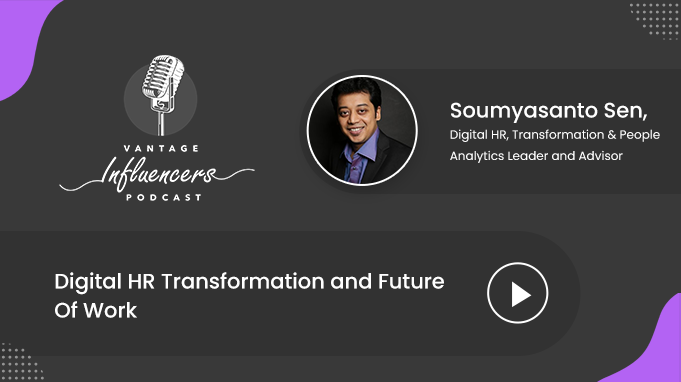
Digital HR Transformation and Future Of Work
Episode Overview
Soumyasanto Sen pushes back hard on the common shorthand that digital HR means buying a cloud platform or digitizing existing paperwork. He argues that framing gets the sequence backwards: technology should follow strategy, not replace it, and the real starting point is figuring out how HR can create measurable value for the business rather than just process efficiency. He lays out a three phase roadmap he calls Revolution, Survival, and Sustainability, moving organizations from an initial mindset shift and cloud driven groundwork, through a workforce focused stage built around human centric experience, remote work, and human machine collaboration, to a final stage centered on innovation, diversity, and building organizations that behave more like living systems than rigid hierarchies.
He also tackles the fear that automation will make HR departments obsolete, rejecting it outright. Instead of eliminating HR, he sees digital transformation as a chance to move the function away from rule enforcement and administrative work toward becoming a genuine business advisor and change agent. For smaller businesses without big technology budgets, his advice is to resist buying solutions before building a strategy, since he has watched organizations spend heavily on digital tools only to lose track of the return because they skipped the roadmap. Looking ahead, he ties HR's future to continuous learning ecosystems, a deliberate rebalancing of tasks between people and machines, and a willingness to treat talent retention and reskilling as core strategic work rather than side projects.
Episode Highlights
- Soumyasanto Sen argues that digital HR is not about digitizing existing processes or buying a cloud solution, and that framing misses the point of the transformation entirely.
- He describes a three phase roadmap, Revolution, Survival, and Sustainability, that takes organizations from an initial mindset and strategy shift through a workforce focused stage to a final phase built on innovation and adaptability.
- The core purpose of digital HR, in his view, is to resolve business issues and create measurable value, not simply to make existing processes more efficient.
- He rejects the idea that digital transformation will eliminate the HR department, arguing instead that it gives HR a chance to move from rule enforcement toward becoming a genuine business advisor.
- His advice to smaller businesses with limited budgets is to build a clear strategy and business case before spending on any technology, since many organizations invest heavily and then cannot show a return.
- Looking toward the future of work, he points to continuous learning ecosystems, a deliberate balance between human and machine tasks, and talent retention as the areas HR needs to prioritize.
About the Guest
Soumyasanto Sen, HR Technology, Transformation & People Analytics Leader and Advisor
Soumyasanto Sen has spent 17 years in HR technology, largely focused on implementing on-premise and cloud HR solutions and leading digitization, automation, and transformation projects for large organizations. His work spans artificial intelligence, people analytics, human machine collaboration, and next generation automation for the future of work, and he has also worked alongside several HR technology startups. He is the author of Digital HR Strategy: Achieving Sustainable Transformation in the Digital Age, a book built around the three phase Revolution, Survival, and Sustainability framework he discusses in this episode. Soumyasanto is also a keynote speaker and blogger, and serves as a strategist of the Future of Work at People Conscience.
Connect with Soumyasanto on LinkedIn
Host
Susmita Sarma, Vantage Influencers Podcast Host
What You Will Learn
- Why Soumyasanto Sen believes digital HR is not about digitizing processes or buying cloud software, and what should come before any technology investment
- What the three phase Revolution, Survival, and Sustainability framework from his book Digital HR Strategy actually involves at each stage
- How small businesses with limited budgets can build a strategy and business case before investing in HR technology
- Why he believes digital transformation will not eliminate the HR department, and what new role it can play instead
- How organizations should think about balancing human and machine tasks as automation and AI reshape jobs
- What HR teams should prioritize, from learning ecosystems to talent retention, to prepare for the future of work
Key Topics & Timestamps
| Timestamp | Topic |
|---|---|
| 00:37 | Soumyasanto's 17-year journey across HR technology, digital transformation, and automation projects |
| 01:55 | What digital HR actually means beyond digitizing existing processes |
| 04:43 | The biggest advantages of moving from traditional HR to digital HR |
| 06:48 | Inside his book, Digital HR Strategy, and its Revolution, Survival, and Sustainability framework |
| 14:45 | How small businesses can approach digital HR investment despite limited budgets |
| 17:35 | Whether digital transformation could eliminate the need for an HR department |
| 19:09 | Preparing HR for the future of work in 2025 |
| 22:10 | Final tips for a successful digital HR transformation |
Full Transcript
Click to read the full episode transcript
Welcome to the Vantage HR Influencers Podcast. This podcast is sponsored by Vantage Circle, the leading employee benefits and engagement platform. Hi everyone, this is Susmita from the Vantage HR Influencers Podcast. Today we have a very experienced HR leader, who is also a speaker, author, and blogger, Soumyasanto Sen. Hello and welcome to the show.
Soumyasanto Sen: Hello Susmita. Nice to be here.
Susmita Sarma: Yeah, a pleasure to have you. So before we get started, we would like to know a little more about you and your journey in HR.
Soumyasanto Sen: Yes, so I've been in HR tech for the last 17 years, mostly involved in implementing HR solutions, both on-premise and cloud. For many years, I've been part of digitization, automation, and transformation journeys with large organizations, including several digital transformation projects for HR over the years. I've also been part of the transitions happening now in the digital age, with a lot of change, uncertainty, and fast-moving technology. I've been heavily involved in AI, people analytics, human machine collaboration, next generation automation, and the future of work. Alongside that work, I do research, write, and speak, and I enjoy helping others in the community, it's a passion of mine. I've also worked with several HR tech startups over the years. Overall, it's a very interesting space to work in, and I'm glad to be part of it.
Susmita Sarma: Okay, great. So the topic today we are taking up is understanding digital HR and the future of work, right? Although digital HR is a very hot topic, many of us would like to understand what exactly it means.
Soumyasanto Sen: Yeah, so digital HR looks different depending on who you ask, different people, different companies, different leaders see it differently. For me too, it's different, and that's how I started engaging with the digital HR space, doing research and working in it, which is also what my book is about. For me, HR should be broader when you think about the whole transformation happening around the digital edge, and it's important that you reach sustainability at some point.
So I always say digital HR is much more than just digitizing your current processes, or buying a cloud solution or digital solution. That's not digital HR, it might be an actionable step, but it's not the starting point. What matters to me is that digital HR should use technology to resolve business issues and create value and opportunities for the business, because if you don't create value for the business, I don't think you're making any significant impact, and that's where digital HR has real possibilities.
The second point I'd make is that it should be a complete rethinking of the organization, its culture, strategies, and operations. When you talk about the organization, that touches the business people, business functions, and the entire HR organization needs to shift too. We've seen this happening for decades, and digital gives us the opportunity again to shift in the right direction.
Another point worth mentioning is that it can emphasize a more human-centric experience, collaboration, and new ways of working. We've seen separate discussions on employee experience, or on data-driven HR analytics, and I think that's a huge opportunity that's also part of digital HR and can be leveraged for real business outcomes.
Once everything aligns on this, it's also important to align and simplify your processes. Process does come into the picture, but what I've noticed in many cases is that it gets treated as the first priority, let's change the process, let's digitize the process, which I don't think is right if you really want to make a big impact.
Susmita Sarma: Okay, so the transformation from traditional HR to digital HR has numerous benefits, right? According to you, what are the top advantages of going digital in HR?
Soumyasanto Sen: As I mentioned in the last question, digital HR gives us a real opportunity to think about HR differently, and there are several advantages, I'll mention a few. One is that it's possible to rethink HR as a profit center rather than a cost center, delivering value to the business and to HR's customers, employees, managers, executives, and investors. That's a big possibility, and there's already a lot of discussion about how HR can move from cost center to profit center. I think digital HR can help make that shift more real.
The next point is around the consumption of HR. Today HR is more of a support function than one built around a consumer-oriented mindset. I think that needs more focus, because most HR systems and solutions are very much process and HR driven. We need to become more consumer-driven, and for HR organizations, the consumers are the employees. If you create a better experience for employees and deliver real business value through them, that automatically gives HR a new direction, and that's one of the advantages of digital HR.
There's also the opportunity that comes from using technology, analytics, and data to make better, more evidence-based decisions for the business, which can have a huge impact, and many organizations are already doing this. Those are some of the primary advantages, there are many more.
Susmita Sarma: So you've authored a really informative book called Digital HR Strategy. As far as I know, it's structured around three parts, which you've named Revolution, Survival, and Sustainability, describing the entire HR transformation journey of businesses. It sounds really interesting, would you like to explain it? Let's start with Revolution.
Soumyasanto Sen: Yes, thanks for mentioning that. For me, digital HR is a whole journey. My goal was to look at how an organization can reach a stage where the transformation becomes sustainable, and that's important, you really have to phase your journey so you can sustain it at the end. It's not a one-shot approach, it's a pragmatic, step-by-step approach. So I mapped out the phases in three parts: Revolution, Survival, and Sustainability, and each of these phases has its own broader strategies.
Revolution is the starting point. It's good to begin by implementing some cloud solutions and thinking about processes, and about how you can impact employees and managers with digital solutions from HR. But revolution also starts with understanding the disruption happening in the digital world, and the volatility, uncertainty, complexity, and ambiguity that organizations face today. Every business function is going through this pace of transformation, so it's also an opportunity. The Revolution phase should focus on learning from others, learning from other business functions, and building a digital mindset for transformation, because you really have to work on mindset first, on how to change and how to make things better. Then you build a strategy for better value propositions for the business, which includes aligning business strategy with people strategy, and then formally building a digital strategy for HR that's more data-driven, along with the culture change that goes with it. That's the Revolution phase, it's the starting point, like lighting a fire for the journey ahead.
The next phase is Survival, which is more focused on the workforce, the employees, everyone who's working. When you talk about the workforce, digital HR should be used to create a human-centric experience, more engagement through employee experience, well-being, and digital workplaces. We've seen this with the shift to remote work during COVID, which came out of a crisis, but I think will also give organizations the opportunity to think beyond their current ways of working going forward.
The next part of Survival is dealing with the rise of artificial intelligence and intelligent systems, because the future of jobs and the future of work is changing. New jobs are arriving, some jobs are disappearing, new roles are being defined, and that creates real anxiety for people about whether their job will still exist in a few years. The Survival phase is about building strategies so new roles can be adopted easily by employees, while roles that are being phased out can be transitioned. Learning is a very important part of this, focusing on new ways of learning, upskilling and reskilling employees, and increasing collaboration, including the collaboration between humans and machines. You have to think about which tasks machines can do, so that people are freed up for more creative, more innovative work. That's how the nature of work is changing, and I think that's the opportunity digital HR has here, to help organizations survive in this fast-changing environment alongside machines.
The last phase is Sustainability, which is really the final goal. Once you start with Revolution, you move into Survival and deal with all the challenges, machines, changing work styles, even a crisis like a pandemic, and you learn how to survive through it. The next stage is to make the organization genuinely sustainable, so it can lead even through crisis and challenge. For that, the organization has to become more responsive, more like a living system. Many organizations today are still bureaucratic, working in silos, with little cross-functional collaboration, and we've seen challenges around diversity and ongoing conversations about new leadership styles. Organizations have to focus on all of this. One of the most important factors for sustainability is innovation, since research shows that the most successful, most innovative companies are the ones that sustain themselves in a constantly changing world, and better innovation needs better diversity, a strong innovation culture, and good leadership. None of this can be achieved alone, you also have to build a strong learning ecosystem, think seriously about developing people, build a community around it, and grow your network. All of this feeds into sustainability, the final stage, and once an organization reaches that stage, it becomes more sustainable for the future. That's how digital HR can take an organization from nothing all the way to a sustainable state.
Susmita Sarma: But in the case of small businesses, their HR professionals, given their size, might not be able to invest in technology, but it's equally important for them. What are your views on how they can overcome this challenge?
Soumyasanto Sen: As I mentioned before, investing in technology isn't really the focus point of digital HR. Yes, technology is involved, but before that, you really have to work out what business outcome you're after, how it can impact the workforce positively, how it can impact the organization and its culture in a way that sustains over the long term, and how it can make processes better and more efficient so that employees and the workforce can actually use them effectively.
Smaller organizations should think about this first before investing in anything, because I've seen many organizations spend huge amounts on solutions and digital tools, and then end up with no clear idea of where to go next, because they never built the right roadmap for their people in the first place. They get stuck wondering about their return on investment, we've invested so much, where's the return, and you can't really determine that unless you build a strategy from the beginning. That's the piece that's often missing. There are also plenty of surveys from major research and consulting firms, including Gartner, showing that most digital transformations fail, and one of the biggest reasons is that they skip the strategy.
So before investing in any solution, before even planning your costs, you really need to build a business case first. And on the cost side, there are different ways to make your costs work better for the whole HR function, you have to look at your operating model and find cost optimization opportunities across HR services and the workforce, not just around buying a solution. There are other ways to find the money to invest. But again, you need to understand the whole picture, otherwise it's very difficult. It's not about buying solutions, it's about really thinking through your organization first.
Susmita Sarma: So is there a chance that this transformation could eliminate the need for the HR department in the future?
Soumyasanto Sen: No, not at all. I always say it actually gives HR the chance to establish itself differently. Today, HR is mostly focused on efficiency, process, and administrative or transactional work, HR is often known mainly for setting and enforcing rules, and that's the popular perception in much of the world. Digital HR is the opportunity to shift from just efficiency toward adding real business value, to become a business advisor and a strategist rather than just a rule enforcer. It's also an opportunity to think about how HR can drive a better experience for employees and the workforce, instead of focusing only on process, and to become a better advisor to the business rather than just an administrator. Ultimately, it also gives HR the opportunity to enable change for the organization, to change the culture and make the organization more effective, rather than simply setting rules. So there's definitely a chance to rethink HR, and taking a broader view of the function can really help.
Susmita Sarma: HR should prepare accordingly, right? So how do you think HR should prepare for the future of work in 2025?
Soumyasanto Sen: The most important thing, as I mentioned when describing the Survival phase and how ways of working are changing, is learning. You really need to build a learning ecosystem that continuously helps employees, the workforce, and managers and leaders to learn and develop themselves. Investing in employee education, cross-training, lateral moves, and mentoring programs definitely helps, this already exists in some form, but you have to build an environment that keeps generating value continuously, not something you invest in for one year and expect a return from immediately, it has to be an ongoing part of how HR operates.
The next point is adopting a new mindset toward technology and skills. There have been plenty of articles saying HR is one of the business functions least interested in technology, which has been somewhat true, HR has lagged behind other business functions, not always very tech-savvy or very supportive of technology projects. But that's changing now, and adopting a new mindset around technology, with the right balance between skills and human factors, is very important for how work is evolving.
The next part, as I mentioned before, is thinking about how to redesign the business in terms of process and work. When HR is advising the business, it's largely focused on the workforce, and we all know that for most businesses, including CEOs, talent and workforce remain one of the most challenging areas even today. Attracting the right talent, developing them, keeping them engaged, and retaining them is still one of the top challenges for any CEO, and HR can play a huge role there.
Finally, as I mentioned, we're already living in a world where humans and machines are working together, with a lot of applications and AI systems replacing parts of current jobs and roles. HR has to think about how to balance humans and machines and how to help people collaborate with them, which means working on skill management, understanding which skills and tasks machines can take on, and then helping the rest of the workforce reskill around the human factors like creativity and innovation. There's a lot of opportunity here for HR, especially when thinking about the talent economy and the future of work.
Susmita Sarma: Last but not least, would you like to give some other tips to the HR professionals listening to us for a successful digital HR transformation?
Soumyasanto Sen: Yeah, transformation is a big word, and again it means something different for different people. As I said, a simple cloud solution can count as digital transformation for some companies, while for others it's a whole new set of organizational changes. I think it's important to start with questions rather than just following others, why do we need to transform, what makes sense for us, where do we start, who can help, how do we change. These are important questions, and I try to capture them in my book too, different questions mapped across different points in the timeline.
If you look at what makes transformations successful, it usually starts with a sense of urgency and readiness, then leadership from the top, because leadership plays a very important role in successful transformation, and a willingness to challenge old ways of working. Some of this is much more visible today than it used to be, in the past it was harder to see, but with the COVID situation, every organization is rethinking things, like whether remote work is part of the future, that's just one example, but you have to rethink your ways of working more broadly. You also have to find your informal leaders, the people who can integrate and collaborate well, and you have to be more innovative, building a culture where employees, the workforce, and leaders are encouraged to experiment and think in new ways.
All of this requires a real change in culture and mindset, and that's why transformation has to start with mindset and culture change across the organization. That's how a successful, sustainable transformation gets achieved, by thinking big, starting with the right things, building your strategy, defining your roadmap, and going step by step. It's not a checklist you can just tick off, you have to keep reconsidering, measuring your progress regularly, using data to make better decisions, and always thinking about how you can make a positive impact on the business. That's how you define your transformation.
Susmita Sarma: There's actually a lot more to learn from you, and it would be great if you could share the best way people can reach out to you.
Soumyasanto Sen: Yes, I'm always happy to share what I know. The easiest way is LinkedIn, I'm very active there, I check my messages regularly, and I always find a way to respond, so you can find me on LinkedIn. You can also read my book if you'd like, that's another good way to get access to the knowledge, I've put a lot of effort into it based on my experience so far, and it's had really good reviews from thought leaders and others.
Susmita Sarma: Sure, thank you so much, it was great having you on our show, thanks for joining.
Soumyasanto Sen: I'm glad, thank you, Susmita.
Thanks for listening to the Vantage HR Influencers Podcast. Please do subscribe to the Vantage HR Influencers Podcast on Apple Podcasts and Spotify for new episodes.
FAQ
What does Soumyasanto Sen mean by digital HR transformation?
Soumyasanto Sen argues that digital HR is not about digitizing existing processes or buying a cloud solution, that's only an actionable step, not the starting point. For him, digital HR means using technology to resolve real business issues and create measurable value, while also rethinking an organization's culture, strategy, and operations from the ground up.
What are the three phases in Soumyasanto Sen's Digital HR Strategy framework?
His book, Digital HR Strategy: Achieving Sustainable Transformation in the Digital Age, breaks the journey into three phases: Revolution, which focuses on mindset and building an initial digital strategy; Survival, which centers on the workforce, human-centric experience, and human-machine collaboration; and Sustainability, the final stage focused on innovation, diversity, and building a more responsive, adaptable organization.
Will digital transformation eliminate the need for HR departments?
No. Soumyasanto Sen rejects that idea outright, arguing instead that digital transformation gives HR the chance to move away from rule enforcement and administrative work and toward becoming a genuine business advisor and change agent for the organization.
How should small businesses approach digital HR without a big technology budget?
He advises small businesses to resist buying technology first. Instead, they should build a clear strategy and business case, understand the specific business outcome they want, and think through how a solution will affect the workforce and culture, since many organizations spend heavily on tools and then cannot show a return because they skipped that step.
Related Reading
Also listen on