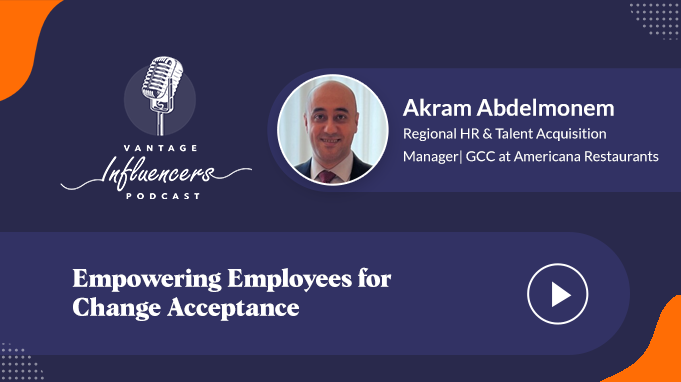
Empowering Employees for Change Acceptance
Episode Overview
Akram Abdelmonem argues that resistance to change rarely has much to do with the change itself, it comes down to fear of the unknown. When employees can't see what's coming next or understand the logic behind a decision, they get anxious and start asking questions, and Akram says that reaction is universal, showing up at every level of an organization, including management. His answer isn't a communication campaign in the traditional sense, but genuine involvement: bringing people into the process early, being transparent about why a change is happening, what it means for them, and how long the transition will take. Even then, he says some resistance is inevitable, and the fix isn't more explaining, it's listening. Sitting down one on one or in small groups to understand the reasoning behind someone's pushback resolves, in his experience, 60 to 70 percent of the problem.
The conversation also digs into how diversity, leadership style, and automation each shape how change lands inside a team. Akram connects a genuinely inclusive culture, one where people across different backgrounds, generations, and working styles feel like they belong, directly to smoother transitions, because a team that already trusts each other absorbs disruption more easily. He also walks through how he runs transparent, almost project managed communication within his own team, and why rolling out HR automation requires the same change management thinking as any other transformation: explain the benefit, address the fear of redundancy head on, and let the data do the rest of the convincing.
Episode Highlights
- Akram Abdelmonem says resistance to change usually comes from fear of the unknown, and that reaction shows up at every level of an organization, including management, not just frontline staff.
- His core strategy for driving acceptance is early involvement: bringing employees into the process before a change is announced, being transparent about the reasoning, the benefits, and the timeline.
- When people still resist after that, he says the fix is listening rather than more explaining, understanding the specific reasoning behind someone's pushback resolves roughly 60 to 70 percent of the problem.
- He treats diversity and inclusion as a practical lever for change management, arguing that a genuinely inclusive team absorbs disruption more smoothly because people already trust and understand each other.
- His leadership style leans on transparency and near constant communication, one on ones, group meetings, and informal check ins, run with the discipline of small internal project plans.
- On HR automation specifically, he says the biggest risk is employees fearing their role has become redundant, so leaders need to explain the benefits and the time savings just as deliberately as they would for any other change.
About the Guest
Akram Abdelmonem, Regional HR & Talent Acquisition Manager for GCC at Americana Restaurants
With over 18 years of experience in HR, Akram specializes in talent acquisition, HR strategy, performance management, and employee engagement. He recently led a talent acquisition strategy that hired over 12,000 candidates from more than 12 nationalities in just three years, and he has spearheaded HR transformation efforts, restructuring departments, creating policies, and digitalizing key HR functions. He is certified in Lean Six Sigma Black Belt and CIPD Level 5, and holds a Master's in Business Administration. Akram is passionate about turning HR into a driver of business success.
Connect with Akram on LinkedIn
Host
Susmita Sarma, Vantage Influencers Podcast Host
What You Will Learn
- Why Akram Abdelmonem believes fear of the unknown, not the change itself, is the real source of employee resistance
- How early involvement and transparency about the reasoning, benefits, and timeline of a change can turn employees into advocates instead of skeptics
- What to do when employees still resist after a transparent rollout, and why listening resolves most of the pushback
- How a genuinely inclusive, multi generational team absorbs organizational change more smoothly than a less cohesive one
- How Akram's transparency driven leadership style, built on frequent one on ones and informal check ins, keeps teams aligned during periods of disruption
- Why HR process automation needs its own change management plan, and how to address employees' fear that new technology will make their role redundant
Key Topics & Timestamps
| Timestamp | Topic |
|---|---|
| 01:44 | Akram's corporate journey and what drew him to a career in HR |
| 02:50 | The experiences that shaped his path to his current role at Americana Restaurants |
| 04:20 | How the workplace has changed, and what that means for employee acceptance of change |
| 06:00 | Strategies for keeping employees engaged and informed during periods of change |
| 08:25 | The impact of diversity and inclusion on change management |
| 11:04 | Akram's leadership style and how it facilitates change |
| 13:10 | How HR process automation influences employee acceptance of change |
| 14:50 | Advice for HR professionals on managing change effectively |
Full Transcript
Click to read the full episode transcript
Welcome to the Vantage HR Influencers Podcast. This podcast is sponsored by Vantage Circle, the simple and AI-powered rewards and recognition platform for employee engagement. As organizations undergo transformative changes, driven by technological advancements, shifting market dynamics, or evolving workplace cultures, the success of these change initiatives largely depends on employees' ability to adapt and embrace the new ways of working. The degree to which employees accept the changes not only influences the effectiveness of the transition, but also shapes the overall health and agility of the organization moving forward.
Hello everyone, welcome to another episode of the Vantage Influencers Podcast. Today we have the pleasure of speaking with Akram Abdelmonem, the Regional HR and Talent Acquisition Manager, GCC at Americana Restaurants. Akram will help us explore the factors that drive or hinder employee acceptance of change. His insights are essential for HR leaders and organizations striving for success in today's dynamic environment. From fostering engagement during transitions to championing diversity and inclusion, effective change management necessitates a multifaceted approach, and Akram will shed light on how to navigate these complexities. Let's begin.
Susmita Sarma: Hi Akram, it's fantastic to connect with you today.
Akram Abdelmonem: Hi, how are you? Thank you for having me.
Susmita Sarma: I'm good, hope you're doing well. Thank you so much for joining me for this podcast. First of all, I'd love to learn about your journey in the corporate world. Akram, what experiences or influences led you to choose a career in human resources, and how have your early professional experiences shaped your understanding of the pivotal role HR plays in fostering workplace culture and employee development?
Akram Abdelmonem: Basically, it goes back to when I was a bit younger, during my college years. A lot of my friends, colleagues, and even my teachers noticed that I genuinely liked helping people, seeing their progress, and supporting them. So right after I finished my university and my bachelor's degree, I started some courses in human resources at an early stage, and I began connecting with people a lot. That's when I really started to understand the different aspects of human resources, and it inspired me to continue in this career and to keep helping people.
Susmita Sarma: In your current role at Americana Restaurants, I'm curious to know how your previous roles have shaped your approach. Are there any specific challenges or lessons from your past experiences that have particularly influenced or guided your strategies for talent acquisition or engagement in such a dynamic environment?
Akram Abdelmonem: Basically, every step of my career was an inspiration in itself. I started my career in hospitality, working in a couple of hotels, including five-star properties, and I learned about the details of hospitality and how much attention to detail matters in human resources. I also had experience in retail and other service industries, and all of that helped me understand the food and beverage industry I work in now, and how to deal with a large number of employees across different markets, and how to interact and engage with them. So my strategy for all the engagement and recruitment activities really comes down to employer branding: how we treat our employees well, how we bring out the best in people, and how we handle day-to-day operations in the smallest, most human way possible.
Susmita Sarma: It's great to see that your past experiences have equipped you for your current position. But I'm sure you'd agree that the workplace landscape has evolved dramatically in recent years.
Akram Abdelmonem: A hundred percent. You can see the markets changing, and the changes are happening so fast. Business is very dynamic, so we need to be dynamic too, even in human resources. We need to be able to adjust and adapt to change quickly. We're kind of the link between top management, the market, and the employees, so we need to be flexible with both sides and able to adapt to both.
Susmita Sarma: How do you think this requirement for employees to engage with and accept change and management initiatives reflects broader societal trends around work and employee expectations?
Akram Abdelmonem: Usually, any employee, and I'd say even management, is afraid of change because they can't see what's coming next, or the logic behind the decisions or the change that management or the culture is implementing. So I think everyone will be afraid of change, and everyone will have a lot of questions. The most important strategy you can implement here is involving people and letting them know what it means for them.
Susmita Sarma: Maintaining employee engagement during times of significant change can be quite challenging. What other strategies do you implement, or would recommend, to ensure employees stay informed and motivated, and can you share specific practices that help foster a positive atmosphere despite the uncertainty that often comes with change?
Akram Abdelmonem: The most effective strategy I've applied, in my previous role as well as my current one, is involvement. Everyone is afraid of change, as I mentioned, so if you involve them and are transparent enough to explain why the change is happening, what impact it will have on them, what the benefits are, how smooth the transition will be, and the timeframe until completion, that makes a real difference. It's also very important to open a communication channel, especially with the key stakeholders who will be implementing the change. Communication, I believe, is the main strategy: effective communication makes everything easier.
Susmita Sarma: And even after taking that approach, which is a solid one, if there are still people who resist the change, how do you deal with them?
Akram Abdelmonem: HR needs to understand how to actually listen to people. Communication isn't just about broadcasting information, it's two-way. You need to communicate the reasoning behind the change and all its benefits, but you also need to listen. If someone has concerns, isn't clear on something, or resists the change, we need to understand why. Once they're clear about it, they usually come around in the end, so you need to take a somewhat slower approach depending on the situation. Whether it's one-on-one or in a group, you need to listen to the reasoning behind the resistance and then address their concerns. That alone will solve about 60 to 70 percent of the problem.
Susmita Sarma: That's quite a solid approach, Akram. Diversity and inclusion also play a very important role in managing change effectively, and you've expressed a strong commitment to fostering DEI within organizations. In your view, how does a diverse workforce impact the acceptance of change management initiatives? What specific benefits have you seen in terms of employee engagement and collaboration when organizations prioritize inclusivity during times of change?
Akram Abdelmonem: Human resources, especially in this part of the region, needs to understand different cultures, races, genders, and now also different generations. You need to be able to deal with different generations. Building a strong, healthy environment to work in makes all of these differences disappear. It brings the team together in one shape, moving toward one direction and one goal. If you're able to bridge the gap between people and get everyone celebrating each other's culture, for example we have colleagues with their own celebrations, from Europe, from Asia, each with its own way of doing things, and if you educate people with a generic, inclusive approach across the organization, so they don't see any type of discrimination or separation, everyone ends up working toward one goal and everyone is engaged. That's the main task of human resources. If everybody is aligned, the transition becomes very smooth.
Susmita Sarma: So when we bring in a diverse team, it gives us different perspectives, and we can better anticipate the various reactions to change. That probably lets us tailor our communication and support strategies, which ultimately enhances buy-in and encourages innovative solutions during adjustments.
Akram Abdelmonem: Totally agree. That's what actually helps us tailor and move between one strategy and another, to see which one works best, and go towards that.
Susmita Sarma: Speaking of leadership style, I understand your leadership style emphasizes dedication, flexibility, and empathy, encouraging open dialogue and adaptability. How do you think these qualities in a leader influence team dynamics and employees?
Akram Abdelmonem: I believe transparency is one of the main keys, both for the leader and for my leadership style. Within the team, we have multiple channels of communication: one-on-ones, group meetings, outings, and even team chats and gatherings. All of this increases connection, which is really my style: increasing connection with the team and communicating every detail to them. I'm very transparent with them, and I involve them in every decision. For every action we take, we run it almost like a small project, so everyone knows and feels comfortable with their role and understands the flexibility required. When you put all of that together, the attention to detail and everyone's individual strengths coming together, the project runs very smoothly and transparently.
Susmita Sarma: Do you adjust your strategies based on real-time feedback from your employees?
Akram Abdelmonem: It depends. There's the major or main strategy, the overall goal we want to reach, and then there are the people actually doing the execution. We try to run a small project management process for each task, not just for the project as a whole, and for each little task, everyone brings their own strengths. As a leader, you need to understand the strengths of every part of your team and use them for the benefit of the larger project.
Susmita Sarma: That's quite a brilliant approach. We're also seeing more HR process automation. I'm interested in understanding how technology has transformed the way employees interact with change initiatives, and what specific tools or practices you've found most effective in enhancing transparency and engagement.
Akram Abdelmonem: For HR process automation, automation is key, it's the new direction for everybody worldwide. It's very important to involve technology in the way we do business and manage human resources. The process used to be manual, using basic tools to help us run the business, and technology has made it much easier, we're able to get a lot of data from it, which enhances our decision-making. When employees see automation coming, a lot of them worry that their role might become redundant, and that fear often takes us back to the same issue we discussed earlier. So again, automation makes it crucial for us to explain the steps and benefits that come with the technology, how it will positively impact the business, and how it will impact employees' day-to-day lives, for example, instead of a task taking ten hours, it can now be finished in a few minutes. It's really important to communicate this with the employees who are using the technology, as well as with leadership, on how the data will enhance decision-making. For example, when we present data to leadership for decisions on human resources, diversity, and so on, we can show it as a simple, dynamic chart that they can read easily and use to make an immediate, even more advanced, decision. That really positively impacts the company and how leadership looks at the future direction. So the key takeaway for leaders listening is that involving employees from the beginning can turn them into advocates for change, and successful change management is about people just as much as it is about processes.
Susmita Sarma: That's quite a powerful lesson, Akram. As we wrap up today, what advice would you give to HR professionals looking to enhance their strategies for managing change and fostering acceptance among employees?
Akram Abdelmonem: My only advice, honestly, is to treat it like a project: set a goal, set KPIs, and have a clear guideline, timeframe, and rules for every person on the team. Communicate in and out, communication is always two-way, so let people know what's in it for them and how it will impact them. Throughout the change, it's crucial to keep following up and getting feedback continuously on how it's working for them and how it's improving their experience. And give it time to be trial and error until it's perfected, be patient and smooth through the transition.
Susmita Sarma: Recognizing that change management is an ongoing process can really help foster a culture of continuous improvement and adaptability in the workplace. Thank you so much, Akram, for sharing your insights with us today. Your knowledge, energy, and the time you dedicated to this discussion have been truly inspiring. We truly appreciate the practical strategies you provided and your passion for fostering positive change in the workplace. Thank you so much once again for being here and for your impactful contribution.
Akram Abdelmonem: Thank you so much for having me, it was a pleasure talking to you.
Susmita Sarma: Thank you, Akram.
Akram Abdelmonem: Thank you, thanks.
FAQ
Why do employees resist change, according to Akram Abdelmonem?
Akram says resistance rarely has much to do with the change itself. Employees, and even managers, get anxious because they can't see what comes next or understand the logic behind a decision. That fear, more than any dislike of the new process, is what drives the pushback.
What is Akram's main strategy for driving employee acceptance of change?
His main strategy is early involvement: bringing employees into the process before a change is announced, and being transparent about why it is happening, what it means for them, what the benefits are, and how long the transition will take.
How does Akram recommend handling employees who still resist a change after a transparent rollout?
He recommends listening rather than explaining further. Sitting down one on one or in small groups to understand the specific reasoning behind someone's resistance and addressing those concerns directly resolves, in his experience, roughly 60 to 70 percent of the problem.
Why does diversity and inclusion matter for change management, in Akram's view?
He argues that a genuinely inclusive team, one where people across different cultures, backgrounds, and generations feel like they belong, absorbs disruption more smoothly, because the underlying trust between team members carries the group through the uncertainty of a transition.
Related Reading
Also listen on