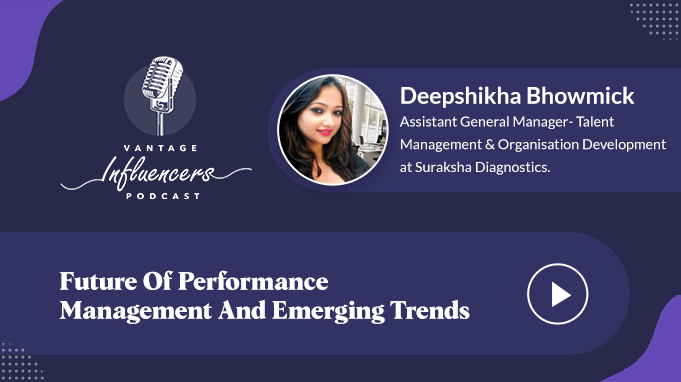
Future Of Performance Management And Emerging Trends
Episode Overview
Deepshikha opens the conversation by breaking performance management down into three linked processes: goal setting, ongoing monitoring, and evaluation, and argues that the real point of a PMS is to give employees clarity on where they stand rather than leaving them guessing about their contribution. She traces how a changing workforce is reshaping that system: with millennials already holding a growing share of management roles and a rising pool of freelancers and gig workers, she makes the case that performance management has to move away from a once a year, backward looking exercise and toward continuous, agile feedback built on daily task tracking and regular check ins.
She also digs into fairness and bias in appraisals, recommending that employees keep weekly journals to counter recency bias and that organizations run calibration exercises on anonymized past assessments before ratings are finalized. Looking ahead, she points to the rise of OKRs and the growing weight companies are placing on employee happiness metrics alongside sales numbers, and closes with a reminder that consistent, reliable delivery, not chasing credit, is what actually builds a professional reputation over time.
Episode Highlights
- Performance management runs on three linked processes: setting goals aligned with organizational objectives, monitoring progress on an ongoing basis, and evaluating results with recognition and reward attached.
- A more agile, technology driven workforce, including millennials moving fast into management and a growing pool of freelancers and gig workers, is pushing companies toward continuous performance management instead of once a year reviews.
- Weekly journaling helps employees counter recency bias, giving managers a fuller record of contributions rather than just the last few weeks before a review.
- Calibration sessions, where small groups review anonymized past assessments together before ratings are finalized, help appraisers justify decisions and build consistency across a team.
- OKRs and other continuous feedback frameworks are replacing purely rewards and punishment systems, with employee happiness increasingly tracked as its own KPI alongside sales and output numbers.
- Cascading annual goals from leadership down to individual scorecards, paired with regular town halls and small group discussions, keeps performance management tied to a company's stated values and culture.
About the Guest
Deepshikha Bhowmick, Assistant General Manager, Talent Management & Organisation Development, Suraksha Diagnostics
Deepshikha is a seasoned people person with over 10 years of experience in talent management, digitalizing HR, talent transformation, and driving OD interventions. She has been instrumental in helping organizations build performance and learning strategies and put them into practice to promote cross organizational decision making, drawing on a background that spans human resources, law, and corporate communications. She holds a strong academic record, having earned the Great Lakes Institute of Management's Gold Medal for Academic Achievement in Leadership and Strategy along with a dual graduate degree in Law and Humanities.
Connect with Deepshikha on LinkedIn
Host
Sanjeevani Saikia, Vantage Influencers Podcast Host
What You Will Learn
- Why performance management works best as three linked processes (goal setting, ongoing monitoring, and evaluation) rather than a single annual event.
- How recency bias distorts appraisals, and why weekly employee journaling is a practical way to counter it.
- What a calibration exercise looks like in practice, and how it helps managers justify ratings consistently.
- Why a more agile, freelancer heavy, millennial led workforce is pushing performance management toward continuous, technology enabled feedback.
- How frameworks like OKRs and happiness KPIs are reshaping what companies actually measure in a performance review.
- How cascading annual goals from the C-suite down to individual scorecards keeps performance management tied to company values and culture.
Key Topics & Timestamps
| Timestamp | Topic |
|---|---|
| 00:50 | Introduction to the episode and today's guest |
| 01:55 | Deepshikha's corporate journey from law into HR and talent management |
| 03:21 | What performance management actually means, and its three core processes |
| 05:54 | The role of technology in building a more agile, continuous performance management system |
| 09:05 | Using performance management to promote fairness, equity, and inclusion |
| 12:06 | Emerging trends: moving from rewards and punishment toward motivation, feedback, and OKRs |
| 15:34 | Aligning performance management with organizational values and culture |
| 18:51 | Deepshikha's closing message and how to connect with her |
Full Transcript
Click to read the full episode transcript
Welcome to the Vantage HR Influencers Podcast. This podcast is sponsored by Vantage Circle, the simple and AI powered rewards and recognition platform for employee engagement. Performance management is no less than an art. Think of it like a symphony orchestra. Each instrument must play in perfect harmony to create a beautiful piece of music. Similarly, a company's way of performance management must be finely tuned and perfectly orchestrated to ensure everyone is working together in harmony to achieve their goals. Owing to its significance, it is important for us to know what the future holds for the area of performance management.
Sanjeevani Saikia: Hello listeners, welcome to another episode of Vantage Influencers Podcast, where we explore a wide range of HR topics that are sure to grab your attention and inspire you. I'm your host, Sanjeevani Saikia, and I work as a content marketer at Vantage Circle. But from now onwards, I'll be a part of the Vantage Influencers Podcast as well. So, all excited for this new journey into podcasting, and going forward, I really hope you have a great time with me. So today, we will be having a conversation on the future of performance management and emerging trends in the field. And for the same, I have with me today Deepshikha Bhowmick, Assistant General Manager, Talent Management and Organization Development at Suraksha Diagnostics. Hi, Deepshikha!
Deepshikha Bhowmick: Hi, hello Sanjeevani.
Sanjeevani Saikia: First of all, I would like to thank you for giving your invaluable time and joining us in today's episode. Before we dive deeper into the area of performance management, would you kindly tell us a little about yourself and walk us through your corporate journey so far?
Deepshikha Bhowmick: Sure. To begin with, thank you. Thanks a lot for having me with you as a speaker. It is a delight to talk to you. So, for my background, born and brought up in Bengal, Kolkata, I did my BL LB from Calcutta University. I belonged to a family of lawyers. I lost my father when I was really young, around eight years old, so I've been very closely brought up by my mom, my single parent, and I'm very, very close to my mother, and that is something that has been my driving force in life. Being a lawyer, I worked with a petrochemical company as my first job in the legal department for almost five years. I realized I had to do higher studies, I had to get into management. So, I did my MBA with all the money that I had earned by then. I collated it all, put it in a bank loan, went and did my MBA from Great Lakes Institute of Management, and I came out as a gold medalist in HR and strategy. That is how my journey started.
Sanjeevani Saikia: Thank you for sharing your journey with us. You've surely gained a lot of valuable insights and skills along the way. So, now we can dive straight into the topic. I'm sure almost all our listeners know the performance management concept, but for those unfamiliar with the term and would want to know more, could you kindly explain what performance management is? Also, it would be great if you could provide a real life example of this concept in use, so our listeners could relate to it better.
Deepshikha Bhowmick: Sure. So, in a PMS, what we focus on is human capital: which people we need to let go, retain, or reward. And for all these purposes, the traditional appraisal system, with its emphasis on individual accountability, brings in the performance management system. Basically, it relies on three processes. Firstly, it starts off with goal management: plan and align employee performance with the objectives of the organization. Then, monitor the performance and the goals to ensure ongoing alignment, provide feedback, and recognize good results. And finally, evaluate and recognize the performance: assess performance consistently and accurately, recognize and reward strong performers, and use data driven insights to quantify the value of the output versus the value that employees bring to the organization. So, that's performance management for you. There are various tools we use for PMS: MBO, OKRs, Balanced Scorecard, 360 degree feedback, and assessment centers, to name a few. I have extensively used MBO initially, then 360 degree feedback, and recently the Balanced Scorecard, and I'm a big fan of that tool. At the end of the day, it is at the heart of the organization to understand where employees stand, how they are aligned with the objectives of the organization, and how they are delivering, with clarity on what they are supposed to do. They should not be left guessing how they are performing. Letting them know on time, effectively, how they are performing and how they can improve is more of a beneficial improvement and feedback process than anything else.
Sanjeevani Saikia: Thank you for explaining the concept in such a lucid manner. I'm sure our listeners will feel more confident about performance management now that you've explained it. I feel listeners will be interested to know the role that technology will play in the future of performance management. So, what role will technology play in the future of performance management? I would love to know your take on this particular aspect.
Deepshikha Bhowmick: So, firstly, in today's day, the biggest problem is when a PMS is focused only on rewards and punishment. When you are grooming talent for the future, which is also critical for the organization's long term survival, aligning the employee with the organization's objectives is key. Some researchers say that companies are moving towards models of performance management that are more agile, and technology has a big part to play in that. Think about today's workforce: we are working with millennials. Twenty seven percent of millennials are already managers today, five percent are senior managers, and two percent have already gone into executive roles. In another ten years, fifty percent of the workforce will be millennials. We are also working with gig workers and freelancers. Today, around forty percent of the entire workforce in the US are millennials, and it is likely to grow. When you are hiring people at this rate, working with freelancers and younger generations, you have to be agile in your processes. Your performance management has to be continuous, which means you will not wait for a year to appraise today's work. You have to build more agility into the system: workflows need predictive, data driven decisions, formal agile methodology, stand up meetings, and encouraging fast failures so people can learn and develop quickly. Define protocols and bring measurable values to everything, so that people can be appraised on a continuous, daily basis. People are working from anywhere today, over the phone, from cafes, from the beach. So, having technology that binds all this together, that lets you see your tasks for the day, the week, the month, and the quarter, and lets you stay in touch with your team members, updating them and getting updates from them continuously, is something technology is helping us with in a big way, and will continue to do so.
Sanjeevani Saikia: Absolutely, I couldn't agree more. Your perspective on this has been really very insightful. Now moving on, I hope you would agree with me when I say that organizations all over the world are going big on diversity, equity, and inclusion. Organizations are recognizing the importance of this concept as they strive to create diverse and inclusive workplaces that foster innovation, creativity, and collaboration. So, our listeners would surely want to know your perspective on this, and how you view DEI in the context of performance management. So basically, my question to you is, how can performance management be used to promote equity and inclusion? Also, it would be fantastic if you could share some tried and tested strategies or techniques for ensuring that performance evaluations are fair and unbiased.
Deepshikha Bhowmick: For performance management to be fair and unbiased, one thing an employee can do that is crucial today is keeping a journal. There are a lot of biases in the system, and one of them is recency bias, which affects employees and managers alike. Whatever you have done recently, you tend to remember, and you forget what you did earlier in the year. So, to counter recency bias, I suggest employees keep weekly journals: document all their activities, record the feedback they have received, and bring these journals together during discussions. It really helps employees showcase what they have done, and it helps managers remember what the employee has done through the entire year, rather than only recalling the most recent activities. Another important step management can take is to run practice scenarios. About a week before appraisals happen, form groups of six to eight people and guide them through hypothetical assessment scenarios. You can use files of previous or recent employees, ask these assessors to make their assessments, have the groups share and discuss their reviews, and compile the assessments before a group discussion where they present them to each other. This helps everyone understand how calibration happens. Having a good calibration exercise through this kind of practice helps appraisers explain an employee's contribution, make them feel valued, and justify the assessment with clear observations. Transparency today is quintessential, and the world is moving towards it, so that is something we have to focus on. So, being consistent in appraisals from the organization's perspective, and keeping a journal from the employee's perspective, is something I would recommend.
Sanjeevani Saikia: Deepshikha, that was really well said, and you've covered a lot of significant points. Many organizations are recognizing that traditional performance management practices, such as annual performance reviews and ratings, are not very effective when it comes to driving performance. As a result, they are experimenting with new approaches and technologies to improve the process, and we can see new trends and practices coming up. So, now let's discuss a bit about the emerging trends that you think will have the biggest impact, and how do you see performance management evolving in the next five to ten years?
Deepshikha Bhowmick: So, this brings me back to the initial point that performance management was very much based on rules and punishment. We are moving away from that and bringing focus more on motivation and feedback. A study recently found that a large share of employees are dissatisfied with their company's appraisal system, and it is often their only channel of feedback, so the number of employees who feel aggrieved and dissatisfied is huge, and it is largely for want of more feedback. So, a much clearer correlation between higher motivation and accurate feedback is something we can see in the most recent trends. And employee happiness today matters especially as companies build the infrastructure to bring employees back to their offices. According to Gallup, fifty two percent of American workers are not engaged with their work, and eighteen percent are actively disengaged. So, bringing employee happiness into the picture, adding happiness KPIs alongside sales KPIs to a manager's basket of metrics, is something that is very important and might really help. Recently, a process called OKRs, objectives and key results, has come up, and we see a lot of application of it everywhere, where people are putting more emphasis on linking personal plans to the growth of the organization. The technique helps with goal alignment, and we have seen companies like Google and LinkedIn take that up, measure objectives, track progress on a regular and daily basis, and keep giving feedback as and when the employee is doing something and as and when they are performing, so that employees are not kept guessing about their output, and the organization is not waiting until the end of the year to find out who was good and who was not. Continuous performance management is something we are seeing adopted increasingly, with roughly a third of the world's employees, especially in offices from Silicon Valley to New York, already part of this shift.
Sanjeevani Saikia: That's a wonderful point, and I'm sure our listeners would love to know your take on how organizations can ensure that performance management aligns with their values and culture. We would also love your tips and suggestions on how we can make it more transparent and effective.
Deepshikha Bhowmick: Right, so one thing that is fairly easy to do: when you have your annual business plans in place, along with the objectives of the organization, you bring that focus down from the scope of the CEO, getting it cascaded to the CMO, the CHRO, the CTO, the CFO, and every C-suite leader, and from there into the scorecards of individual managers and employees. This cascading methodology really helps when an organization is planning to ramp up production, move into new areas, or launch new product lines. Whatever the goals are for the next year, having them align down to the last person, say if cost effectiveness is a priority for the year, then even the last employee should have it written down how they are contributing to those savings. That is how individual goals align with organizational objectives, and how people understand what the organization values at that moment and what they can deliver in line with those goals. Having your core values, vision, and mission put up on the walls and screens in conspicuous places across offices builds awareness of what the values, vision, and mission actually are. Once that is done, it becomes ingrained in people's minds, and everything they do aligns with the objectives of the organization. The first part is to define these well: have the annual objectives written down clearly, quantify them well, and then finally align and cascade them down to the next level, so that every level is aligned. A continuous rolling up of this, maybe weekly, monthly, quarterly, bi-annually, and yearly, helps management stay in touch. Performance management should have two parts: not just numbers driving it, but also behavioral factors, learning agility, and the ability to understand organizational culture. Identifying who the culture carriers are, the spokespeople, the critical individuals who bring forth the organization's values, and recognizing and rewarding them is something that brings a lot of change in how organizations align with their employees. Also, having small focus group discussions, regular interval discussions, skip level meetings, and management town halls are very important tools organizations can use to cascade their values down to the last employee.
Sanjeevani Saikia: Agreed. So, Deepshikha, we have reached the end of today's podcast. Do you have any message for our listeners? Our listeners will be delighted to hear it from you. Also, our audience might want to stay in touch with you after this podcast, after all, it was really an enriching one. So, it would be great if you could tell them how they can reach out to you.
Deepshikha Bhowmick: Right, so firstly, the message from my end to everybody is: when you're doing your work, just focus on what you're supposed to be doing. A lot of credit goes to people who don't look for credit and just get their work done. Being a team player, understanding what the organization needs in the moment, and being able to deliver year after year is what brings recognition anyway, at the end of the day. So, not thinking about your own credit, and thinking instead about what's best for the organization, is something that will bring you a lot of value and help you build your own personal brand, which will help you in your future endeavors. I do a lot of sessions on performance management and the Balanced Scorecard. You can stay in touch with me on LinkedIn, my profile is Deepshikha Bhowmick, and I have around 10,000 followers there. Please come and join one of these conversations with me, I would love to hear from you, and I'm sure our listeners would too.
Sanjeevani Saikia: So, Deepshikha, it's been a pleasure to have you as our guest today. Your insights and expertise have been invaluable, and we are grateful for the time you've taken to share your knowledge with our listeners as well as with me. Thank you so much.
Deepshikha Bhowmick: Thank you. Thanks a lot for having me on your podcast. Take care. Bye bye.
FAQ
What are the three core processes of a performance management system, according to Deepshikha Bhowmick?
Deepshikha breaks a PMS down into goal management (planning and aligning employee performance with organizational objectives), ongoing monitoring (tracking progress and giving feedback to keep goals aligned), and evaluation (assessing performance consistently and recognizing or rewarding strong performers with data driven insights).
How can employees counter recency bias during performance appraisals?
She recommends that employees keep a weekly journal documenting their activities and the feedback they receive throughout the year. Bringing these journals into a review discussion gives both the employee and the manager a fuller picture of contributions, instead of the conversation being skewed toward whatever happened most recently.
What role does technology play in making performance management more agile?
Deepshikha argues technology enables continuous, daily performance tracking instead of a once a year appraisal, which matters as more of the workforce becomes millennial, freelance, or remote. Tools that surface daily and weekly tasks, support predictive workflows, and keep managers and employees in constant touch replace the old wait and see model of annual reviews.
How can organizations keep performance management aligned with their values and culture?
Her recommendation is to cascade annual business objectives from the CEO and C-suite down through managers to individual scorecards, so every employee's goals visibly connect to company priorities. She also recommends making vision, mission, and values visible across the workplace, and using regular town halls, skip level meetings, and focus group discussions to reinforce them, while recognizing the people who actively carry the culture forward.
Related Reading
Also listen on