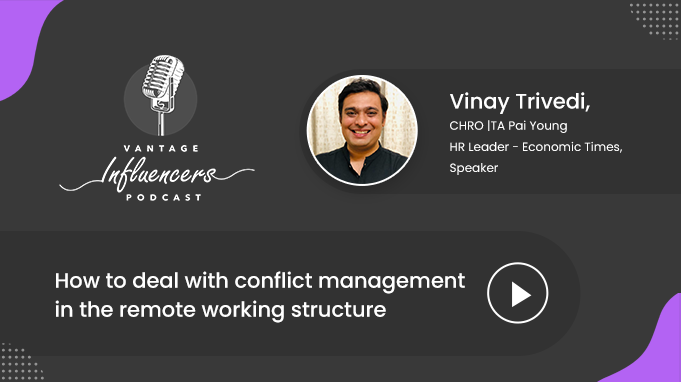
How to deal with conflict management in the remote working structure
Episode Overview
Vinay Trivedi draws on 14 years spent moving across IT services, BPO, banking, life insurance, and now a startup to unpack why conflict feels harder to manage once teams go remote. His starting point is that conflict itself isn't the enemy: it's simply what happens when someone has to choose between two valid options, or between people they believe in, and management is the discipline of steering that choice toward the larger good. In a remote setting, he argues, the same disagreement that would cool down naturally in an office (a colleague quietly pulling someone aside after a tense meeting) has no real equivalent online, so tension left unaddressed for even a day or two has more room to harden.
His sharpest point is a boundary he draws for HR: get involved only when a disagreement turns into an HR issue (disrespect, personal attacks), and stay out when it's a business issue (a debate over which idea or strategy wins), because the manager, not HR, is the actual first line of defense in resolving everyday friction. For re-engaging people after a conflict cools down, he offers a concrete three-step routine: create distance for everyone involved, let the situation diffuse before anyone tries to solve it, then step back in with clear direction. He pairs that with two habits he credits with preventing most remote conflict before it starts: over-communicating progress across the whole company, not just within one department, and staying transparent about what isn't working yet, both of which starve the rumor mill that fuels virtual disagreements.
Episode Highlights
- Conflict is simply the act of choosing between two valid options or between two people you trust, and management means steering that choice toward the larger good rather than eliminating disagreement altogether.
- Remote conflicts escalate faster than in-person ones because no one is around to quietly pull a disgruntled colleague aside right after a tense meeting, so how quickly you respond matters more than usual.
- Video calls strip out the non-verbal cues, a hesitant nod, a pause, that managers normally rely on to catch a brewing disagreement before it grows.
- HR should only step into a conflict once it turns disrespectful or abusive; disagreements over ideas or strategy are business issues the manager should resolve directly, making the manager the real first line of defense.
- Two habits prevent most remote conflict before it starts: over-communicating company-wide progress on a regular cadence, and staying transparent about what isn't working yet.
- His distance, diffuse, direct method (stepping back from a conflict, letting emotions cool, then re-engaging with clear direction) works better than trying to resolve tension in the heat of the moment.
About the Guest
Vinay Trivedi, HR Professional
Vinay Trivedi is an HR professional with 14 years of experience spanning Talent Management, Talent Engagement, and Talent Acquisition across IT, ITES, banking, insurance, and fintech. His path has taken him through large IT services and BPO organizations, into banking and life insurance, and now into a startup, a journey he describes as adventurous rather than linear, with plenty of setbacks along the way. That range across industries and company sizes shapes how he thinks about HR today: he believes challenging times call for innovative methods, and he's currently focused on bringing the human element back into HR practice.
Connect with Vinay on LinkedIn
Host
Susmita Sarma, Vantage Influencers Podcast Host
What You Will Learn
- How to define conflict management, and why some disagreement is actually a healthy sign of a growing team
- Why virtual disagreements escalate faster than in-person ones, and how to manage that compressed timeline
- How to compensate for the non-verbal cues that video calls strip away
- Where to draw the line between a business issue and an HR issue when a conflict flares up
- How over-communication and transparency reduce rumor-driven conflict on remote teams
- A repeatable framework, distance, diffuse, direct, for re-engaging employees after a conflict cools down
Key Topics & Timestamps
| Timestamp | Topic |
|---|---|
| 00:00 | Cold open and guest introduction |
| 01:21 | Vinay's 14-year journey across IT, BPO, banking, and insurance |
| 02:11 | Defining conflict and conflict management |
| 03:19 | Why remote disagreements escalate faster than in-person ones |
| 05:23 | The most common types of conflict in remote workplaces |
| 08:00 | Where HR should (and shouldn't) get involved |
| 10:08 | Why the manager, not HR, is the first line of defense |
| 11:49 | Over-communication and transparency as remote conflict management practices |
| 15:03 | Judgmental bias and how to reduce it |
| 16:59 | The "distance, diffuse, direct" re-engagement method |
| 18:37 | Steps managers can take to prevent future conflicts |
| 20:58 | Book recommendation: Strengths Based Leadership |
| 22:07 | Where to find Vinay online |
Full Transcript
Click to read the full episode transcript
Welcome to the Vantage HR Influencers Podcast. This podcast is sponsored by Vantage Circle, the leading employee benefits and engagement platform. We all face conflict at work, and dealing with conflict is a crucial skill to succeed. It can be your coworker who keeps going over your head for more benefits, or it may be your manager who took all the credit for your initiative. Sometimes we decide to have the difficult conversation, and sometimes we just shy away. So we know that getting everyone on the same page is difficult, and it is far more challenging when it comes to the remote working structure.
Susmita Sarma: Hello everyone, this is Susmita from the Vantage HR Influencers Podcast, and today we will have a conversation on the topic of conflict management in the remote working structure. Introducing our guest speaker today, Mr. Vinay Trivedi, who currently works as Head HR at a startup, with 14 years of experience in the field of talent management, talent engagement, and talent acquisition, across IT, BPO, banking, insurance, and fintech. Welcome to the show, Vinay.
Vinay Trivedi: Thank you very much for having me here, and let me also tell you that this is my first podcast.
Susmita Sarma: So, great. Very glad to partner with you and share some insights. Okay, so before we start, Vinay, we would love to know a little more about you and your journey in HR.
Vinay Trivedi: I had a very interesting journey as far as my HR career is concerned. I say it's interesting because I've actually tried four or five different types of industries. I've worked across information technology services, BPO, banking, life insurance, and now I'm in a startup ecosystem. So my journey in that sense has been very exciting and adventurous. I've failed many times, I've fallen flat many times, and I've had a lot of conflicts, and I've still sort of progressed and kept going.
Susmita Sarma: So coming to the topic, Vinay, how would you describe the term conflict management?
Vinay Trivedi: See, in my view, let's first understand what conflict really means, and then the management of it can come in. Conflict is sometimes to do with making a choice between two rights, or making a choice between two people that you believe in. And conflicts are also internal. When I say internal, it's more of a conflict between the left and right side of our own self, of what we want to do and what we don't want to do. So conflict really is about making that difficult choice, and management is trying to see how the choice we make is in the larger good, in this context an organization, or it could be anything else that you're actually deciding for.
Susmita Sarma: So conflicts are common in any team, but they need to be handled a little more carefully when it comes to remote teams. Why is it that disagreement among virtual teams can escalate more quickly than in face to face encounters?
Vinay Trivedi: This is a very interesting question that you actually ask. When you're in a normal scenario and there are conflicts, there are ways and means to diffuse or reduce those conflicts, because you're present together in a particular location. When it comes to virtual teams, you don't get that immediacy. I'll give you an example. There's a heated argument that happens in a team meeting, there's a conflict of views and opinions, and a certain decision gets taken which obviously may not be agreeable to everybody in the team. But when two or three people are disgruntled or angry after the meeting, in person there's usually somebody who will reach out to them and have a conversation to diffuse that tension. Virtually, that may not be possible with the same intensity, because you'd have to do a call or a video conference. So conflicts in a virtual setting have to be managed in a very time-sensitive manner, because it's critical that you address it as soon as you can when it comes to virtual teams. And the only reason it escalates so quickly is because there's nobody who can come to you and say, "Hang on, don't worry, I have a different view, let me explain," while you sort this out, because everyone is virtual. So it has to be treated very sensitively, and more importantly, time-sensitively. The timing of how we diffuse it matters more.
Susmita Sarma: So what are the most common conflicts that we see in remote workplaces?
Vinay Trivedi: Remote workplaces still see the normal conflicts that happen anywhere, differences of opinion, differences of strategy, differences of approach in trying to get to a solution for a problem. Those are your normal workplace conflicts. When you're working virtually, the compounding factor is that people aren't able to clearly read your non-verbal communication. In a team meeting in person, somebody may nod and say "I agree" when you can tell they're actually not comfortable, so you can ask, "Hey, what's the matter, you don't seem convinced." Virtually, that's not 100% possible. So another layer to these common conflicts is the non-verbal communication piece, which is often present in a conflict scenario. That's one. The second thing, when you look at remote workplaces, is the appreciation of complexity. We're human beings, we're social beings, we're tuned to meet people and feel their physical presence. Virtually, that absence may add to the stress that leads to conflict, because you're not in physical presence in any of these conversations. So it makes you that much more hypersensitive in your approach. And there's also FOMO, fear of missing out. Because you're not together, you may be wondering what the other people are thinking after a call. Had you been in the office, that would have been a normal, visible scenario, you'd be seeing what's happening around you. So it may not be true, but it can become a conflict point where we're constantly wondering what's happening on the other side, are they on the same track, are they thinking differently, we don't know. That invisible parameter can add to a conflict scenario. So those are two conflict types specific to the virtual world, apart from the normal conflicts that happen everywhere.
Susmita Sarma: So is it true that HR shouldn't be involved in every conflict, because then they become the police station of the company?
Vinay Trivedi: HR is also the police, HR is also the principal of a college, HR is also a friend, a philosopher, a guide. HR is basically the one back you can keep punching on and not expect retaliation or any issue arising out of that punching. As HR, we're that sponge, we keep absorbing a lot of these things. In my personal opinion, and in my professional journey, HR should only get involved in a conflict if it's an HR issue. HR should not get involved if it's a business issue. Now you may ask, how are they different? Ultimately it's all connected, but a business issue is, say, there's a project you have to run, and for that project there are different ideas coming up, and there will be conflict in the way those ideas take shape, and eventually one idea has to be chosen over the other. HR cannot get involved in that process and say, "No, no, you should look at the project like this or like that." That's not a conflict HR should be involved in. When I say an HR conflict, I mean if something becomes disrespectful in that whole exchange, if the conflict turns ugly into a fight where people are abusing each other, that becomes an HR issue. So you're not really telling them how the project should be run, but you're telling them how they should behave in those conflict moments. HR should consciously separate itself from business issues and only get involved in HR issues. That's how I'd look at HR's involvement in a conflict scenario.
Susmita Sarma: But we see that most of the time, when employees are disappointed, they tend to say, "If you can't resolve this, I'm going to HR." That comes across as a threat to many managers, I suppose. So should managers exhaust their own strategies to resolve a conflict before involving HR?
Vinay Trivedi: HR and the manager aren't two different people, by the way. The manager is the first HR you always have. Even in defense, there's a first line of defense, which is your soldier level, then a second layer, then a third layer. If you look at chess as a game, you have pawns as the first line of defense and then your other pieces behind them. The manager, in this context, is the first line of defense, in the sense that they're the first HR solving the problem, in two ways. Somebody comes to the manager disgruntled, saying, "Boss, what's happening, this person is treating me like this, this isn't how it should be," and so on. The manager separates two issues: are you angry with the person, or are you angry that your idea isn't moving fast enough? If it's the latter, the manager can explain why the idea isn't moving fast. If it's that you feel someone is responsible for holding you back, then you have to separate your personal bias and look at it objectively. That's HR work that a manager does. So it's never a threat, in fact the manager is the first HR before somebody ever comes to us for conflict resolution. Does that make sense? It gives you a perspective.
Susmita Sarma: Sure. So what are the top conflict management practices you'd like us to know and learn, especially considering the remote working structure?
Vinay Trivedi: I think there are two things that clearly work very well in a remote working structure. The first thing that works, and that every organization should adopt, is over-communication of what's happening and progress reports. In an office environment, you're walking past someone, you take an update, you go to different meetings, you get an update, everyone's around you, so you keep getting updates and information. When you're working remotely, that chain is broken, you're only walking from your room to your kitchen and back, you're not meeting anybody in between. So over-communication as a policy, where the leadership team and managers give weekly updates on what's happening around the company, not just in their own department (because in their own department they'll anyway be up to date), but overall what's happening, that's important. You need to keep telling people where things stand and what's being done. What that does is give people reassurance in their head that they're still involved, that they know what's happening in marketing, sales, tech, finance, because they're getting those overall updates. So over-communication, as a strategy to reduce the conflicts that build up in people's minds, is an important step. The second step is transparency. I think people assume transparency gets impacted the most when working virtually, because it's a look-and-feel thing, imagine working on a keyboard you can't see, an invisible laptop, just typing and assuming, that alone makes you feel uncomfortable. So transparency in your approach, whenever communication happens, also telling people transparently what isn't happening, where things stand, what the issue is, that really builds confidence and trust. The minute that trust is built, conflicts reduce, because otherwise, if somebody calls and says, "Do you know that person was also trying to do this," it plants a seed in your head and you start looking at things from a conflict perspective. But if you have transparent, over-communication happening, daily or weekly updates, you can say, "What are you talking about, I already know this, it was discussed in the last meeting." It reduces rumor-driven conflicts. So transparency and over-communication are two critical tools people have to use while managing virtual teams.
Susmita Sarma: Is there a huge scope for judgmental bias in remote workplace conflict management?
Vinay Trivedi: Judgmental bias has nothing to do with virtual or physical working, judgmental bias is to do with one's own assumptions in their head. How do you reduce judgmental bias, or how do you keep it from creating an impact on you? By continuously communicating. It's like when people keep repeating something to you, this is what it is, this is what it is, you stop judging, because you start believing whatever communication is coming through. And when people are transparent, saying "we're doing these things well, these other things we haven't addressed yet, so please bear with us till then," it reduces the conflicts that arise from you making assumptions. What we need to understand here is that in any conflict situation, the approach to managing conflict isn't a cure, these are supportive measures, not permanent fixes. When I say supportive, it only reduces the level of conflict, it doesn't end it, you'll still continue to have some conflict, you address one thing and something else comes up. You look at how you reduce it, you can never say you'll eliminate conflict from your organization altogether. So judgmental bias, in a similar manner, through the tools you use to gain your employees' trust, over-communication, transparency, giving regular updates, talking to people, will only help reduce that bias.
Susmita Sarma: So how do you re-engage an employee after a conflict has taken place?
Vinay Trivedi: We particularly use an approach which is distance, diffuse, and direct. If there's a conflict, and we realize it's going out of control or could turn into a bigger problem, we immediately look at creating distance from that conflict, every party involved distances themselves. Once you distance yourself, because in the heat of the moment a lot of things happen, it diffuses the situation for a while. Once you let it cool down, and people are in a calmer frame of mind than before, you immediately look at engaging and talking to them, and giving them direction on what needs to happen. That's why we say distance, diffuse, direct: first we distance, then we wait for it to diffuse, and then we give direction on what needs to be done. That really works. Whenever there's a conflict, there's no point jumping in to solve it immediately, because sometimes what you use to douse the fire may not be water but kerosene, which only increases the intensity of the fire. So distancing first is important.
Susmita Sarma: So what are the most important steps remote managers can take to avoid future conflicts?
Vinay Trivedi: If you ask me, for remote managers, or managers in general, conflicts are a sign that the team is progressive and growing. Conflicts are never bad, not addressing conflicts is the bigger issue. Sometimes people don't want any conflict in their team at all, but when you don't have conflict, you don't grow, because everybody's just saying yes to whatever you're saying, so where's the growth coming from? How do you outgrow what you've already done? So conflicts are good, mostly, because when diverse ideas come in, conflict occurs. The fact that diverse ideas are coming in means you're growing, and that only happens when there's some friction, like in the Stone Age, when friction between two stones created fire. Without that friction, nothing happens. So my advice to managers is that you should allow healthy conflict. If there's no conflict, that means your team isn't telling you something, so it's critical to have those conflicts. What you also need to do, as a manager, is recognize when a conflict is about to turn into a major issue, and at that point, use the distance, diffuse, direct approach I just mentioned, so you can control those conflicts.
Susmita Sarma: Based on your studies and research, would you like to suggest some good books or courses on conflict management to our audience?
Vinay Trivedi: I think it's not really a conflict management book specifically, but it's a very important book for building leadership character, and conflict is just one part of what you manage as a leader. It's called Strengths Based Leadership. This book talks about how great leaders and great teams are made, and why people follow those leaders and teams, and conflict resolution is a very critical part of this book. So I think people should read this book, Strengths Based Leadership.
Susmita Sarma: Well, it was a great session with you, Vinay, and there's a lot more to learn, so please tell us the best way our listeners can reach out to you.
Vinay Trivedi: LinkedIn is a platform I'd prefer, they can look up Vinay Trivedi on LinkedIn, I'm sure they'll find me. I also have a channel called VT Talks, short for Vinay Trivedi Talks. This channel has short, six or seven minute videos that help a lot of people work on building their careers, whether it's building your profile, tips on interview skills, or tips on conflict management, multiple videos. They can look up VT Talks on YouTube and check out the videos as well.
Susmita Sarma: Okay, thank you so much for all your valuable inputs, and thanks for joining us, Vinay.
Vinay Trivedi: Thank you very much, Susmita, for this great conversation, and for giving me my first podcast. This is going to be memorable, because the first is always memorable. Thank you very much, thank you for inviting me.
Thanks for listening to the Vantage HR Influencers Podcast. Do subscribe to the Vantage HR Influencers Podcast on Apple Podcasts and Spotify for new episodes.
FAQ
What does Vinay Trivedi mean by "conflict management"?
Conflict, in his framing, is the act of choosing between two valid options or between two people you respect; management is the discipline of steering that choice toward the larger good of the organization, or whatever you're deciding for. It isn't about eliminating disagreement, since conflict, when handled well, is often a sign a team is growing rather than stagnating.
Why do conflicts escalate faster on remote teams than in person?
In an office, someone upset after a heated meeting can usually be pulled aside by a colleague within minutes to defuse the tension. Remote teams don't have that safety net: reaching someone requires a deliberate call or video chat, so unresolved friction has more time to harden. Vinay stresses that remote conflict has to be addressed in a time-sensitive way precisely because that informal, in-person defusing simply isn't available.
Should HR get involved in every workplace conflict?
No. Vinay draws a clear line: HR should step in only when a conflict becomes an HR issue, meaning it turns disrespectful or abusive, not when it's simply a business disagreement over which idea or strategy to pursue. In his view, the manager is effectively the first line of defense, resolving day-to-day disputes before they ever need to reach HR.
How does Vinay recommend re-engaging an employee after a conflict?
He uses a three-step approach he calls distance, diffuse, direct: first create distance from the conflict for everyone involved, then wait for emotions to cool rather than trying to solve things in the heat of the moment, and finally re-engage with clear direction on what needs to happen next. He also credits over-communication and transparency, regular company-wide updates and honesty about what isn't working, with preventing many conflicts from arising in the first place.
Related Reading
- 7 Great Tips to Effectively Manage Your Virtual Teams
- 13 Tips On How To Have Difficult Conversations With Employees
- Transparency in the Workplace: A Complete Implementation & Measurement Guide
This episode is part of the Vantage Influencers Podcast, where we bring HR thought leaders to discuss engagement, compensation, benefits, and everything related to HR.
Also listen on