Back to Office: Revival or Rebellion?
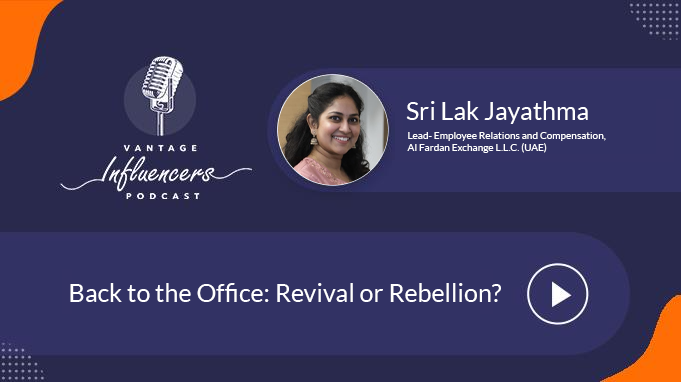
Episode Overview
Sri Lak Jayathma argues that no single motive explains the return-to-office push. It is a blend of genuine business needs (leaders who believe in-person collaboration solves problems faster), cultural anxiety (organizations that want new hires to absorb culture in person, especially after pandemic-era onboarding left many new joiners disoriented on their first physical office visit), and, for some managers, plain old control born from a mistrust that off-site work means lower output. She is clear that the pandemic did not create a workplace rebellion, it forced a rethink: with Gen Z employees entering the workforce with different expectations than millennials or baby boomers, organizations that cling to one-size-fits-all mandates will keep losing that argument.
Her sharpest point comes from a personal story: a former boss running HR at a Sri Lankan tech company that has no permanent office at all, only a rented "workspace" used on demand for client meetings or team gatherings. That model works, Sri Lak says, because it starts from trust, the location does not matter as long as employees deliver. She extends that logic into a practical policy framework of her own: hybrid decisions should be made by job role, not industry. Frontline, healthcare, and hospitality roles need physical presence because you cannot serve a customer through a screen, while back-office functions like HR, accounts, and compliance do not need to be tied to a desk at all. Looking ahead, she expects the workplace to keep leaning hybrid, with flexibility earned through mutual accountability rather than granted through blanket policy.
Episode Highlights
- The push to bring employees back to the office is rarely just one thing. It's usually a mix of real business needs, a desire to protect company culture, and, for some managers, plain mistrust of remote work.
- Pandemic-era onboarding done entirely online left many new hires disoriented on their first day in a physical office, which is part of why some organizations now insist new joiners experience culture in person.
- The pandemic significantly shifted power toward employees, driven by a generational shift in priorities: baby boomers worked for survival, millennials for standard of living, and Gen Z weighs benefits and flexibility as heavily as salary.
- A former colleague's tech company in Sri Lanka has no fixed office at all, only a rented workspace used for meetings, proof that trusting employees to deliver results matters more than requiring their physical presence.
- Hybrid policy should be designed around job role rather than industry: frontline, healthcare, and hospitality roles need physical presence, while back-office functions like HR, accounts, and compliance can work just as well remotely.
- Looking five to ten years ahead, the workplace will likely stay hybrid rather than swing fully remote or fully in-office, with flexibility built on mutual trust instead of rigid monitoring.
About the Guest
Sri Lak Jayathma, Lead - Employee Relations and Compensation, Al Fardan Exchange L.L.C.
Sri Lak Jayathma is a Human Resources professional with over 13 years of experience across the software, automotive, and financial sectors, currently serving as Lead - Employee Relations and Compensation at Al Fardan Exchange L.L.C. in the UAE. She specializes in HR operations and employee relations, with a track record of implementing hybrid work models, redesigning global onboarding programs, and building inclusive, engagement-driven workplace cultures. Sri Lak holds a Bachelor's degree in Human Resources from Northumbria University and an MBA in HR from the University of Bedfordshire.
Connect with Sri Lak on LinkedIn
Host
Shabana Shahnaz, Vantage Influencers Podcast Host
What You Will Learn
- Why the push to return to the office is rarely driven by a single factor, and how to tell whether your organization's motive is business need, culture, or control
- How to build a hybrid policy that adapts to Gen Z's different expectations of work instead of applying blanket in-office mandates
- Why the pandemic shifted negotiating power toward employees, and what that means for compensation and benefits conversations
- How the "workspace, not workplace" model works, and when it makes sense to trust employee output over physical presence
- Why hybrid policy should be built around job role rather than industry, with concrete examples of which roles need in-person presence and which don't
- What a sustainable hybrid culture could look like five to ten years out, and how to build flexibility without inviting misuse
Key Topics & Timestamps
| Timestamp | Topic |
|---|---|
| 01:31 | What is really driving the return-to-office push: business need, culture, or control |
| 04:35 | Why employee resistance to RTO mandates isn't rebellion, it's a request to rethink work |
| 07:34 | How COVID-19 reshaped the balance of power between employers and employees |
| 12:16 | Designing hybrid work models that deliver results without sacrificing flexibility |
| 15:07 | Which roles and industries genuinely need physical presence, and how policy should adapt |
| 18:17 | What workplace culture could look like a decade from now |
Full Transcript
Click to read the full episode transcript
Welcome to the Vantage HR Influencers Podcast. This podcast is sponsored by Vantage Circle. After years of working in pajamas and attending meetings from the kitchen table, the corporate drumbeat is getting louder: it is time to come back to the office. But is this a revival of teamwork, or the start of a workplace rebellion? In today's episode, we explore the forces behind the return-to-office push and what it means for the future of work. This is Back to Office: Revival or Rebellion?, where we peel back the glossy HR memos and dig into what is really driving this movement. And to help us do just that, we have someone who lives and breathes employee relations every single day. Let's welcome our esteemed guest for today's episode, Sri Lak Jayathma, who is the Lead for Employee Relations and Compensation at Al Fardan Exchange L.L.C. in the UAE. Sri Lak is a seasoned HR professional with over 13 years of experience in creating engaged workforce cultures, driving HR digitalization, managing HR operations, and championing people and culture initiatives. Sri Lak, a very warm welcome to the show. It's a pleasure to have you with us today.
Sri Lak Jayathma: Thank you so much, Shabana. It's a great pleasure and a great opportunity for me as well to join today.
Shabana Shahnaz: Great, amazing. So Sri Lak, to set the tone of today's episode, let's start right at the heart of it. There's been a noticeable push from many companies to bring employees back to the office. From your perspective, what do you think is truly driving this push? Is this pure business need, a desire to rebuild workforce culture, or is there an element of control as well? What's your take on it?
Sri Lak Jayathma: Shabana, I believe it's actually a mix. It's not purely business needs, or culture, or control. Some leaders believe in an in-person approach to collaboration, because they think problem-solving and team-building are more effective face to face. So they think if employees are back in the office, it will be more effective. There's the culture angle too, because some organizations value their culture highly, and they believe that if employees are back in the office, they can maintain a strong identity, especially for new talent coming through onboarding.
During the pandemic, if you recall, we used to do onboarding and induction for newcomers entirely online. Then after some time, when they finally came into the office, they would feel like, "Oh my goodness, is this another planet?" No, it's just the office. So in that case, it's basically about culture. I believe new joiners must come to the office and see the culture in person before they can truly adapt to it.
And then there's control, because some managers, I don't like calling them leaders, actually, think that if their subordinate works from home, their productivity or efficiency will go down. They have that orthodox mindset, so they push employees to come in.
But based on my experience, it should be mixed, it should be hybrid. If it's a genuine business need, fine, come to work. If it's about culture, we can factor that in too. But we're in 2025 now, after the pandemic and after so many ups and downs over these years, and we should be flexible with employees. Our new joiners are increasingly Gen Z, not millennials or baby boomers, and their thinking and way of working is totally different from ours. We have to cater to that as well.
Shabana Shahnaz: Great, great. So Sri Lak, how do you think employees are actually responding to these return mandates? Would you call this resistance, an act of rebellion? Or is it more of a collective request to rethink what work should look like?
Sri Lak Jayathma: When it comes to requesting employees to come to work or report to the office, it's not rebellious, actually. It's about rethinking. Organizations should rethink their culture and rethink their work policies.
Before the pandemic, the concept of remote work or work-from-home wasn't as common. I remember when I started working, one of my previous companies had flexible working hours, but work-from-home wasn't really an option, especially in HR. We felt we needed to see our employees in person, to talk to them face to face. But after the pandemic, the good side of it was that we learned how to do everything online: groceries, medication, even schooling moved online. There was a bad side too, of course, but because of the pandemic, we learned so many concepts that already existed but weren't that popular, like work-from-home, which used to be mostly confined to the tech industry and not other industries.
After the pandemic, all of us had to work from home, and employees realized they could get work done without physically going to the office. At the same time, they understood work-life balance better. If you look at it, Shabana, most of us, even millennials, think a lot more now about work-life balance, mental health, and flexibility, because we finally have time for ourselves and our families. That's why employees now lean toward flexibility, not fully remote, but hybrid: some days in the office, some days from home. So organizations always need to rethink their work policies.
Shabana Shahnaz: Right. So, talking about this power dynamic, do you think the pandemic has fundamentally shifted the balance of power between employers and employees, or are we slowly sliding back to pre-2020 norms?
Sri Lak Jayathma: I would say the pandemic has significantly shifted the balance of power toward employees in many ways. Let me give you an example, Shabana. Back in my father's or grandfather's generation, the baby boomers, their mindset was about survival: food and shelter, working to provide for the family. For us, yes, we also need food and shelter, but it's beyond that. Millennials mainly focus on standard of living when choosing a job, because our parents already built the foundation for us. So now, for us, it's about standard of living.
For Gen Z, their parents or grandparents already built that base too, so for them, it's about even more than standard of living. When it comes to comparing generations, my father's generation only thought about salary. If they got two offers at the same time, they'd compare salaries. But nowadays, including for people like me, apart from salary, which we still need to pay our bills, we also look at benefits. I'll check whether we're getting weekends off, flexible working hours, hybrid options. During recruitment and offer negotiations, candidates are increasingly asking about benefits first. Even if I get two offers and one pays a little less, if it gives me those flexible options, I'll choose it, because the pandemic proved that organizations can replace you at any time, however harsh that sounds. But at the end of the day, for my loved ones, I'm the person they rely on, as a son or daughter, husband or wife. So I need to stay healthy and focused on myself.
Because of that, most Gen Z employees, and millennials too, are now more focused on mental health and well-being than salary alone, even though they still need salary. Employees now have more leverage to choose. If a company isn't offering the pay, work-life balance, or culture they want, they'll simply choose another option. Employees are increasingly advocating for mental health and diversity, and because of that, employers need to recognize these generational shifts in the market and update their policies and procedures accordingly, instead of sticking to old-school thinking.
Shabana Shahnaz: Correct, correct. I completely agree with everything you've said. That actually brings me to something many of us wonder: apart from power dynamics, because that's obviously only part of the puzzle, there's also the challenge of designing a work model that delivers results while keeping employees engaged at the same time. In your view, how can organizations strike that balance between productivity, flexibility, and collaboration, especially as many lean toward office-first setups?
Sri Lak Jayathma: Whenever you bring up office setups, it reminds me of something. I'm originally from Sri Lanka, and I now live in the UAE. Last year, I visited my home country and met one of my previous bosses. She's in the tech field, and her thinking is quite different from typical MNC HR thinking.
I asked her, "Where's your workplace?" And she said, "Excuse me, we don't have a workplace, we have a workspace." I asked what that meant, because for us, whether in the UAE, India, or Sri Lanka, we usually have an office, with our branches based there. She explained that because tech culture is quite different, and a little funky, they don't have a fixed workplace, they have a workspace. That means they don't push employees to come in every day. If they have meetings or need to get together, they rent a workspace from a management company, and other companies use the same shared space too.
It's a very good initiative. If they want to meet a client, they go there. If they have employee engagement activities, they hire a space and bring employees together for networking. The flexibility they give employees is really remarkable, because it starts from trust: they trust that the location doesn't matter, what matters is that employees deliver the tasks assigned to them.
Shabana Shahnaz: Right, I completely agree. I imagine not all industries, or even all job roles, are in the same boat when it comes to workspaces versus workplaces. So are there specific sectors or positions where returning to the office simply makes more sense? And if so, how should workplace policies adapt to account for those differences?
Sri Lak Jayathma: You mentioned job roles, and that's exactly right. We can create different work-schedule policies based on industry and job role. For example, industries like healthcare, retail, and hospitality need physical presence. You can't welcome a guest online. It's the same with healthcare. We now have online doctor consultations, but as people, we still prefer visiting a hospital in person, because that human touch from a doctor matters. So in those industries, physical presence really is important.
But we used to think teachers also had to be physically in school, and now a lot of that happens online too. So we shouldn't create the same policy for every organization or industry based purely on the industry itself; it should be based on job role. In my current organization, we have frontline and back-office roles. Frontline employees face customers directly, so they can't work from home or hybrid, because they need to meet customers face to face. But for back-office employees, in HR, accounts, compliance, and most other functions, we can work hybrid. If there's something specific that requires their presence, they come in; otherwise, they can work from home. So I believe policy shouldn't be based on industry alone, it should be based on job role. It's not about tailoring policy to the industry as a whole; it needs to be customized to the actual role, not just copied from somewhere else and applied wholesale.
Shabana Shahnaz: That was really insightful. I think I'll come to the last question for today's episode. If we zoom out and look five or ten years ahead, what do you see? Is there a workplace that's fully flexible, shaped by employee choice, or a slow but steady return to the traditional office environment?
Sri Lak Jayathma: I believe all of this is good, but the traditional office setup should still exist, just gradually moving toward a hybrid model. That doesn't mean fully remote or fully in-office, it should be somewhere in between. If you have something that requires you to come in, you come in.
Because I'm in HR, I always think from the employee's perspective. Some days we're full of projects, and the next day maybe we don't have much to complete because the deadline is further out. And there are days when employees have a lot of work but not much energy, mood swings happen to all of us. On a day like that, if I can tell my boss, "Can I work from home today? I'm not feeling my best," and my boss says, "No problem, but you still have this deadline, so just deliver," that's how a healthy work environment should function. You have to understand your employees. If you try to monitor and control them constantly, you won't get real productivity, even if you think that requiring people to physically report to the office guarantees it. That's not true. Some employees do misuse the flexibility or benefits an organization gives them.
I always tell new hires during induction: don't misuse the opportunities or benefits given to you, because if you do, you might not feel the impact immediately since you're the one enjoying it, but the people who come after you will be the ones who lose that opportunity. So please be mindful. We're all working professionals, we know how to use these benefits responsibly and shouldn't misuse them.
So overall, I believe it's better to move toward a hybrid model, because it benefits both the organization and the employee. As I mentioned earlier, mental health matters more now, even baby boomers are focused on their health today, going to yoga, the gym, following meal plans, all for their physical and mental well-being. A hybrid, adaptive, and flexible work culture allows people to fit that in.
Shabana Shahnaz: Right, correct. I agree that there has to be a balance that considers employee health and mental well-being while also staying dedicated to the work we do. Whether we call it revival or rebellion, one thing is certain: the conversation about where and how we work is far from over. I think this brings us to wrapping up today's episode, Sri Lak. It was a very insightful conversation and honestly a lot of fun. Thank you so much for sharing your insights and giving us a closer look at what's really happening inside organizations today. And to our listeners, if you enjoyed this episode, remember to subscribe and share it with a colleague. Most importantly, let's keep the conversation going, because the future of work is being written right now, and we're all part of that story. Sri Lak, thank you so much once again, it was delightful to have you on the show.
Sri Lak Jayathma: Thank you so much for inviting me today. I really enjoyed this, and I'm happy I got the chance to share my thoughts and experience with our fellow listeners.
Shabana Shahnaz: Of course, of course. Thank you so much, listeners, for tuning in. I look forward to exploring the next chapter of the world of work with you. Until next time, then. Thanks for listening to the Vantage HR Influencers Podcast. Please do subscribe to the Vantage HR Influencers Podcast YouTube channel for new episodes.
FAQ
What is really driving the push to bring employees back to the office?
According to Sri Lak Jayathma, it is rarely one single motive. It is typically a mix of genuine business needs, a desire to protect company culture (especially for onboarding new hires), and, in some cases, a manager's mistrust that remote work lowers productivity.
Is employee resistance to return-to-office mandates a form of rebellion?
No. Sri Lak Jayathma argues it is not rebellion but a request to rethink outdated work policies. She points to the fact that employees, especially Gen Z, now expect flexibility and work-life balance as standard, not as a concession.
Has the pandemic shifted the balance of power between employers and employees?
Yes, significantly, according to Sri Lak Jayathma. Generational shifts in priorities, from survival-focused baby boomers to benefits- and flexibility-focused Gen Z employees, have given employees more leverage to choose employers based on more than salary alone.
Should hybrid work policy be based on industry or job role?
Job role, according to Sri Lak Jayathma. Industries like healthcare, retail, and hospitality need physical presence for certain functions, but within any organization, frontline roles that face customers need in-person presence while back-office functions like HR, accounts, and compliance can work hybrid.
Related Reading
Also listen on




You might also like
 Remote Working Wfh
 How Are Total Rewards Strategies Evolving to Meet the Demands of Hybrid and Remote Work?
 Remote Working Wfh
 How to keep communication open for remote employees with Amit Malik
 Remote Working Wfh