
Every generation enters the workplace carrying its own ideas about what work should feel like. But with Gen Z, the shift feels sharper, faster, and far harder for organizations to ignore.
Many companies initially assumed Gen Z would simply be "Millennials, but younger." They are not. The differences appear almost immediately in how they communicate, what they question, what they tolerate, and what makes them leave.
Gen Z grew up in a world shaped by instant access to information, seamless technology, economic uncertainty, and constant digital connection. They learned to navigate AI tools before entering full-time work. They watched burnout become normalized online long before they experienced it themselves. And unlike previous generations, many entered the workforce already skeptical of the idea that loyalty to a company automatically guarantees stability, growth, or reciprocity.
As a result, they approach work differently. They learn quickly, adapt quickly, and disengage just as quickly when systems feel outdated, performative, or unnecessarily rigid.
Perhaps the biggest shift, however, is their expectation of alignment. Gen Z pays close attention to the gap between what companies say and what employees actually experience.
Organizations are now realizing that meeting those expectations is not just about attracting Gen Z talent. It is about building a workplace that feels relevant to the future of work itself.
Key Takeaways
- Who are Gen Z'ers or Generation Z?
- Key Expectations of Gen Z Employees in the Workplace
- How to Implement Rewards and Recognition Program for Gen Z
- Learning to Prioritize Mental Health and Well-being of Gen Z Employees
- Why does Gen Z Prioritize Workplace Transparency and Real-time Feedback
- Understanding Why Gen Z Value Open Communication and Teamwork
Who are these Gen Z'ers?
Gen Z is the cohort born between 1997 and 2012, the first fully digital-native generation, and the fastest-growing segment of the global workforce. Gen Z accounts for 27% of workers worldwide in 2026 (Deloitte 2025) and is projected to overtake Baby Boomers in headcount across every major economy by 2030 (World Economic Forum 2025).
There are three forces shape how this generation shows up at work.
- They entered the workforce mid-disruption. Gen Z graduated into a pandemic, watched remote work become normal, and saw two waves of layoffs before turning 25.
- They are fluent in feedback. Gen Z grew up with social-media metrics, gaming scores, and instant peer response.
- They are the most mental-health-aware generation in workforce history. They expect employers to treat well-being as infrastructure, not as a perk.
The fastest way to understand Gen Z is to see what changed from the two generations before. The table below maps eight workplace dimensions across the three active generations.
| Dimension | Gen X (1965–1980) | Millennials (1981–1996) | Gen Z (1997–2012) |
|---|---|---|---|
| Preferred work model | Office-default, flexibility as a perk | Hybrid by negotiation | Hybrid or remote by default |
| Feedback cadence | Annual review | Quarterly or bi-monthly | Weekly to daily |
| Recognition expectation | Tenure-based, milestone awards | Project-based, manager-led | Continuous, peer-driven, public |
| Career view | Climb the ladder | Build a portfolio | Skills over titles, lateral moves welcomed |
| Mental health at work | Private matter | Acknowledged, often unspoken | Openly discussed, employer-supported |
| Technology fluency | Adopted | Adapted | Native |
| Loyalty to employer | High, long tenures | Medium, 3–5 year cycles | Conditional, values-tied |
| Purpose at work | Pay first, purpose second | Purpose alongside pay | Purpose as a non-negotiable |
The 12 Key Expectations of Gen Z Employees
1. Work-Life Balance and Schedule Flexibility
For Gen Z, flexibility isn’t really about avoiding the office. It’s about autonomy, trust, and having some say in how work fits into a life. They watched older relatives build entire routines around rigid schedules and brutal commutes, and they came away with a simple conclusion, and that is being in a chair from nine to five is not the same thing as doing good work.
That’s why a vague promise of "work-life balance" lands flat with them. They’ve heard it before, usually from companies that didn’t mean it. What earns their trust instead are clear policies, real schedule options, async work where it makes sense, and managers who treat someone’s well-being as part of their performance rather than a competing priority.
2. Recognition and Appreciation
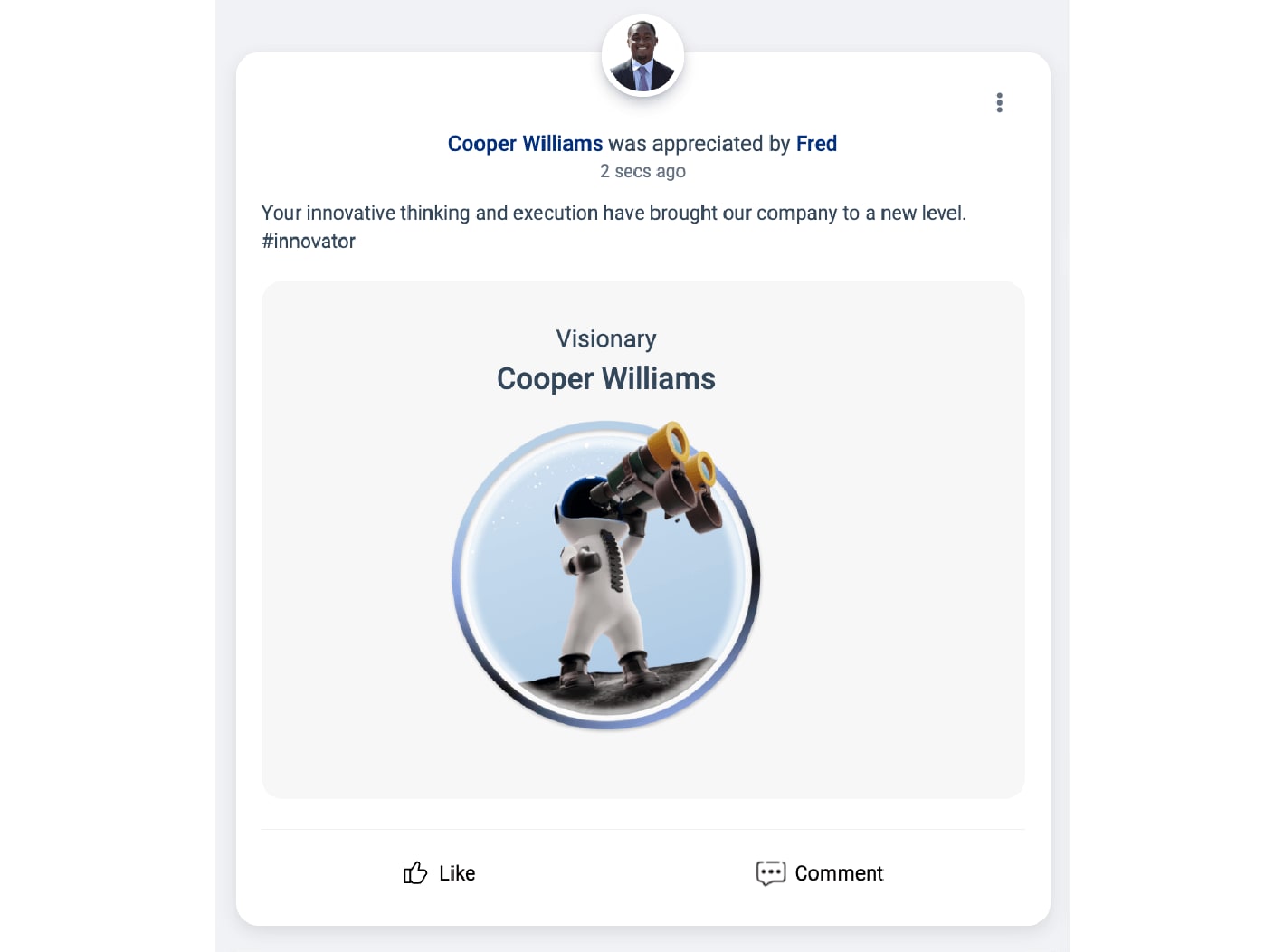
FranklinCovey’s 2024 research found that 80% of Gen Z employees want recognition at least a few times each month, more than any other generation surveyed. The traditional service-anniversary plaque sitting beside stale office cake does not quite meet the moment for them.
What actually registers is recognition that’s timely and visible. A quick public acknowledgment after a difficult presentation or a thoughtful peer shoutout in a team channel carries more weight than generic praise delivered months later during a review cycle.
It’s worth noticing that for this generation, being seen at work has become its own kind of currency. They want to feel seen not just by managers, but by teams, peers, and leadership alike.
Source: Vantage Recognition
3. Diversity, Equity & Inclusion in Action
Gen Z has a sharp instinct for the gap between a company that talks about inclusion and one that has built it into how decisions get made. Some of that comes from lived experiences. They are the most racially and ethnically diverse generation in the workforce, and they tend to evaluate DEI through evidence rather than branding.
The questions they’re quietly asking are concrete. Are employee resource groups actually funded, or just listed on a careers page? Are pay-equity audits shared, or referenced? Does the leadership team look anything like the diversity the company posts about during heritage months?
To them, inclusion isn’t measured by the statement a company releases. It’s measured by who gets heard in the meeting, who gets promoted after it, and who gets paid fairly the whole time.
4. Continuous, Specific Feedback
This is a generation raised in environments built on instant response from grades uploaded online to social media engagement appearing in seconds. The traditional annual review feels outdated and incomprehensible to them.
Long silence at work doesn’t read as "everything’s fine." It reads as uncertainty.
What Gen Z looks for is not constant validation but a sense of direction. They want to know whether they are improving, whether their work matters, and whether small frustrations can be addressed before they turn into burnout or disengagement.
Managers who succeed with Gen Z tend to replace formal performance rituals with smaller, more consistent conversations that feel useful rather than performative — a shift toward continuous performance management.
5. Mental Health and Well-Being
For Gen Z, mental health is not a side conversation at work. It is part of the job itself — and they increasingly expect employers to treat well-being as a strategic advantage, not a perk.
Unlike older generations, Gen Z entered the workforce speaking openly about burnout, anxiety, and emotional fatigue. Which means they can usually tell when a company treats well-being as a real investment versus a branding exercise tucked inside a benefits portal.
This generation looks for practical supports like mental-health days that do not require explanation, therapy included in healthcare plans, managers trained in psychological safety, and workplaces where asking for help does not quietly damage career growth.
6. Continuous Learning and Development
LinkedIn’s 2025 Workplace Learning Report found that 76% of Gen Z employees consider learning and development opportunities one of the most important factors when choosing an employer. And when growth slows, they leave. Lack of career development is now the top reason Gen Z workers quit.
It is not difficult to understand why. Gen Z entered the workforce at a moment when entire industries were shifting in real time. Roles evolving faster than university curriculums can adapt, and AI has already begun reshaping the skills many white-collar jobs depend on.
As a result, Gen Z tends to judge employers by how seriously they invest in employee growth. A company that funds certifications, offers mentorship, or provides easy access to learning platforms — in short, one committed to building a culture of continuous learning — signals adaptability and long-term value. In many ways, development has become less of a workplace benefit and more of a promise that employees will not be left behind as work continues to evolve.
7. Clear Career Growth Paths
What this generation struggles with is not slow growth, but invisible growth. Previous generations were often expected to trust that hard work would eventually be noticed. Gen Z is less comfortable operating on implication alone. They want to know what progression actually looks like: what skills matter, what behaviors are rewarded, and what separates one level from the next.
In practice, this means vague promises about "future opportunities" no longer carry much weight. Gen Z responds better to visible career frameworks, documented expectations, and regular conversations about long-term development separate from day-to-day performance feedback.
For them, clarity signals fairness. Ambiguity feels like stagnation waiting to happen.
8. Modern, AI-Enabled Tech Stack
Gen Z has very little patience for outdated workplace technology, partly because they have spent their entire lives using products designed to feel intuitive. Consumer technology has trained Gen Z to expect speed, clarity, and seamless design by default.
They see frustrating software as a reflection of how seriously a company values employees’ time and experience. A slow onboarding portal, a complicated expense system, or an HR platform that feels impossible to navigate creates the impression of a workplace still operating several years behind.
AI-powered tools are becoming part of everyday life, from personalized recommendations to instant information access. As a result, Gen Z increasingly expects workplace technology to eliminate friction rather than create it. They value systems that reduce repetitive tasks, simplify communication, and make work feel more efficient.
9. Purpose-Driven, Values-Aligned Work
Gen Z trades pay for purpose more often than any prior generation. Deloitte’s 2025 Gen Z and Millennial Survey found that 44% of Gen Z employees have turned down jobs because the company’s values did not align with their own.
This does not mean every Gen Z employee expects to change the world through work. But they do want coherence. They want to feel that the organization’s values show up somewhere beyond recruitment campaigns and mission statements.
For many of them, purpose ultimately comes down to a simple question: "Can I comfortably explain why I work here without having to make excuses for it?"
10. Fair, Transparent Compensation
Gen Z expects pay ranges to be published, pay equity to be audited, and pay decisions to be explainable. They are the generation most likely to discuss pay openly with peers, which has dissolved the information asymmetry employers used to rely on.
Pay transparency laws now cover much of the US and EU, but Gen Z would likely expect transparency even without legislation. For them, openness around compensation is not viewed as radical. It is viewed as fair. Silence around pay, on the other hand, often creates suspicion.
In a way, transparency also shapes trust. When employees understand how salaries are determined, what influences raises, and how progression works, they are more likely to view the organization as credible and equitable.
11. Less Bureaucracy, More Autonomy
Gen Z has a low tolerance for bureaucracy that feels unnecessary. What frustrates them is not structure itself, but structure that appears to exist simply because nobody has questioned it in years. Endless approval chains, meetings with no clear purpose, or processes requiring five clicks where one would have been enough.
Having grown up with technology designed around speed and convenience, Gen Z tends to approach workplace systems with the same expectations. If something feels unnecessarily complicated, they are likely to ask why it exists at all.
What they respond to more positively are workplaces that focus on outcomes rather than unnecessary control, encouraging autonomy in the workplace instead of micromanagement. They want clear goals, flexible execution, and faster decision-making. Most importantly, Gen Z wants to feel trusted in making decisions and solving problems independently.
12. Collaborative, Psychologically Safe Culture
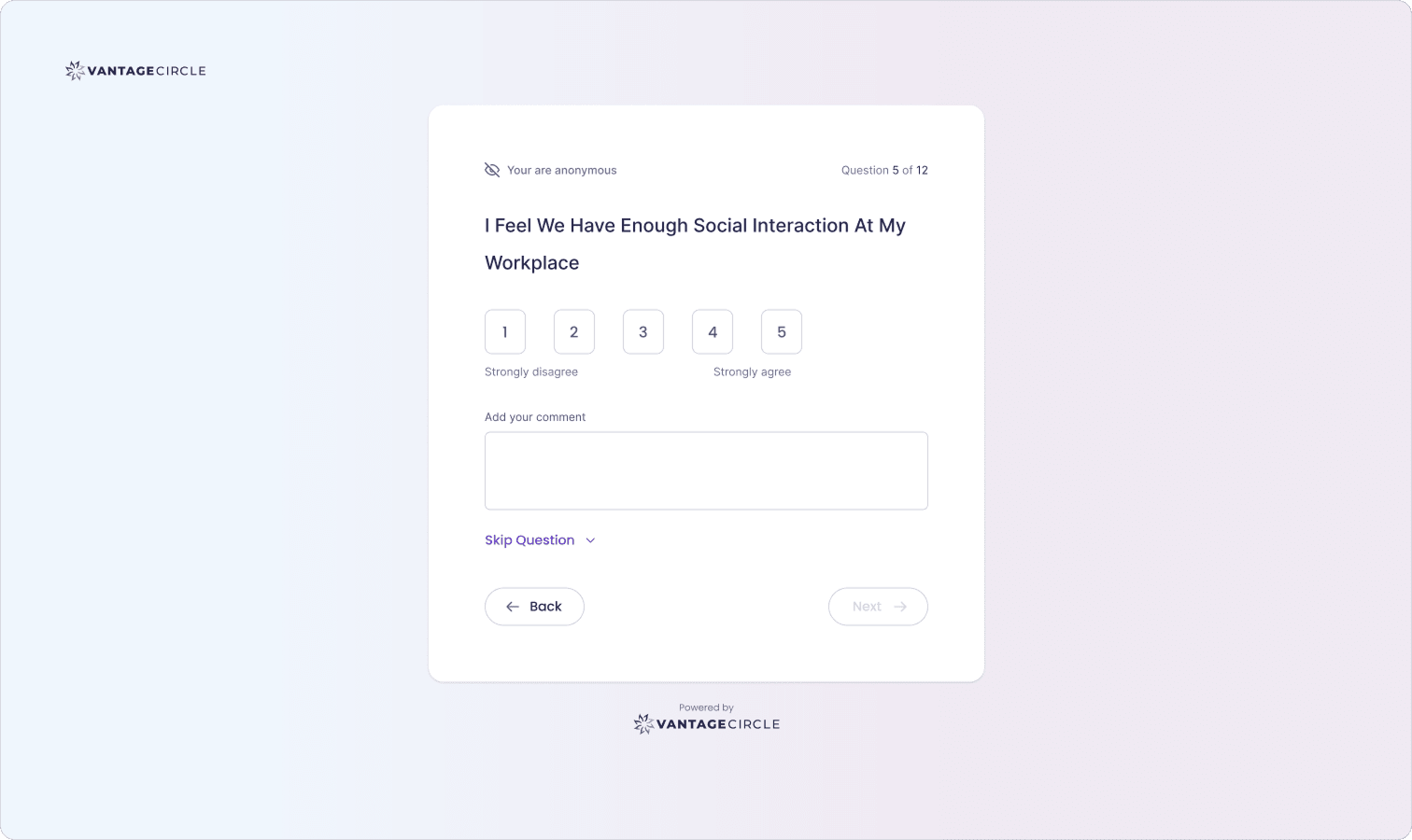
For a generation often described as digitally detached, Gen Z cares deeply about feeling connected at work.
What they are looking for, though, is not manufactured corporate bonding. Mandatory fun, forced icebreakers, and after-hours social obligations often have the opposite effect. Gen Z tends to value connection that feels natural, low-pressure, and built into everyday work rather than performed around it.
This generation wants workplaces where people are treated as human beings with personalities, interests, and lives outside their job titles. Small moments matter more than grand gestures: mentorship conversations, collaborative projects, casual check-ins, or spaces where employees can interact without feeling monitored or obligated.
Addressing the "Lazy Gen Z" Narrative: What the Data Actually Says
Few workplace stereotypes have spread faster than the idea that Gen Z doesn't want to work.
It's a convenient explanation. Productivity challenges? Blame Gen Z. Retention issues? Blame Gen Z. Empty office desks on Fridays? Surely, Gen Z again.
The problem is that the data refuses to cooperate with the narrative.
The stereotype of Gen Z as disengaged becomes harder to sustain when you look at how they actually spend their time. Deloitte's 2025 global survey found that 67% of Gen Z workers are actively building career skills outside working hours, while Harris Poll research shows that 57% maintain a side hustle in addition to their primary job.
That doesn't sound like a generation avoiding work. If anything, it sounds like a generation working more hours, across more roles, and under more economic pressure than many of its critics acknowledge.
The misunderstanding stems from a simple mistake. And that is people confusing a change in attitude with a decline in work ethic.
Gen Z came of age watching previous generations absorb the consequences of corporate promises that did not always hold. They saw layoffs arrive after years of loyalty. They watched Millennials accumulate degrees, debt, and delayed financial milestones despite doing everything they were told would lead to stability. They entered adulthood during a period marked by economic uncertainty, rising living costs, and constant workplace disruption.
When managers describe Gen Z as "lazy," they are often describing something else entirely.
They are describing employees who question why unpaid work is expected outside paid hours. That is not a motivation problem. It is a conversation about boundaries.
They are describing employees who opt out of workplace rituals that feel performative rather than meaningful. The mandatory happy hour, the meeting that exists because it has always existed, the all-hands presentation that could have been a three-minute update. That is not disengagement. It is a demand for relevance.
And they are describing employees who leave when the reality of a role fails to match the version that was sold during recruitment. That is not disloyalty. It is a response to unmet expectations.
None of this means leaders must agree with every Gen Z preference. But it does require us to diagnose the situation correctly.
The most effective organizations have stopped asking, "Why doesn't Gen Z work like previous generations?" and started asking a more useful question: "What are they responding to that we have failed to see?"
The answer, more often than not, is not a lack of ambition. It is a lack of trust in outdated workplace assumptions.
How Can HR Build a Gen Z-Ready Workplace?
Step 1: Move from Annual Feedback to Continuous Listening
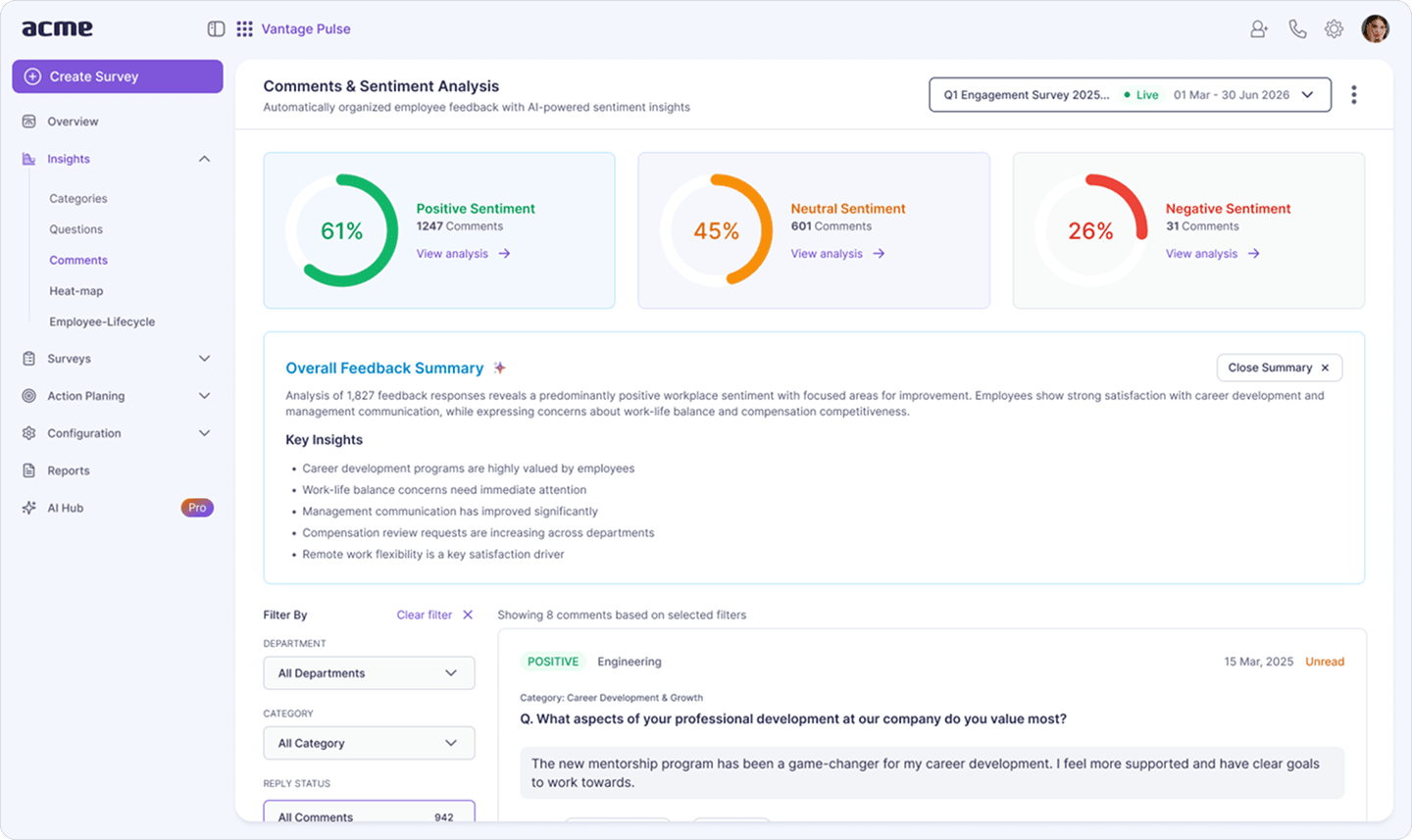
Start with infrastructure that tells you what is happening. Quarterly engagement surveys are too slow for Gen Z sentiment cycles.
Short eNPS surveys every few weeks can help leaders spot emerging issues before they become resignation letters. Pair quantitative scores with open-ended questions that allow employees to explain the "why" behind their responses.
The goal is not simply collecting feedback. It is creating a visible system where employees believe their voices influence decisions.
Source: Vantage Pulse
Step 2: Make Recognition Part of the Weekly Experience
One of the fastest ways to disengage Gen Z employees is to make recognition feel rare.
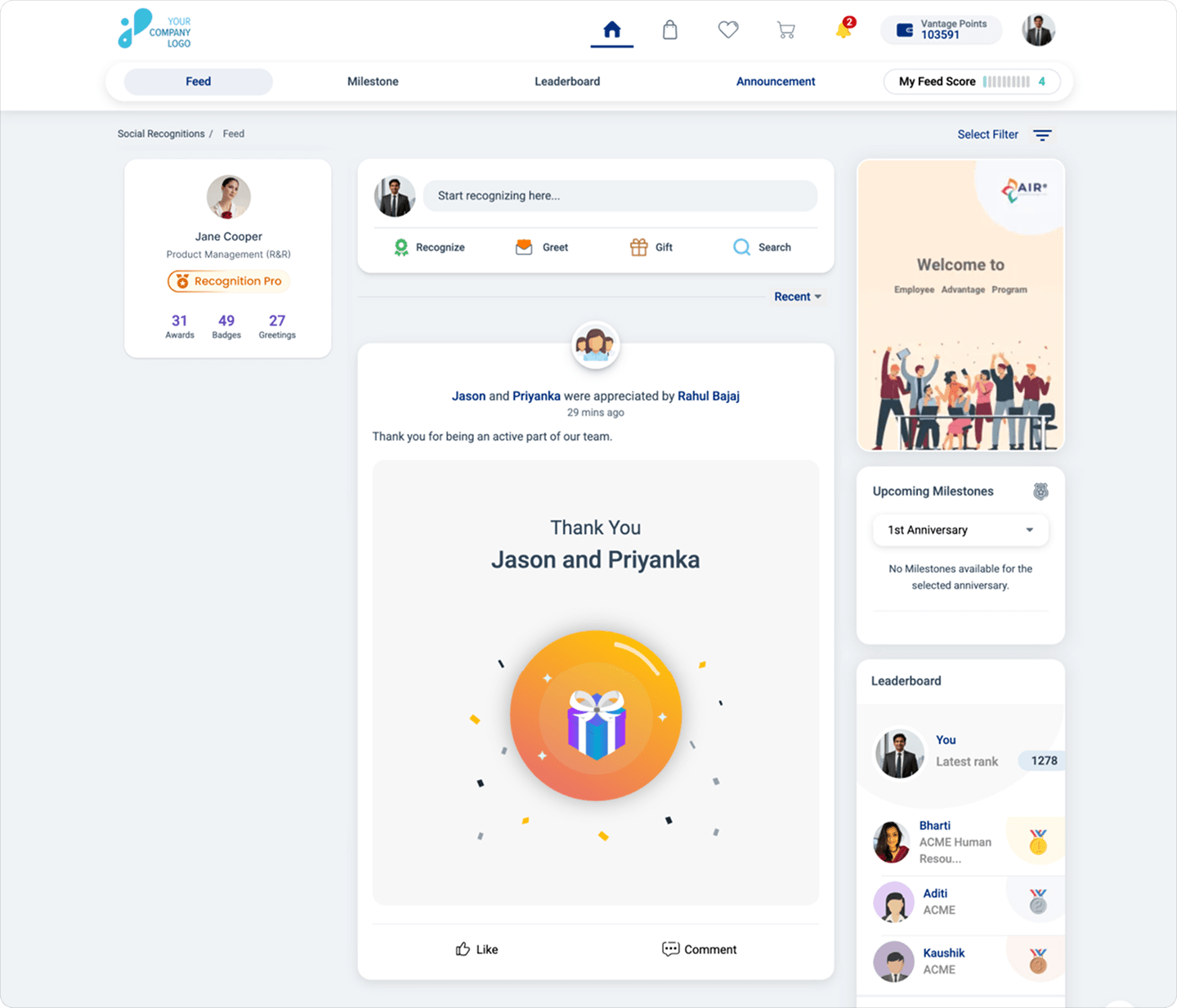
Annual awards ceremonies and end-of-year performance reviews cannot carry the entire weight of employee appreciation. Recognition works best when it becomes part of the everyday rhythm of work.
Create opportunities for peer-to-peer recognition, encourage managers to acknowledge contributions consistently, and connect recognition to specific company values. When employees can see how their work contributes to something larger than a task list, recognition becomes more meaningful and more credible.
Source: Vantage Recognition
Step 3: Replace Ambiguity with Career Clarity
Most Gen Zs are not demanding guarantees. They are asking for visibility. They want to know what skills lead to advancement? What does success look like at the next level? How are compensation decisions made? What opportunities exist for growth?
Too many organizations leave these questions unanswered and then wonder why employees start looking elsewhere for opportunities.
Clear career frameworks, transparent promotion criteria, and published pay ranges create trust because they remove guesswork. Employees are far more likely to stay engaged when they can see a path forward, even if that path takes time.
Step 4: Treat Well-Being as a Business Strategy
Many organizations still approach wellness through isolated initiatives such as a meditation app, a resilience webinar, or an occasional awareness campaign. While valuable, these efforts rarely address the broader conditions that influence employee well-being.
A stronger approach combines practical support with cultural change. Mental health resources, financial wellness programs, flexible work arrangements, manager training, and dedicated mental health days all signal that employee well-being is being treated as an operational priority rather than a communications initiative.
The goal is not to eliminate stress from work. It is to create an environment where employees have the support, autonomy, and psychological safety to navigate it.
Source: Vantage Pulse
Step 5: Measure Whether Your Values Show Up in Daily Work
Beyond measuring engagement, organizations should actively measure alignment. Ask employees where company values showed up. Ask where they did not. Look for patterns in the stories employees share, not just the scores they provide.
Because ultimately, Gen Z is not evaluating the values written on the company website. They are evaluating the values demonstrated in meetings, promotions, recognition moments, and everyday decisions.
Bottomline
As the workforce continues to evolve, addressing the needs and expectations of Generation Z is a strategic investment that can drive innovation and growth in any organization.
You can benefit greatly by recruiting these self-motivated young talents who are always eager to take up challenges. So, it is upto you now to make Gen Z'ers an integral part of the organization and move upward in the future.
FAQs
What are the Expectations of Gen Z Employees in the Workplace?
Gen Z expects meaningful work, career growth, flexible work arrangements, transparent communication, modern technology, fair compensation, and a workplace culture that aligns with the organization's stated values.
What Motivates Gen Z in the Workplace?
Gen Z is motivated by opportunities to learn, develop new skills, receive regular recognition, make an impact, and maintain a healthy work-life balance. They also value purpose and career progression.
How is Gen Z Changing the Workplace?
Gen Z is pushing organizations toward greater transparency, flexibility, continuous feedback, pay equity, mental health support, and technology-enabled employee experiences.
What are Gen Z Workplace Problems?
Common challenges include career uncertainty, burnout, financial stress, limited growth opportunities, poor management, lack of recognition, and workplaces where company values do not match employees' day-to-day experiences.

Shikha Gogoi is a Content Marketing Specialist focused on SEO-driven content around employee engagement, recognition, and workplace culture, helping build people-first workplaces.
Connect with Shikha on LinkedIn.