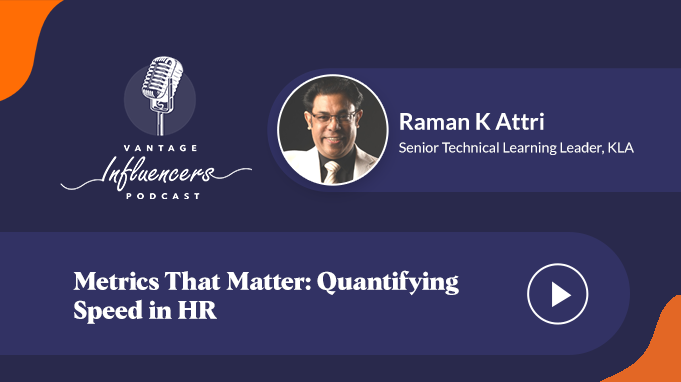
Metrics That Matter: Quantifying Speed In HR
Episode Overview
Dr. Raman K Attri manages training operations across five countries for a $60 billion Fortune 500 corporation, with two decades of research behind him as a performance scientist studying the "science of speed" in organizational learning. His central metric, and the one he says most HR dashboards are missing entirely, is time to proficiency: not how fast you hire or onboard someone, but how quickly a new employee reaches a state of reliable, repeatable, unsupervised performance.
Dr. Attri's sharpest point cuts against the instinct to simply compress timelines: speed, in his framework, isn't about rushing a process, it's about "first time right" — getting the outcome correct the first time, even if it takes longer, because rework destroys both customer satisfaction and employee engagement far more than a longer timeline does. He also pushes back on treating remote and hybrid work as fundamentally different management problems, arguing the real lever is universal: helping every employee, regardless of location, leave work with a genuine "sense of achievement."
Episode Highlights
- Time-to-market for major products has collapsed from roughly three years pre-pandemic to about three months post-pandemic, and HR's job is to translate that external market pressure into internal workforce development speed.
- "Time to proficiency" — how quickly an employee reaches reliable, repeatable, unsupervised performance in a role — is the metric Dr. Attri says most HR dashboards don't track at all, even though it matters more than time-to-hire or time-to-onboard.
- Capability alone is no longer a competitive differentiator, because most organizations now have access to similarly skilled talent — the real edge is how fast an organization can develop that talent.
- Speed doesn't mean rushing; it means "first time right." Compressing timelines under pressure tends to produce rework, which damages both customer satisfaction and employee engagement more than a longer, correct-the-first-time process would.
- HR leaders should own technology decisions rather than leaving them to IT, because the technologies chosen directly determine whether the organization can actually measure and improve time-to-proficiency metrics.
- Rather than managing remote and on-site workers under different frameworks, Dr. Attri argues every employee's core motivation is the same: a "sense of achievement," and optimizing for that dissolves most of the remote-versus-hybrid distinction in engagement.
About the Guest
Dr. Raman K Attri — Senior Technical Learning Leader, KLA
Dr. Raman K Attri is an award-winning learning executive and a world authority on the science of speed in organizational learning and performance, with two decades of research and 50 published books. He manages a Hall of Fame training organization ranked among the world's top 10 at a $60 billion high-tech corporation, has been featured in over 200 media appearances, and holds two doctorates in strategic organizational learning along with more than 100 international educational credentials. He founded the GetThereFaster portal as a resource for accelerated professional development.
Connect with Dr. Raman K Attri on LinkedIn
Host
Sanjeevani Saikia — Vantage Influencers Podcast Host
What You Will Learn
- Why "time to proficiency" is the speed metric most HR dashboards miss, and why it matters more than time-to-hire or time-to-onboard
- Why capability alone no longer differentiates organizations, and why development speed has become the real competitive edge
- Why speed should mean "first time right," not compressed timelines, and how rushed processes create costly rework
- Why HR leaders need to own technology decisions instead of deferring to IT, especially for AI and analytics tools tied to speed metrics
- Why treating remote and on-site employees as fundamentally different management problems misses the real driver of engagement: a shared sense of achievement
Key Topics & Timestamps
| Timestamp | Topic |
|---|---|
| 01:40 | Dr. Attri's corporate journey so far |
| 02:50 | A brief introduction to the concept of "speed" within HR operations |
| 06:30 | Key Performance Indicators (KPIs) HR leaders must focus on |
| 11:03 | Harnessing data for quick, impactful decision-making |
| 16:26 | Retaining quality while ensuring speed in HR practices |
| 19:50 | Technological advancements shaping the future of HR speed metrics |
| 25:17 | Impact of remote and hybrid models on HR speed metrics |
| 29:13 | End note |
Full Transcript
Click to read the full episode transcript
Sanjeevani Saikia: Hello listeners, welcome to another episode of the Vantage Influencers Podcast, where we explore a wide range of HR topics designed to grab your attention and inspire you. I'm your host, Sanjeevani. In this episode, we'll uncover the pivotal metrics defining speed in HR, joined by Mr. Raman K. Attri, an expert in the field, to lend us his insights. Hi, Raman.
Dr. Raman K Attri: Hi, Sanjeevani.
Sanjeevani Saikia: First and foremost, I want to express my gratitude for your presence today. Before we delve into today's topic, metrics that matter, quantifying speed in HR, could you kindly walk us through your corporate journey so far?
Dr. Raman K Attri: Certainly. I'll start backward — right now, I'm a Fortune 500 learning leader for a $60 billion corporation, managing the training operation across five different countries. I've been with the company for about 18 years now. Prior to that, I worked mostly in scientific and research positions in the corporate sector. In parallel, I've been engaged in research — I hold two doctorates, researching the people aspect of capabilities. That's been a brief overview of about 30 years of professional experience.
Sanjeevani Saikia: Thank you for sharing your journey with us — truly remarkable. Raman, I think you'll agree that in today's dynamic business landscape, the ability to swiftly navigate HR operations is a critical factor in maintaining competitiveness. What constitutes speed within HR operations, and how does this concept intersect with organizational success in fast-paced environments?
Dr. Raman K Attri: Great question, and there are several parts to it. Today, business is undeniably fast-paced. A few things are happening in the market: customers are demanding products immediately — they can't wait — and they're also demanding higher quality, better technology, better solutions, and they want all of it faster, or they'll go to a competitor. That's the kind of regional competition we're seeing. Most organizations are struggling with this speed, because if you're introducing a product today, you also need to make it available to the customer today. That shows up as time-to-market — for services, if you're a services organization, or for a product, how soon you can bring something new to market. Interestingly, time-to-market used to average about three years for major products before the pandemic. After the pandemic, it's dropped to about three months — a massive contraction. The pandemic was the main driver, because organizations urgently needed new technologies and couldn't wait for the pandemic to end, so it became an accelerator.
Now, the problem is you can't directly manage time-to-market, because it's controlled externally by competition and customer demand. So the question becomes: how do we translate that market-facing speed into corporate speed? That's where HR leaders have a bigger role to play, because now we need to upgrade our operations, our way of thinking, and our whole leadership culture — what I call a "speed-savvy culture" — in order to develop employees who can produce solutions at a faster rate. That's the high-level speed we're talking about, and it's becoming existential for organizations — if they don't hit their time-to-market, they'll be out of the market pretty soon.
Sanjeevani Saikia: Absolutely true. In pursuit of operational efficiency, HR leaders face the challenge of quantifying the velocity of their processes and initiatives. As organizations pivot toward agile frameworks, identifying key metrics becomes pivotal for assessing and optimizing the speed of HR operations. Which specific KPIs or metrics should HR leaders focus on to gauge and enhance the speed and efficiency of their operations?
Dr. Raman K Attri: Great question. Let me bring you back to the nature of speed HR needs to focus on. As I said, time-to-market pressure is intensifying. The only way to meet that is if we can develop our workforce at the speed of business — meaning that pressure has to translate into how fast we develop our people. Workforce performance and development is one of the most critical things HR leaders need to deliver. HR leaders have traditionally focused on one thing: workforce capability. But widespread research tells us capability alone is no longer a differentiator, because most organizations now have access to similarly talented, similarly capable people. If capability is roughly the same across organizations, that's no longer a competitive edge. The real competitive edge becomes whoever can develop their workforce, their employees, their leaders, at a faster rate, to deliver a shorter time-to-market.
So the metric becomes: how fast are you developing your people compared to the market? That's what you should be measuring, tracking, and improving over time. We call this metric "time to proficiency" — if you move into a new role, how soon do you become proficient in it? And proficiency means a state of performance where your outcomes are reliable, repeatable, and you produce the same standard of result regardless of customer or situation — a high degree of unsupervised repeatability. That's the performance level we're looking for, and how soon we can get employees there is the metric called time to proficiency. HR teams measure lots of other metrics, like how fast you can hire or onboard people, but those are becoming less relevant, because what actually matters is how soon an employee you hired can produce the product or outcome you need for a launch three months out. If you're launching a service in three months, you need the ability to develop your people within two months. You also need a baseline for that number, so you can tell whether you're better or worse than your competitors when you benchmark. Currently, most HR dashboards don't include time to proficiency at all — it's simply not part of the quarterly metrics most organizations present.
Sanjeevani Saikia: You've mentioned some very key points — the rate at which an organization develops its workforce, and time to proficiency. These are the two things you think are most critical?
Dr. Raman K Attri: Yes, certainly, pretty critical to match the speed of business.
Sanjeevani Saikia: I think it's obvious that organizations increasingly seek data-driven approaches to navigate rapid change. How can HR departments harness data to derive actionable insights that facilitate quick, impactful decision-making?
Dr. Raman K Attri: Decision-making is a pretty wide area — HR leaders today have to decide on many fronts, related to talent, benchmarking, even HR technology itself. Decision-making in HR has become very complex, but we need to focus on the outcome: what are we really trying to achieve? The sole goal of an HR leader, as I see it, is the ability to bring in the right talent, groom them, retain them, develop them, and do all of this faster than competitors. How well they make decisions across all these operations determines their efficiency. Historically, HR leaders have gathered a lot of data — compensation, job grades, workforce demographics, time-to-hire, engagement surveys — but most of this data is operational in nature. What HR actually needs is more strategic data.
In my research, I found that while HR leaders pile up data related to compensation, talent, demographics, and time-to-hire, the entire dataset almost never includes time-to-proficiency data. If you want to be more strategic and gain a competitive edge, you should start measuring and baselining time to proficiency today. If you can't find that data today, at least work with department heads to determine what development timeline, for each critical role, would actually give your organization a competitive edge. This data then needs to get married to your existing data — time-to-hire, time-to-onboard, and other factors.
One more point on data: HR leaders are often responsible for people performance, so they look at a lot of individual performance data — ratings, potential, and other factors gathered during performance reviews. But in reality, HR hasn't historically integrated into gathering organization-level performance data — how fast can we launch products, how are we performing against competitors — because HR has focused only on people data without correlating it to business performance. What we recommend is gathering not just people data, but data on how people are actually driving business outcomes — not just how they're doing their job, but whether they're producing the right outcomes, what your time-to-deliver is for certain services, and how much improvement you want going forward. All of this depends on having the right technology — not just to gather data, but to timestamp every event, so you can baseline, monitor over time, and see what kind of improvement you're getting across metrics, and how that improvement shows up in business outcomes.
Sanjeevani Saikia: While speed in HR operations is crucial, maintaining the integrity and quality of HR practices is equally vital. How do HR leaders navigate ensuring that the pursuit of speed through metrics doesn't compromise quality?
Dr. Raman K Attri: I agree, and I think we need to look at it through a couple of lenses. One is input — the things you track, the policies and benchmarks you put in play — which eventually enable business units to perform the job they're hired for. There are also output metrics that measure the final outcome of a business unit. Now, the speed we're talking about isn't about putting aggressive timelines on projects or shortening the time to accomplish a task — that's not what determines real speed. The speed we're talking about is "first time right" — the point at which your operations, policies, and people can deliver the right outcome the first time, even if it takes longer.
What we've realized is that when we put a mad rush on employees or processes — saying we need to do in six months what historically took nine — we push the entire ecosystem to chase milestones at a higher speed, but that often degrades quality. We end up reworking outputs, which reduces effectiveness. So it's okay to take longer, as long as the outcome is right the first time and doesn't need rework. That produces real efficiency, as opposed to going faster and then spending a lot of time reworking, which reduces both customer satisfaction and employee engagement. Efficiency shouldn't mean doing it faster — it should mean producing it right the first time, so you never have to go back and fix it.
Sanjeevani Saikia: That's a very important and crucial point — it's not just about the time taken, but about getting it right the first time, even if that takes longer. Raman, you've been witnessing how innovation and technology are redefining HR operations, particularly in metrics and analytics. How do you see technological advancements shaping the future of HR metrics for speed, and what emerging trends do you anticipate?
Dr. Raman K Attri: Great question — we're certainly in the middle of a lot of technological revolution. There are a couple of pieces to this. First, the technologies organizations use, and how HR gets involved in selecting them. Second, how those technologies are going to change the jobs themselves and the skills we'll need, and whether HR leaders are really thinking in that direction. From a technology standpoint, historically, organizations and HR leaders have looked for technology purely for efficiency — automating things, making operations less manual — and HR often wasn't deeply involved, because that was largely IT's domain. But the technology we've historically selected was never really geared toward measuring, baselining, or improving the speed of employee development. So now we need technology that can truly accelerate those processes — and if we accelerate the processes, the corresponding time-to-proficiency metrics improve too, but only if the technology we choose actually lets us measure those metrics.
A lot of new technologies now have the ability to timestamp every event, so we can measure improvement over a long period. Analytics can look at large amounts of data and figure out patterns; coupled with AI, we can pinpoint patterns and forecast likely bottlenecks based on historical data. HR leaders need to think about implementing technology differently now, because it has far more impact on how infrastructure gets applied across the organization. On the employee side — can we use AI to develop people faster? If we can, employees demonstrate shorter time to proficiency. But this also means there are parts of a job we shouldn't necessarily train people to do, because if we can't train them efficiently on it, we're wasting their time and lengthening their development. So we need to think about how we leverage state-of-the-art systems — AI, data analytics, AI-driven LMS platforms — because all of these affect how we improve speed, both in our processes and in employee development.
HR leaders can't leave these decisions entirely to the IT department. Because technology is changing so fast, HR leaders need to be at the center of that revolution — the decision-makers on what technology should be delivering to improve their operations and processes. Technology has already begun impacting jobs themselves, so HR leaders also need to understand whether certain roles are still needed going forward, or whether automation or AI will replace parts of them. Business departments will provide input, but HR leaders can't just be on the receiving end — they need to help determine, if certain jobs are going to phase out, how work should be restructured, and advise business unit leaders accordingly.
Sanjeevani Saikia: Raman, we're arriving at the end of today's episode, but before we let you go, there's one last thing I'd love to know your take on — how does the integration of remote or hybrid work models impact the measurement and optimization of HR speed metrics? Post-pandemic, we've seen a shift toward hybrid work models — how does that affect HR metrics?
Dr. Raman K Attri: My take on this is a little unorthodox, I'd say, because the shape of work has certainly changed, but one key thing we've seen is that we over-emphasize the idea that remote work needs to be managed fundamentally differently from on-site work. That assumption took hold particularly during the pandemic, when, as a manager or HR leader, you suddenly felt you needed a completely different framework for remote versus on-site — perhaps because nobody had ever managed that kind of disruption before.
At a higher level, my appeal to HR leaders when I run sessions is this: think about why people come to work. Most employees come to work because they want to do good work — nobody wakes up planning to do bad work, whether they're remote or on-site. Whether your workforce is fully on-site, hybrid, or fully remote, every employee comes in with the intention of doing good work and walking away with a genuine sense of achievement, a sense of pride in what they accomplished. We believe that's the most foundational thing that engages a workforce, irrespective of setting. As long as HR leaders focus on that one parameter — sense of achievement, and how soon remote, on-site, or hybrid workers can attain it — the moment you achieve that, everybody becomes fully engaged, takes on more responsibility, and goes several miles ahead of their role. At that point, the distinction between hybrid and on-site engagement largely dissolves. Of course, at a policy level, you still need specific do's and don'ts for remote versus on-site work, but at a high level, how you engage your workforce — through sense of achievement — is the most critical KPI for any HR leader, regardless of working model.
Sanjeevani Saikia: Your perspective has been very interesting — you've added a humane and empathetic lens to how we think about remote work. We've reached the end of today's episode — do you have any message for our listeners? And how can they stay in touch with you?
Dr. Raman K Attri: The audience can reach me pretty easily — my handle on most social media is Dr. Raman K Attri, or "Dr. RKA" for short. You can search for me on any platform, or visit my website, GetThereFaster.com, where I post a lot of learning material and tips on progressing your career in learning leadership and HR leadership. My message for the larger audience is this: in the middle of this technological revolution, a lot of the content floating around is technical or technology-oriented. But before you make any policy, before you even talk about technology, the first thing you need to look at is people. Your people should be at the center of your universe — technologies are there to enable, not replace. Once you keep people at the heart of it and build the entire ecosystem around that, you'll be able to develop them faster, and you'll be able to hit metrics like time-to-market, provided you keep employees at the center and let the rest of the technology and process surround that ecosystem. That would be my message for how to move forward in this fast-paced world.
Sanjeevani Saikia: Wonderful, Raman. It's been a pleasure having you as a guest today. Your insights and expertise have been invaluable, and we're grateful for the time you've taken to share your knowledge with our listeners. Thank you so much, thanks a lot, Raman.
Dr. Raman K Attri: I appreciate your time as well today — it was a wonderful interview. Thank you so much.
Thanks for listening to the Vantage HR Influencers Podcast. Please subscribe to the Vantage HR Influencers Podcast on Apple Podcasts, Spotify, and our YouTube channel for new episodes.
FAQ
What is "time to proficiency" in HR?
Dr. Raman K Attri defines time to proficiency as how quickly an employee reaches reliable, repeatable, unsupervised performance in a role — a metric he says most HR dashboards don't track, even though it matters more than time-to-hire or time-to-onboard.
Why is capability no longer a competitive advantage for organizations?
Because most organizations now have access to similarly skilled, similarly capable talent, Dr. Raman K Attri argues the real competitive edge is how fast an organization can develop that talent, not the talent's baseline capability.
Does speed in HR mean rushing processes?
No. Dr. Raman K Attri defines speed as "first time right" — getting the outcome correct on the first attempt, even if it takes longer, since rushed timelines tend to produce rework that damages customer satisfaction and employee engagement more than a longer, correct process would.
How should organizations think about remote versus hybrid work and engagement?
Dr. Raman K Attri argues against treating remote and on-site work as fundamentally different management problems — every employee, regardless of location, is motivated by a genuine "sense of achievement," and optimizing for that dissolves most of the remote-versus-hybrid engagement gap.
Related Reading
Also listen on