The Differences Between Rewards And Recognition In The Workplace
Episode Overview
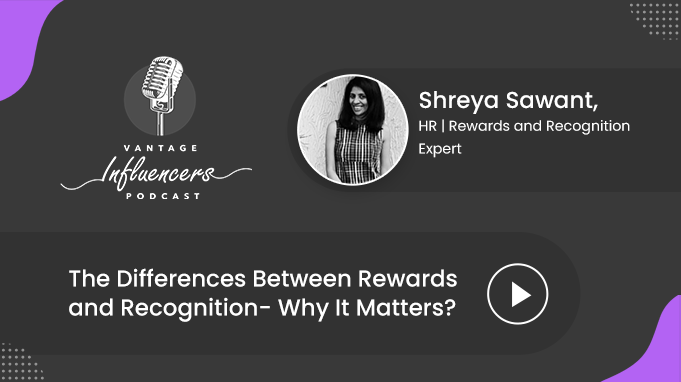
Shreya Sawant's HR career began in recruitment for the media and entertainment industry in 2008, and roughly a decade of work across agencies, broadcasters, OTT platforms, film production and music labels shaped the core argument she makes in this episode: rewards and recognition are not interchangeable, and treating them as if they were is where most companies go wrong. Rewards, she explains, are physical or monetary, a bonus, a gift, a raise. Recognition is invaluable and intangible, a genuine thank you, public acknowledgment, or the added trust placed in someone's judgment. Both matter, but they solve different problems, and leaning on one when the other is called for leaves employees feeling undervalued even when their paycheck looks fine.
Her sharpest point is about how companies get the arithmetic of recognition wrong. Sales targets get celebrated while the marketing, support and operations work that made the sale possible goes unnoticed, quietly signaling to half the workforce that their effort doesn't count. Her fix is concrete: recognize the ambition and the process behind a result, not just the outcome, and build communication, timeliness and fairness into any program before it launches. That discipline matters even more for remote teams, where a spontaneous round of applause in the office has to be deliberately rebuilt as a scheduled video call, a LinkedIn shout out, or a dedicated recognition platform.
Episode Highlights
- Rewards are physical or monetary, while recognition is intangible, and mixing the two up is the most common mistake companies make.
- A 2015 study found recognition, not monetary incentives, is the strongest driver of employee motivation.
- Teams that focus rewards on the person who closed the deal, while ignoring the support functions behind it, end up recognizing outcomes over effort.
- Recognition can be structured, like an employee of the month program, or spontaneous, like a flexible afternoon off or a public thank you, and organizations need both.
- Remote work forced HR teams to replace hallway high fives with virtual ceremonies, LinkedIn shout outs and video call recognition moments.
- A good rewards and recognition program rests on four things: knowing your audience, setting a realistic budget, communicating clearly, and being specific, timely and fair with every award.
About the Guest
Shreya Sawant, HR Professional
Shreya Sawant is an HR professional with over a decade of experience across recruitment, business partnering, talent acquisition, talent management, and employee engagement, having built her career at organizations including Dentsu Aegis Network, Star TV Network, Hotstar, and Times of India, with her most recent stint as HRBP for Saregama India at the RP-Sanjiv Goenka Group. She holds a postgraduate degree in Human Resources Management from the Welingkar Institute of Management Development and Research. Outside of the corporate world, she volunteers with AMTM (Animal Matters to Me) in Mumbai and spends her downtime on a family run fruit farming project, where she has introduced a few modern cultivation techniques.
Connect with Shreya on LinkedIn
Host
Susmita Sarma, Vantage Influencers Podcast Host
What You Will Learn
- How to tell the difference between a reward and a recognition moment, and why conflating them undermines both.
- Why recognition, not money, is the stronger driver of long-term employee motivation.
- How to make sure recognition credits the effort and ambition behind a result, not just the headline number.
- Ways to build both structured and spontaneous recognition into your culture.
- How to adapt recognition practices for a distributed or remote workforce.
- The four building blocks of a rewards and recognition program that actually holds up over time.
Key Topics & Timestamps
| Timestamp | Topic |
|---|---|
| 00:00 | Cold open: why money alone doesn't satisfy employees |
| 01:20 | Shreya's journey from media and entertainment recruitment to HR business partnering |
| 03:50 | The range of rewards and recognition practices organizations use today |
| 05:15 | The core difference between recognition and rewards |
| 06:00 | Why recognition beats monetary incentives as a motivator |
| 09:57 | Rewards versus recognition: which one matters more |
| 11:00 | Recognizing employees through the shift to remote work |
| 14:15 | The end goal every rewards and recognition program should serve |
| 15:55 | Four tips for building a great rewards and recognition program |
| 18:25 | Advice for HR managers designing their own strategy |
Full Transcript
Click to read the full episode transcript
Welcome to the Vantage HR Influencers Podcast. This podcast is sponsored by Vantage Circle, the leading employee benefits and engagement platform. You might be inclined to think that the only thing that matters to your employees is money. They're happy as long as they get their salary, right? Not really. To feel completely happy with their work, employees need both rewards and recognition. But when is a reward suitable, and when is the best time for recognition? And what is the difference between rewards and recognition? Let's find out in today's episode.
Susmita Sarma: Hi everyone, this is Susmita from the Vantage HR Influencers Podcast. Today we have with us Shreya Sawant, who is an HR professional with ten years of expertise in managing a full spectrum of human resources programs, services and functions. She has a strong understanding and hands-on experience in business partnering, talent acquisition, talent management, employee engagement, and training and development. She has worked with some of the best firms in broadcast, digital, music label, film production and print. Welcome to our podcast, Shreya.
Shreya Sawant: Hi, Susmita. Thank you so much for giving me the honor of being an HR influencer speaker on this particular podcast.
Susmita Sarma: Welcome. So before we start, please let us know a bit about your journey in the corporate world and your areas of interest.
Shreya Sawant: So in 2008, I graduated and got my first job in recruitment consultancy, hiring talent for one of the most exciting industry functions, media and entertainment. I was always inclined towards being part of the media and entertainment industry. From there, the journey started under the guidance of my manager. Interestingly, the business was being driven by female leadership, which not only made me comfortable in my day to day job but also inspired me to grow. The first hiccup I had was around the economic downturn of 2008 and 2009, but with a never give up attitude, I settled through it and reached the level I'm at now.
It's been almost 10 years that I've worked with some of the best firms across agency, broadcast, digital, OTT or VOD platforms, film production, job portals and music label, and I've grown not just as a professional but as an individual too. Over the years, I've made good friends and encountered charismatic leaders, and I consider myself fortunate to have worked with people I found committed to excellence.
The mantra of my corporate life is learn, unlearn and relearn, which means we need to innovate, transform ourselves to become more agile and open to challenges, fail wisely, and network extensively.
In my career, things have moved fastest whenever motivation has been in the driver's seat. I believe the key to success in the corporate workplace lies in self-motivation and a focused approach to individual goals. In recent years, the driving factor in my career has been passion for the work itself and a genuinely positive work culture.
My areas of interest, if I had to sum them up, are business partnering, talent acquisition, talent management, and rewards and recognition. At present, I'm building a rewards and recognition program for the organization I'm working with, alongside employee engagement, welfare, and training and development. And thanks to COVID, we're bringing the focus back to human resources.
Susmita Sarma: Right, exactly. So, Shreya, when we speak about rewards and recognition, we should define the different ways organizations can better appreciate their employees. What kinds of rewards and recognition are offered by organizations today?
Shreya Sawant: Let me ask you a question first. What comes to mind when you think of employee recognition? Maybe corporate gifts, employee of the quarter, employee of the year, team of the year, or staff performer awards, to name a few. But implementing employee recognition at the workplace goes well beyond that. Employee gratitude is supreme at the workplace, that's one thing. When employees are well recognized or rewarded, they feel empowered and motivated.
I've seen a trend where reward and recognition carries more economic value than emotional value. For example, if an employee has hit a sales target, they're rewarded and recognized as a top performer. But reaching that target usually depends on other factors too, support from IT, lead generation, marketing, recruitment, and so on. Or say a creative producer manages to bring costs down and deliver a film within the timeline, that person often isn't appreciated. It's case by case, but that kind of appreciation is often missing, and when it does show up, it's almost always in monetary terms.
Susmita Sarma: It would really make a difference to our broader HR thinking if we understood the difference between reward and recognition strategy. So what are the key differences between recognition and rewards, in your view?
Shreya Sawant: Yes, it will make a difference. Employees stay loyal for a reason, and employee recognition works wonders for retention and loyalty. A simple thank you or celebrating an employee's achievement is often all it takes, and that benefits the company's retention rate in turn. So the difference, I'd say, is that rewards are physical and monetary, while recognition is invaluable.
Susmita Sarma: Right. Recognition is typically the right way to go when it comes to employee motivation. A 2015 study also showed recognition as the most significant motivating factor for employees, ahead of monetary benefits or incentive packages. That said, it's not the only approach, reward systems have a special place in workplace culture too and can be a way of empowering workers. So how do you know when a reward is necessary, and when recognition is the right call?
Shreya Sawant: If you've heard of Bob Nelson, he once said people may take a job for more money, but they often leave it for more recognition. Have you heard that one?
Susmita Sarma: Yeah.
Shreya Sawant: Right. So recognition can take a variety of forms. A structured program can include regular recognition events, like a recognition breakfast, an employee of the month award, or an annual report or book that features accomplishments across departments, along with recognition boards. That kind of approach can do wonders. Then there's casual or spontaneous recognition, which can take the form of privileges like working from home, starting late, leaving early, or longer lunch breaks. A job well done can also be recognized by giving someone more support or more autonomy, like a wider choice of assignments, more authority, or naming them an internal consultant for other staff. And summing it up, a buddy program helps a lot too. If a new joiner comes in, pairing them with someone who's a great fit to guide them can itself be a form of recognition.
When designing a reward program to secure benefits like increased productivity, you have to identify the company or group goals and the behaviors or performance that will actually contribute to them. It sounds obvious, but companies frequently end up rewarding behaviors or achievements that either don't move the needle on business goals or actively work against them. Similarly, if quality matters most to the employer, the reward system shouldn't end up emphasizing the quantity of work instead. You need to measure performance appropriately to make sure the program is actually paying off.
Rewards carry a real cost in time or money, so employers need to confirm that performance has genuinely improved before rewarding someone. That often means measuring things beyond financial returns, fewer shortcomings, happier customers, faster delivery, and so on. So if a food delivery company is launching a reward program, they should be looking at whether delivery time has come down or customer satisfaction has gone up, not just at revenue.
When building a reward program, HR should match rewards to the actual outcome for the company. Perfect attendance deserves a different kind of reward than, say, saving the company a significant amount through better contract negotiation, those are two different categories of achievement. It's also worth rewarding both individual and group accomplishments, to encourage both individual initiative and teamwork. Rewards shouldn't just be handed out because someone did a good job in isolation, other factors need to be considered too.
Susmita Sarma: So now, Shreya, in your view, reward versus recognition, which is better?
Shreya Sawant: Although the terms are often used interchangeably, reward and recognition should really be treated as separate systems. For me, recognition has always been the key to my own success. During my time at Saregama India, I designed the new joiner orientation program that the team still uses for induction, and I also hired a hundred candidates in 45 days, which was a real milestone. I'm still recognized by both current and former colleagues for that work. So for me, it's always recognition. That quote from Bob Nelson, that people take a job for money but leave it for recognition, really holds up here.
Susmita Sarma: Right, it does. So hardworking people are what every company is looking for, in this pandemic and after it. But with everything so disrupted, how can organizations best recognize and reward people for their efforts right now?
Shreya Sawant: Employees and organizations across the world have been working remotely for a while now, and with COVID-19, that's likely to continue for some time. A year ago, no one would have thought working from home would last this long, and in a way, that flexibility has become a reward in itself for some employees. But with so many distractions at home, it's also easy to disengage from work, it can reduce engagement and hurt productivity. I notice it myself on calls like this, when one of my nephews pops in to ask what I'm doing.
Because of COVID-19, it's been harder for managers to run traditional employee recognition programs, and that's affected organizations across every industry. As a result, remote recognition tools, employee recognition software, and similar platforms have become a lot more widespread. I recently spoke to someone from a software vendor who showed me a portal that could run engagement activities, like a virtual Christmas celebration where you could send a decoration or a tree to employees to celebrate online. There are more and more of these employee recognition and engagement platforms coming up now.
These unprecedented times call for unprecedented measures. In the office, it used to be easy to reward and recognize employees with something as simple as a stand up, sponsoring lunch, or a round of applause for whoever did well. Now that people are remote, organizations have shifted to video meetups over Google Meet, Skype or Zoom to announce achievements, that's become the new normal. I was part of a virtual ceremony recognizing young HR leaders recently, and it was surprisingly interactive and well planned.
I've also seen a lot of organizations use their social and professional pages, LinkedIn, Facebook, Instagram, to share employee achievements, whether it's someone's personal milestone, professional development, or a job well done. That serves two purposes at once, it builds employer branding, and it gives the employee a genuine feel good moment. So overall, rewards and recognition hasn't disappeared from the organizational plan, it's just happening in smaller, more distributed pieces now.
Susmita Sarma: Vantage Circle has its own rewards and recognition programs too, so we'd love to know, what should be the end goal of any rewards and recognition program?
Shreya Sawant: If I had to say one thing, anyone building a recognition program shouldn't just recognize an employee for closing a sale. Recognize the ambition and the effort the employee puts in to get there. Sales shouldn't be the only trigger for recognition, attendance can be a reason, a well delivered presentation can be a reason. Rewarding only sales outcomes doesn't create real impact, every small effort matters.
For example, say there's a virtual engagement event for a couple hundred employees, run by the marketing team but supported by HR and admin. That's a form of recognition too, because getting two or three hundred employees onto one platform at the same time, and pulling off something like arranging food deliveries to each employee's home through an admin team or a vendor, is genuinely hard work that deserves to be recognized.
Susmita Sarma: So what would be your tips for creating a great rewards and recognition program?
Shreya Sawant: I'm currently building one for an organization I consult with, so here's what I'd say. Know your audience, there's no one size fits all approach to a successful reward program, everyone is different, so understand your audience first. Know your budget, depending on whether it's a short term or long term reward and the size of your target audience, the budget will vary, and figuring out the right cost for the reward matters a lot. If you're rewarding someone, make sure the reward is genuinely valuable to them.
Set the right targets and rewards, depending on your company's situation, you might offer monetary or non-monetary rewards. Sometimes a simple thank you email or a certificate works just as well. Communicate clearly, employees at every level need to know about the program, since they're the ones participating in it, and only with enough communication can management actually track how well it's working. Without clear communication across the organization, a rewards and recognition program won't hold up.
And for the program to succeed, be specific, be timely, be fair. If you run the program in the first quarter, skip the second, then bring it back in the third, or if only one out of a hundred eligible employees gets recognized in a quarter, that inconsistency undermines the whole thing. Timing matters a lot, it's part of what makes the reward valuable to employees, but it has to match the achievement too. Rewarding someone a quarter after the fact just doesn't land the same way.
Susmita Sarma: Last question, any suggestions for HR managers or people experience managers shaping rewards and recognition strategy within their organizations?
Shreya Sawant: I'd say every company has a set of values, so find out what they are and reinforce them as much as possible, name meeting rooms after them, put them on everyone's desktop wallpaper, whatever it takes to keep them visible. Once employees are genuinely familiar with the values, get them working toward living them out. It's a great link to build into a recognition program. Once you've sorted and defined your values, you can build your whole strategy around them.
Susmita Sarma: Shreya, how can our listeners reach out to you?
Shreya Sawant: I'm available on LinkedIn, you can find me there, or reach out to me by email.
Susmita Sarma: Great, that was a really insightful conversation, Shreya. Thanks so much for joining us.
Shreya Sawant: Thank you so much, it was my honor.
Thanks for listening to the Vantage HR Influencers Podcast, where we engage with HR influencers about human resources. Please subscribe to the Vantage HR Influencers Podcast on Apple Podcasts and Spotify for new episodes.
FAQ
What is the difference between rewards and recognition?
According to Shreya Sawant, rewards are physical or monetary, things like a bonus, a gift, or a raise, while recognition is invaluable and intangible, a thank you, public acknowledgment, or added trust and responsibility. Both play a role in employee motivation, but conflating them causes companies to over-invest in monetary rewards while underinvesting in the recognition that actually drives loyalty.
Why does recognition matter more than money for employee motivation?
Shreya cites a 2015 study showing recognition was the most significant motivating factor for employees, ahead of monetary benefits or incentive packages. She also references Bob Nelson's observation that people take a job for money but leave it for recognition, arguing that a simple, genuine thank you does more for retention than a bonus check.
How should recognition change for remote and hybrid teams?
Shreya explains that once employees moved to remote work, simple in-office moments like a round of applause or a team lunch had to be deliberately replaced: video call ceremonies over Google Meet, Zoom or Skype, shout outs on LinkedIn or other company social pages, and dedicated employee recognition software. Without this intentional effort, she notes, remote work can quietly reduce engagement and productivity.
What makes a rewards and recognition program successful?
Shreya lays out four essentials: know your audience, since there's no one size fits all approach, know your budget, communicate the program clearly to every level of the organization, and set the right targets and rewards for your company's situation. She adds that consistency matters just as much, a program has to be specific, timely and fair, or employees will notice the gaps.
Related Reading
Also listen on






You might also like
 Employee Recognition
 Humanizing the Workplace Through Recognition
 Employee Recognition
 Scaling Culture Without Losing Its Soul as Recognition Drives Growth Inside and Out
 Employee Recognition