
A SMART goal for teamwork is Specific, Measurable, Achievable, Relevant, and Time-bound, set at the team level with a named owner and a concrete starting number. Example: "Reduce average customer ticket resolution time from 8 hours to 4 hours across the support team by Q3, by adopting paired on-call coverage and a weekly triage review." Vague goals fail because they have no owner and no measurable target.
Most team goals fail at the same point: they sound good at the Q1 kickoff and disappear by week three. Teams that write goals without a starting number, a target, and a deadline end up reviewing them in the next quarter and setting the same goals again. This guide covers 15 concrete teamwork SMART goal examples across sales, marketing, engineering, customer success, and HR, plus a weak-vs-SMART rewrite table and a free downloadable template.
Hero example: A fully worked SMART goal
What Is a SMART Goal for Teamwork?
A SMART goal for teamwork is a shared team objective that meets all five SMART criteria, assigns a named owner, and targets a team-level outcome that can be measured.
Here is what each letter means in a team context:
- Specific: The goal names the team, the metric, and the behavior to change, not just a desired outcome.
- Measurable: The goal states a starting number and a target number. "Improve" is not measurable. "From 4.2 to 4.6 on the CSAT survey" is.
- Achievable: The goal is ambitious but within the team's control, given current resources and headcount.
- Relevant: The goal connects to a broader business objective, an OKR (Objectives and Key Results), or a department priority that matters now.
- Time-bound: The goal has a specific deadline, not "ongoing" or "by end of year."
The two legs most teams skip are M and T. Without a measurable baseline and a hard deadline, a goal is a wish. According to Gallup, only 50% of employees strongly agree they know what is expected of them at work — which is exactly the gap the Specific and Measurable legs are designed to close. Goal setting for employees research consistently shows that specificity and time pressure are the factors that separate goals that get done from goals that get forgotten.
Weak Goals vs SMART Goals: Side-by-Side Rewrites
The table below shows five common team objectives, why each fails, and the SMART rewrite that fixes it.
| Weak Version | Why It Fails | SMART Rewrite |
|---|---|---|
| Improve team communication | No owner, no metric, no deadline | Each team member posts a Friday async update in #team-channel by 4pm, starting July 7, measured at 80% adherence by end of Q3 2026 |
| Be more collaborative | Unmeasurable — "collaboration" means different things to different people | Run 2 cross-functional retros per quarter with documented action items, owned by team leads, completed by end of Q4 2026 |
| Increase productivity | No baseline, no target, no time frame | Reduce sprint carryover from 25% to under 10% across the engineering team within 60 days of July 1, 2026 |
| Improve customer service | No metric, no ownership | Lift CSAT from 4.2 to 4.5 across the support team by Q3 2026, measured via post-resolution survey |
| Build a stronger team culture | No measurable outcome | Run monthly peer recognition rituals with 70% or above team participation, tracked in Vantage Rewards, by month 3 |
15 SMART Goals for Teamwork by Function
The examples below are organized by team function. Every example includes a concrete starting number, a target, and a deadline.
Sales Team
Goal 1: Increase team-level qualified opportunities from 80 to 110 per quarter by end of Q3 2026 by implementing weekly territory standups every Monday morning.
Goal 2: Reduce average sales-cycle length from 45 to 35 days across the team within 90 days of July 1, 2026 by adopting a shared deal-review template and bi-weekly pipeline scrubs.
Goal 3: Lift team forecast accuracy from 75% to 90% within the next two quarters through bi-weekly pipeline reviews, with the sales manager as the accountable owner.
Strong sales-team SMART goals target a team-level metric, not individual rep quotas. When the whole team can see the starting number and the target, accountability shifts from the manager to the group.
Marketing Team
Goal 4: Grow organic blog traffic from 50,000 to 75,000 monthly sessions by December 31, 2026 through consistent publication of 8 optimized posts per month, owned by the content lead.
Goal 5: Increase MQL (marketing-qualified lead) to SQL (sales-qualified lead) conversion from 18% to 25% within 90 days by establishing a weekly handoff review between marketing and sales.
Goal 6: Launch 3 cross-channel campaigns per quarter with documented attribution reports, each campaign owned by a named campaign lead and delivered on the last business day of the quarter.
Marketing SMART goals work best when they include a collaboration goal alongside a performance metric. Goal 5 above is both a marketing goal and a sales-alignment goal, which makes it relevant to both teams.
Engineering Team
Goal 7: Reduce average code review turnaround from 24 hours to under 8 hours across the engineering team within 60 days by adopting a reviewer rotation and designated daily review windows.
Goal 8: Hit a sprint commitment of 85% or above for 4 consecutive sprints starting July 1, 2026 by refining story-pointing rituals and capping sprint additions after day 2.
Goal 9: Cut critical bug escape rate from 4% to under 1% per release within 2 quarters by adding automated regression tests to the CI/CD (continuous integration and continuous delivery) pipeline.
Engineering teams make SMART goals stick when the goals come from team data, not from above, and when the target addresses something the team already wants to fix.
Customer Success Team
Goal 10: Reduce average first-response time from 6 hours to under 2 hours across the support team by October 1, 2026 by implementing tiered ticket routing and paired on-call shifts.
Goal 11: Lift CSAT from 4.2 to 4.6 out of 5 across the success team by Q4 2026, measured via post-resolution survey sent within 24 hours of ticket close.
Goal 12: Increase product-adoption health score from 70 to 85 for the assigned account portfolio within two quarters by running monthly check-in calls and in-app onboarding sessions.
Customer-success SMART goals work best with a tight review loop: set the target, track the metric weekly in the ticketing or CRM system, and review at the team standup rather than waiting for a quarterly check-in.
HR Team
Goal 13: Lift employee eNPS from +18 to +30 across all teams within 6 months by running monthly pulse surveys through Vantage Pulse and acting on at least one identified improvement per cycle.
Goal 14: Reduce voluntary turnover from 14% to 10% within 12 months by implementing bi-weekly manager check-in templates and quarterly stay interviews for all direct reports.
Goal 15: Achieve 80% or above participation rate on quarterly engagement pulses from month 2 onward, tracked via department-level dashboards.
For more examples specific to the people function, see SMART goals for HR professionals. For HR teams, the gap between setting a SMART goal and hitting it is usually a measurement gap. eNPS and engagement pulse surveys give the team a real-time read on whether people-side goals are on track, instead of waiting for annual results to find out a goal was missed six months ago.
SMART Goals for Managers
Manager SMART goals combine team-outcome goals with one or two manager-development goals. For a deeper set of examples, see leadership SMART goals. The manager owns both the result and the path to get there.
Manager Goal 1: Increase team eNPS from +20 to +35 within 6 months by running monthly team retrospectives and acting on at least one identified improvement per cycle.
Manager Goal 2: Reduce team voluntary attrition from 18% to 12% within 12 months by completing bi-weekly one-on-ones with every direct report and identifying one growth opportunity per person per quarter.
Manager Goal 3: Complete ICF Level 1 coaching certification and deliver 3 structured coaching conversations per direct report per quarter by December 31, 2026.
Manager-development goals address the "Relevant" leg of SMART directly: the manager improves a skill with a measurable downstream effect on team performance. According to Gallup's 2024 State of the Global Workplace report, only 23% of employees worldwide are engaged at work, and manager quality is the single biggest lever organizations can pull. A SMART goal that sharpens how a manager coaches is a team-performance goal.
Employee engagement research consistently shows that teams with clear, shared goals and managers who recognize progress outperform those with neither.
How to Set SMART Goals for Your Team: A 5-Step Cadence
Setting the goal is step one. Making it stick across a quarter requires a cadence that most teams skip entirely.
Step 1: Draft together, not top-down
Bring the team into the goal-drafting session. Research published in MIT Sloan Management Review found that goals set collaboratively and made transparent to the team drive higher commitment than top-down targets. Employees are significantly more likely to follow through on goals they helped write. Use a shared document and give each person 15 minutes to propose one goal they believe the team needs.
Step 2: Pressure-test each letter
For every proposed goal, run the SMART checklist explicitly. Ask: "What is the starting number?" If nobody can answer, the M leg fails. Ask: "What is the deadline?" If the answer is "ongoing," the T leg fails. Kill vague goals before they leave the room.
Step 3: Assign named owners
"The team" owns nothing. Assign one named owner per goal who is accountable for tracking and reporting. Other team members support, but one person is on the hook.
Step 4: Set the review cadence
Weekly check-ins for the M leg (are the numbers moving?). Quarterly reviews for the R leg (is this still the right goal?). Link goals to the team's OKR cycle so they connect to broader business priorities. For more on that connection, see performance management.
Step 5: Tie completion to recognition, not just review
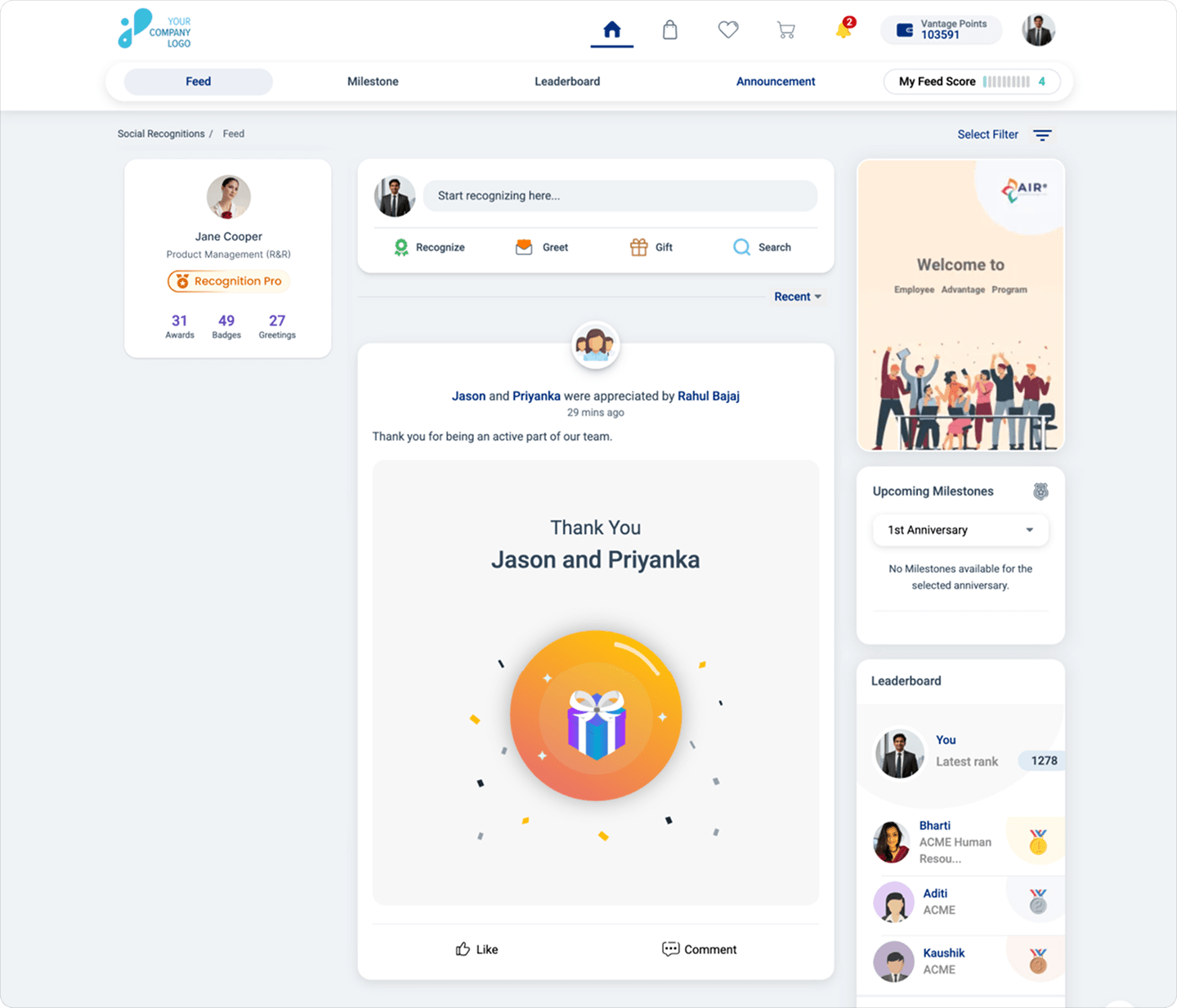
Teams that reach SMART goal milestones without acknowledgment learn that hitting targets makes no difference. Tying goal completion to recognition via Vantage Rewards closes the loop. The recognition lands when the achievement happens, not at the next quarterly review.
Frequently Asked Questions
1. What is an example of a teamwork SMART goal?
A clear example: "Reduce average first-response time from 6 hours to under 2 hours across the support team by October 1, 2026 by implementing tiered ticket routing and paired on-call shifts." It names the team, the metric, the baseline, the target, the method, and the deadline. Every SMART teamwork goal needs all six of those elements to be actionable.
2. What are the 5 C's of teamwork?
The 5 C's of teamwork are Communication, Coordination, Cooperation, Collaboration, and Commitment. They describe the behavioral conditions a team needs to function well. SMART goals operationalize the 5 C's by translating each condition into a measurable target: for example, a communication goal with a tracked adherence rate, or a collaboration goal measured by cross-functional retros delivered per quarter.
3. What are 5 SMART goals examples?
Five concrete SMART goals from this guide: increase qualified sales opportunities from 80 to 110 per quarter by Q3 (Sales); grow organic blog traffic from 50,000 to 75,000 monthly sessions by December 31 (Marketing); reduce code review turnaround from 24 hours to under 8 hours within 60 days (Engineering); lift CSAT from 4.2 to 4.6 out of 5 by Q4 (Customer Success); lift eNPS from +18 to +30 within 6 months (HR).
4. What are the goals of teamwork?
The goals of teamwork are to produce results that no individual could deliver alone, to distribute accountability across a group, and to build shared context that makes the next project faster. SMART goals serve teamwork by making the shared target visible and measurable, so every team member can see what success looks like and track progress toward it.
5. How do you write a SMART goal for a team?
Start with the metric your team is responsible for. State the current number and the target number, then add the deadline. Include the method (the "how") so the approach is part of the commitment, not an afterthought. Assign one named owner. Then run it through the checklist: Specific (team and metric named?), Measurable (starting number and target?), Achievable (possible with current resources?), Relevant (connected to a business priority?), Time-bound (hard deadline?)
6. What is the difference between SMART goals and OKRs?
SMART goals are a framework for writing any goal with precision. OKRs (Objectives and Key Results) are a goal-management system in which one qualitative Objective is supported by 3 to 5 quantitative Key Results. The two work together: use SMART criteria to write the Key Results within an OKR cycle so each result is specific, measurable, and time-bound. For more on combining both, see OKRs and CFRs.
Bottom Line
SMART goals work when three things are true: each goal has a named owner, the team reviews progress on a regular cadence, and goal achievement is recognized when it happens, not in the next all-hands. When recognition is missing, the goal gets done once and nobody sets a harder one next quarter.
Vantage Rewards closes the recognition loop so the team feels the achievement at the moment it happens. That is what makes next quarter's goals worth committing to. Learn more about employee recognition and how it connects to team performance.

Susmita Sarma is a Digital Marketer at Vantage Circle, making employee recognition less of a checkbox and more meaningful - helping organizations say we value our people and truly mean it.
Connect with Susmita on LinkedIn.