


Think about the last time an employee on your team went silent. Not in an obvious way, a dramatic resignation or a heated confrontation, but more like a withdrawal. Fewer ideas in meetings, shorter replies on Teams, and less enthusiasm during check-ins.
Don’t misinterpret this as a personality shift. That is an early warning signal.
And if you are only relying on your annual engagement survey to catch it, you are probably catching it six months too late.
Strong employee relations are not built on benefit checklists or annual review cycles. They are built on continuous listening, transparent processes, and visible recognition.
Modern HR leaders measure employee relations (ER) through real-time sentiment analysis and recognition analytics, rather than annual surveys.
This blog walks you through the three pillars of effective ER, the five Key Performance Indicators (KPIs) that matter, and how to implement a data-driven ER strategy using tools like eNPS (Employee Net Promoter Score) surveys, peer recognition, and sentiment analysis.
What is Employee Relations?
Employee relations comprises a strategic practice of building and maintaining positive, trust-based relationships between management and employees. It is measured in real time through sentiment analysis, strengthened through recognition, and improved through feedback-driven interventions. Strong ER reduces turnover, increases engagement, and creates the psychological safety employees need to perform at their best.
I know what you might be thinking. Employee relations? That is the team that handles complaints, right?
But that framing is obsolete, and it is costing organizations real money.
Traditionally, employee relations described the administrative function that handled grievances, contracts, and workplace policies. But today, ER has evolved into a proactive, data-driven discipline that directly drives retention and engagement outcomes.
It’s crucial to highlight the shift as the workforce has changed tremendously. In 2026, employees expect to be heard consistently, not just during annual reviews. The relationship quality between managers and their reportees is a significant driver of voluntary attrition. Organizations that treat ER as a measurement discipline, not a policy compliance exercise, are the ones that retain their best people and build cultures that attract new talent.
Why Modern ER Matters: The Business Case
According to Gallup, managers account for at least 70% of the variance in employee engagement.
According to the LinkedIn Workplace Learning Report, 90% of organizations are concerned about employee retention, and providing learning opportunities is the number 1 retention strategy.
A study found that 12% of employees with the lowest levels of psychological safety were likely to quit within a year. But when psychological safety is high, only 3% of employees are at risk of quitting.
Investing in ER measurement and recognition reduces turnover costs. But the deeper return is trust, the foundation every performance, development, and change initiative is built on. That's a business outcome, not a soft one.
3 Pillars of Modern Employee Relations
Here is where most organizations go wrong. They pick one of these three pillars and run with it. They do pulse surveys but forget about recognition. Or they have a strong recognition platform but no real conflict- resolution process. Or they invest in conflict resolution frameworks while neglecting to listen continuously.
Strong ER does not work in isolation. The magic happens when all three pillars function together.
| Pillar | Definition | Measurement | VC Product Tie-In |
|---|---|---|---|
| Continuous Listening | Regular pulse surveys and eNPS tracking; real-time mood signals that surface issues before they escalate | eNPS score, sentiment trend, early warning flags | Vantage Pulse |
| Recognition and Belonging | Peer-to-peer and manager recognition tied to company values; public celebration of contributions | Recognition rate, frequency, reach | Vantage Rewards |
| Conflict Prevention and Resolution | Proactive trust-building, fair documented processes, clear escalation paths, timely close | Conflict incidents, resolution time, psychological safety score | Platform and HR best practices |
Pillar 1: Continuous Listening — The Sentiment Feedback Loop
Here is the truth most HR teams do not want to hear: your annual engagement survey is not telling you what is happening in your organization. By the time you analyze the results, the employees who scored low have already updated their resumes.
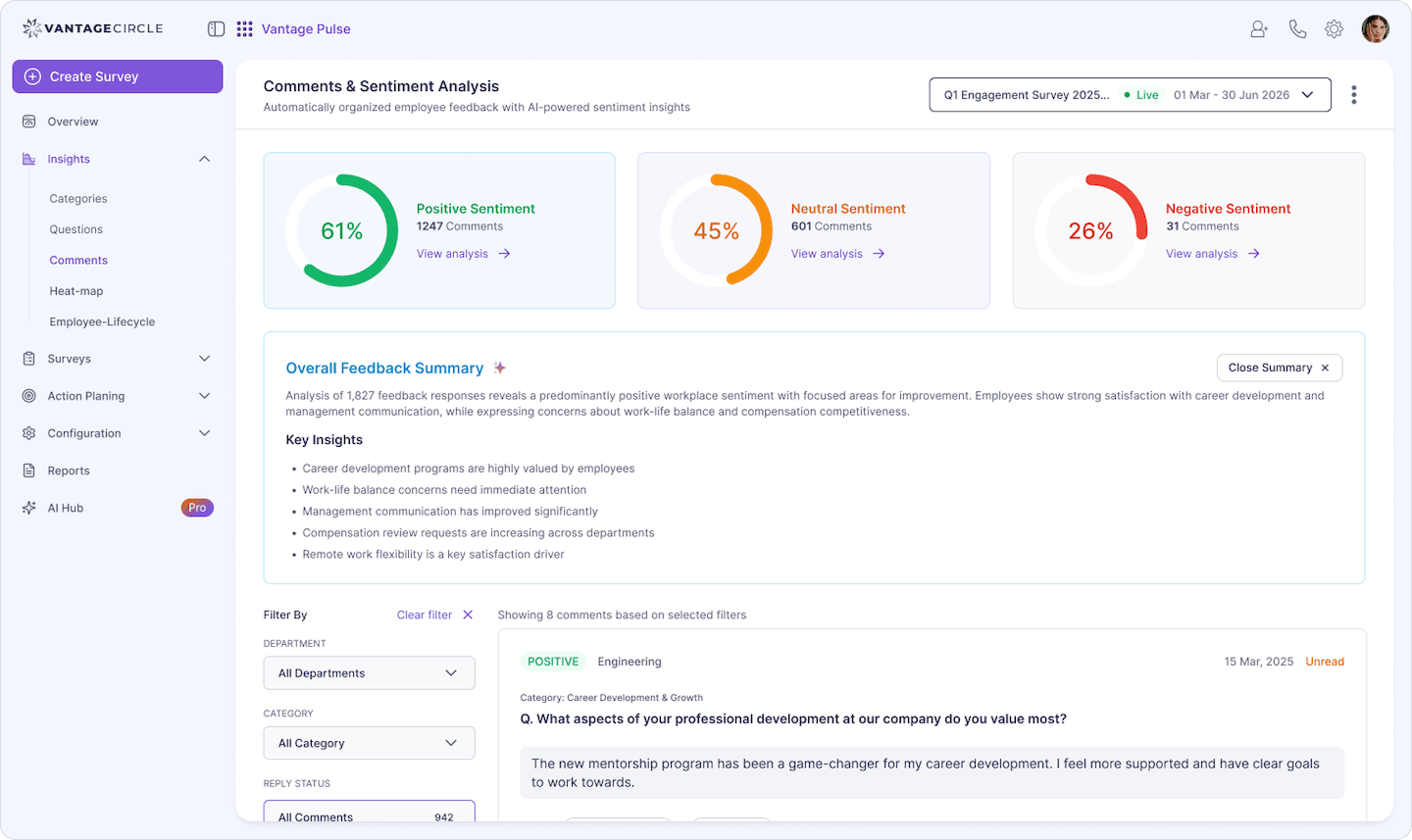
The foundation of strong ER is real-time sentiment tracking that tells you what employees feel before they decide to leave.
eNPS is the sole direct measure of ER health. Ask employees one question every month: "How likely are you to recommend this company as a place to work?" on a 0 to 10 scale. Promoters score 9 to 10. Detractors score 0 to 6.
The formula is: eNPS = % Promoters minus % Detractors. Industry average sits between +20 and +30. A score above +40 signals strong ER health.
Track eNPS trends, not just point-in-time scores. A team that moves from -15 eNPS in January 2025 to +35 by mid-2026 does so through consistent action on feedback. Monthly pulse surveys, combined with manager-led follow-up, create the feedback-to-action loop that drives that change.
Sentiment analysis surfaces the reasons behind eNPS fluctuations. When sentiment drops, you can identify what drives the drop, be it workload, unclear communication, or a relationship breakdown between a manager and their direct reports. That diagnostic speed is the difference between an early intervention and an exit interview. Gallup, data show that 80% of employees who say they have received meaningful feedback in the past week are fully engaged.
Real-time sentiment analysis helps you catch ER issues before employees resign.
Pillar 2: Recognition as the Language of Trust
I want you to think about a colleague who genuinely made a difference last week. Did anyone acknowledge it?
If you are pausing to think, that pause is your answer.
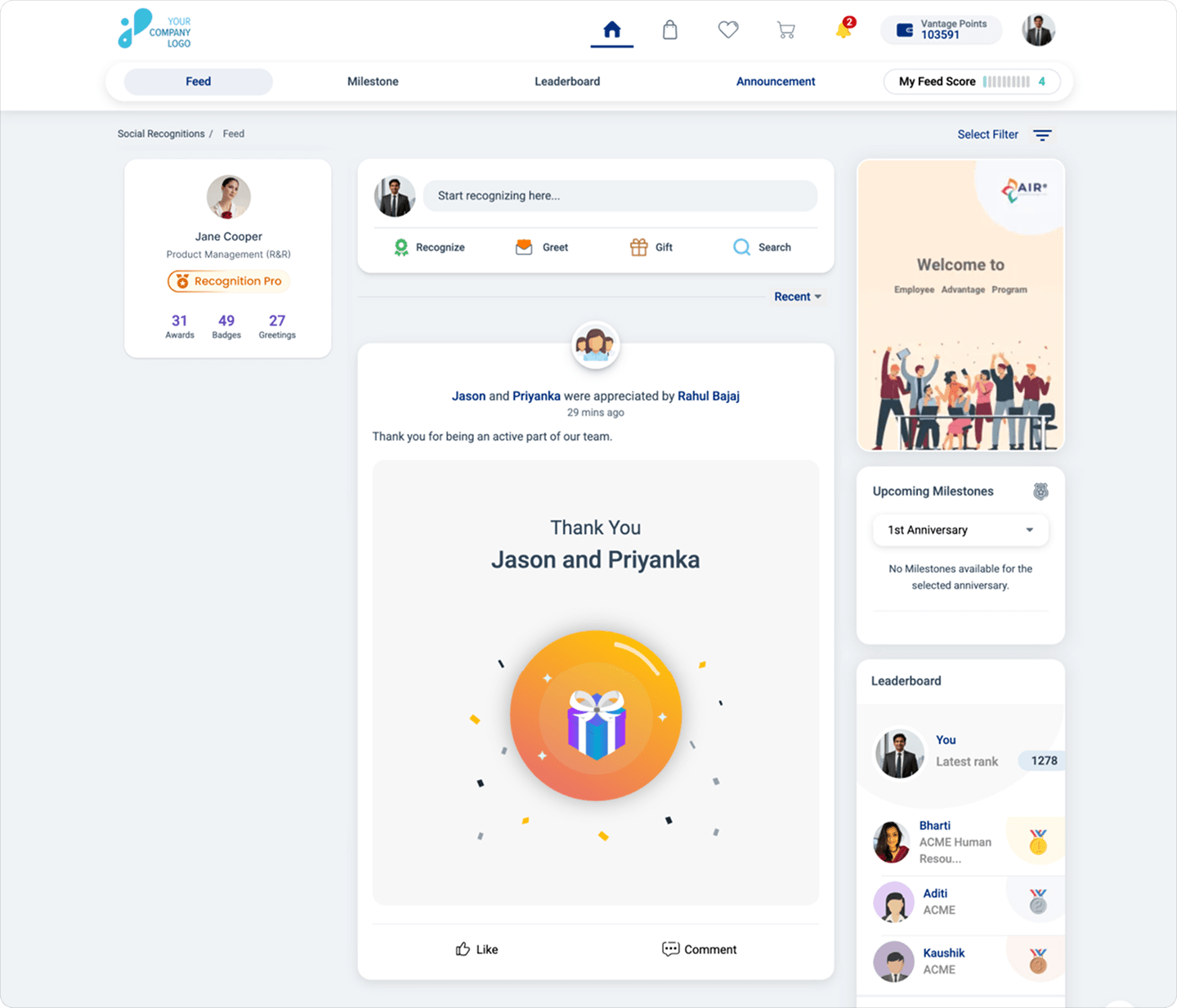
Strong ER is built on consistent, visible recognition. Not through annual reviews, but day-to-day acknowledgment where employees are seen, valued, and contribute to something meaningful.
To draw your attention, peer-to-peer recognition and manager recognition serve different psychological functions. Peer recognition builds horizontal trust and psychological safety. When colleagues recognize each other publicly, they signal that contributions matter and that relationships are genuine, not transactional. Manager recognition validates effort with organizational authority, which directly shapes how employees interpret their standing at work.
Recognition program analytics helps reveal which teams collaborate with most, which managers consistently recognize their reports, and which groups are isolated from the recognition loop. These patterns identify the relationships that need investment before they deteriorate into disengagement.
When core values are aligned with recognition and employees are specifically recognized for behaviors that demonstrate company values, it reinforces cultural identity and shared mission.
Pillar 3: Fair Processes and Conflict De-escalation
Let me tell you what silence looks like in an organization with unresolved conflict.
It looks like your highest performers are suddenly becoming your quietest voices in team meetings. It looks like two departments that formerly collaborated now communicate only through email. It looks like a team whose productivity data is fine, but whose sentiment scores have been declining for three consecutive pulse cycles.
As you can see, trust erodes when employees feel processes are unfair or when conflicts remain unresolved. Conflict resolution is not an HR administrative function; it is a core ER KPI.
The mechanism is straightforward: when employees know that workplace friction is addressed fairly and quickly, they naturally invest more in their relationships and their work. When they do not trust the process, they withdraw before the formal conflict ever escalates.
Here are the five practices that define effective conflict resolution in high-performing organizations:
Transparent process: Every employee knows the steps from report to resolution before a conflict occurs. Documented, accessible, and reviewed annually.
Manager training: Managers receive active listening and de-escalation skills as part of their core role, not as an optional workshop offered once a year.
Mediation option: Neutral third-party mediation is available for disputes where direct manager involvement creates bias or further breakdown.
Timely resolution: Conflicts are resolved within 30 days from report to close. Resolution time is tracked and reviewed monthly.
Learning culture: Post-resolution retrospectives identify whether the process requires changes to prevent recurrence and whether the root cause was systemic.
Sentiment data accelerates conflict prevention. When a team's sentiment score drops sharply over two consecutive pulse cycles, that is an early warning indicator. ER leaders act on the signal before a conflict escalates into turnover.
How to Measure Employee Relations: 5 KPIs That Matter
If you ask most HR leaders how their employee relations health is right now, they will give you an answer that is either vague or six months old. That is the problem we need to address.
Gut feeling is not an employee relations strategy. These five KPIs give HR leaders a measurement framework that connects daily ER practices to retention and engagement outcomes.
| KPI | Target | What It Signals | Measurement Tool |
|---|---|---|---|
| eNPS | >40 (industry avg: 20–30) | Overall ER health; willingness to advocate for the organization | Vantage Pulse |
| Sentiment Trend | Positive responses ≥60% | Real-time mood; early warning indicator for turnover risk | Vantage Pulse + Sentiment Analysis |
| Recognition Rate | 5+ moments per employee per month | Trust, belonging, psychological safety across teams | Vantage Rewards Analytics |
| Conflict Resolution Time | <30 days from report to close | Process fairness; organizational commitment to ER | Internal tracking + Pulse follow-up |
| Retention Rate (Year-Over-Year) | >90% (industry benchmark: 85–88%) | Ultimate ER outcome; churn prevented | HRIS + Turnover Analytics |
How to use this dashboard:
Review all five KPIs monthly in a dedicated ER review meeting between HR leadership and department managers. Any two consecutive months of declining eNPS or sentiment scores must trigger an intervention conversation, not a wait-and-see approach.
Quarterly trend analysis identifies patterns such as seasonal sentiment dips or team-specific recognition gaps that inform the next quarter's ER investment priorities.
Vantage Pulse and Vantage Recognition Analytics bring eNPS trends, sentiment data, and recognition rates into a single view so that ER leaders can spend their monthly review in conversation, not in data compilation.
7 Actionable Steps to Improve Employee Relations Starting This Week
I want to be practical here. These steps are arranged by implementation speed. Start with Step 1 this week. Build toward Step 7 within 90 days. Each step is something you can act on without waiting for a budget cycle or an executive approval.
Measure your baseline eNPS: Run a pulse survey this week. Ask one question: "How likely are you to recommend this company as a place to work?" on a 0 to 10 scale. Your score is your starting point. You cannot improve what you have not measured, and you cannot prioritize ER interventions without knowing where you currently stand.
Train managers on psychological safety: Share a guide on psychological safety and active listening with your management team. Identify one concrete skill for managers to practice in their one-on-ones each week. Managers who model listening and recognition behaviors primarily influence team-level eNPS improvement, according to LinkedIn L&D 2025 research.
Launch peer recognition: Introduce peer-to-peer shout-outs in your recognition platform, or as a starting point, a dedicated channel in your communication tool. Track recognition frequency by team from week one. Aim for five or more moments per employee per month within the first 60 days of launch.
Create a sentiment trend dashboard: Plot your eNPS scores across the past 12 months. If you lack 12 months of data, start now and track monthly going forward. Plot sentiment trend alongside eNPS. Dips identify your intervention calendar for the next quarter.
Define your conflict resolution process: Document the steps, resolution timeline (30-day maximum), and escalation paths. Share the documentation with every employee manager before a conflict arises. Transparency in process design is itself an ER intervention. Employees who trust the process engage more, even when conflicts arise.
Schedule monthly ER reviews: Block 60 minutes per month for an ER review with HR leaders and department managers. Review sentiment data, recognition trends, and conflict resolution timelines together. The goal is to make decisions driven by data, not crisis-derived responses.
Tie recognition to company values: Reframe recognition criteria in your platform or culture norms. When peers and managers recognize colleagues, ask them to name which company value the contribution demonstrates. Recognition anchored to values reinforces culture, builds ER at the team level, and creates a feedback loop that strengthens psychological safety across the organization.
The Path Forward
Employee relations is no longer a compliance function buried in an HR filing cabinet.It is a strategic competitive advantage, measurable through eNPS scores and sentiment trends, strengthened through peer recognition, and protected by fair conflict resolution processes.
The organizations winning the talent war treat ER as a monthly measurement discipline, listening continuously to employees and acting visibly on feedback.
Start this week: measure your baseline eNPS, train managers on psychological safety, launch peer recognition, build your dashboard. The seven actionable steps outlined in this blog are implementable without waiting for budget cycles or executive approval.
The question is not whether you should invest in employee relations. The question is when you will begin.
FAQs
How do you improve employee relations?
Start with continuous sentiment listening through monthly pulse surveys, then act on feedback through recognition programs, manager training, and fair conflict resolution processes. Set a target eNPS of +40 and work backward from your current score to identify the specific ER gaps your organization closes first. Monthly cadence, not annual reviews, is the operational rhythm that creates sustained ER improvement.
What are the benefits of employee relations?
Strong employee relations reduce turnover, increase engagement, decrease conflict escalation, improve innovation output, and build the psychological safety that allows employees to take creative risks. LinkedIn's L&D Report shows companies with robust ER frameworks see 23% lower turnover than industry peers. SHRM benchmarks connect strong ER to measurable gains in productivity and organizational resilience.
Why is employee relations important?
McKinsey's 2025 research shows that 73% of voluntary departures stem from poor management relationships, not from compensation gaps. Employee relations is a direct retention lever. Organizations that invest in ER strategy prevent turnover costs that average 50–200% of an employee's annual salary according to SHRM benchmarks. ER is not a soft people initiative. It is a financial performance driver.
What is the main goal of employee relations?
The main goal of employee relations is to create an environment where employees trust leadership, feel valued and heard, and experience fair processes when conflict arises. Organizations measure ER health through eNPS scores, sentiment trends, and recognition rates to ensure that goal translates from intention into outcome and from outcome into retention.
How do managers build good employee relations?
Managers build strong employee relations by listening actively in one-on-ones, recognizing contributions specifically and publicly, resolving conflicts fairly and within a defined timeline, communicating transparently about team and business context, and modeling the company values they ask employees to live. Recognition frequency is the most measurable manager behavior that correlates with team-level eNPS improvement and sustained psychological safety scores.
Written by