


Survey incentives are rewards or motivators offered to employees to encourage participation in a workplace survey. They range from monetary rewards like gift cards and prize draws to non-monetary approaches like transparency about results and public follow-through from previous surveys. The right incentive increases response rates without compromising the honesty or quality of the data you collect.
TL;DR: Not all survey incentives are equal. Non-monetary incentives (transparency, trust, and showing that last time's feedback actually changed something) consistently outperform cash for internal employee surveys. Monetary rewards have their place, but only for long, infrequent surveys or hard-to-reach groups. This post gives you 20 specific ideas and a framework for choosing between them.
Key Takeaways
- Survey incentives increase response rates but introduce data quality risk when applied without care
- Non-monetary incentives are more effective for internal employee surveys than cash or gift cards
- Monetary incentives are appropriate for surveys of 20 minutes or more, or for reaching disengaged groups
- Transparency about results is the single strongest participation driver in employee surveys
- Real-time participation tracking lets HR intervene before the survey closes, reducing dependence on incentives
Before the List: Why Incentives Can Backfire
Most HR teams treat low survey participation as a motivation problem. It usually is not. It is a trust problem.
Employees skip surveys for a few consistent reasons: they do not believe the results will change anything, they are not sure their responses are truly anonymous, or they remember the last survey that disappeared into a spreadsheet and was never mentioned again. A gift card does not fix any of those things. In some cases, it makes them worse. Attaching a reward to a trust-based request sends a strange signal: "We know you wouldn't do this otherwise, so here's a bribe."
That said, incentives do have a legitimate role. You just need to know when to reach for them and which type to use.
There is also a specific failure mode worth naming before we get into the list: satisficing. When employees know a reward is coming for completion, a portion of them stop answering honestly and start answering quickly. They hit the midpoint on every scale, skip the open-ended questions, and collect their gift card in under two minutes. Your participation rate looks great. Your data is not.
A 2023 study in PLOS ONE found that financially motivated respondents showed measurably different engagement patterns than those who opted in for other reasons (Abdelazeem et al., 2023). A separate analysis found that whether incentives were offered upfront versus post-completion had a direct effect on data quality (Smith et al., 2019, BMC Medical Research Methodology).
"An incentive is a bullet, a key: an often tiny object with astonishing power to change a situation."
– Steven D. Levitt (Economist, University of Chicago)
The same power that makes incentives work can make them work against you. Keep that in mind as you read through the 20 ideas below.
Recommended Resource: Why Employee Survey Participation Rates Matter (and How to Improve Them)
8 Monetary Survey Incentive Ideas
Use these when the survey is long, infrequent, or targeting a group that has little existing reason to participate. For a two-minute recurring pulse, none of these are necessary and most will do more harm than good.
1. Gift Cards
Gift cards are the default choice for most HR teams, and for good reason. They are flexible, easy to distribute digitally, and feel different from a direct cash payment in ways that actually matter. Research on reward psychology consistently shows that people respond differently to a £15 voucher than to a £15 bank transfer, even though they are worth exactly the same amount. The gift card feels like a gift. The transfer feels like a transaction.
The satisficing risk kicks in when the value is too high relative to the survey length. A £25 gift card for a five-question pulse is almost guaranteed to attract people who want the reward more than they want to share honest feedback. Keep the value proportional: for surveys of 20 minutes or more, gift cards in the range of £15–25 / $15–25 per person are appropriate.
2. Prize Draws
Prize draws are underrated. Most HR teams skip straight to per-person gift cards because it feels fairer. It is not always the smarter call.
A prize draw (one larger reward, distributed by lottery among all completers) removes the "I'm only doing this for the money" dynamic. The reward is real but uncertain, which means the survey itself becomes the primary reason to participate. It also costs less per survey run, which matters if you're running quarterly assessments across a large workforce.
Keep the prize meaningful but not life-changing. £50–£100 / $50–$100 is enough to generate interest without creating pressure. The goal is a small extra reason to respond. Not to make non-completion feel like a financial loss.
3. Charitable Donations
Donating to a cause on behalf of survey completers strips out the personal financial incentive and replaces it with something different: the feeling that participation has collective meaning.
This works best when the cause is relevant to the survey topic (a wellness survey raising money for a mental health charity, for example) or when it aligns with the company's stated values. It performs less well when the charity feels arbitrary or when employees are already disengaged. You cannot compensate for a trust deficit with a donation to a cause the respondent doesn't care about.
4. Reward Points and Recognition Credits
If your organisation runs a recognition platform, survey completion can be a trigger for points allocation. This ties participation to an existing behaviour employees already value, rather than introducing an external reward that feels disconnected from their day-to-day.
The important design principle: the points need to be meaningful within your existing system. If employees can redeem 500 points for something they actually want, completion becomes part of a behaviour loop that reinforces itself. If the points disappear into an account nobody checks, the incentive is theoretical at best.
5. Cash or Direct Payment
Cash is the most straightforward monetary incentive and the one most likely to attract satisficing behavior. It is also the most appropriate for genuinely demanding surveys: long external studies, research panels, or one-time assessments asking employees to invest 45 minutes or more.
The rule of thumb: if you are paying cash, structure it as a post-completion payment rather than pre-announcing a per-minute rate. Pre-announced cash payments attract respondents who want to optimise their time. Post-completion payments attract people who were already willing to participate.
6. Experience-Based Rewards
A team lunch, an extra half-day off, or a group activity for the department that hits a participation target changes the dynamic in a useful way. The reward is shared, which means colleagues have a mild social interest in each other completing the survey. Peer accountability is a quieter and less manipulative participation driver than financial pressure.
Experience-based rewards work best when framed around team achievement rather than individual incentive. "If 80% of the team completes the survey by Friday, we'll do the team outing we've been pushing back" is more effective than "complete the survey and get a day off."
7. Subscription Services
A month of a streaming service, an audiobook credit, or a digital learning platform subscription works similarly to a gift card but feels more personal. Employees tend to see subscriptions as a treat they might not buy themselves, which increases perceived value without increasing actual cost.
The practical upside: subscriptions are easy to deliver digitally, require no procurement overhead, and arrive in a format employees are already familiar with.
8. Company Store or Swag Credits
Credits for branded merchandise or a company store give participation a visible, social dimension. Employees who collect the reward and use it are, in a small way, signalling participation to peers. This only works if the merchandise is actually desirable, which means it needs to be considered honestly before being offered.
If your company swag tends to sit in a drawer, this incentive does not work. If employees actively use and wear the branded gear, it is a reasonable low-cost option for recurring surveys.
Use this as a quick reference when deciding which monetary incentive (if any) fits your next survey:
| Survey Length | Recommended Incentive Type | Suggested Value | Notes |
|---|---|---|---|
| 2–5 min (pulse survey) | Non-monetary | N/A | Recognition and transparency are sufficient; monetary incentives at this length create more bias than benefit |
| 5–10 min | Non-monetary or optional token | £5–10 / $5–10 if used | Results transparency typically sufficient; monetary adds cost without proportional benefit |
| 10–20 min | Prize draw | 1× £25–50 / $25–50 | Prize draw outperforms per-head reward; avoids satisficing at the individual completion level |
| 20–45 min | Individual gift card | £15–25 / $15–25 per person | Cognitive load warrants direct reward; deliver post-completion to reduce pre-survey bias |
| 45+ min | Direct payment | £25–50+ / $25–50+ per person | Research survey rates apply; budget for response quality, not just completion count |
"The best use of money as a motivator is to pay people enough to take the issue of money off the table."
– Daniel Pink (Author and Behavioral Science Writer)
Once the monetary component becomes the primary reason to complete a survey, it has stopped being a participation tool and become the subject of the interaction. That is a problem you cannot fix by raising the incentive value.
12 Non-Monetary Survey Incentive Ideas
These are the ones most HR teams underinvest in. They also tend to produce better data, cost less, and have a compounding effect over time. A gift card works once. Closing the feedback loop works for every survey you run after it.
9. Full Transparency on How Results Will Be Used
This one is free, takes five minutes to implement, and outperforms almost every monetary incentive on this list for internal employee surveys.
Tell your employees, before the survey opens, exactly what is going to happen with their answers. Not "your feedback matters." That is a corporate filler phrase and everyone reading it knows it. Be specific. Who will see the results? When will they be shared? What decisions will be influenced? "We'll share outcomes in the all-hands in Q3, and the results will directly inform how we restructure our performance review cycle" is a sentence that gives someone a real reason to spend two minutes on a survey.
IBM research found that 83% of employees say they would participate in an employee listening program when given the opportunity (IBM Institute for Business Value, "Amplifying Employee Voice"). The participation potential already exists in most workforces. What blocks it is the belief that nothing will change as a result.
When that trust is present, the impact is measurable. Salesforce research found that employees who feel their voice is heard are 4.6 times more likely to feel empowered to perform their best work (Salesforce). Transparent survey communication is how that feeling starts.
10. Design the Survey to Be Short
Survey length is itself an incentive. A two-minute pulse needs no reward. A 45-minute annual assessment without one is asking employees to make a significant time investment in something they may not trust.
If your participation rate is low and your survey is long, shortening the survey is more effective than adding a gift card. It fixes the participation problem at the design stage rather than trying to compensate for a poor design with a financial band-aid. As a rule: if you cannot explain why each question on the survey is there, remove it.
11. Close the Feedback Loop. Every Time.
The most powerful participation driver for the next survey is what happens after this one.
If employees complete a survey and see a concrete change result from it, their likelihood of completing the next one increases sharply. If they hear nothing, that baseline drops. This is not a theory. It is how trust compounds or erodes over time. The communication does not have to be elaborate. "Last quarter, you told us communication from leadership needed work. We've added a monthly team-level update from every director. Here's what that looks like." That's the whole message.
12. Get Managers to Personally Endorse the Survey
An email from HR asking employees to complete a survey lands differently from a manager saying: "I'll be reading these results with your team in mind. Please take two minutes."
The difference is accountability. The manager is telling their team that the data matters to them personally, not institutionally. For this to work, managers need to be briefed before the survey goes live. They need to know what the survey covers, why it is happening now, and what they will do with results. A briefed manager is a force multiplier for participation. An unbriefed one is a liability.
13. Use Social Proof and Team Participation Milestones
"83% of your team has already completed the survey" is a more effective nudge than most monetary incentives for employees who are on the fence. People are social. Most do not want to be the outlier.
At the company level, showing overall participation in real time creates a sense of momentum. At the team level, sharing department-specific completion rates gives managers something concrete to reference in follow-up messages. "Your team is at 40%. The company average is 65%. Let's close that gap." This only works if your survey platform tracks participation in real time. If you are finding out completion rates after the survey closes, you've missed the window where this is actually useful.
14. Run a "Here's What Changed" Pre-Survey Campaign
Before a survey opens, send one message. Not a reminder to complete the survey, but a results summary from the previous cycle. Show employees what they said last time and what changed as a result. Then tell them the next survey is opening.
This is the most effective sequence for building recurring participation: close the loop, then open the next one. It turns what could feel like a repeat obligation into a conversation with visible outcomes. Three bullet points in a Slack message is enough. "You asked. We changed X, Y, and Z. Here is what we are asking about this time."
15. Make Anonymity Visible, Not Just Claimed
Most surveys say they are anonymous. Employees often do not believe it. The gap between the claim and the belief is one of the most underestimated participation barriers in internal surveys.
Fix it at the survey design level. Show employees exactly what data is collected and what is not. Use trust signals in the survey interface ("No name or email tracking. Your identity is never stored."). Explain how the data is aggregated and why individual responses cannot be traced. The more specific you are, the more credible the claim.
16. Share a Leadership Message Explaining Why This Survey Matters Now
A brief video or written message from a senior leader, recorded specifically for this survey cycle, changes the perceived importance of the exercise. It signals that the survey is not just an HR initiative. Leadership is asking, and leadership will be reading.
The message should be short (under two minutes if video, under 200 words if written), specific to this survey and this moment, and honest about what the results will be used for. A generic "your feedback is important to us" from the CEO is worse than no message at all. A specific "we are asking these questions because we are making a decision about X and we need to hear from you before we do" is genuinely useful.
17. Share Department-Level Results with Managers
When managers receive their team's results rather than just the company-wide summary, two things happen. First, they become personally invested in the outcome because the data reflects their team. Second, they have something specific to discuss with their team in the follow-up, which makes the loop-closing conversation feel real rather than corporate.
This requires a platform that can segment and export results by team or department without compromising individual anonymity. When it works, it turns every manager into a participant in the feedback process, not just a conduit for the HR team's messages.
18. Host a Dedicated Results Town Hall
A results town hall, scheduled in advance and announced before the survey opens, changes employee expectations. If people know there is a specific meeting where results will be presented and discussed, participation becomes part of that process rather than a form they fill out and forget.
The town hall does not need to present perfect data or definitive solutions. It needs to be honest. "Here is what we found. Here are the things we are committing to change. Here are the things we are still working through." That level of transparency builds the trust that drives the next round of participation.
19. Run an Ongoing "You Asked, We Did" Channel
A dedicated Slack channel, intranet page, or regular newsletter section that consistently links survey feedback to visible changes creates an ambient feedback culture. Employees who see that link regularly, as part of their daily or weekly work context, do not need to be convinced to complete the next survey. They already believe it is worth their time.
The format is simple: "In [Month]'s survey, employees in [Department/Region] flagged [Issue]. We changed [X]. Here is what that looks like." Keep it specific, keep it short, and keep it consistent. One update per month is enough to maintain the habit.
20. Involve Employees in Designing the Next Survey
After a survey closes and results are shared, ask employees which topics they want the next survey to cover. This can be a simple open comment field at the end of the current survey, a quick follow-up vote, or a manager-led discussion in team meetings.
The participation impact is direct: employees who had a hand in choosing the questions are meaningfully more likely to complete the survey when it arrives. They are invested in the outcome because they chose what was being asked. It also signals that the organisation views employees as partners in the listening process, not just data sources.
Recommended Resource: Why Employee Surveys Fail (and What HR Can Do About It)
How to Match the Right Incentive to Your Survey
Not every survey calls for the same approach. Here is the decision logic.
Use non-monetary incentives when:
- The survey is a recurring pulse (weekly, bi-weekly, or monthly)
- The survey is 10 minutes or less
- Participation in the last cycle was above 40%
- The primary friction is trust, not effort
Consider monetary incentives when:
- The survey is a one-time annual assessment of 20 minutes or more
- You are surveying a group with historically low participation (frontline workers, contractors, part-time staff)
- The survey is externally administered or voluntary by design
- You need a statistically representative sample for a specific business decision
Always pair any incentive with:
- A clear pre-survey communication explaining the purpose
- A named person accountable for acting on results
- A post-survey results summary shared with participants
- A specific commitment to action, even if that action is "we're still reviewing this and will share findings by [date]"
The failure pattern worth watching: launching with a gift card, sharing no results, and wondering why the next survey has lower participation despite a higher incentive value. Incentive dependency is real. Once employees expect a reward to complete a survey, the threshold rises automatically each time. You are building a habit you will have to maintain indefinitely or break at cost to your participation rate.
How Vantage Pulse Takes the Guesswork Out of Participation
Gallup estimates that low employee engagement costs the global economy approximately $10 trillion in lost productivity each year (State of the Global Workplace, 2025). The decisions HR teams make from survey data either reduce that number or add to it. Biased data from poorly designed incentives is not a neutral outcome.
The fundamental participation problem is not that employees are unwilling to share feedback. It is that HR teams find out about low response rates after the survey closes. By then, nothing can be done about it.
Vantage Pulse surfaces participation data in real time, so you can act during the survey window rather than after it.
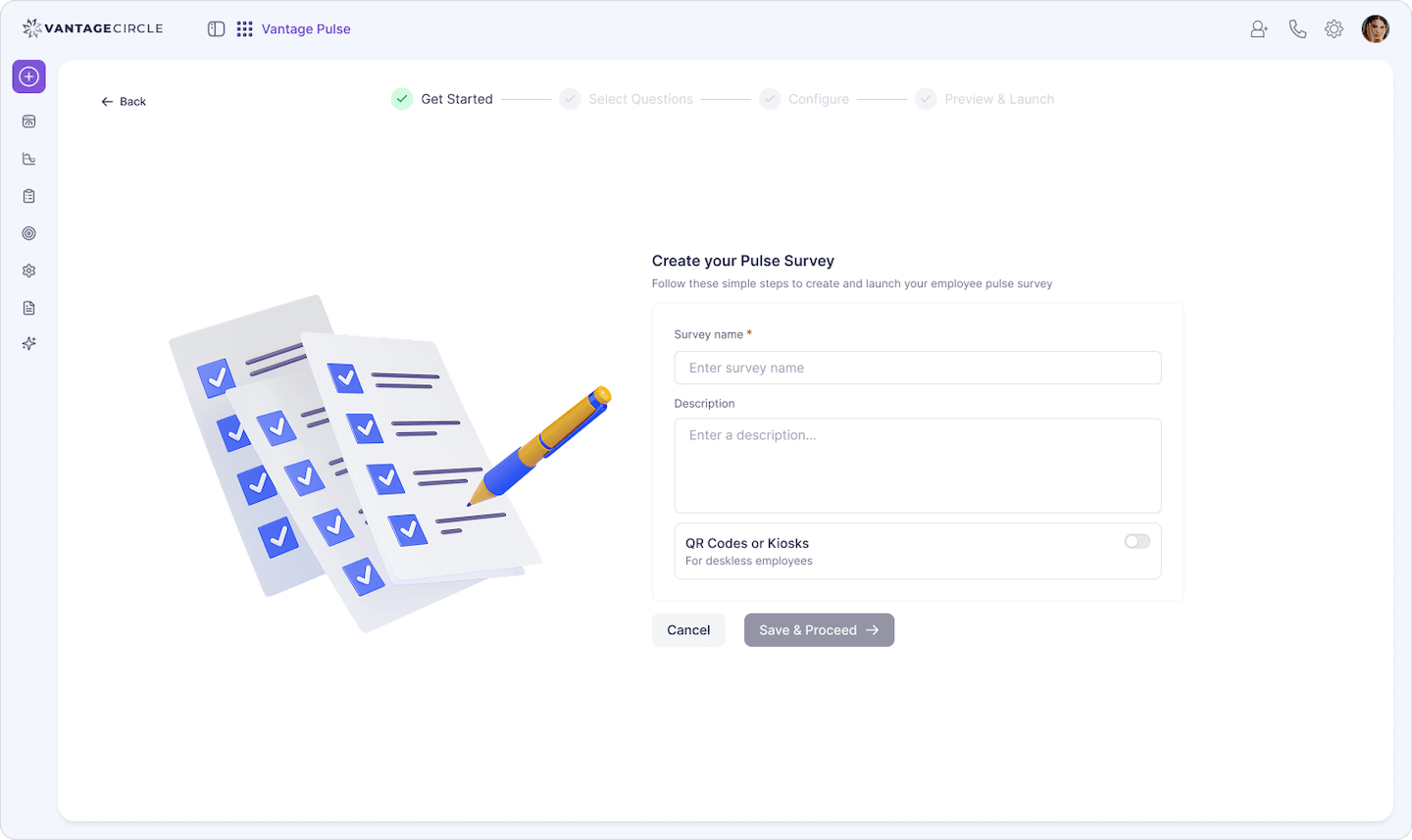
When you create a survey in Vantage Pulse, you set the schedule, the target population, and the anonymous submission settings in a single flow. The platform tracks participation as responses come in, department by department, with benchmark comparisons, so you can see where your coverage is thin before the survey closes.
If the Customer Success team is at 18% with two days remaining, you know to send a targeted reminder through the manager channel. You do not find out at 8% when the survey has closed and you are trying to explain low-confidence data to leadership.
The Two-Way Anonymous Conversation feature addresses a related problem: what happens with employees who respond but share concerns that need follow-up. HR can reply directly to any anonymous comment. The employee receives the reply without their identity being revealed at any point. This visible engagement (employees seeing that their feedback generates a real response) is one of the strongest predictors of higher participation in the next survey cycle.
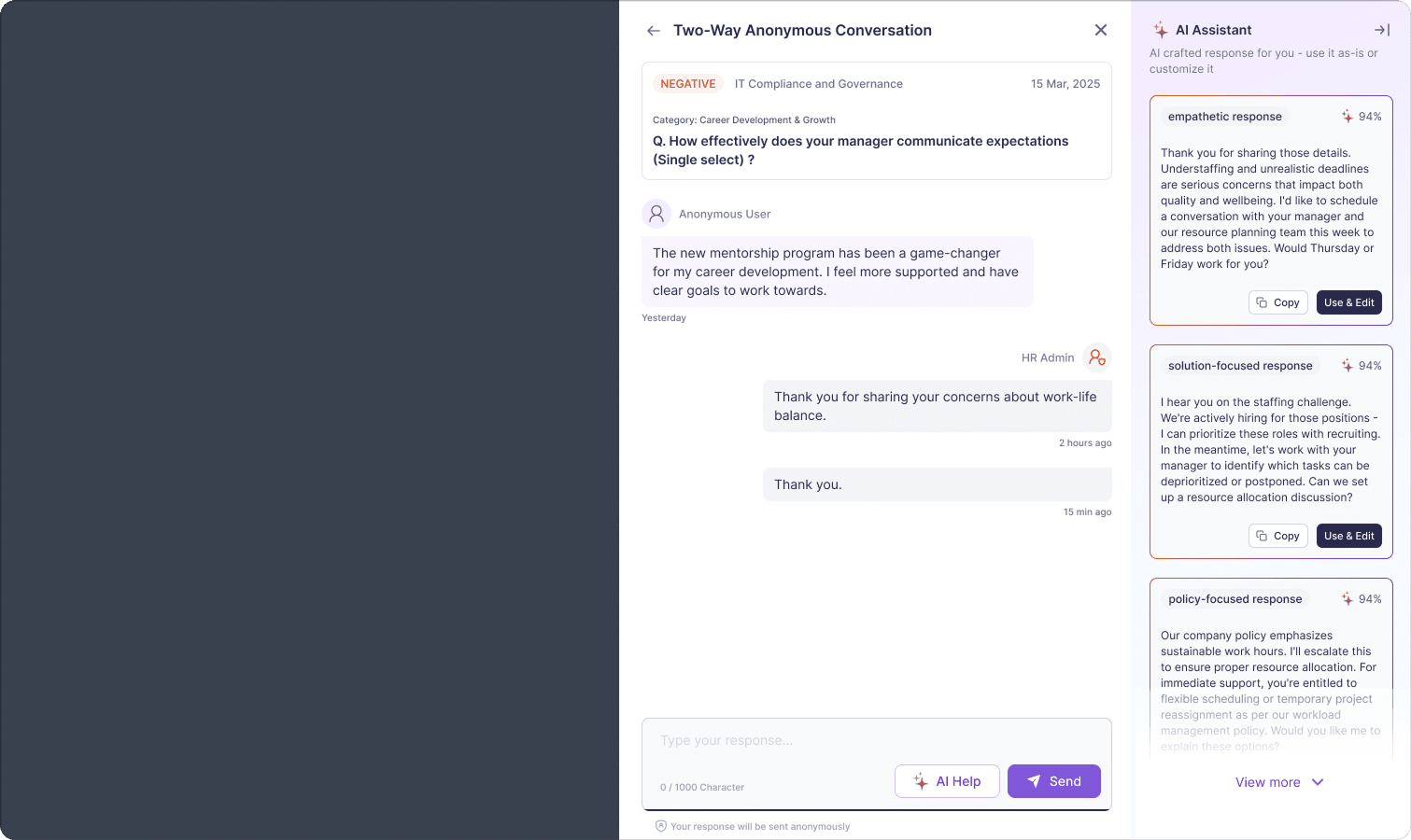
When an HR manager opens a comment thread, the AI Assistant suggests three empathetic response drafts, each scored at 94% confidence. The manager can use any draft as written or edit it before sending. The result is consistent, thoughtful responses to every piece of feedback. Not just the items that surfaced at the top of someone's inbox.
For organisations running recurring pulse surveys, this capability directly improves future participation rates. Employees who receive a response to previous feedback complete subsequent surveys at higher rates than those who hear nothing.
See it in action: Book a 15-minute Vantage Pulse demo and see how real-time participation tracking and AI-assisted anonymous conversations change how your team acts on employee feedback.
AccessOne: 67% Participation in Month One Without a Single Gift Card
AccessOne, a US-based healthcare financial technology company, launched Vantage Pulse to replace their annual engagement survey cycle. In their first month running a pulse survey, they hit a 67% participation rate, against an industry benchmark of 30–50%, without relying on monetary incentives.
The result was not driven by rewards. It was driven by trust.
Their HR team made two decisions that shifted the dynamic. First, they committed to sharing results with the full organisation within two weeks of each survey close. Second, they made the heatmap visible to department managers, so every leader could see exactly how their team was responding.
Both decisions told employees the same thing: this data is going somewhere. It will be used, not filed.
The eNPS from their first pulse: 45. The industry average sits between 10 and 30. The split (Promoters 58%, Passives 29%, Detractors 13%) gave HR a picture of engagement distribution that no annual survey had ever produced.
The critical number from the heatmap: the Customer Success department had a Relationship with Peers score of 20. That triggered a follow-up conversation the HR team would not have known to have without segmented, real-time data.
"Seeing honest feelings in real numbers? Priceless. We could actually watch morale lift after each change."
– Cassidi Ross, HR Coordinator, AccessOne
Participation follows trust. When employees believe feedback leads to action, the participation problem largely solves itself.
Conclusion
Survey incentives are a tool, not a strategy. They address the effort barrier. They do not address the trust barrier.
Most employees are not skipping your surveys because completing a two-minute form is too much effort. They are skipping because the last survey went nowhere. Because they do not believe their responses are truly anonymous. Because they have learned, reasonably, that nothing changes.
No gift card closes that gap. Consistent follow-through does. Sharing results does. Responding to anonymous feedback does. Making participation feel worthwhile is what gets you to 67%. Not making it financially attractive.
If your participation rate is lower than it should be, the first question to ask is not "what incentive should we add?" It is "what happened to the feedback from last time?"
Answering that question, visibly and for the whole organisation, is the most effective survey incentive you have.
Ready to see what 67% participation looks like in practice? Book a 15-minute Vantage Pulse demo and see how real-time participation tracking, anonymous two-way conversations, and AI-assisted follow-through change how your team acts on every piece of employee feedback.
FAQs:
Do survey incentives really improve response rates?
Yes, monetary incentives reliably increase raw completion rates. The catch is that higher completion rates do not always produce better data. Incentives can introduce satisficing behavior and response bias that reduce response quality even as the overall count goes up. Non-monetary incentives (transparency, short surveys, visible follow-through) produce more durable participation gains without the data quality trade-off.
What is the best incentive for an employee survey?
For most internal employee surveys, the most effective incentive is a clear pre-survey communication explaining exactly what will be done with the results, paired with a visible example of something that changed after the last survey. For surveys longer than 20 minutes or targeting populations with historically low participation, a prize draw (one larger reward across all completers) tends to outperform per-participant gift cards.
Can survey incentives cause bias in results?
Yes. Monetary incentives attract respondents who are primarily motivated by the reward rather than genuine engagement with the survey content. This leads to satisficing: completing the survey as quickly as possible. Results skew toward socially desirable or neutral answers. The bias effect is stronger when incentives are announced before the survey opens rather than delivered as a post-completion acknowledgment. For employee pulse surveys, response quality matters more than maximising completion count.
How much should you pay for survey participation?
For short pulse surveys (under 10 minutes), no payment is necessary or recommended. For surveys of 10–20 minutes, a prize draw in the range of £25–50 / $25–50 is a reasonable benchmark. For surveys of 20 minutes or more, individual gift cards in the range of £15–25 / $15–25 per person are appropriate. For surveys exceeding 45 minutes, research-level rates apply and the cost per complete should honestly reflect the time investment.
What are non-monetary survey incentives?
Non-monetary survey incentives are participation drivers that do not involve direct financial reward. They include: communicating clearly how results will be used before the survey opens, sharing results with participants after it closes, demonstrating that previous feedback led to visible changes, keeping surveys short enough that completion feels effortless, and having managers personally endorse the survey to their teams.
How do I increase survey participation without incentives?
The three highest-impact interventions are: (1) close the feedback loop from your last survey by sharing what changed as a result, (2) get managers to personally invite their teams to participate with a specific reason why their feedback matters right now, and (3) keep the survey to 10 questions or fewer if it is a recurring pulse. Real-time participation tracking also helps. Knowing which teams are underrepresented while the survey is still open lets you send targeted reminders before the window closes.
Written by