
Team morale never shows up on a dashboard. You hear it long before you can measure it.
Team morale is a team's belief that its goal is reachable, along with its willingness to carry each other there. The direct manager shapes it more than any company-wide program does.
I've sat through enough team meetings to spot the quiet kind of bad. Debate dries up. Hands stay down when a task needs an owner. The work still ships. Nobody raises it for months.
Written for the team lead or HR partner staring at one flat team. The company-wide view is in our guide to employee morale across the whole company.
Key Takeaways
- What Is Team Morale?
- Why Team Morale Matters
- Signs of High vs Low Team Morale
- What Lowers Team Morale
- How to Measure Team Morale With a 5-Question Pulse
- 10 Moves Managers Control to Improve Team Morale
- A 30-Day Plan to Rebuild Low Team Morale
What Is Team Morale?
Team morale: a team's shared confidence in its work. It also covers how far teammates will go for each other.
When I size up a team, I start with one question. Does anyone still think the target is reachable? That's the confidence part. Then I watch who grabs the task nobody assigned. That's willingness, and it's the harder one to fake.
Most people say team spirit when they mean this, and we have a whole guide on team spirit. Esprit de corps shows up in older writing.
I still catch "team moral" in draft headlines. Morale, with the e, is the mood. Moral without it belongs in an ethics class. Spell-check waves either one through.
Team morale vs employee morale vs engagement
People swap these three terms all the time. Scope is the real difference. The table sorts the three by who shapes them and how fast they move. Engagement, the one-person version, has its own guide on employee engagement.
| Team morale | Employee morale | Employee engagement | |
|---|---|---|---|
| Scope | One team | Whole company | One person |
| Who shapes it most | Direct manager | Senior leaders | Manager and the work itself |
| How fast it moves | Fast | Slow | Medium |
| How to measure | 5-question pulse | Company-wide survey | Engagement survey |
Why Team Morale Matters
High-morale teams stay longer and push harder. Recognition is the lever a manager can pull fastest.
One flat teammate changes the room on a small team. The people sitting closest start matching their pace within a few weeks. We measured this in 2025 with Great Place to Work India.
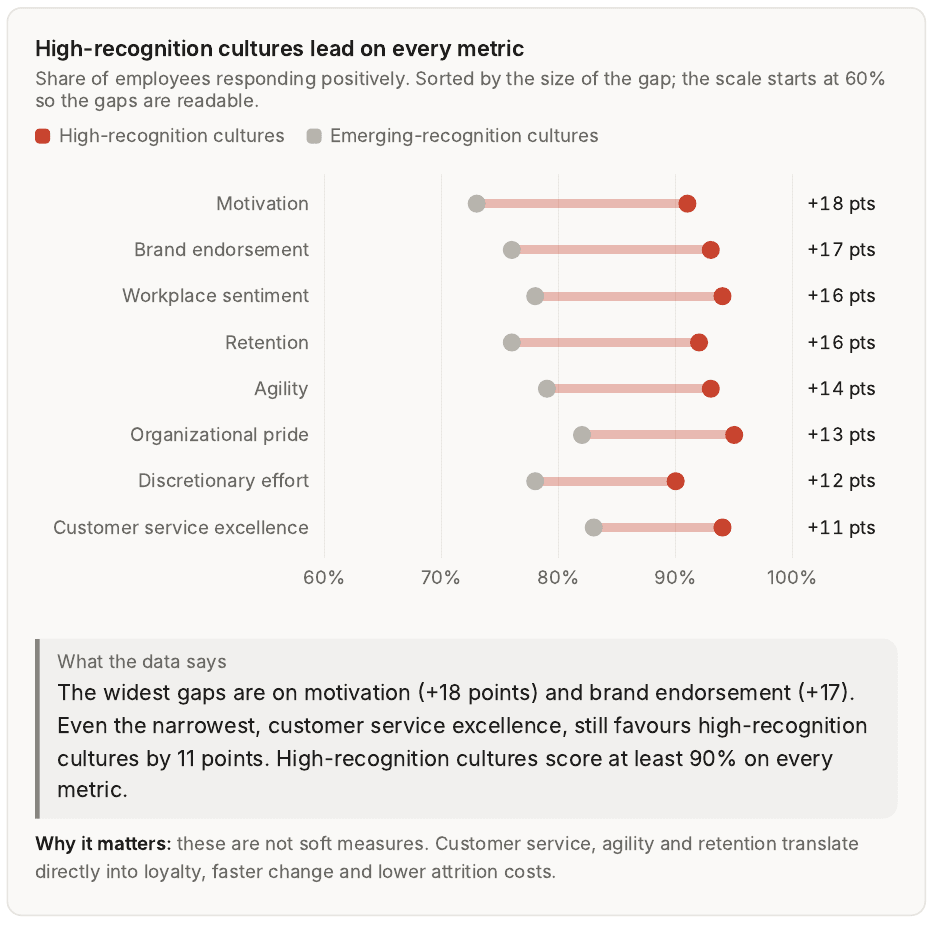
91% of employees in high-recognition cultures feel motivated, compared with 73% in emerging-recognition cultures, an 18-point gap, according to The Recognition Effect (Great Place To Work® India × Vantage Circle, 2025).
On a team of eight, you can see that gap from your desk. The awkward ticket sits unclaimed.
Then the person who knows where the billing exports live hands in notice.
92% of employees in high-recognition cultures express intent to stay, compared with 76% in emerging-recognition cultures, according to The Recognition Effect (Great Place To Work® India × Vantage Circle, 2025).
Their work lands on everyone else. A replacement takes months to hire and longer to settle in.
Source: The Recognition Effect 2025
Signs of High vs Low Team Morale
Attrition numbers show up late. The six behaviors in this table show up first.
| Area | High morale looks like | Low morale looks like |
|---|---|---|
| Meetings | People disagree out loud | Silence after "any questions?" |
| Helping each other | Questions get answered in minutes | Questions sit unanswered |
| Deadlines | Slips get flagged early | Slips surface on the due date |
| Feedback | Teammates ask for it | Feedback gets avoided |
| Time off and sick days | Steady, planned absences | Sudden spikes around hard weeks |
| Exits and referrals | Teammates refer friends | Quiet exits, no referrals |
That right-hand column is what our glossary calls bad morale.
The earliest sign I trust is small: one teammate's name quietly stops showing up in the thank-yous.
30% of employees still feel unseen at work, according to The Recognition Effect (Great Place To Work® India × Vantage Circle, 2025).
Vantage Rewards has a recognition analytics view that lists teammates who've gone 30 days without a thank-you, which gives a manager a head start before anyone starts job hunting. See recognition analytics →
What Good Team Morale Looks Like in 3 Examples
Good morale rarely looks impressive. These 3 are composites. None of them is a real company.
A nine-person support team survives an outage weekend. Monday's standup has no lecture. The lead reads out the two tickets that closed at 2 a.m. and who closed them.
A sales team misses its quarter by three points. Two reps send their lost-deal notes to the group that afternoon. Nobody asked them to. The last debrief didn't hunt for someone to blame.
An engineering team has six weeks and a hard end date. At kickoff, the lead cancels two recurring meetings. She tells the team which two, and why.
What Lowers Team Morale
Unrecognized effort does the most damage. Shifting priorities are a close second, and the list below has four more.
- Unrecognized effort. Work gets done and nobody says so. Or the thanks show up a quarter late, which feels the same to the person waiting.
- Shifting priorities. The target moves on Wednesday and nobody says why. Commitments turn into maybes.
- Uneven workload. The reliable person gets the next job too.
- Unresolved conflict. Two people stop speaking, everyone else routes around them, and the routing slowly becomes the team's real process.
- After-hours pings. A 9 p.m. message sets the rule.
- A manager who only appears when something breaks. Every conversation with them turns into a problem conversation.
Manager behavior sits under much of that list. One McKinsey number stays with me. One in four employees report high rates of toxic behavior at work. Those people were eight times more likely to show burnout symptoms. That's from McKinsey Health Institute's 2022 survey of nearly 15,000 people in 15 countries. Its definition of toxic includes a manager ridiculing someone in front of others. I read it as correlation, though. Burnout can also color how people see their manager.
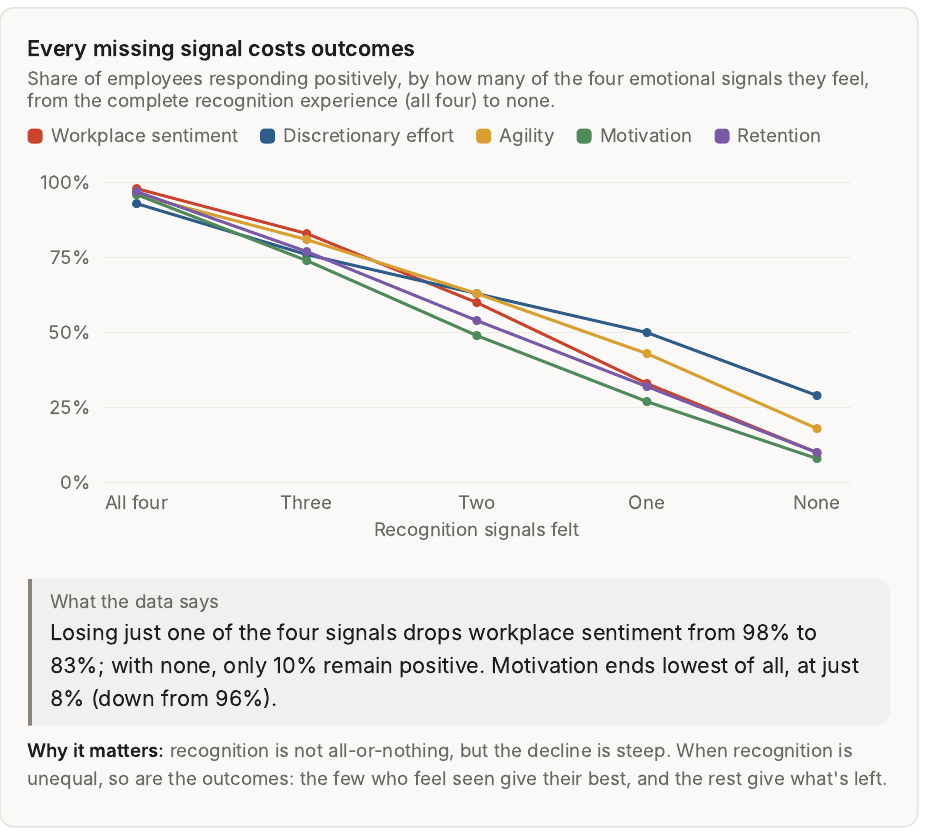
Our Recognition Effect research shows the same slide from the recognition side. Take recognition signals away one at a time and five outcomes drop together. Retention is one of them.
Source: The Recognition Effect 2025
Our root causes of low morale piece has the company-wide list. If the cause is the manager, poor management covers what that looks like.
How to Measure Team Morale With a 5-Question Pulse
Five anonymous questions on a 1-to-5 scale, run every 4 to 6 weeks, are the fastest way I know to measure team morale.
Score each line 1 to 5. One means you strongly disagree and five means you strongly agree.
- I know what this team is trying to achieve this month.
- My work was noticed by someone on this team in the last two weeks.
- I can raise a problem in a team meeting without it being held against me.
- My workload is fair compared with my teammates'.
- I would recommend this team to a friend looking for a job.
Average the five answers across the team, then read the band.
| Average score | What it means | First move |
|---|---|---|
| 4.0 to 5.0 | Healthy | Keep the weekly habits |
| 3.0 to 3.9 | Watch | Fix the lowest-scoring item |
| Below 3.0 | Act now | Start the 30-day plan |
Psychological safety is greater when people feel authentically seen, according to a 2023 review of 185 research papers by Harvard Business School's Amy Edmondson and Derrick Bransby. Question 2 covers the seen part. Question 3 covers the safe part.
On a team of five, true anonymity is a fiction. Use a shared form with no names and report only the team average. Sick days and exits confirm a bad pulse after the fact, and referrals show whether people would put their own name behind the team.
I went back and forth on whether five questions is too few. Longer surveys feel more rigorous. A manager will actually run five in a team meeting, though, and never gets around to twenty. For the longer version, see the full employee morale survey questions.
A pulse helps most when you can see one team's score beside the rest. Vantage Pulse breaks short surveys down by department, so a dip shows up as your team's problem or the whole floor's.
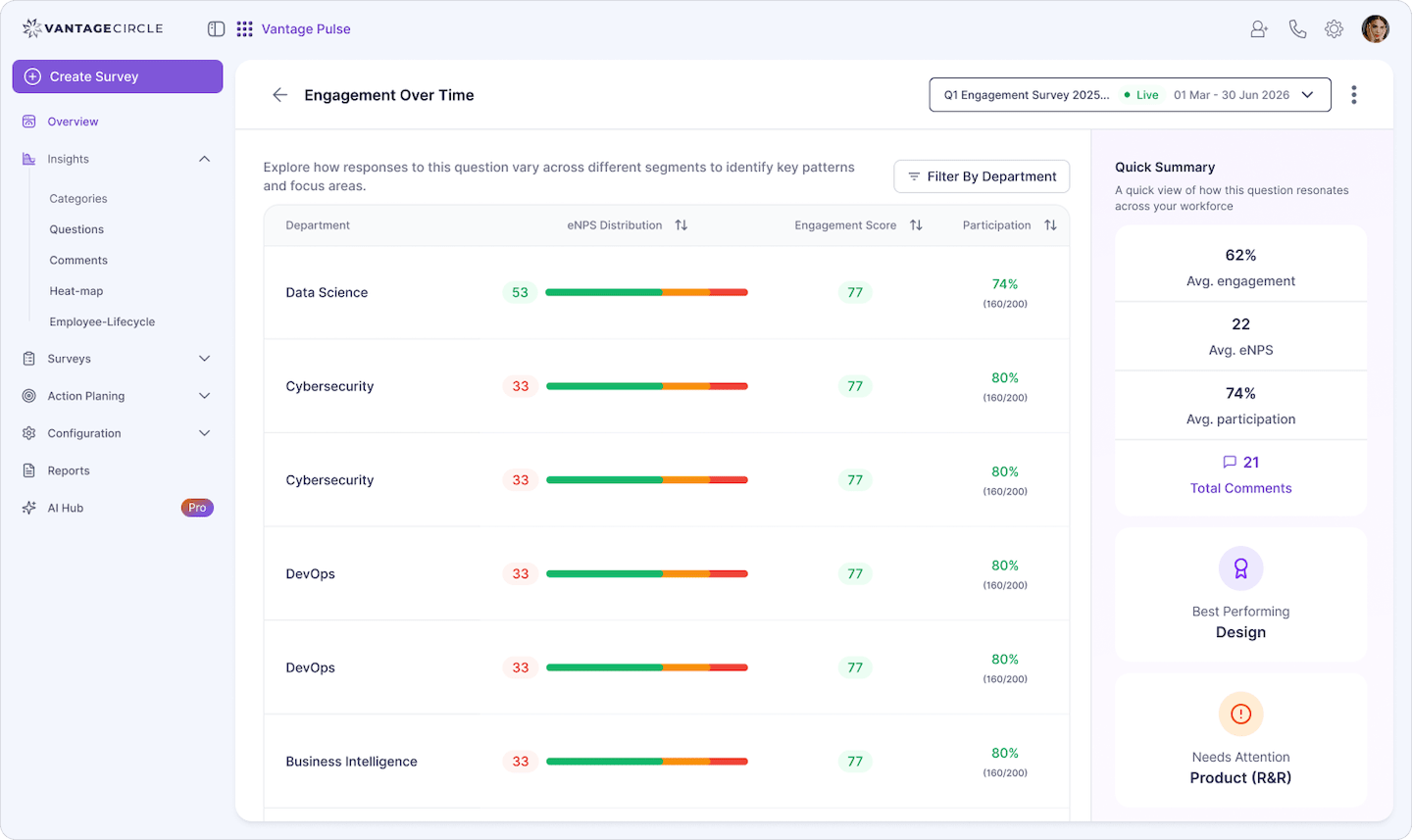
Vantage Pulse compares survey results team by team, so a morale dip on one team stands out right away.
Source: Vantage Pulse
How to Improve Team Morale With 10 Moves Managers Control
All ten moves sit inside a manager's control. Weekly recognition and a fair workload carry most of the weight.
1. Credit the team, then the standouts
Credit the team first.
79% of high-effectiveness recognition programs recognize both the team and standout individuals when celebrating collective achievements, compared with 37% of other programs, according to The State of Recognition & Rewards 2025 (Vantage Circle).
Organizations with high-effectiveness recognition programs are far more likely to amplify recognition through team or town hall mentions (80% vs 41%) and formal award events (72% vs 28%) than other organizations, according to The State of Recognition & Rewards 2025 (Vantage Circle).
Post the win where the whole team can see it. A shout-out in a meeting fades fast; put it in writing too. The social recognition feed in Vantage Rewards does that job, with team awards for the collective result and individual shout-outs in the same stream. At the end of your next win, thank the group and then name two people, with what each one did. See the recognition feed →
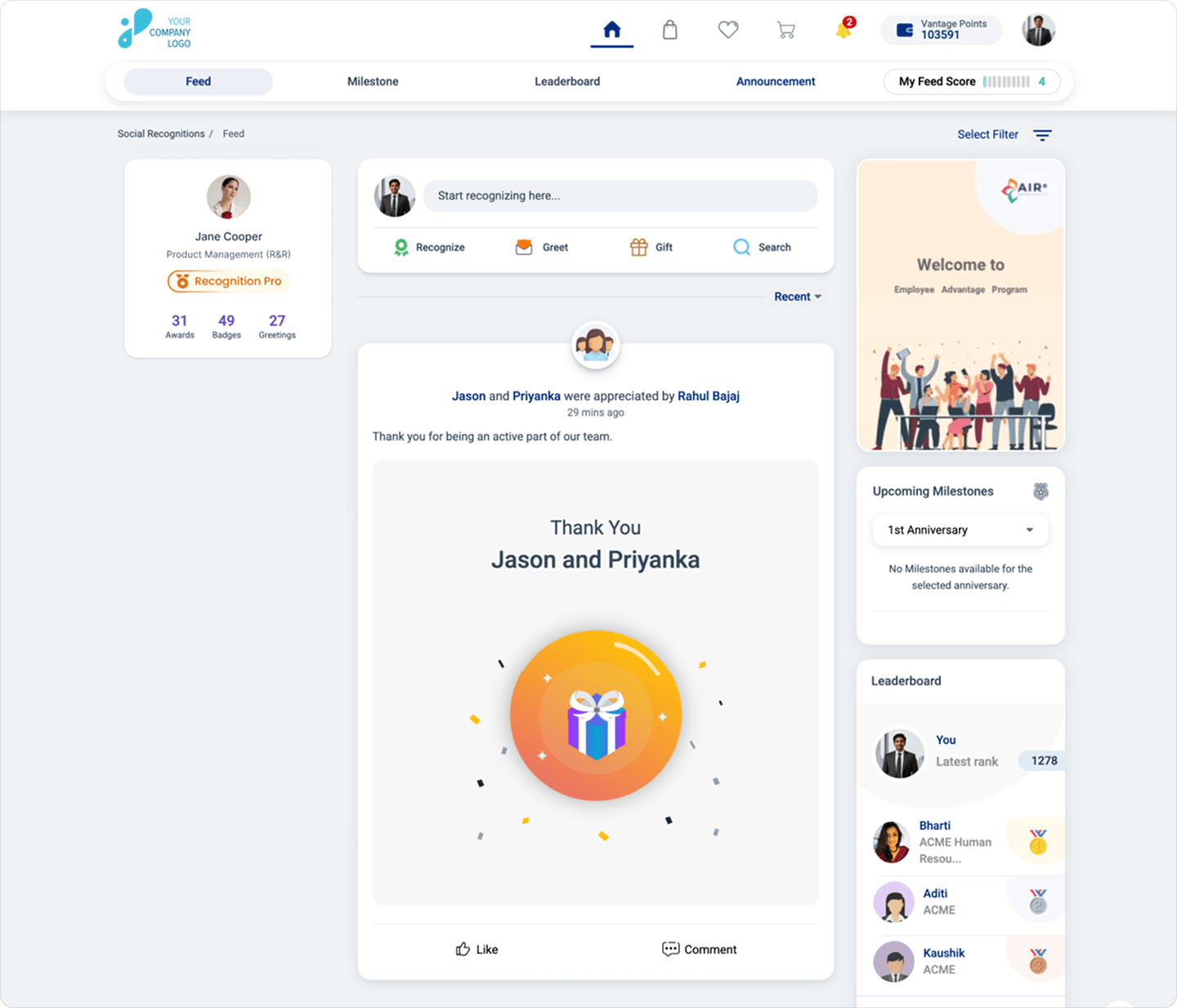
The Vantage Recognition feed keeps a team win visible after the meeting ends, with badges, comments and reactions from teammates.
Source: Vantage Recognition
2. Give thanks on a schedule
Calendar a thank-you every week.
Fewer than 20% of US employees are recognized every quarter, according to AIRe Benchmarking Report USA 2023-24 (Vantage Circle).
Whitney Johnson and Amy Humble wrote in a November 2022 Harvard Business Review piece about a habit I like: everyone writes a specific note of appreciation to each teammate and copies the team lead. The specific part matters. Anyone can type "great job" in four seconds, and it shows.
Weekly thank-yous from one manager rarely last past month two. Peers have to join in. Peer-to-peer recognition lets teammates thank each other while the work is still fresh. Close standup with two specific thank-yous.

A manager picks a quick appreciation badge or a formal nomination in two clicks, which makes weekly thanks easy to keep up.
Source: Vantage Recognition
3. Pick the month's two outcomes
Two outcomes, max. Say out loud what falls off the list to make room.
Priorities mostly live in the manager's head. The team learns they changed when the work comes back wrong. Only 41% of employees say their manager helps them prioritize their work. That's under half. The number comes from Gartner's late-2025 survey of 2,947 employees and managers. Pin the two outcomes to the top of the team channel on Monday.
4. Spread the load
Every Monday, look at who holds what. If one name carries three urgent items, move one. Your most reliable person gets handed the next job, then the one after. I've seen that end in a resignation letter. When a request lands that the team can't absorb, decline it yourself. Offer a later date.
5. Run conflict in the open, early
Bring disagreement out early, while it is still cheap to resolve. Most managers protect harmony and call it kindness. I think that gets it backwards.
Patrick Lencioni put fear of conflict second in his list of five team dysfunctions. That was back in 2002, in The Five Dysfunctions of a Team. Josh Bersin made a similar point in August 2025. Several of his clients call their own cultures too nice. Performance problems get left alone because nobody wants the hard conversation. His fix is a gym idea called time under tension: make people talk when things go badly. Next time you make a call, ask the room to argue against it first.
6. Make one-on-ones about the person
Twenty minutes, tops. Status updates can go in the team channel. Ask what slowed them down this week. Write the answer down and bring it back next time. The feedback half has its own guide on giving useful feedback.
7. Guard the evenings
Almost nothing needs an answer tonight. Late messages used to feel harmless to me. I sent them to clear my head. Then I noticed how fast a late message becomes the team's unwritten rule.
Aon's numbers on this are big. Its 2022-2023 Global Wellbeing Survey asked more than 1,100 HR and benefits leaders in 46 countries. By Aon's estimate, better wellbeing can lift company performance by at least 11% and up to 55%. I'm wary of that range. The same HR leaders rated both the wellbeing and the performance. Our work-life balance guide covers the personal side. Schedule-send your late messages for 9 a.m.
8. Set a shared goal nobody can fail alone
Pick a goal the whole team reaches together.
At Allston Trading, a 4-week Vantage Fit step challenge got the team past 6,500+ km together. There is no deadline pressure, and that's the appeal. A win that costs nothing to attempt gives a team something to talk about besides the backlog. More ideas sit in team building activities. See team challenges →
9. Coach before you correct
When someone ships a mistake, ask what they'd do differently before you mention your own fix. Answer with a verdict and you'll hear about the next mistake a month late. Hold the standard high and make the next attempt the topic of the conversation.
10. Act on the pulse within two weeks
Show the team one visible change within two weeks of every pulse.
Gartner's June 2023 survey of nearly 3,500 employees found that only a third believe their organization acts on feedback. That number describes whole organizations, and a single team lead can beat it inside a fortnight.
Open-ended answers carry the detail the scores miss. A word cloud of "what would make this team better" in Vantage Pulse shows the first irritant to fix.
Want quick wins on top of these? See 35 employee morale boosters.
A 30-Day Plan to Rebuild Low Team Morale
Thirty days is enough to start turning a flat team around. The table splits it into four weeks.
| Week | Focus | Manager actions | Signal it's working |
|---|---|---|---|
| 1 | Listen | Run the pulse for a baseline, then one-on-ones asking what slows each person down | People name specific irritants |
| 2 | Fix one irritant | Pick the most-named blocker, remove it, tell the team | Blocker gone and team informed |
| 3 | Restart recognition | Two specific thank-yous a week, and ask peers to join | Peers thank each other unprompted |
| 4 | Re-run the pulse | Repeat the 5 questions and compare with week 1 | Average rises, lowest item improves |
I used to reach for an offsite first. Then I watched a team enjoy the trip and go straight back to the same blocked process on Monday.
Conclusion
A flat team rarely complains. It just goes quiet, and the manager tends to hear last. Pulse the team this week. The lowest-scoring question is your first job. Vantage Rewards can show who has gone unthanked this month. Re-run the pulse in week 4 and compare.
FAQs About Team Morale
Q. What is meant by team morale?
A. The mood a group shares about its work. You see it in fast replies and open arguments. Belief that the team can win is usually the first thing to go.
Q. Is it team moral or morale?
A. Morale is correct. Say it muh-RAL. Moral is for ethics.
Q. How do you boost morale on a team?
A. Tell people what this month is for. Thank someone for something specific every week. After each pulse, change one thing they can see within two weeks. For a team that has already slipped, use the 30-day plan above.
Q. What is another word for team morale?
A. Team spirit comes closest. Esprit de corps is the formal version. Camaraderie covers the social side only.
Q. What are the top 3 motivators for employees?
A. The sources on this page point to three. Specific credit tops my list. A clear target for the month and a safe room to speak up follow it. Pay matters too, but the manager controls these three directly.
Q. What are some examples of poor management in the workplace?
A. Ridiculing someone in front of the team is the clearest case. McKinsey Health Institute counts it as toxic behavior. Playing favorites with assignments is another. So is changing priorities with no explanation. Poor management lists more.

He has worked in the human resources environment and has elevated recognition and rewards through his insightful and detailed writing. He aims to enhance the practice of Recognition in the workplace with new ideas and innovation that will help shape the work culture. For any related queries, contact editor@vantagecircle.com


