
An underperforming employee is someone whose output, quality, or reliability has slipped, measurably, below what the role actually needs. Usually for reasons you can name. Most cases turn around in 30 to 90 days. Catch the pattern early, name the real cause, pair clear expectations with support people can actually see.
Here's the scale of it, from Gartner's own numbers: about a quarter of the workforce is running at least 20% below average productivity, on any given team, right now. And most organizations? Remarkably tolerant of it. That's Gartner's own language, from their October 2025 talent management research, not mine. Which is the whole reason this deserves more than a single hallway conversation.
What Is an Underperforming Employee?
An underperforming employee falls short of what the role needs, consistently, in output, quality, or reliability. That's different from a bad week. It's also different from someone who was never the right fit to begin with. Different problem. Different fix.
Underperformance is a pattern, not an incident. One missed deadline is a Tuesday. Three in a month, with work that used to be sharp and now needs constant fixing? That's a pattern worth naming.
The distinction matters. A skills gap gets training. A motivation gap gets a completely different conversation. Managers who treat both the same way end up nowhere, and employee engagement erodes faster when a manager guesses instead of actually figuring out what's going on.
Worth separating out too: underperformance versus a genuinely bad fit, or a conduct issue. They look similar from a distance. They get managed completely differently. Mix them up and a fixable situation turns into a mess that drags on for months.
| Underperformance | Bad Fit or Conduct Issue | |
|---|---|---|
| What changed | Output or quality dropped from a previous baseline | Was never consistently meeting the bar, or the issue is behavioral |
| Root cause | Usually goals, recognition, growth, or burnout | Usually skills mismatch, values mismatch, or repeated policy violations |
| Right first move | Coaching conversation and the recovery framework below | HR-guided conversation, often earlier than a standard PIP timeline |
| Recoverable with support? | Often, yes | Sometimes, but not always, and not on the same timeline |
7 Signs of an Underperforming Employee
Seven signs, and most managers only catch two or three of them. Declining output. Rising absenteeism. Missed expectations. Low engagement. Weaker quality of work. Reduced initiative. Quiet withdrawal from the team. The other four hide in plain sight, sometimes for months, before anyone names them out loud.
| Sign | What It Looks Like Day to Day |
|---|---|
| Declining output | Fewer completed tasks per week; work that used to take two days now stretches into four |
| Rising absenteeism | Unplanned sick days cluster around Mondays or Fridays; a sudden pattern of late arrivals |
| Missed expectations | Deliverables land below the agreed bar, or deadlines slip without any heads-up |
| Low engagement | Sits quietly in meetings, stops volunteering for stretch work, answers get shorter |
| Weaker quality of work | More errors need catching in review; work that once needed no revisions now needs several |
| Reduced initiative | Waits to be told what's next instead of flagging the next problem themselves |
| Withdrawal from the team | Skips optional social moments, contributes less in group discussions, stops asking for help |
Absenteeism and missed deadlines get noticed fast. They're on a calendar. Withdrawal and reduced initiative are quieter, and that's exactly why they matter more. By the time someone's stopped flagging problems before they blow up, they've usually gone inert a while ago already. The visible signs? Just the tail end. They were never where this started.
What Causes Employee Underperformance?
Underperformance almost never starts with a lack of ability. Honestly, that's the cause people assume first and get wrong most often. Four things actually drive most of it: unclear goals, a shortage of recognition, no real room to grow, and stress that's built up long enough to turn into burnout.
Start with goals. Most common cause, cheapest to fix. Hand someone work without specifics and they'll fill in the blank themselves, guessing at what "good" looks like. Sometimes the guess is close. A lot of the time it isn't, and nobody finds out until review time, by which point they've spent a whole quarter chasing a target that was never actually written down anywhere.
Recognition is the slow burn. Gallup and Workhuman ran a two-year study across more than 3,400 employees. People who got consistently high-quality recognition were 45% less likely to have quit by the end of that window. That's Gallup and Workhuman, 2024, not a guess. The same research goes further: employees whose recognition hit at least four of the five pillars of strategic recognition were 65% less likely to be actively looking or watching for another job opportunity than those getting lower-quality recognition.
I'd push back a little on treating recognition as just a retention number, though. It's diagnostic too. When someone stops responding to recognition, shrugs off a shoutout that would've mattered six months back, they're telling you something the engagement survey hasn't picked up yet.
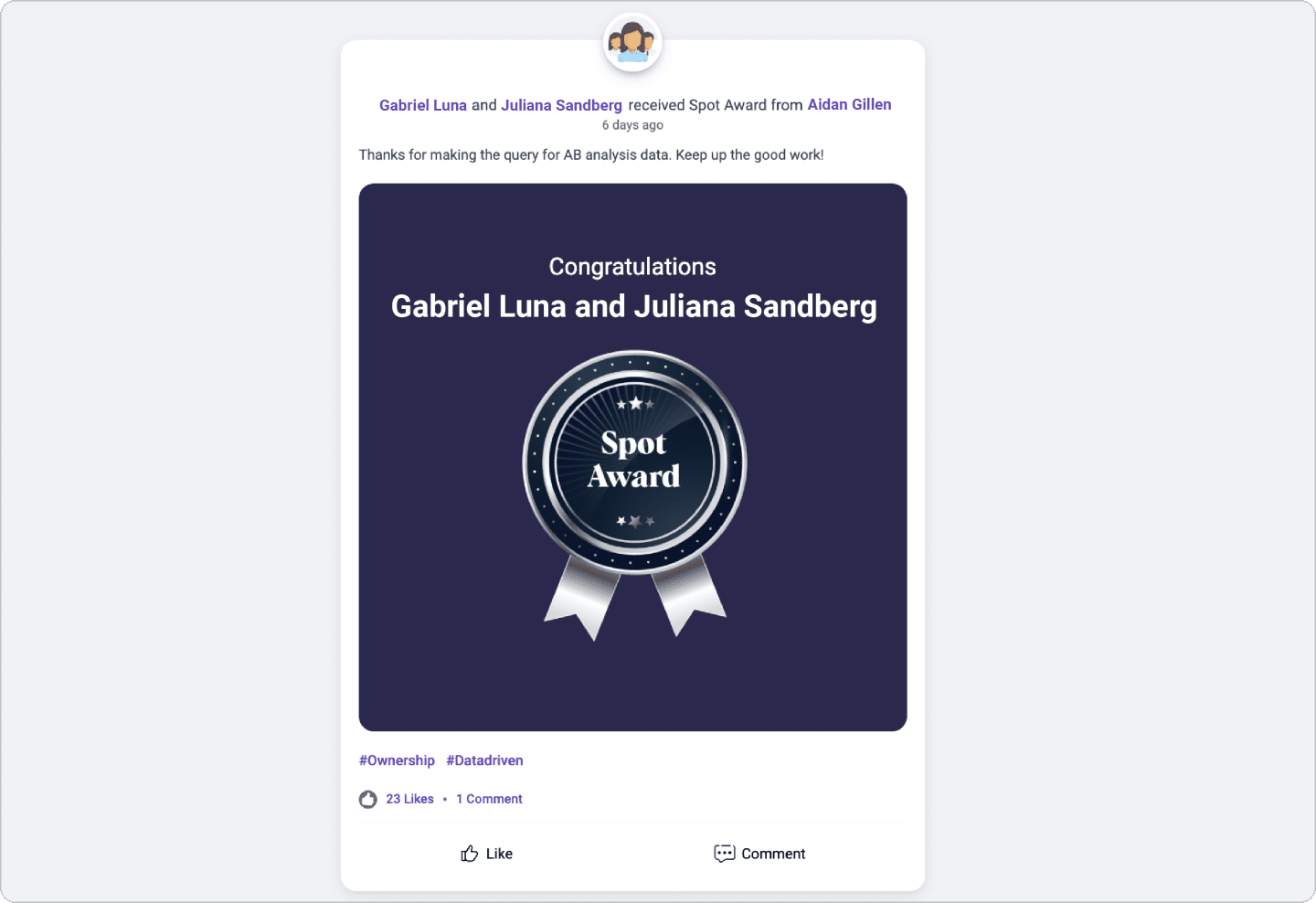
Where Vantage Rewards fits: Lack of recognition is one of the most common, and most fixable, causes of underperformance. A manager who consistently acknowledges small wins gives an underperforming employee something to rebuild momentum around, instead of only hearing about what's going wrong.
Source: Vantage Circle — Rewards & Recognition Platform
Growth's the one people underrate. A capable employee with no room to stretch doesn't quit loudly. They just go inert. Promotion isn't always the fix, and it's usually the first, wrong, answer managers reach for. Sometimes it's a project nobody else has bandwidth for. Sometimes it's just actually listening when someone says the work's gone flat, instead of rushing to tell them it hasn't.
Burnout's the one managers catch last. Should probably catch first. Gallup's latest Global Workplace research puts burnout symptoms at 67% of employees, current job, right now. Up from 52% back in 2021. Two out of three people on a team, running on empty at some point, still showing up anyway.
These four don't show up alone, usually. Unclear goals breed exactly the kind of low-grade stress that tips into burnout. Burnout makes someone quieter, which reads as disengagement, which makes them easy to skip over for recognition, which just feeds the same cycle right back in. Pull on one thread anyway. Just don't be shocked when the other three come along for the ride.
The Real Impact of Underperforming Employees
One underperforming employee drags down more than their own numbers. Team productivity. Morale. Customer experience. Eventually, the bottom line. And it compounds, the longer nobody deals with it.
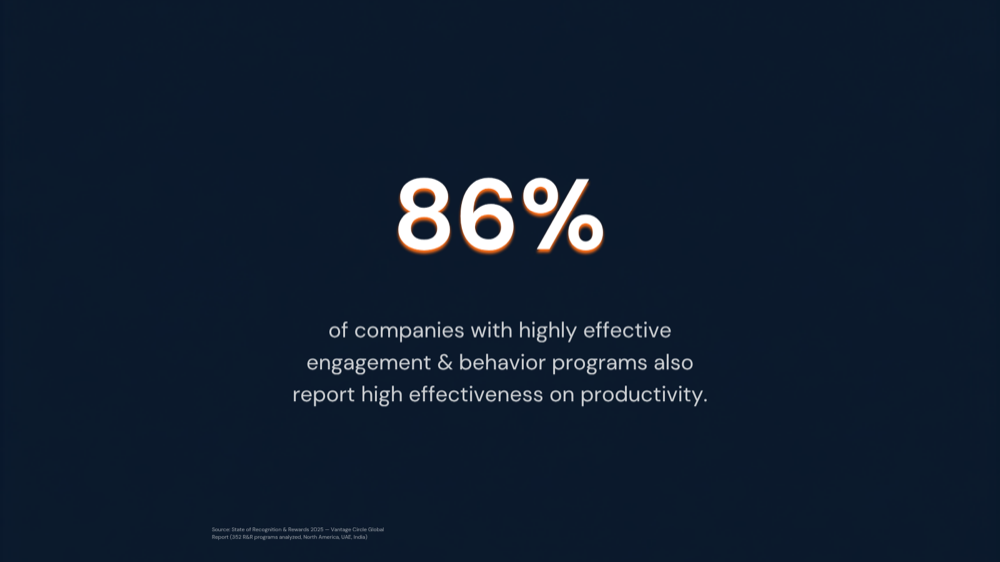
The nearest people feel it first, even before the numbers catch up. Our own AIRe Report, drawn from 352 recognition programs across North America, UAE, and India, found a clear chain effect: among companies whose programs are highly effective at driving engagement and behavior, 86% also report high effectiveness on productivity too. None of that chain runs through the underperforming employee's own review, though. Run the logic backward instead. Engagement drops first on a team carrying someone who's checked out. Behavior and standards slip right after. Productivity is the last domino, and it lands on whoever's standing closest, quietly, because most teams have no formal way to flag it until it's already a fire.
Source: State of Recognition & Rewards 2025 — Vantage Circle Global Report
Customers feel it next, especially anywhere there's a direct touchpoint. Slow replies. Dropped follow-ups. To a customer, that doesn't read as "this employee is struggling." It reads as the company not caring, and that's a much harder impression to walk back than one missed deadline ever was.
Morale's the cost that's hardest to put a number on. When one person keeps not pulling their weight, everyone picking up the slack notices first, and holds the grudge longest. Leave it running long enough and it doesn't just flatten that one person's output. It teaches the whole team that mediocrity's fine, actually, which is a much harder thing to walk back than a single bad quarter. Nobody puts that part in the deck.
Some of this ends in turnover eventually. Either the underperformer leaves, worn down by a role that was never right for them, or their frustrated teammates leave first, which honestly happens more often than people admit. Josh Bersin, the independent HR analyst most leaders already trust on this, puts the real cost of replacing someone at 2 to 3 times their annual salary once you count the lost knowledge, the client relationships that walk out the door with them, and the culture hit nobody puts on a spreadsheet. Underperformance rarely stays contained to one desk. That's exactly what ties it to the broader cost of disengaged employees across a whole team.
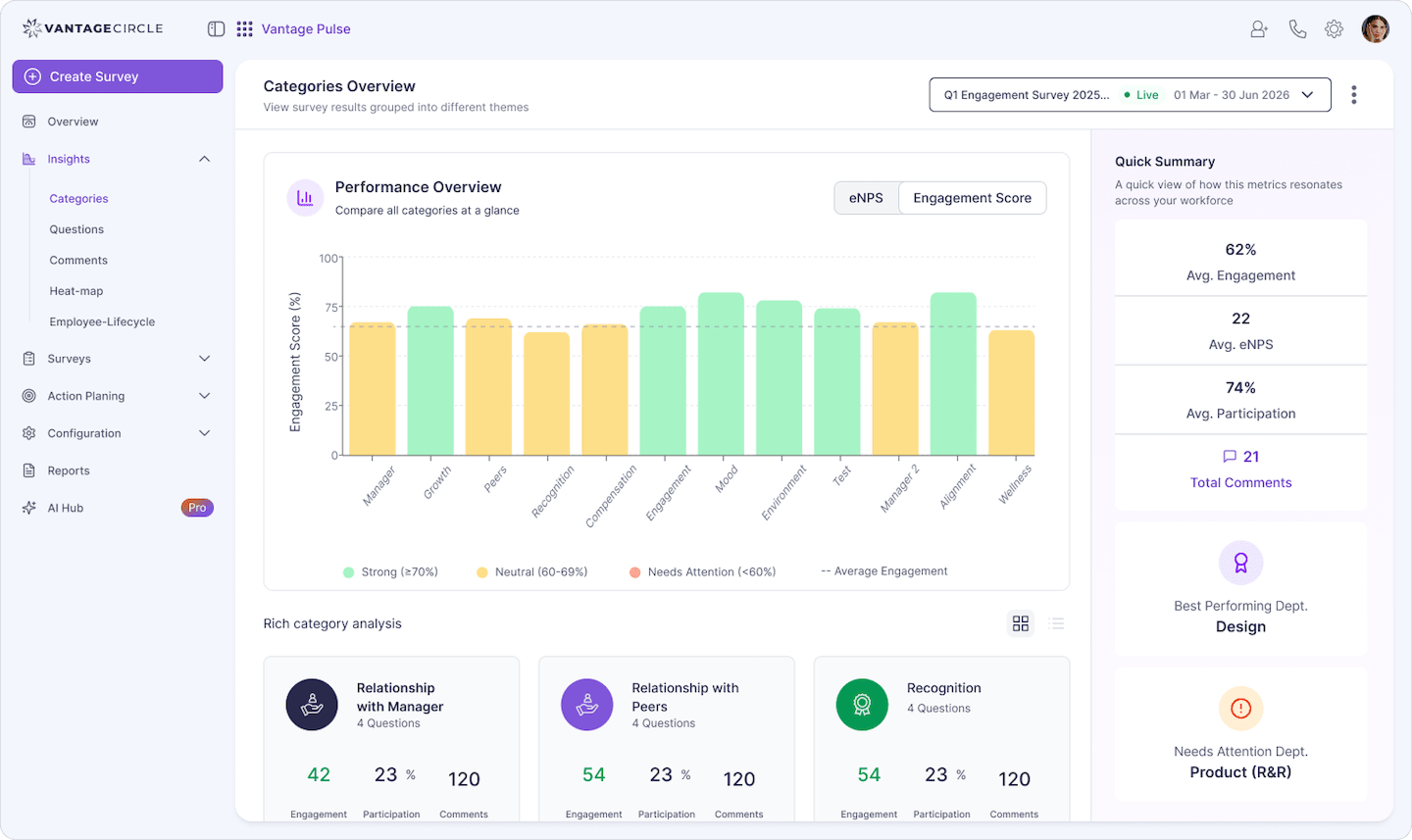
Where this gets measurable: Most of this impact stays invisible until it's tied to a number. Engagement Analytics connects an individual's performance trend to team-level engagement data, turning "something feels off on this team" into a specific, defensible case for stepping in early.
Source: Vantage Circle — Vantage Pulse
How to Manage an Underperforming Employee: A 4-Step Recovery Framework
This framework is for performance specifically. If the problem is behavior instead, disruption, conflict, or attitude rather than output, managing a difficult employee walks through the equivalent process for that.
Four moves, really. Find the actual root cause. Set expectations specific enough to measure. Give support people can actually see, not just assume is happening. Follow up on a timeline you keep, not one you meant to keep. Skip one and the other three fall apart.
Done right, this doesn't just fix one person's output, either. Team motivation tends to lift too, since everyone else notices when a struggling teammate gets handled fairly instead of quietly managed out the back door.
1Identify the Root Cause
Don't jump straight to consequences. Sit down. Ask how they're doing. Actually listen before you diagnose anything. Most managers walk in already sure they know the cause. Half the time, they're wrong. The other half, they're only catching a piece of it.
Ask what's actually in the way. Not "why has your performance dropped," which puts someone on the defensive before you've even finished the sentence. Try something closer to "what's getting in the way for you right now." You'll get something closer to the truth than a rehearsed answer.
Don't do this over email. Don't do it in a hallway between meetings either. Sit down, in person if you can swing it, and give it room to breathe. Listen first. Save the "here's what needs to change" part for after. Most employees already sense something's off. What they don't know yet is whether you showed up to help, or to build a case against them.
2Set Clear, Measurable Expectations
"Improve your communication" isn't a target. Nobody can hit that. "Respond to client emails within one business day" is a target. That's the level of specific to aim for, once you actually know the cause.
Write it down. Agree on it together, don't just hand it down. Give it a real window, 30 to 60 days usually. Long enough to actually show a pattern. Short enough that it doesn't quietly become a permanent fixture nobody ever circles back to.
3Provide Visible Support
Most performance conversations stall right here. Manager sets the expectation, disappears until the deadline, calls it "giving them space." Except space isn't support. Support looks like checking in without it feeling like you're watching over their shoulder. Removing a blocker you didn't even know was there. Calling out progress the moment you see it, not saving it all up for the final review.
Here's a stat worth sitting with, and it's not the one everyone quotes. McKinsey tracked companies by how their middle managers actually behave day to day, then matched that against five-year financial performance. The top quartile pulled three to 21 times greater shareholder return than the bottom three quartiles combined. Not a typo. That's manager quality, not strategy decks or org charts, showing up directly in the numbers years later.
Call it the recognition recovery curve, if you want a name for it. It's not some formal study Vantage Circle ran. It's a synthesis, built on research that already exists, applied to a much shorter window than McKinsey's five years. If manager behavior moves outcomes that much over half a decade, the support given during a 30-day recovery window probably matters more than the initial conversation that kicked the whole thing off. An employee who gets one piece of real, public recognition sometime during that window has a manager who's paying attention the right way. Employees who only hear from their manager when something's wrong? They turn around slower. Some of them never do.
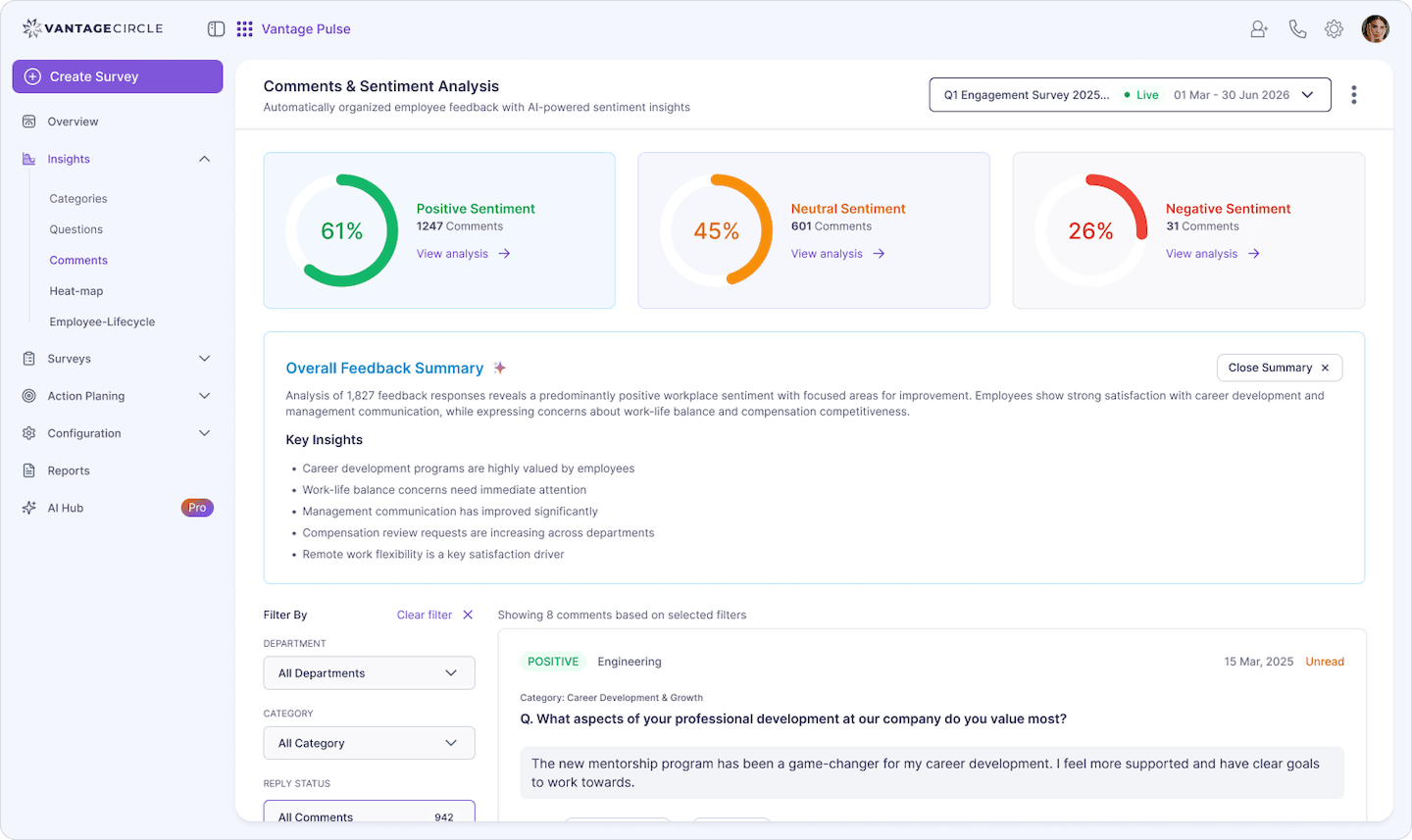
Sentiment data helps here too. Before assuming a dip is about motivation, pulse survey trends can show whether that employee's score dropped at a specific point. Usually that points to something that happened, not a character flaw.
Source: Vantage Circle — Vantage Pulse
4Follow Up on a Defined Timeline
Set the check-in schedule at the same time you set expectations. Not after. Weekly for the first two weeks works for most people, then biweekly. Miss the first check-in and you've told the employee, without saying a word, that this plan wasn't actually serious.
Monitor without micromanaging. Ask how it's going. Offer resources. Actually acknowledge the small wins along the way, not just the big finish. Loop in your own manager or HR if it's still not working after a real, genuine effort on both sides. That's not escalating for the sake of it. It's a second set of eyes, and a record of what was actually tried.
And when it works? Say so. Out loud. A lot of managers run the whole recovery process, watch it succeed, and then never actually close the loop. The employee's left wondering if they're still on thin ice. A five-minute conversation confirming the plan's closed and performance is back where it needs to be undoes weeks of quiet anxiety. Costs almost nothing.
Questions to Ask an Underperforming Employee
Focus on blockers, not blame. Ask what's in the way, not why performance dropped, and you'll actually get an honest answer instead of a defensive one.
Most managers walk in with the wrong question already loaded. "Why can't you keep up with your workload?" Sounds neutral enough on paper. In practice, it puts someone on the defensive before you've learned a single useful thing. Blocker-focused questions get you further. Faster. And they tend to open up conversations a warning letter never could.
Conversation starters that actually work:
- "What's getting in the way for you right now?"
- "Where do you feel least confident about what's expected of you?"
- "Is there anything happening outside of work I should know about, if you're comfortable sharing?"
- "What would make the biggest difference for you this month?"
- "When did this start feeling different for you?"
- "What support have you not gotten that you needed?"
- "If you could change one thing about how we work together, what would it be?"
A signal worth watching: An underperforming employee often stops receiving informal recognition from peers well before a manager notices the drop in output. Peer-to-peer recognition data can surface that shift earlier than a formal review cycle would.
When to Move to a Formal Performance Improvement Plan
Move to a formal Performance Improvement Plan, a PIP, once informal coaching hasn't produced real, measurable improvement inside 30 to 60 days. Or once it's clearly about conduct, not skill. Everything short of that stays informal. Just keep coaching.
A PIP isn't a punishment, even if it usually feels like one on the receiving end. Done right, it's a documented, time-boxed shot with real goals and real support behind it. Done badly? It's a paper trail built to justify something that was already decided weeks ago. Employees can tell the difference within the first five minutes, no matter how carefully the memo's worded.
I used to think most PIPs were theater dressed up as process. Honestly, a lot of them still are. Gartner called this out directly in their own 2026 talent trends research: most organizations, in their words, are remarkably tolerant of low performance, and the standard PIP is part of why. Their fix is a more prescriptive plan, not a vaguer one. Clear development goals. A real deadline, not a symbolic one. The PIPs that work share three things, Gartner or no Gartner. Real coaching, not just paperwork. Goals the employee helped set, not goals handed down. Check-ins that actually happen on schedule, not ones that quietly slip.
One more thing worth separating out. If burnout's the real cause, not skill, not motivation, a PIP alone won't touch it. You can document expectations all day long. The actual capacity problem just sits there, exactly where it was.
Where this connects: If burnout is the actual cause, wellness benefits address the underlying capacity problem a performance conversation can't solve on its own.
Summing It Up
Underperformance is rarely about talent, honestly. It's almost always a gap, in clarity, recognition, growth, or capacity, that built up quietly until it finally showed up in the work.
The managers who turn it around fastest aren't running the most disciplinary process. They're the ones who catch the pattern early, name it honestly, and actually stay present through the recovery instead of vanishing until the deadline. That's the whole idea behind the recognition recovery curve, from a few sections back. Attention, not paperwork, is what moves someone from struggling back to solid.
That kind of consistency is harder than it sounds. It's also, pretty much, the entire job.
FAQs
Q. How do you handle an underperforming employee?
A. Start with an actual conversation, not a warning shot. Figure out what's really blocking them before assuming it's motivation. Set expectations specific enough to measure. Offer support people can see, not a vague "let me know if you need anything." Follow up on a schedule you actually keep. Do all four, consistently, and most cases turn around inside 30 to 60 days.
Q. How to professionally say someone is underperforming?
A. Skip the euphemisms entirely. "Your output this month has been below what the role needs" is direct, without being harsh about it. Anchor it to specifics, missed deadlines, dropped quality, whatever's actually happening. "There's room for improvement" tends to land as a footnote. It's not the signal you meant to send.
Q. How to get rid of a bad employee?
A. That question's actually two different questions wearing one coat. If it's underperformance, meaning the person's capable but the output isn't there, use the recovery framework above first. If it's conduct, or a genuine culture mismatch, that's a different process entirely, usually involving HR and legal, and it deserves its own conversation. Not a quick fix here.
Q. How to deal with difficult team members?
A. Different problem, honestly. A difficult team member often hits their targets while still creating friction. Underperformance is about the output itself. Figure out which one you're actually dealing with before picking a fix. And go after the specific behavior, not the person's whole personality.
Q. What are the five employee signs of struggle?
A. Declining output. Rising absenteeism. Missed expectations. Low engagement. Weaker quality of work. Those are the five people usually cite. Our list above adds two more that get missed constantly: reduced initiative, and quiet withdrawal from the team. Honestly, those two tend to show up first.
Q. How to deal with an employee that is not performing?
A. Same core framework, basically. Find the cause. Set a specific, measurable target. Offer real support. Check in on schedule. The real variable's usually just how long it's been allowed to run. Catch it early, and the fix stays short and informal.

He has worked in the human resources environment and has elevated recognition and rewards through his insightful and detailed writing. He aims to enhance the practice of Recognition in the workplace with new ideas and innovation that will help shape the work culture. For any related queries, contact editor@vantagecircle.com