I’m sure you’ve played with puzzles at some point. Each piece matters, right?
Your puzzle will be complete only when every piece fits. And not to mention the sense of satisfaction you get when the picture comes together beautifully.
But what happens when you can’t find a few pieces? Doesn’t the puzzle look incomplete and unimpressive?
Interestingly, employee retention works a lot like that puzzle. Each of your employees is a crucial part, contributing to your organization’s big picture. The vision of your company, its goals and success. Hence, losing even a single piece is undesirable.
Also, you’ll be shocked to know that,
The average cost of turnover per employee can be thousands of dollars. Some studies estimate that the cost of turnover typically ranges from six to nine months of the employee's salary.
Don’t get me wrong. It’s not solely about money. It’s more about losing a valuable talent.
In this blog, we’ll discuss the five main drivers of employee retention. And how addressing them can help you keep your team intact, engaged, and thriving.
So, here they are!
Key Takeaways
- 5 Main drivers of employee retention
- Strategies to improve the drivers of retention
What Are the 5 Main Drivers of Employee Retention?
The five main drivers of employee retention are:
- Competitive compensation and benefits
- Positive work culture
- Career development opportunities
- Recognition and appreciation
- Strong employer brand
Employees rarely leave over just one of these. It's usually a combination, underpaid and unrecognized, or well-paid but stuck with no growth path. That's why treating retention as a single-lever problem (just raise salaries, just throw a party) rarely works.
Each driver addresses a different reason people quit: pay and benefits cover financial security, culture and recognition cover how valued people feel day to day, and career growth and employer brand cover whether they see a future worth staying for. Fix all five, and you're covering the full range of why people leave.
How to Tell Which Driver Is Actually Weak in Your Org
You can sense something's off. Quieter meetings, fewer high-fives, a general flatness, without knowing which of the five drivers is actually behind it. Guess wrong, and you could end up throwing a pizza party at a team that's really leaving over a stalled career path.
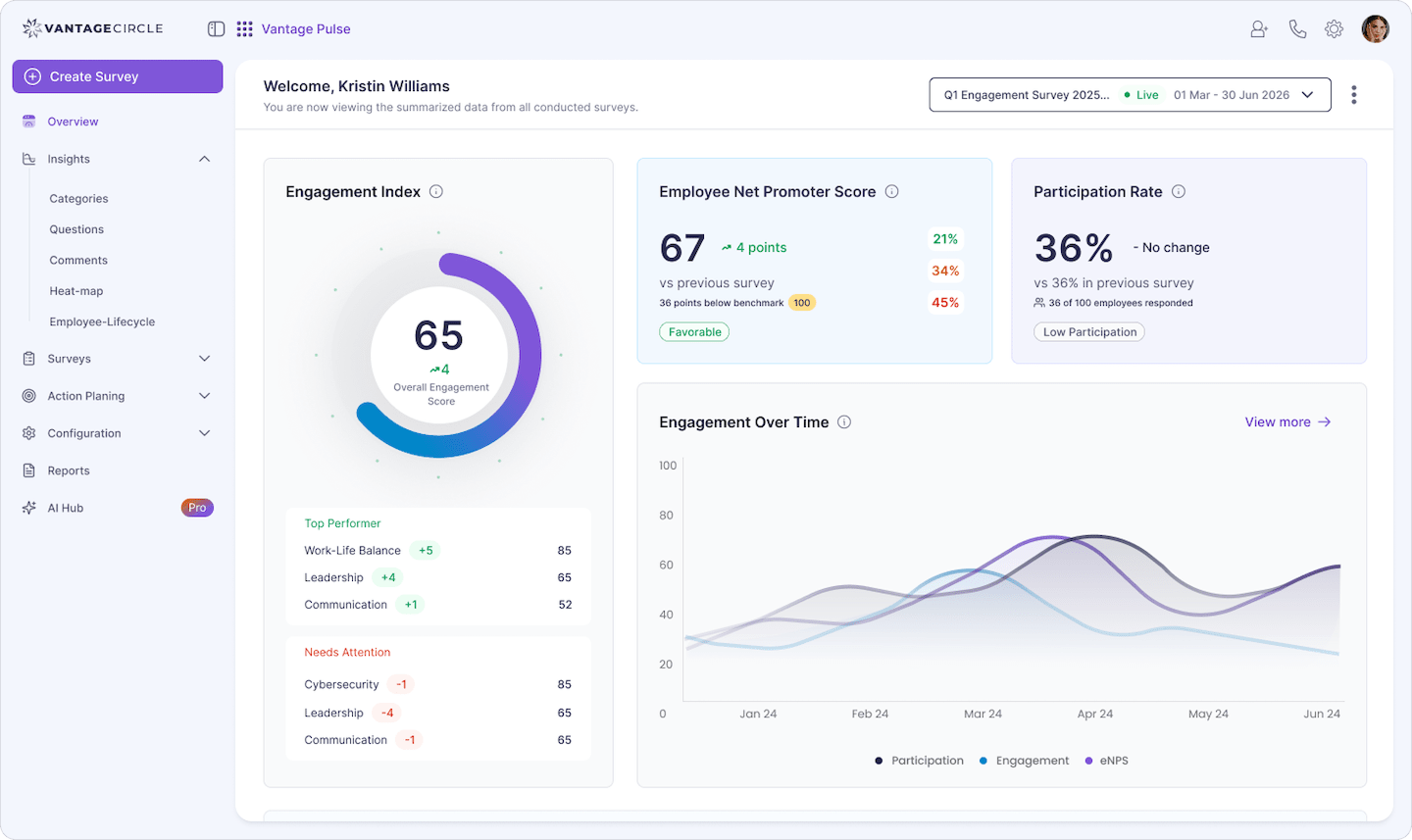
That's where an eNPS pulse survey earns its keep. Run one every quarter at minimum, and the score alone tells you that something's off, while the follow-up questions start pointing at what. Once responses are broken down by team, tenure, and manager, patterns tend to surface on their own, a dip concentrated among two-year employees usually has more to do with a missing growth path than with the paycheck.
The open-text comments and exit interviews fill in the rest of the story. "No growth path" showing up again and again isn't a pay problem, it's a career development one. And when people keep talking about feeling invisible, recognition is probably the driver quietly failing.
It's also why platforms like Vantage Pulse exist, recurring pulse surveys, eNPS tracking, and segmented reporting built right in, so the weak driver shows up on your dashboard long before it shows up as a resignation letter.
Driver 1: Competitive Compensation and Benefits

Money talks! We can’t deny.
But fortunately, employees' perspectives have evolved over the years. They place a high value on a great paycheck. But remember, only when it’s paired with robust employee benefits that truly support their overall well-being.
In fact, competitive compensation and benefits have become a non-negotiable for attracting and retaining top talent. No wonder why,
According to Gallup, 42% of employees who voluntarily left their job say the departure was preventable, and compensation or benefits was the fix they named in 30% of those cases.
Here, you’ve to understand that “competitive” means more than just meeting industry standards. It’s about understanding your team members’ needs and offering them more than they expect. Not just salaries, but benefits like:
- Health Insurance
- Mental Wellness
- Retirement Contribution
- Flexible Work Arrangements or more
Strategies to Offer Competitive Compensation and Benefits
1. Start with Research
You must regularly benchmark salaries and benefits in your industry to ensure you’re staying competitive. For that, you can use tools like market surveys and reports to stay updated.
2. Think Beyond Salary
Never fail to offer benefits that address your employees’ lives. Now, this could include wellness programs, tuition reimbursements, childcare support, or even flexible hours.
3. Personalized Benefits Packages
“One size doesn’t fit all,” remember that! Some of your employees may value extra vacation days. But others in your team might prefer professional development stipends or remote work options.
4. Communicate Transparently
“Communicate Transparently!” Make this your mantra. You've got to be open about the value of your compensation and benefits. Your employees may not be aware of some of your benefits. It’s your responsibility to inform, educate and guide them to use it.
Driver 2: Positive Work Culture

Do you know there’s an invisible thread that ties employees together?
The thread is the “culture” of your organization. And not simply any kind of culture. But a positive one in which your team members can grow and thrive.
Without a positive work culture, no employees would wish to stay in your organization for longer.
I mean think for yourself. Would you want to stay in an environment where communication is poor, recognition is rare, or collaborations feel forced? Certainly not! So, why should your employees?
Moreover, positive culture in the workplace benefits both employers and employees.
Recently, Deloitte's 2024 Global Human Capital Trends report found that,
According to Deloitte, organizations that support team-level "microcultures" are 1.8 times more likely to achieve positive human outcomes like creativity and collaboration, and 1.6 times more likely to hit their desired business outcomes.
So, you see how much a deliberately-shaped culture pays off, for the people in it and for the business itself.
And the best part? A positive culture not just retains talent but attracts it too.
Strategies to Foster a Positive Work Culture
1. Start with Leadership
Leaders set the tone for the entire organization. If you want your organization to be transparent, empathetic, and collaborative, your leaders have to model these behaviors first. After all, a leader who listens, leads by example, and practices inclusivity inspires the same qualities in their team.
Listen to our Vantage Influencers Podcast: Practical Leadership Insights by Michael F. Andrew
2. Encourage Two-Way Communication
You’re aware that regular check-ins and feedback loops are essential to building trust. Your employees should feel valued and confident that their concerns are not neglected. But for that, you’ve to collectively create an environment where open dialogue is a norm, not an exception.
3. Recognize Achievements
A simple shoutout in a team meeting or a structured recognition program like “Employee of the Month” or “Star Performer” can boost morale. Acknowledging hard work and milestones shows your employees that their efforts are noticed and valued.
4. Support Work-Life Balance
Offer your employees work-life balance and they’ll never be able to part ways from you. You can offer flexible work hours, remote work setups, or initiatives like “no-email weekends” to help your team recharge.
5. Foster Inclusion and Diversity
There is nothing more amazing than celebrating diverse perspectives. And ensuring everyone’s voice is heard. Trust me, when your employees feel respected and valued for who they are, they’re more likely to stay and contribute fully.
Driver 3: Learning and Career Development Opportunities

According to LinkedIn's Workplace Learning Report, 94% of employees say they'd stay at a company longer if it simply invested in helping them learn and grow.
No matter what, learning & development opportunities for your employees are very important in today’s time. In fact, it’s safe to say that it’s their right. Without it, it’s going to be difficult for you to attract and retain your employees for a long time.
Given that, how do you provide them with these opportunities.
Well, we’ve a couple of ideas.
- Why not set up some interesting training sessions? Your employees will pick up new skills and feel awesome about it.
- Or how about sending someone to that big industry conference? They’ll come back buzzing with fresh ideas.
- You can also assist them in enrolling into mentorship programs.
When your team members see you’re investing in them, they’ll be pumped to give their best and make a difference in their organization.
Driver 4: Recognition and Appreciation

Did you have a day where you worked hard, achieved results, but at the end of it, no one acknowledged your efforts?
It’s disheartening, no wonder!
But imagine the opposite for once. Your hard work is recognized and celebrated. Won't you feel more motivated, appreciated, and ready to tackle your next challenge?
Undoubtedly, recognition makes people feel seen and valued. It’s this feeling of being appreciated that keeps people coming back day after day. Without it, no matter how great the work itself is, your employees can start feeling disconnected and demotivated.
It’s been found that,
According to Gallup, which tracked nearly 3,500 employees from 2022 to 2024, well-recognized employees are 45% less likely to have left their job within two years.
With this, the power of recognition is quite evident.
Ways to Recognize your Employees
1. Peer-to-Peer Recognition

Source: Vantage Circle
Peer-to-peer recognition is where other team members recognize each other’s efforts. A big step forward in creating a positive and supportive environment and the least expensive way. A simple 'thank you' or a shoutout can go a long way to building camaraderie.
2. Public Recognition
To make your employees feel valued, publicly recognize their achievements at a meeting or through company-wide emails. It is always great to promote the work of your team members in front of others, no matter what.
3. Promotion and Career Advancements
It is a clear way to reward their hard work and motivate continued success by offering promotions or growth opportunities because you believe in your employees' potential.
4. Bonuses or Financial Incentives
Monetary rewards like bonuses or spot incentives are great and you can never go wrong with them. It has the potential to make your employees feel appreciated and directly tied to the company’s success.
5. Personalized Gifts
A custom gift that reflects your employees’ personalities is always well received. You don’t have to go over the top with the shopping; you can just get them a coffee mug, decorative items or something more thoughtful. It shows you care about them as people, not just their work.
Do Give a Read: Types of Employee Recognition: All You Need to Know
Driver 5: Strong Employer Brand

Talent is attracted to organizations with great reputation. It’s not an assumption, it’s a fact. A great employer brand not just attracts but retains talent as well.
You know, recent research found that
According to LinkedIn, a great employer brand can cut an organization's turnover by 28% and its cost-per-hire by as much as 50%.
Impressive, isn’t it?
But do you know what makes your brand strong?
It’s pretty simple!
When your company is known for treating people well, offering growth opportunities, and maintaining a positive work culture, people want to be part of it.
But you’ve got to remember that building a strong brand isn’t an overnight job. It takes time. However, you can start by promoting your company’s values and culture across different social media platforms.
Let me explain it to you in detail.
Examples of Strengthening Employer Brand
1. Social Media Presence
Share a peek behind the curtain! Show what it’s really like to work at your company. You can celebrate team achievements, milestones, and highlight your awesome employees.
2. Employee Testimonials
Let your team tell their own stories. Real voices resonate, and potential candidates will trust the experiences of your current employees.
3. Positive Workplace Reviews
A consistent flow of good reviews on sites like Glassdoor or Indeed speaks volumes. It shows your company cares about feedback and strives to improve. You must encourage employees to share their stories and experiences on platforms like these.
But do not forget to monitor their reviews and act on their feedback.
Drivers vs. Factors vs. Strategies: What's the Difference?
These three terms get used interchangeably, but they answer different questions.
A driver is the underlying force behind why people stay or leave, the five we've covered here: compensation, culture, career development, recognition, and employer brand.
A factor is broader and more granular: any single condition that shapes retention, from manager quality to commute length to remote-work policy, drivers are really a curated shortlist of the most influential factors. A strategy is the action you take in response: the specific program, policy, or initiative built to strengthen a driver or fix a weak factor, a peer recognition program, a compensation benchmarking cadence, a mentorship rollout.
Think of it as cause, category, and cure. If you want the full landscape of what shapes retention, see our guide to employee retention factors. If you're ready to act, our employee retention strategies guide has the playbook.
FAQ
1. What are the main drivers of employee retention?
The main drivers of employee retention are competitive compensation and benefits, positive work culture, career development opportunities, recognition and appreciation, and a strong employer brand. Employees rarely leave over just one; it's usually a mix of feeling underpaid, unrecognized, or stuck with no growth path. Addressing all five covers the full range of reasons people quit.
2. What is the biggest factor in employee retention?
There's no single biggest factor, it depends on the employee and the organization. That said, Gallup's data consistently points to workplace culture and the manager relationship as the categories behind the most departures, ahead of compensation. Pay matters, but it's rarely the primary reason someone actually quits.
3. How can HR improve employee retention?
HR improves retention by diagnosing the actual weak driver instead of guessing: running quarterly eNPS pulse surveys, segmenting results by team and tenure, then acting on the specific gap, raising pay where it's below market, building real career paths, recognizing contributions consistently, and strengthening the employer brand candidates and employees both see.
4. What's the difference between retention factors and retention strategies?
Retention factors are the conditions that shape whether someone stays or leaves, things like manager quality, pay, or growth opportunities. Retention strategies are the actions taken in response: a mentorship program, a compensation review cadence, a recognition platform. Factors describe the problem; strategies describe the fix.
Conclusion
Retaining employees is a game-changer for your business. It cuts down on the costs of hiring and training new people. It keeps the team morale high and builds a stronger company culture.
When your experienced employees stick around, you see better productivity and smoother operations, which leads to happier customers and stronger results.
Plus, loyal employees are more invested, bringing fresh ideas and long-term growth. In the end, high employee retention sets your business up for lasting success.

Sanjeevani Saikia is a Senior Content Strategist at Vantage Circle, where she leads end-to-end content strategy across SEO, thought leadership, brand storytelling, podcasts, and video. She is also the host of the Vantage Influencers Podcast, where she brings conversations with HR and business leaders from top global organisations, including Fortune 500 companies.
Connect with Sanjeevani on LinkedIn.