
My first job out of college was at a startup where the CEO greeted us every morning by name, joined us for lunch, and made us feel like we were building something together. There were no ping-pong tables. No lavish perks. Just a genuine sense that what we did mattered, and that we mattered to the people leading us.
I gave everything I had. Not because I had to. Because I genuinely wanted to.
My second job was at a large MNC. Great salary. Good benefits. State-of-the-art office. And absolutely zero of that feeling.
Same industry. Similar role. Completely different experience of work.
That gap, between a workplace that looks good on paper and one that actually makes you want to show up, is the clearest illustration of what employee engagement is not. And in years of working in this space, the thing that surprises me most isn't how many organizations struggle with engagement. It's how many are confidently solving the wrong problem.
Employee engagement is not job satisfaction, not a perk, not a survey score, and not HR's job alone. It is the emotional commitment that drives discretionary effort. Confusing engagement with satisfaction is the reason most programs fail, even as Gallup (2026) reports only 31% of US and Canadian employees are actively engaged.
The mistakes aren't harmless. Companies that misunderstand engagement don't just waste budget on the wrong initiatives. They quietly lose their best people while the satisfaction scores look fine.
Understanding what employee engagement is not is, in many ways, just as important as defining what it is.
Here are the five I see most often, along with what the data actually says.
Key Takeaways
- Satisfaction and engagement are not the same. You can have one without the other.
- Engagement isn't HR's job. It lives in every manager conversation and leadership decision.
- One-time events create moments. Culture creates engagement. They are not interchangeable.
- Annual surveys are a starting point, not the full story.
- Perks prevent dissatisfaction. They don't build commitment.
The Numbers That Should Alarm Every Leader

of employees in the US and Canada are actively engaged at work. Globally, the figure falls to 20%, the lowest since 2020. In both cases, the majority are either checked out or actively working against the organization.
lost globally to disengagement every year, equivalent to 9% of global GDP sitting idle.
of the variance in team engagement scores is attributed to managers, not perks, platforms, or HR programs.
of HR professionals say recognition makes employees more likely to stay, yet most organizations still lack a structured, continuous recognition practice.
Vantage Circle R&R Benchmarking Report 2024–25, with SHRM & Aon
more likely to be engaged when employees feel comfortable being themselves at work.
What makes the Gallup 2026 number particularly striking is not just that it's low. It is the lowest since 2020, a year defined by crisis-level disruption. Organizations have had five years to rebuild. Most haven't. The answer to why this keeps happening is usually one of the five mistakes below. For a broader look at where employee engagement trends are heading, the pattern holds across industries and regions.
What Employee Engagement Actually Is
Before we get into what it's not, a quick grounding.
Employee engagement is the emotional commitment a person brings to their work and their organization. Not showing up. Not being content. Actually caring about the team, the mission, and whether the work makes a difference.
Engaged employees show up differently in three inseparable ways:
- Emotionally: they feel connected to the organization's purpose, not just their job description
- Mentally: they think proactively, spot problems before they're asked, and connect their work to the bigger picture
- Behaviorally: they go beyond what's expected, not because they have to, but because they want to
Now. Here's what it's not.
Why Most Employee Engagement Efforts Fail
Most employee engagement programs fail not because organizations don't care, but because they target the wrong causes. Four patterns explain the majority of employee engagement challenges across industries and company sizes:
- Manager behavior is the problem, not the program. Gallup (2026) data shows managers account for 70% of team engagement variance. No HR initiative closes that gap when the daily manager relationship is broken.
- One-off events are treated as culture. A team offsite or recognition ceremony creates a moment. Engagement requires daily, continuous reinforcement. Organizations that confuse the two invest in punctuation instead of the story.
- Perks are substituted for meaning. Benefits packages and office upgrades reduce dissatisfaction. They do not build commitment. Spending on one does not move the other.
- Measurement stops at the survey. Annual sentiment data tells you how people felt when they answered it. By the time results reach leadership, the employees flagging early warning signs have either quietly withdrawn or already left. Behavioral metrics tell the real story.
The cost of disengaged employees is not abstract. Gallup (2026) puts it at $10 trillion annually. Each of the five mistakes below is a variation of one of these four root causes.
Mistake 1: Treating Employee Engagement as Job Satisfaction

This one trips up even seasoned HR leaders, and honestly, it tripped me up early in my career too.
Satisfied employees are comfortable. Engaged employees are invested. Not the same thing, and the difference shows up in everything from innovation to voluntary turnover.
PwC's Global Workforce Hopes and Fears Survey found that 60% of employees say they're satisfied with their jobs. Gallup, the same year, found only 31% are actively engaged in the US and Canada (20% globally). That gap is where quiet quitting lives: people who aren't unhappy enough to leave but aren't invested enough to contribute beyond the minimum. (Note: PwC and Gallup use different survey methodologies and populations; the gap illustrates the satisfaction-engagement distinction, not a direct apples-to-apples comparison.)
Our own Comprehensive Guide to Building a Culture of Engagement found that only 33% of employees are truly engaged, even in organizations where satisfaction scores look healthy on paper.
Frederick Herzberg figured out why back in the 1950s. His two-factor theory separated workplace factors into two buckets: hygiene factors (salary, benefits, working conditions) that prevent dissatisfaction, and motivators (meaningful work, recognition, growth, responsibility) that actually drive commitment. Hygiene factors don't build motivation; they remove the conditions that suppress it. Motivation comes from the second bucket. Satisfaction lives in the first. You can fill it completely and still have a disengaged workforce.
Employee Engagement vs. Job Satisfaction: Key Differences

| Job Satisfaction | Employee Engagement | |
|---|---|---|
| Nature | Passive: how they feel | Active: how they act |
| Core driver | Fair conditions and pay | Purpose, recognition, and growth |
| Business impact | Reduces attrition risk | Drives performance and innovation |
| Measured by | Surveys alone | Surveys + behavior + output |
Satisfaction keeps people in their seats. Engagement is what makes them actually care about the work once they're there. You can't substitute one for the other, and measuring only satisfaction while wondering why performance is flat is a trap a lot of organizations fall into.
Recommended Read: The ROI of Employee Engagement: Why It Pays to Invest
Mistake 2: Making Employee Engagement HR's Job Alone

There's a pattern I've seen play out at organizations of all sizes. A new engagement initiative gets announced, a rollout plan gets built, and then, somewhere in a leadership meeting, someone says: "HR's got this, right?"
That's usually where it starts to fall apart.
Why Manager Behavior Is the Real Driver
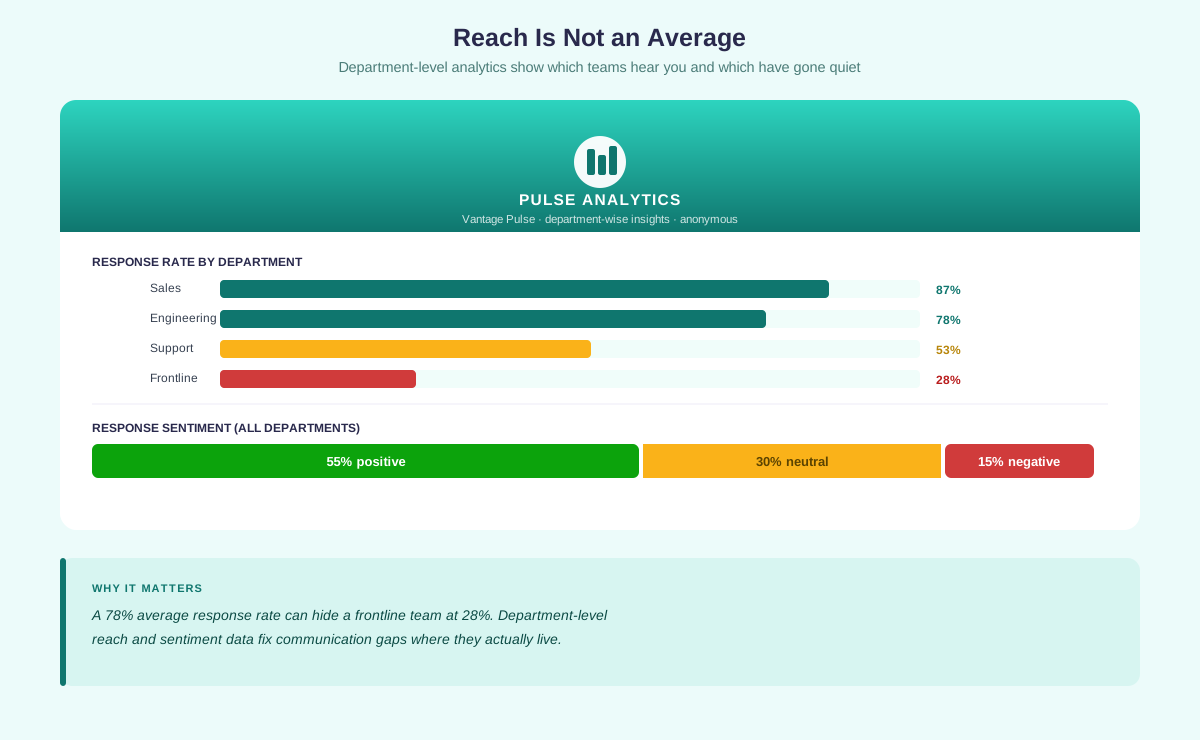
HR can build the framework, design the recognition program, run the surveys, and put the strategy on paper. But engagement itself, the daily experience of feeling seen, trusted, and invested in, lives in the conversations between managers and their teams. In the one-on-one that didn't get cancelled. In the feedback that was specific and honest instead of vague and annual. In whether a manager noticed someone was struggling before it became a resignation letter.
Gallup's data puts a number on this that leadership teams need to sit with: managers account for 70% of the variance in team engagement scores. Not the platform. Not the perks program. The manager, the person who decides every single day whether their team members feel like people or headcount.
Vantage Circle's Annual R&R Benchmarking Report 2024–25, developed with SHRM and Aon, found the same pattern across industries: organizations where senior leaders actively participated in recognition, not just endorsed it, consistently outperformed those where engagement was delegated entirely to HR.
When leaders show up visibly, employees notice. When they don't, employees notice that too.
A real example worth remembering: Indra Nooyi, during her time as CEO of PepsiCo, personally wrote letters to the parents of her senior executives, thanking them for their children's contributions. Not a campaign. Not a program rolled out by HR. One consistent, human act from the top that made people feel the organization genuinely saw them. That kind of signal cannot be manufactured by an engagement team working alone.
Organizations often confuse visibility with value. Launching an engagement initiative is visible. Changing how managers recognize effort every Tuesday afternoon is valuable. One gets applause. The other changes culture.
Deep Dive: 10 Employee Engagement Strategies That Drive Results
Mistake 3: Believing a Single Event or Program Creates Engagement

The annual offsite. The team-building day. The wellness week. The recognition ceremony in December. These aren't bad ideas. They genuinely create moments of connection, visibility, and shared experience.
But they're not engagement. They're punctuation marks in a story that has to be told every single day.
Microsoft's Work Trend Index 2024 found that 79% of employees want their manager to help them find meaning in their work. That's not a request for an annual event. That's a daily need that can't be addressed by scheduling a team-building activity and moving on.
Vantage Circle's Global AIRe Benchmark Report, built from behavioral science research across industries worldwide, found a consistent pattern: high-frequency, behavior-linked recognition significantly outperforms sporadic, event-based recognition on both engagement and retention outcomes. The act of recognizing specific contributions regularly, not waiting for a ceremony, is what rewires how employees experience their work.
Think of it like compound interest. A large deposit once a year will never outperform consistent, steady contributions. The same principle applies to engagement.
Event vs. Program vs. Culture: The Distinction That Matters
Here's the distinction that actually matters in practice:
- An event creates a moment. Valuable, memorable, but it fades.
- A program creates a structure. Useful, but it has a start date and an end date.
- A culture creates a daily reality. And that's where engagement actually lives.
Building that culture requires things that don't fit neatly on a calendar: regular check-ins that aren't just status updates, pulse surveys that actually get acted on, recognition woven into how work happens rather than bolted on top of it, and growth conversations that happen continuously instead of once a year at performance review time.
The organizations that get this right aren't doing more events. They're doing engagement differently, consistently, and at every level. For practical starting points, see 50+ employee engagement activities that actually work.
Mistake 4: Assuming Surveys Are Enough to Measure Engagement

Surveys are genuinely useful. I'm not arguing against them. But there's a version of survey-reliance that becomes a substitute for actually knowing what's happening with your people, and that version is widespread.
An annual survey tells you how someone felt on the morning they filled it in. By the time those results get analyzed, compiled into a deck, and presented to leadership, months have passed. By the time an annual engagement survey reaches the executive team, it is often describing the organization that existed six months ago, not the one employees are experiencing today.
A once-a-year satisfaction survey measures mood, not engagement. The emotional signal is visible in real time if you're measuring the right things: who feels disconnected, who is quietly withdrawing, which team is struggling under a specific manager.
Behavioral Metrics That Measure Engagement Better Than Surveys
The real engagement signal lives in behavior, and it's visible every day if you know where to look:
| Metric | What It's Really Telling You |
|---|---|
| Voluntary turnover rate | Whether people see a future here |
| Absenteeism trends | Whether they want to show up |
| Productivity and output quality | Whether they're giving discretionary effort |
| eNPS (Employee Net Promoter Score) | Whether they'd recommend this place to someone they care about |
| Internal mobility rate | Whether people are growing within, not leaving to grow elsewhere |
| Customer satisfaction scores | Whether frontline engagement is translating outward |
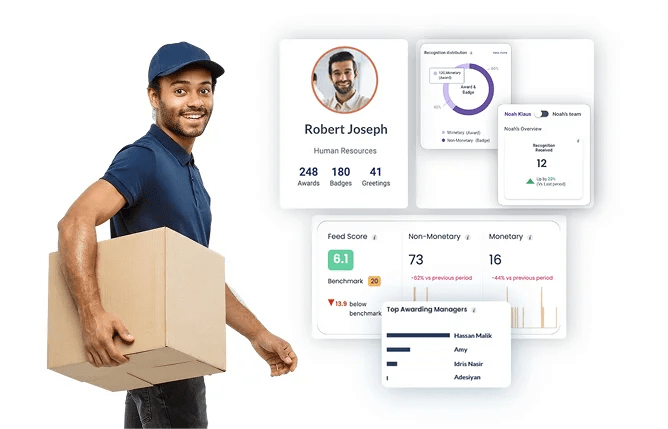
Gallup's Q12 Meta-Analysis, which studied over 100,000 business units across industries, found that highly engaged teams post 10% higher customer ratings than their disengaged counterparts. That connection, from internal engagement to external experience, shows up in behavior long before it shows up in a survey.
Use surveys as one input. Use behavior as the proof.
Next Read: 15 Employee Engagement Metrics Every HR Leader Should Track
Mistake 5: Thinking Perks and Benefits Drive Engagement

Free lunches, gym reimbursements, flexible Fridays, fancy offices. These things are not nothing. They signal investment, and they matter to candidates evaluating offers.
But they are hygiene factors. Herzberg's two-factor theory again: they prevent dissatisfaction. They do not create engagement. An employee with free snacks and a disengaged manager is still a disengaged employee. An employee with meaningful work, a manager who invests in their growth, and regular recognition of their contributions will stay and perform even without the perks.
I've lived this. I've worked in environments with every perk on the list and none of the connection that actually makes work feel worth doing. And I've watched people turn down more money to stay on teams that made them feel genuinely valued.
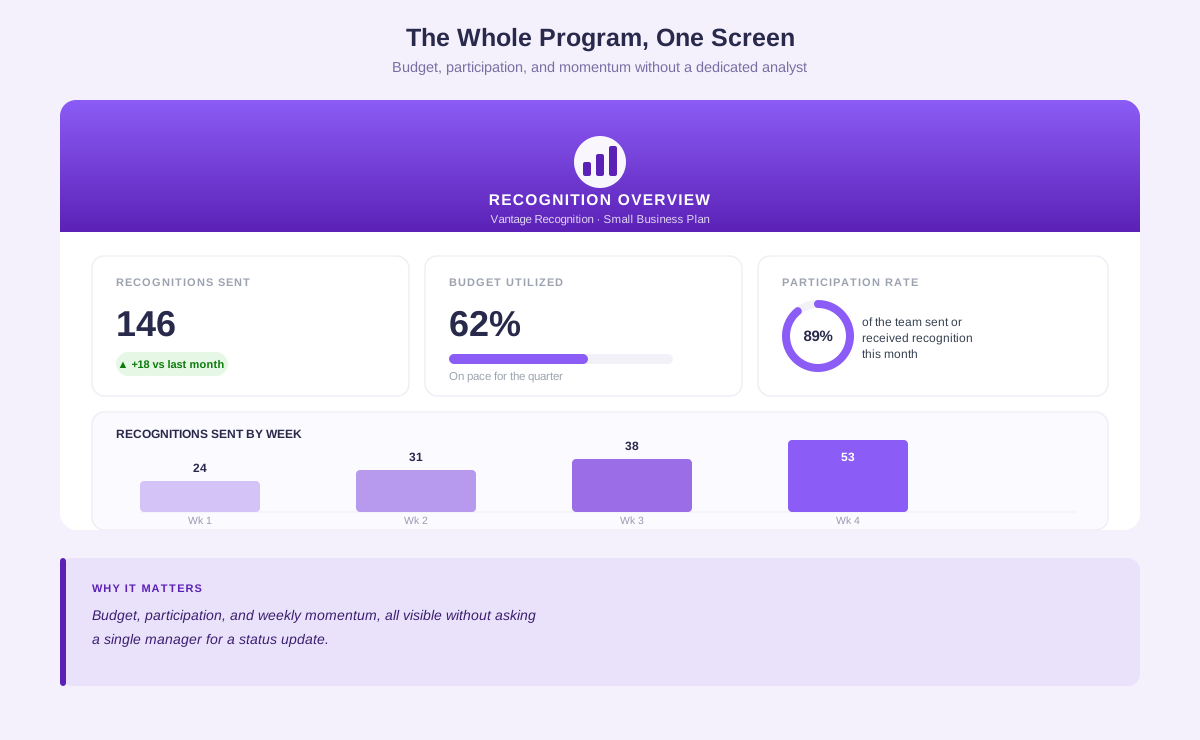
The data from Vantage Circle's own research underscores this. Our Annual R&R Benchmarking Report 2024–25 found that 82% of employees say recognition improves their engagement, not compensation, not benefits, but being seen and acknowledged for their specific contributions. Meanwhile, 68% of HR professionals say recognition positively impacts retention, and 56% say it actively supports recruitment.
What Actually Drives Engagement
- Feeling that your work connects to something bigger than your task list
- Being recognized specifically, consistently, and not just at annual reviews
- Having a manager who knows your goals and invests in your growth
- Trusting that leadership is honest, especially during difficult periods
The employee engagement theory behind this is consistent across Herzberg, Maslow, and Deci and Ryan's Self-Determination Theory: meaning, autonomy, and growth are the real drivers. The perks trap is real because perks are easy to buy and easy to communicate. The harder work of building trust, developing managers who actually engage their teams, and creating psychological safety doesn't show up in a benefits brochure. But it's where engagement is made or lost.
What Genuine Engagement Actually Looks Like
Genuine engagement shows up in moments that were never designed to happen.
It's the developer who spots a product issue before anyone asked them to look. The customer success manager who goes off the script because they genuinely care about the client's situation. The team member who tells a colleague something is wrong with a plan, even though it would have been easier to say nothing.
None of those moments came from a perks program or an annual survey. They came from people who felt their work mattered, that their voice was worth using, and that the organization would have their back if they used it.
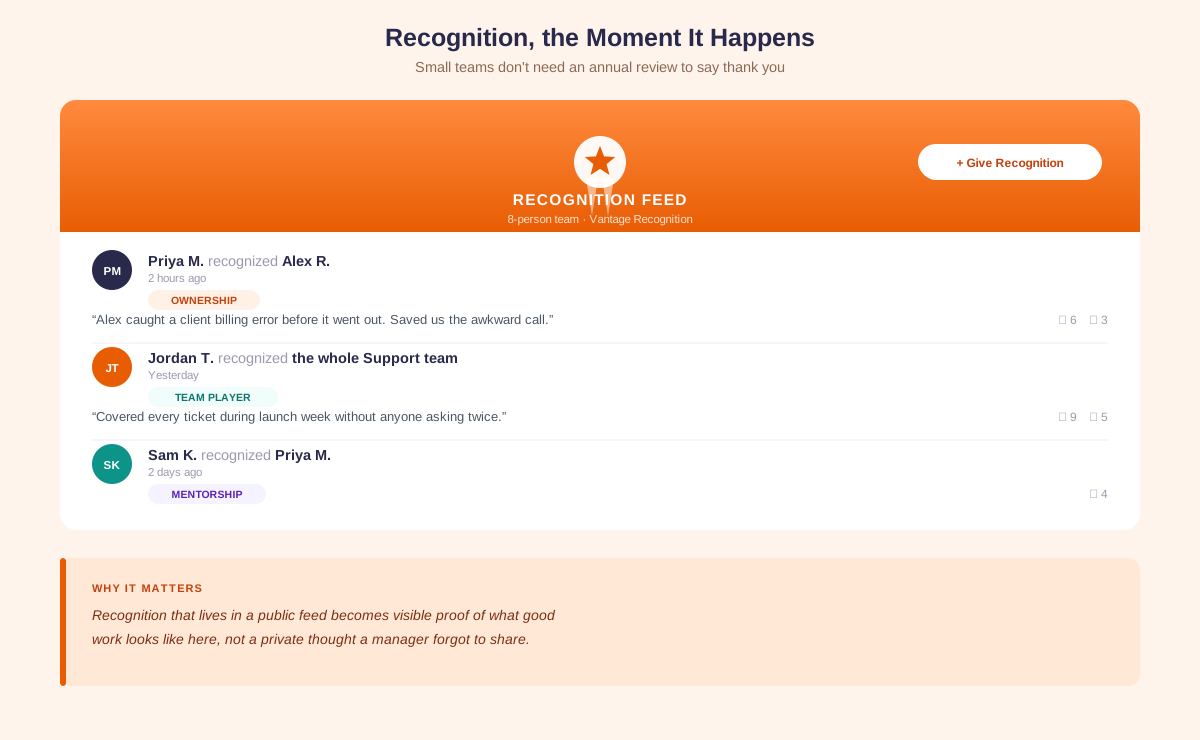
Most engagement programs are designed to generate visible activity. Genuine engagement generates invisible effort: the kind that shows up in quality, judgment, and initiative before it ever shows up in a metric.
Frequently Asked Questions
What is the difference between employee engagement and job satisfaction?
Satisfaction is passive: it reflects whether someone is content with their conditions. Engagement is active: it reflects whether someone cares enough to invest discretionary effort. PwC found 60% of employees say they're satisfied. Gallup, the same year, found only 31% of US and Canadian employees are actively engaged. That gap is not a survey anomaly. It's where quiet quitting lives.
Is employee engagement only HR's responsibility?
HR is responsible for the framework. Managers are responsible for engagement itself. Gallup's data puts managers at 70% of team engagement variance, not platforms, not perks programs, not HR initiatives. The most consequential engagement decisions happen in everyday conversations that HR never sees.
Can you measure employee engagement through surveys alone?
An annual survey tells you how someone felt the morning they filled it in. By the time those results reach leadership, often three to six months later, the employees who were flagging warning signs have either gone quiet or already left. Behavioral signals (turnover rate, absenteeism, internal mobility, eNPS) tell you what's actually happening. Surveys are one input. They are not the answer.
How often should engagement be addressed?
Every day. Not every quarter. Not at the annual review. The organizations that get engagement right treat it the way good managers treat their teams: consistently, specifically, and without waiting for a formal occasion to notice when something is wrong.
Do perks and benefits improve employee engagement?
Perks reduce dissatisfaction. They do not create commitment. An employee with free lunches and a disengaged manager is still a disengaged employee. An employee with meaningful work, honest leadership, and a manager who invests in their growth will often choose to stay, even without the perks. Herzberg established this distinction in the 1950s. Most engagement programs still haven't caught up.
What are the most common employee engagement mistakes?
The five covered here: treating engagement as satisfaction, delegating it to HR, mistaking events for culture, relying on annual surveys, and substituting perks for meaning. What they share is this: each one is easier to execute than what actually works, which is why organizations keep making them.
Why is employee engagement important?
Disengagement costs the global economy $10 trillion annually, per Gallup (2026). That number is not a backdrop. It's the accumulated cost of millions of people showing up to work without caring about the outcome. Engaged employees don't just perform better. They stay longer, serve customers better, and build the institutional knowledge that disengaged employees take with them when they leave.
The Bottom Line
Employees don't disengage because organizations stop caring. They disengage when organizations confuse activity with commitment.
Engagement isn't created by better calendars, better perks, or better surveys. It's created in thousands of ordinary moments between managers and employees: the feedback that was honest instead of polished, the recognition that was specific instead of ceremonial, the conversation that happened before someone had already decided to leave.
Get those moments right, and the metrics follow.
Stop scheduling engagement. Start building it.

Supriya is a Content Marketing Lead at Vantage Circle, where she writes on employee engagement, recognition, workplace communication, and culture. Her work on remote team recognition draws on primary research from Vantage Circle's platform data and customer deployments across distributed workforces. She spent the earlier part of her career in corporate communications at Burson, ESPN Star Sports, and CBRE, advising organizations on the messages employees actually hear.
Connect with Supriya on LinkedIn.