
Remote employees don't have fewer moments worth recognizing. They have fewer moments where that recognition is visible.
In an office, appreciation can happen almost accidentally. A manager hears how someone handled a difficult client call. A colleague sees someone step in to help a teammate. A team celebrates a deadline over lunch. For remote employees, those moments are harder to see, and easier to miss.
Remote work has moved from a contingency plan to a mainstream model. According to a 2025 Pew Research Center study, 75% of employed adults work from home at least some of the time. Yet much of the recognition infrastructure organizations rely on was built around physical proximity. The result is a growing gap between how people work and how their contributions are recognized.
That's why rewarding remote employees requires more than sending a gift card or adding another perk to the benefits list. Effective rewards make contribution visible, give employees meaningful choice, strengthen connection, and reinforce the behaviors and values an organization wants to see more often.
Below are 20 practical reward ideas for remote employees across five categories, from monetary rewards and recognition to professional development, flexibility, and well-being. You'll also find a comparison of reward types and practical principles for building a rewards program that is consistent, equitable, and personalized.
Recommended Reading: 50 Rewards and Recognition Ideas for Every Budget and Team Type
Why Rewards Matter for Remote Employees
Rewards matter for remote employees because distance makes contributions less visible and recognition less frequent. A structured rewards program gives managers and peers a consistent way to acknowledge performance, reinforce values, and maintain connection across distributed teams.
In a typical office, recognition is ambient: a manager overhears a strong client call, a peer notices effort in a meeting, a team celebrates a deadline over lunch. None of that happens automatically in a remote environment. Appreciation either gets built into a system or it does not happen at all.
The cost of getting this wrong shows up clearly. Research by Deloitte (2024) found that fully remote employees report daily loneliness at higher rates than onsite peers: 25% for fully remote workers versus 16% for fully onsite employees. That isolation is not simply a morale issue. It is a disengagement risk that can compound over time.
What changes when organizations build the right infrastructure is equally measurable. When Tata Motors, managing a dispersed workforce of 78,000+ employees, deployed a structured recognition platform, peer-to-peer recognition rose by 82% (Vantage Circle case study, 2021). That kind of lift is only possible when recognition is a system, not a manager habit.
The Recognition Effect 2025 report (Vantage Circle x Great Place to Work India), drawing on 5.7 million employees across 2,000 organizations, found that only 55% of employees experience the full emotional impact of recognition at work. Organizations in high-recognition cultures see 91% of employees feeling motivated, compared to 73% in emerging-recognition cultures. When employees receive all four recognition signals of Appreciation, Acceptance, Validation, and Accomplishment, 97% report intending to stay.
For remote teams, the implication is direct: rewards and recognition are not a cultural bonus. They are the infrastructure that replaces what physical proximity used to provide automatically.
Rewards answer what the employee receives. Recognition answers what behavior or contribution is being reinforced. A strong remote rewards program needs both: the tangible signal of something given, and the specific acknowledgment of why it was given.
For a broader view of how recognition connects to remote employee engagement, see our guide on what drives engagement across distributed teams.
20 Practical Reward Ideas for Remote Employees

Designing meaningful rewards for distributed teams requires more than digitizing old office perks. Remote employees value flexibility, autonomy, emotional connection, and recognition that feels personal rather than performance-focused. The most effective programs blend creativity, context, and choice, allowing employees to receive rewards that genuinely improve their day-to-day remote experience.
Category 1: Monetary Rewards

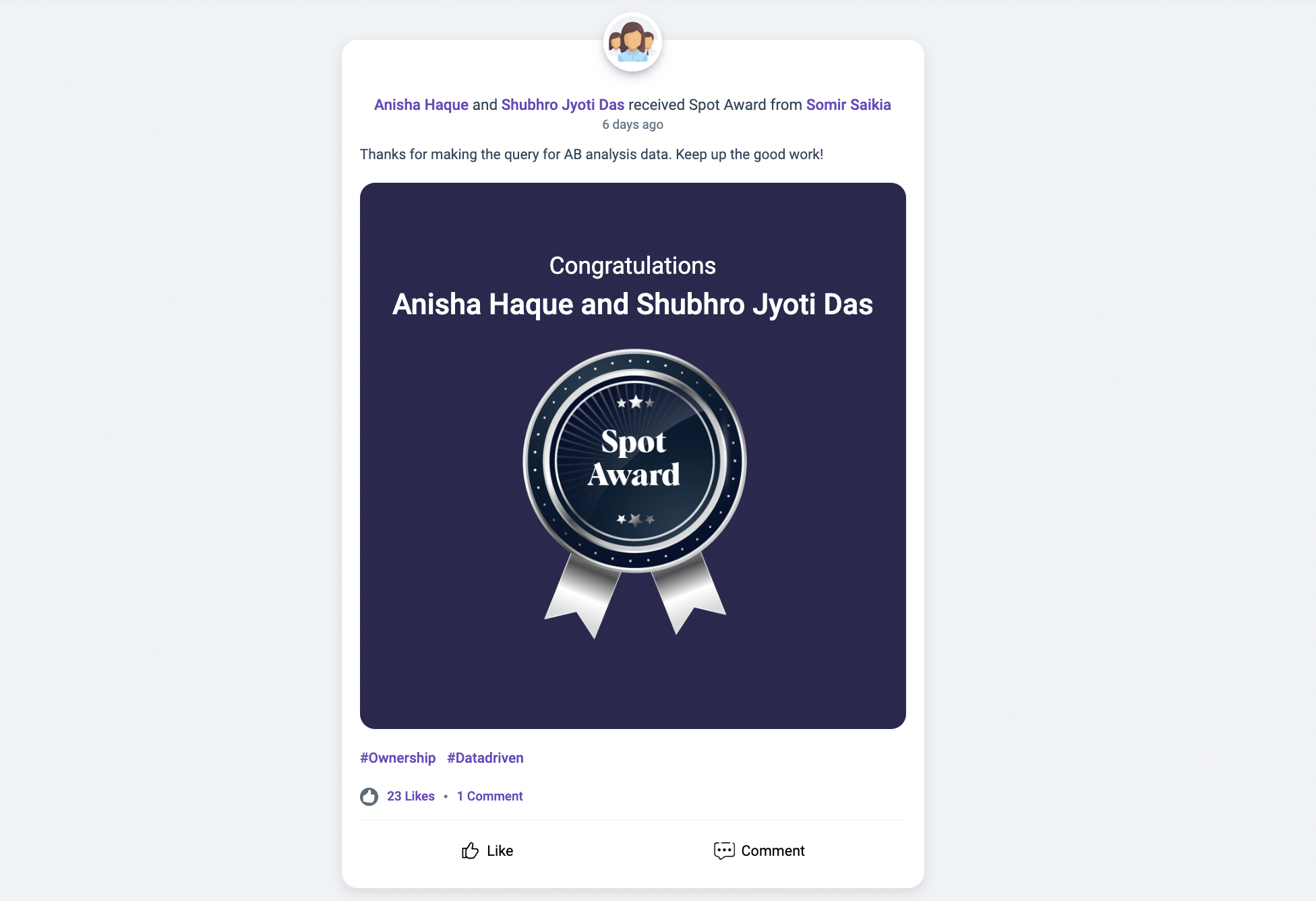
1. Spot Bonuses for Fast Wins
Remote employees rarely get in-office praise moments, so spot bonuses help recognize momentum in real time.
Reinforces agility and signals that high-impact work never goes unnoticed, even across time zones.
Source: Vantage Recognition
2. Personalized Gift Cards
Instead of generic vouchers, choose cards tied to actual interests: books, fitness, gaming, groceries.
Personalization increases the perceived value of the reward. A gift card someone actually uses feels like recognition; one they never redeem does not.
3. Project-Based Incentive Pools
Reward entire remote teams for meeting timelines or exceeding targets together.
Inspires collaboration and reduces siloed behavior in distributed work.
4. Home Office Setup Stipends
Investing in an employee's workspace directly improves their daily productivity.
Reduces fatigue and increases focus hours. One of the highest-impact rewards for remote workers because it improves every workday, not just the day of recognition.
Category 2: Recognition and Appreciation Rewards

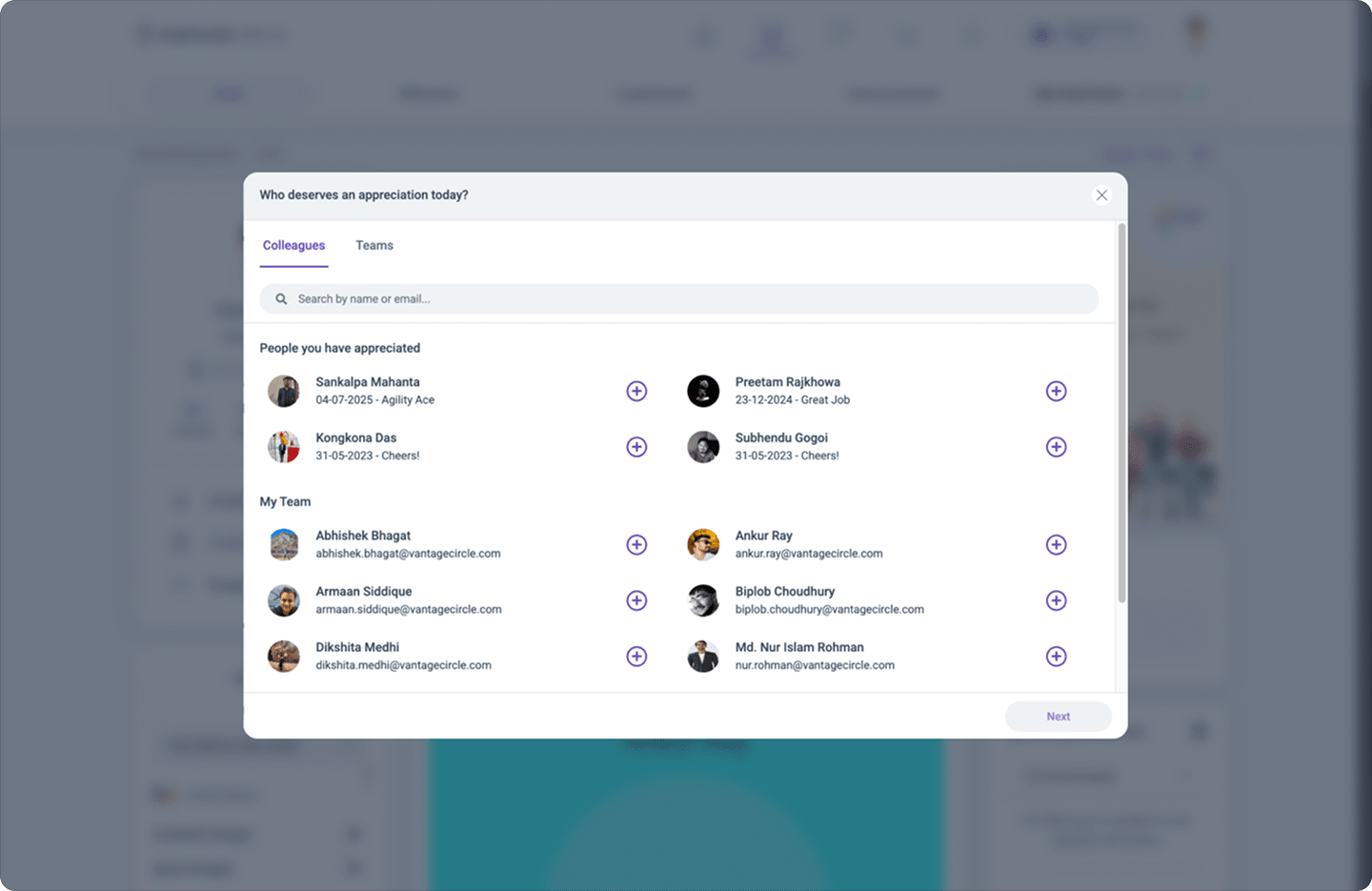
5. Peer-to-Peer Recognition Programs
Peer recognition puts appreciation in the hands of the whole team, not just managers. That matters most in distributed teams, where managers have limited visibility into day-to-day contributions and much of an employee's best work happens outside a manager's line of sight.
Builds a culture where appreciation flows freely, not hierarchically. Platforms like Vantage Circle enable employees to award peer recognition or kudos in real time.
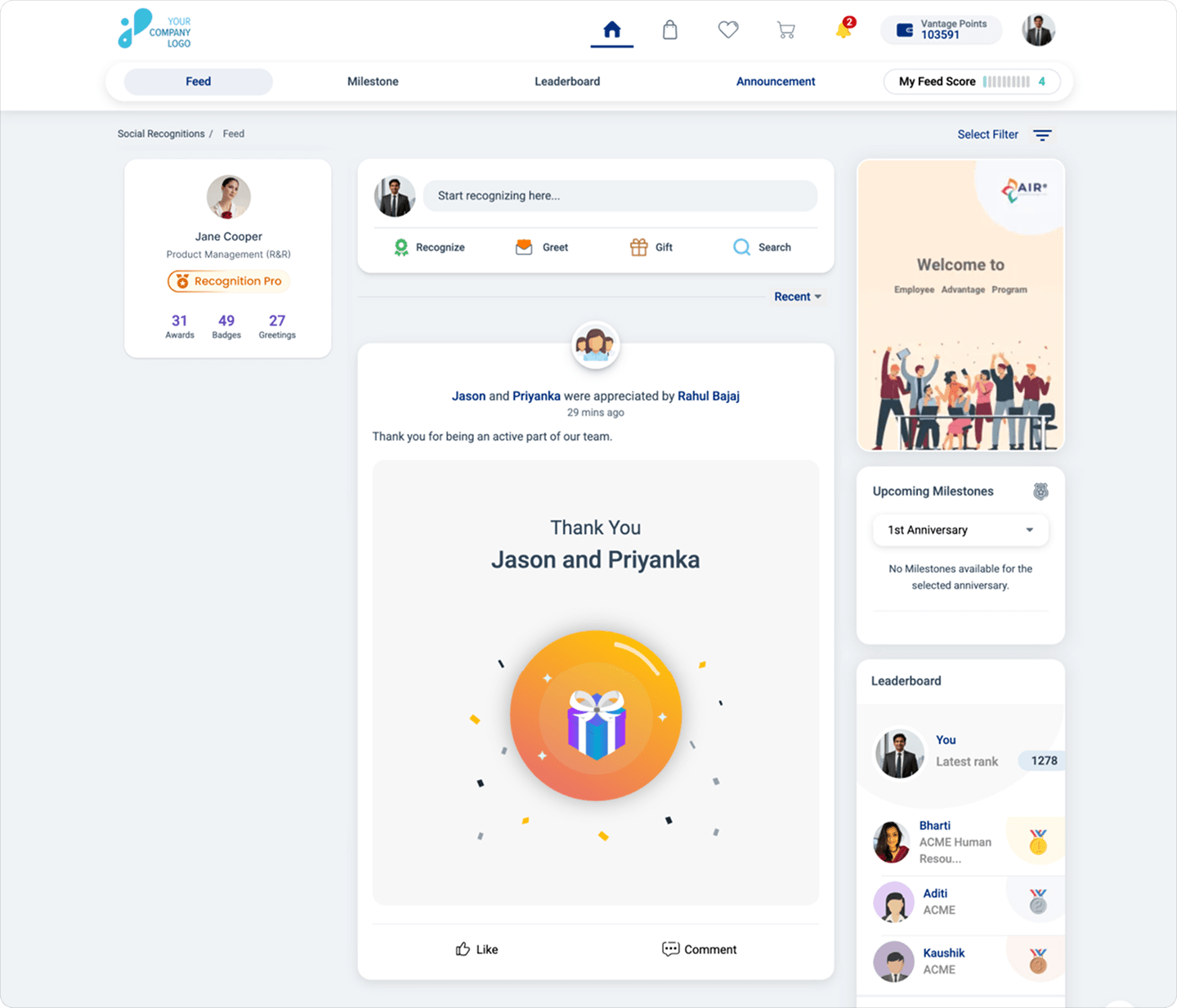
6. Social Recognition Feed
A public recognition feed turns a private thank-you into a moment the entire remote team can see and react to. It recreates the "water cooler" effect that distributed teams lose.
Strengthens a sense of belonging, which is one of the most consistent drivers of remote engagement.
Source: Vantage Rewards
7. Weekly Value Spotlights
A weekly 10-minute ritual where managers spotlight one remote employee who embodied a core company value.
Makes recognition predictable rather than accidental, which reduces the anxiety remote employees feel about being invisible to leadership.
8. Employee Spotlight Stories
Short video or written stories shared internally, highlighting one employee's impact and work approach.
Humanizes the workforce and reduces the isolation that remote employees cite as their top day-to-day challenge.
Also Worth Reading: Managing Remote Employees: 7 Key Steps You Must Follow
Category 3: Professional Growth and Development Rewards

9. Certification Sponsorships
Growth is a top driver of retention. LinkedIn Learning (2018) found that 94% of employees would stay longer at a company that invests in their career development.
Builds internal capability while directly supporting career aspirations, which remote employees cite as one of their most common unmet needs.
10. Learning Wallets and Skill Credits
Give employees a flexible annual budget to spend on any learning they choose.
Encourages self-driven development in remote settings where in-person mentorship is harder to access.
11. Mentorship and Leader Shadowing
Remote workers often lack the casual visibility that in-office employees gain through proximity to senior leaders. Structured mentorship closes that gap.
Builds pipeline strength and boosts internal mobility.
12. Stretch Assignments With Visibility
Meaningful responsibility and exposure in a high-stakes project can be among the most valued rewards for remote employees.
Increases engagement by signaling trust and readiness for growth, two signals that remote employees are less likely to receive through informal channels.
Category 4: Flexibility and Lifestyle Rewards

13. Recharge or Wellness Days
Short, frequent breaks reduce burnout, which is especially prevalent in remote teams where overwork is common.
Improves mental well-being and resets motivation between high-intensity periods.
14. Work-From-Anywhere Pass
Allow an employee to work from another city or country for a defined period.
Appeals to younger and globally distributed talent. For high performers, this reward signals a level of trust that standard compensation cannot replicate.
15. Flexible Schedule Credits
A reward built on trust: allow employees to choose their own hours for a month.
Enhances ownership and work-life integration, both of which directly support intrinsic motivation in the workplace.
16. Quarterly No-Meeting Days
Time can be one of the most valuable rewards for remote employees. Giving it back is a signal of genuine trust.
Increases productivity and reduces meeting fatigue, one of the top contributors to remote burnout.
Category 5: Experience-Based and Well-Being Rewards

17. Virtual Experiences
From cooking classes to escape rooms, shared virtual experiences strengthen remote culture beyond screen-based work.
Creates shared memories that distributed teams lose without deliberate investment in connection.
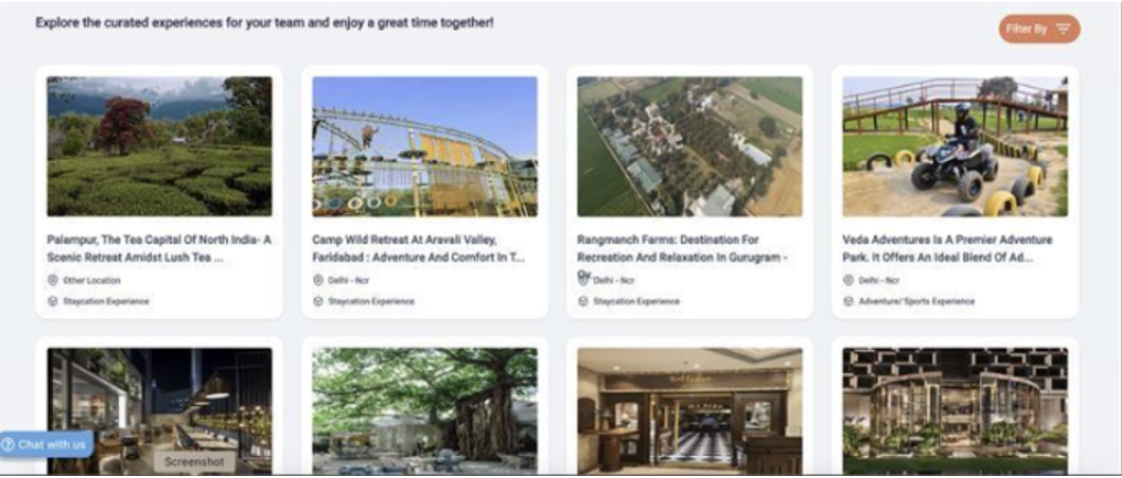
18. Travel or Staycation Vouchers
Ideal for celebrating tenure milestones or significant project completions.
Source: Vantage Perks
Rewards feel restorative and personal, not transactional, which is the key distinction between a perk and a recognition moment.
19. Wellness Subscriptions
Gym, meditation, therapy, or fitness app memberships as ongoing well-being support.
Improves physical and mental health, reducing sick days and burnout risk over the long term.
20. Personalized Care Packages
A thoughtful, memorable reward that communicates genuine appreciation rather than a standardized benefit.
Strengthens emotional connection between the employee and the organization, which is one of the hardest things to sustain in a fully remote context.
Also Worth Reading: Employee Engagement and Well-Being: How They Drive Each Other
Reward-Type Comparison: Cost, Effort, and Best Fit
Not every reward works for every team or budget. This table maps the five reward categories to typical cost tiers and team contexts to help HR leaders make faster decisions. Figures below are general planning ranges based on common market practice, not a Vantage Circle benchmark study.
| Reward Type | Typical Cost Range (Illustrative) | Best For |
|---|---|---|
| Spot bonuses and gift cards | Medium ($25–$200 per instance) | Individual performance wins, real-time recognition |
| Peer recognition badges via platform | Low (platform subscription cost) | Distributed teams of any size, daily recognition cadence |
| Learning wallet or certification sponsorship | Medium–High ($100–$500 per employee per year) | Growth-oriented employees, reducing early attrition risk |
| Flexibility credits (extra PTO, schedule choice) | Low (cost: manager time and trust) | High-performing teams, burnout prevention |
| Wellness subscriptions and care packages | Low–Medium ($10–$100 per employee per month) | Global remote teams, well-being and connection |
How to Build a Remote Rewards Program That Actually Works
A remote rewards program is not a collection of perks. It is an operating model that signals what the organization values, how it enables performance, and how it builds emotional connection across distance. The companies that get this right consistently outperform on engagement, retention, and trust.
The following six elements form a practical framework for building a program that holds up over time for distributed teams.
Align Rewards With Company Culture and Values
The most effective remote rewards reinforce the behaviors and values the organization wants employees to repeat. Rewards that feel disconnected from what the organization actually stands for feel transactional. Remote workers, who have less access to informal cultural cues, depend even more on reward signals to understand what the company values.
In practice:
- If the culture celebrates innovation, reward risk-taking and creative contributions.
- If customer obsession is a core value, recognize moments where remote employees go above and beyond for clients.
- If well-being is central, make time-off rewards and wellness stipends a formal part of the reward mix, not an afterthought.
According to the Recognition Effect Report 2025 (Great Place to Work India x Vantage Circle), organizations with value-aligned recognition systems see 94% of employees perceiving the workplace positively, compared to markedly lower levels in companies with ad hoc recognition.
Personalize Rewards for Better Impact
Giving employees meaningful choice in how they are rewarded makes recognition more relevant across different locations, lifestyles, and preferences. Remote employees work in different environments, time zones, and life situations. A one-size-fits-all perk delivers a fraction of the engagement value that a personalized reward does.
Personalized rewards activate deeper motivation because the employee feels genuinely seen, not simply compensated. What personalization looks like in practice:
- Allow employees to choose between lifestyle perks, learning opportunities, or wellness benefits.
- Maintain employee preference profiles covering favorite rewards, hobbies, and learning interests.
- Offer flexible redemption options instead of a fixed catalog.
Make Rewards Transparent and Accessible
Remote employees engage more consistently with recognition programs they understand and can access equally, regardless of time zone or location. In remote teams, lack of visibility into how rewards work is itself a disengagement risk. Employees who do not understand why someone was recognized, or who believe access to rewards is unequal, disengage from the system entirely.
Transparency requires three things: published criteria for how rewards are earned, equal access for all remote employees regardless of geography or time zone, and a visible record of who was recognized, for what, and against which organizational value.
The Recognition Effect Report 2025 found that 92% of employees in high-fairness recognition cultures report intending to stay with their organization.
Use Technology to Streamline the Reward Process
The right technology turns a manual, inconsistent recognition process into a scalable, data-informed one. Managing rewards manually across a distributed team leads to delays, inconsistencies, and recognition gaps that quietly compound over time. Technology is what makes modern remote reward systems scalable, equitable, and data-informed.
A recognition platform centralizes peer recognition, manager shoutouts, and point-based rewards in one place accessible to every team member regardless of location. Automation ensures that work anniversaries, milestones, and project completions never get missed because a manager was traveling or time zones did not align. A global redemption catalog means a reward feels equally accessible whether someone is in Bangalore or Boise.
Source: Vantage Rewards
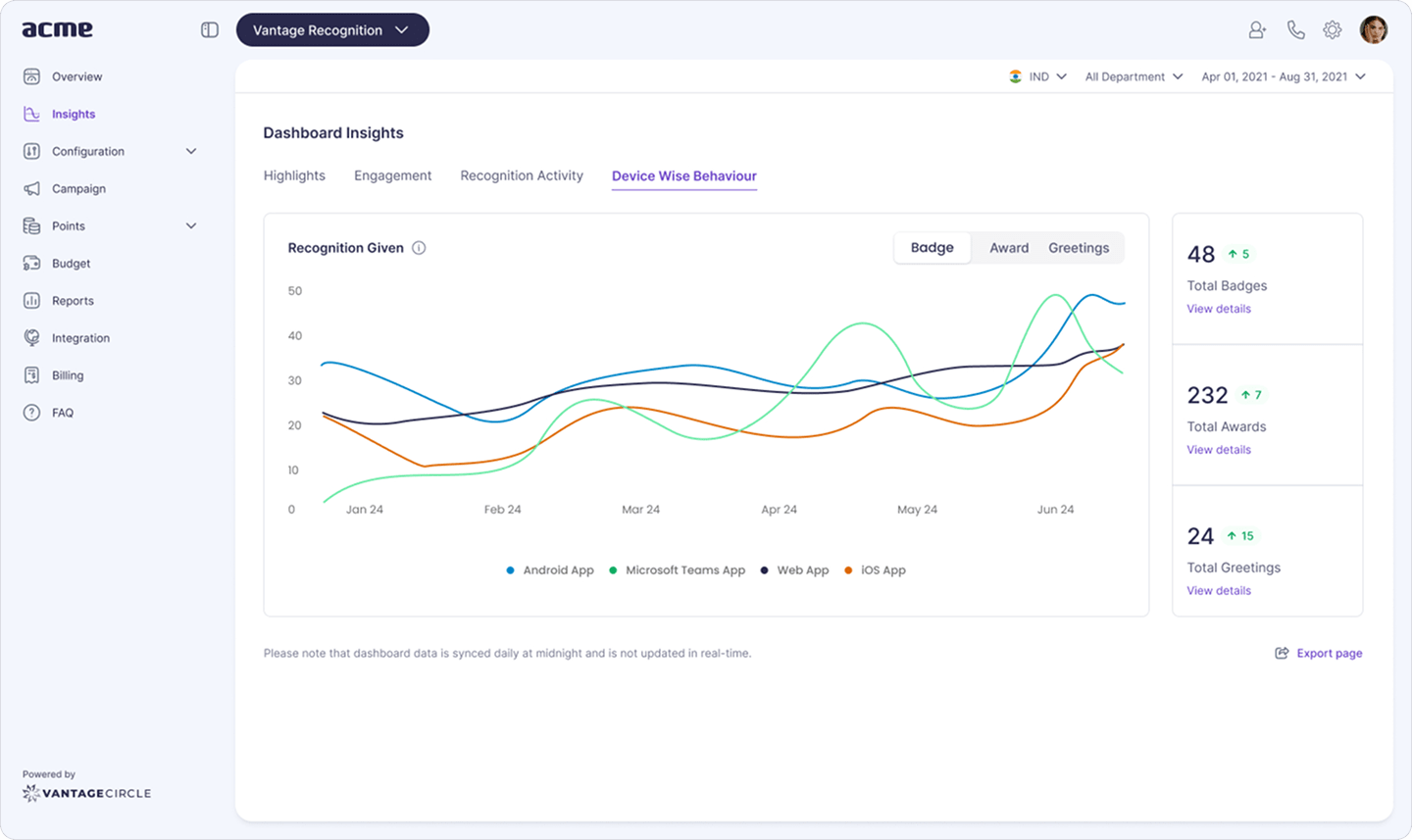
Recognition analytics are equally important. Remote managers often cannot see the informal recognition happening around them the way an in-office manager can overhear a hallway compliment. Analytics dashboards show exactly how often and where appreciation is flowing across a distributed team, making recognition gaps visible before they affect retention.
Source: Vantage Rewards
Ensure Consistency and Fairness Across the Team
A recognition program that reaches some employees reliably and others sporadically creates more disengagement than no program at all. Remote work amplifies perceptions of inequity. Without visibility into day-to-day work, employees may feel recognition is uneven or biased toward those in certain time zones, roles, or reporting relationships.
Building fairness into the system requires clear and published criteria for rewards, objective behavior- or value-based performance indicators, equal access for all remote workers, and a mechanism to track recognition distribution and surface gaps.
The Recognition Effect Report 2025 found that employees who perceive recognition as fair are 2.5x more likely to feel motivated and more likely to stay with their organization.
Keep Rewards Frequent and Regular
Consistent, frequent recognition sustains remote employee motivation more effectively than occasional large rewards. The cadence matters as much as the reward itself. Remote workers do not experience daily in-office appreciation moments, so consistent reinforcement becomes essential to sustain engagement between major milestones.
Frequent, smaller moments of recognition can create a stronger reinforcement rhythm than relying only on occasional large rewards. Regular appreciation sustains motivation over time, encourages continuous performance, and reduces the disengagement that tends to build in the gaps between annual reviews or year-end bonuses.
A simple cadence to build from: weekly peer kudos or shoutouts, monthly small rewards tied to specific behaviors or milestones, quarterly performance-based awards.
Time-boxed recognition campaigns, such as a work-from-home anniversary push or a values week spotlight, give distributed teams a shared moment of celebration that is easy to miss without a structured trigger. Campaign management tools built into recognition platforms automate the setup so these moments happen reliably, rather than depending on a manager remembering to act at the right time.
Related: How Peer-to-Peer Recognition Builds Stronger Teams
The Challenges of Remote Rewards (and How to Solve Them)
The biggest obstacle to rewarding remote employees well is not a lack of budget. It is a lack of infrastructure.
Invisible effort. Fully remote employees report daily loneliness at higher rates than onsite peers: 25% for fully remote workers versus 16% for fully onsite employees (Deloitte, 2024). The same visibility gap that drives isolation also hides contribution. A remote employee can deliver significant work without a single informal moment of acknowledgment.
Fewer reinforcement moments. Spontaneous in-person praise disappears in a distributed environment. Recognition that happens organically in an office must be engineered into the systems and rhythms of a remote team.
Physical perks do not travel. Rewards designed for an office, free lunches, onsite events, office swag, create equity gaps when they are delivered inconsistently or not at all to remote employees. A reward that reaches in-office staff but not distributed team members is not a reward; it is a signal of exclusion.
Delayed recognition weakens the behavior signal. In remote workflows, the closer to the moment of the behavior, the stronger the recognition lands.
The fix is the same across all four challenges: build recognition into structured systems rather than leaving it to informal channels. Organizations that do this consistently see measurable results. Research by Quantum Workplace (2023) found that employees who expect to be recognized are 2.7x more likely to be highly engaged. For remote teams running on deliberate recognition systems, that multiplier is the baseline, not an exception.
Conclusion
Remote work has changed how employees experience recognition, motivation, and belonging. Rewards that were designed for in-person teams do not automatically translate to distributed ones.
The organizations that close this gap are those that stop treating remote recognition as a logistics problem and start treating it as a design problem: deliberate about what they reward, consistent in how they deliver it, and equitable across every time zone and location.
The 20 reward ideas in this guide, and the program framework behind them, are where that redesign starts.
See How It Works: How to Build an Employee Recognition Program That Actually Works
FAQs on Rewards for Remote Employees
What are some good appreciation gifts for remote employees?
Good appreciation gifts include personalized gift cards, home office stipends, wellness subscriptions, and curated care packages. The most valued gifts feel personal and directly improve the employee's daily remote experience.
What are some fun incentives I can give my employees?
Effective incentives include work-from-anywhere passes, no-meeting days, learning wallets, and spot bonuses tied to specific wins. The best incentives feel like real choices rather than standardized perks.
What are some effective recognition ideas for remote employees?
Effective recognition ideas include peer-to-peer shoutouts on a shared social feed, manager spotlight moments in weekly standups, and milestone celebrations for work anniversaries and project completions. Combining manager and peer recognition ensures appreciation is not dependent on a single person's attention.
What benefits do remote workers get?
Remote workers typically receive flexible working hours, home office stipends, technology allowances, mental health support, learning budgets, and employee discount programs. Competitive packages in 2026 have shifted toward benefits that support the home work environment, financial wellness, and well-being.

Supriya is a Content Marketing Lead at Vantage Circle, where she writes on employee engagement, recognition, workplace communication, and culture. Her work on remote team recognition draws on primary research from Vantage Circle's platform data and customer deployments across distributed workforces. She spent the earlier part of her career in corporate communications at Burson, ESPN Star Sports, and CBRE, advising organizations on the messages employees actually hear.
Connect with Supriya on LinkedIn.